Te Reo MāoriFreePrintable

Matariki Poetry Workshop

A free te reo māori worksheet ready for your classroom. Open in Kuraplan to grab the print-ready PDF, customize it for your students, or generate a fresh version in seconds.
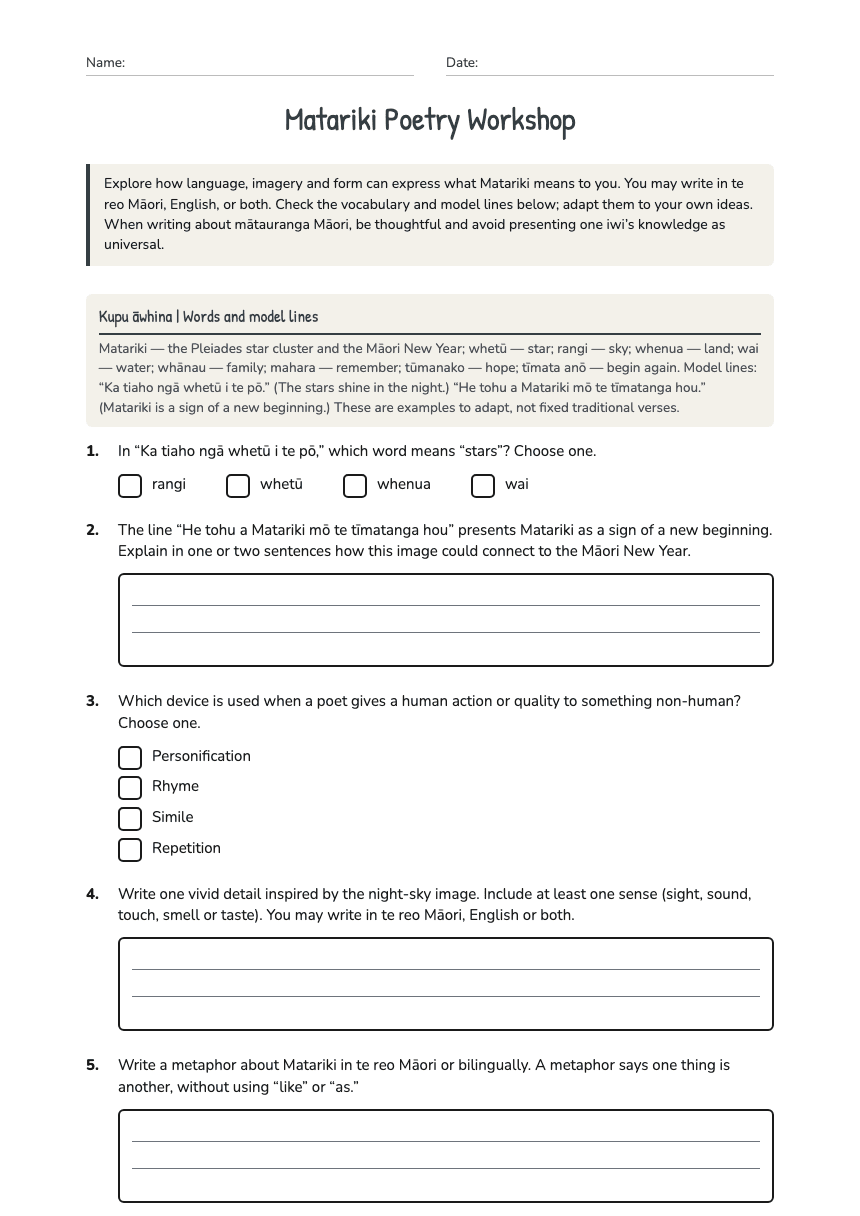
Matariki Poetry Workshop worksheet preview
Name:Date:

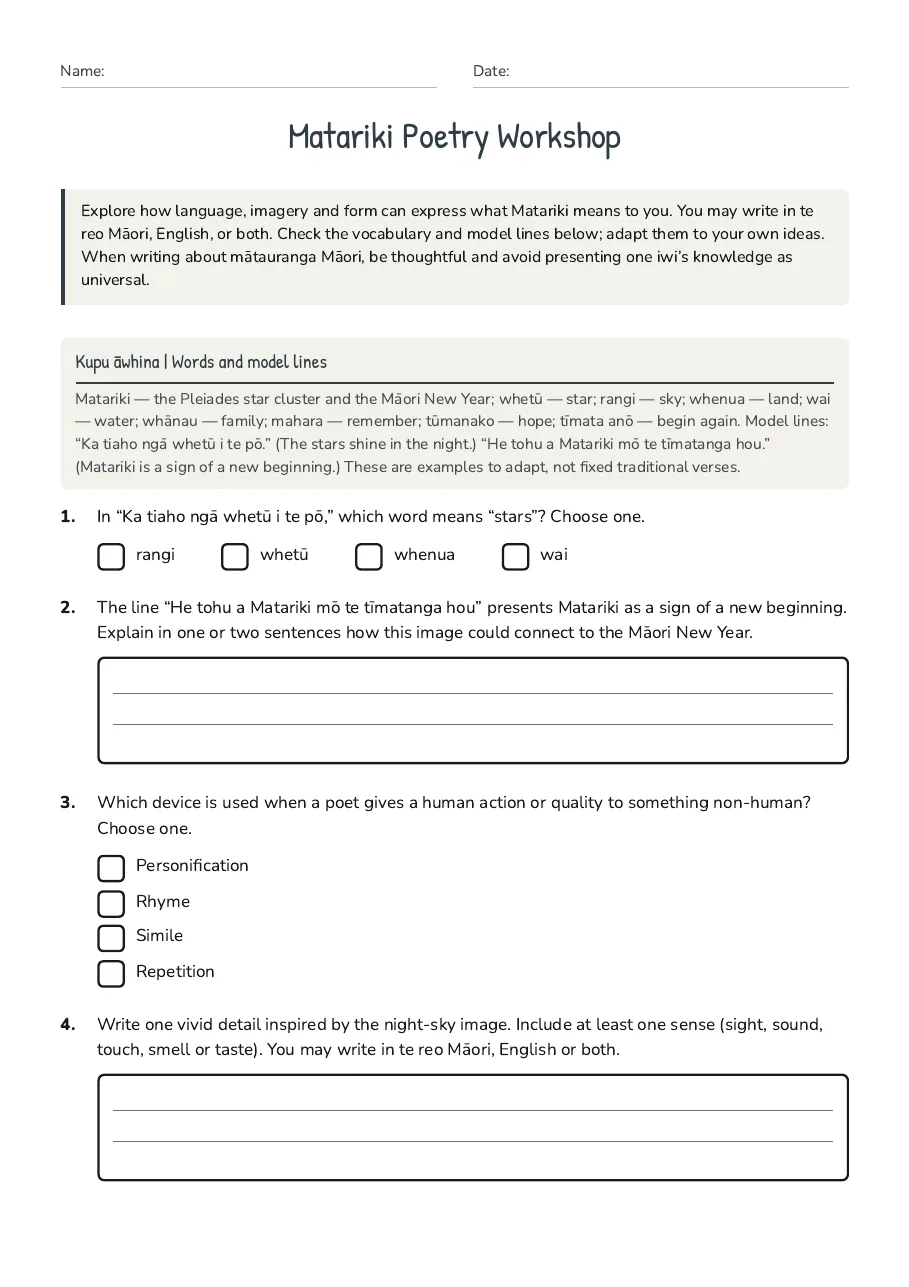
Matariki Poetry Workshop

Explore how language, imagery and form can express what Matariki means to you. You may write in te reo Māori, English, or both. Check the vocabulary and model lines below; adapt them to your own ideas. When writing about mātauranga Māori, be thoughtful and avoid presenting one iwi’s knowledge as universal.

Kupu āwhina | Words and model lines

Matariki — the Pleiades star cluster and the Māori New Year; whetū — star; rangi — sky; whenua — land; wai — water; whānau — family; mahara — remember; tūmanako — hope; tīmata anō — begin again. Model lines: “Ka tiaho ngā whetū i te pō.” (The stars shine in the night.) “He tohu a Matariki mō te tīmatanga hou.” (Matariki is a sign of a new beginning.) These are examples to adapt, not fixed traditional verses.

1.In “Ka tiaho ngā whetū i te pō,” which word means “stars”? Choose one.
  • rangi
  • whetū
  • whenua
  • wai
2.The line “He tohu a Matariki mō te tīmatanga hou” presents Matariki as a sign of a new beginning. Explain in one or two sentences how this image could connect to the Māori New Year.
3.Which device is used when a poet gives a human action or quality to something non-human? Choose one.
  • Personification
  • Rhyme
  • Simile
  • Repetition
4.Write one vivid detail inspired by the night-sky image. Include at least one sense (sight, sound, touch, smell or taste). You may write in te reo Māori, English or both.
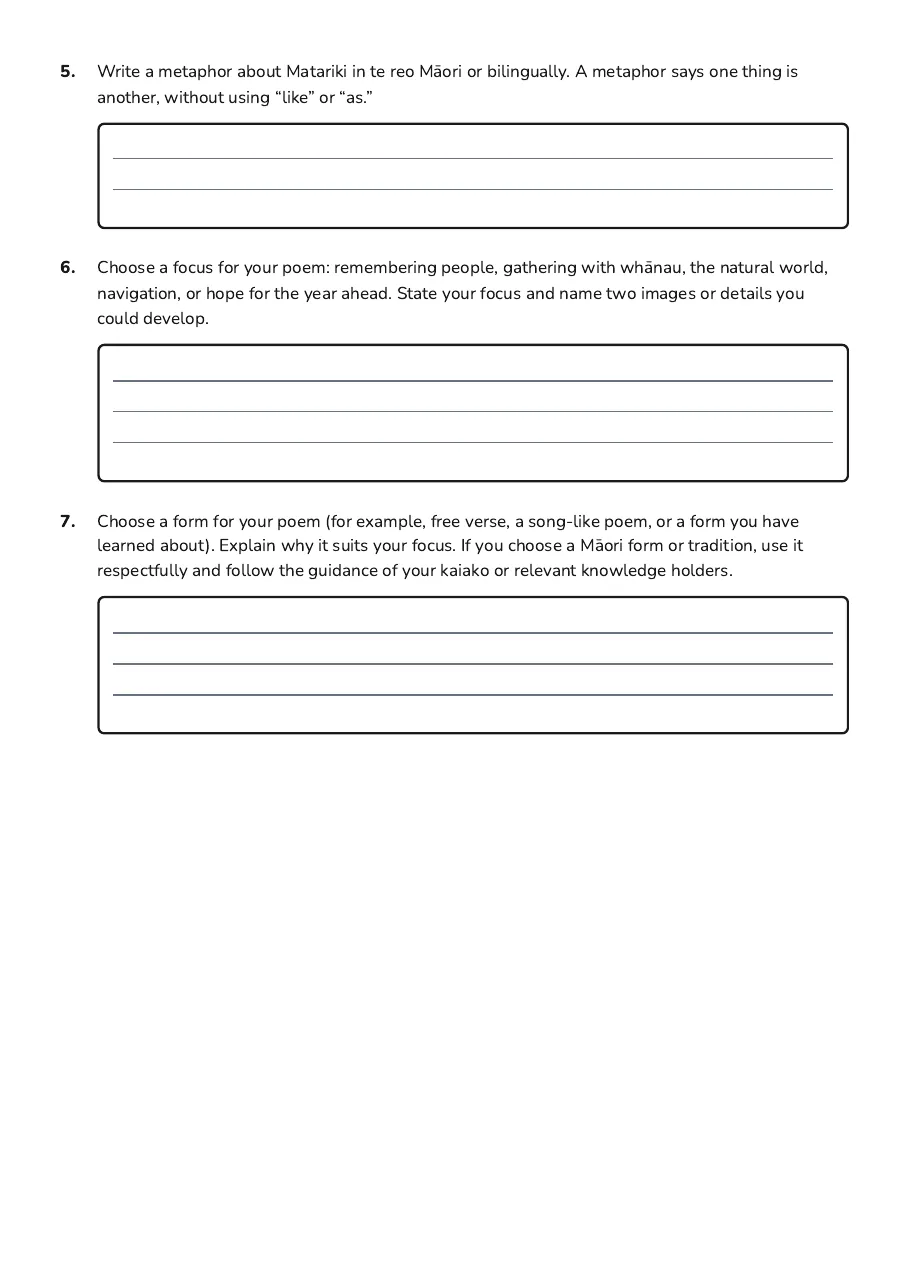
5.Write a metaphor about Matariki in te reo Māori or bilingually. A metaphor says one thing is another, without using “like” or “as.”
6.Choose a focus for your poem: remembering people, gathering with whānau, the natural world, navigation, or hope for the year ahead. State your focus and name two images or details you could develop.
7.Choose a form for your poem (for example, free verse, a song-like poem, or a form you have learned about). Explain why it suits your focus. If you choose a Māori form or tradition, use it respectfully and follow the guidance of your kaiako or relevant knowledge holders.
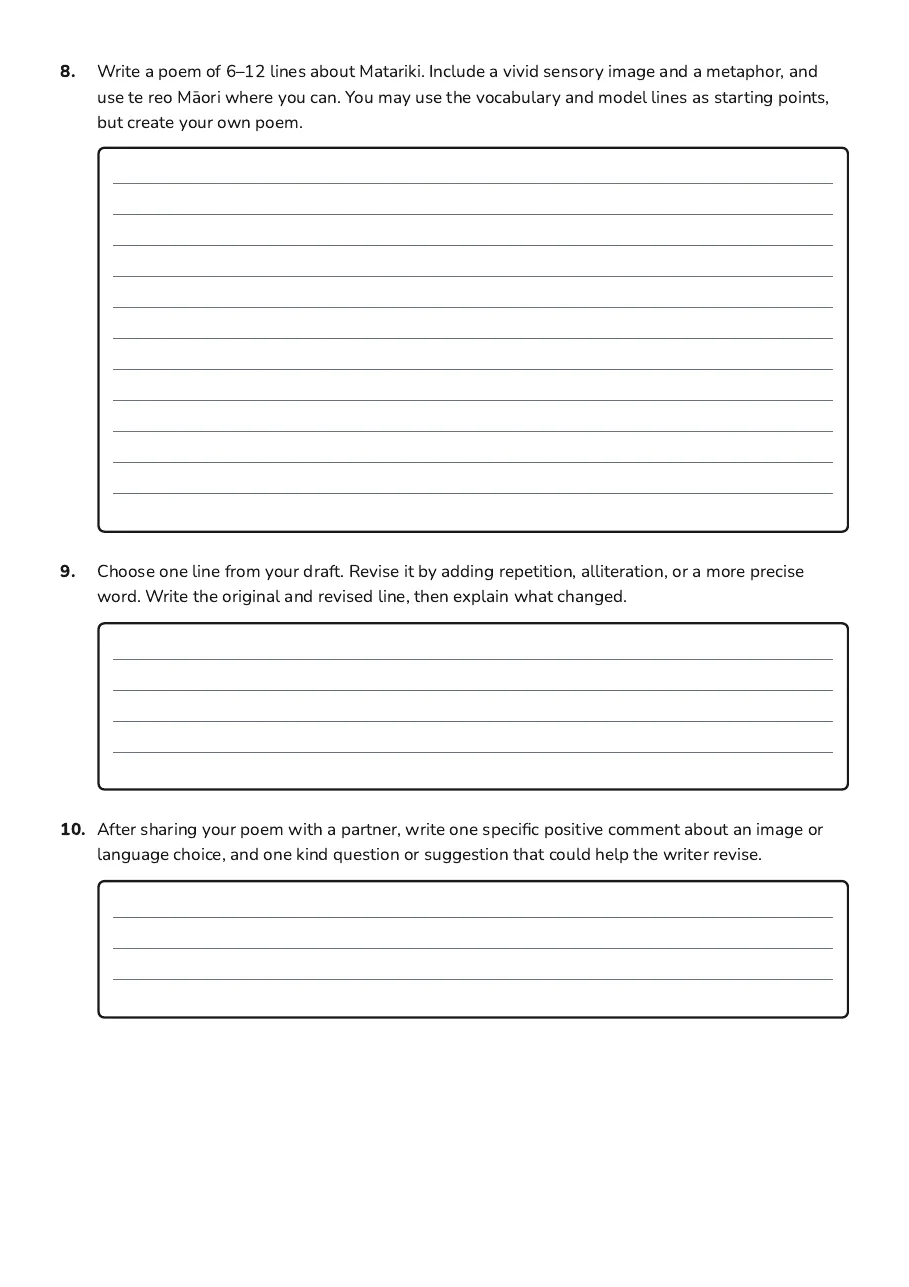
8.Write a poem of 6–12 lines about Matariki. Include a vivid sensory image and a metaphor, and use te reo Māori where you can. You may use the vocabulary and model lines as starting points, but create your own poem.
9.Choose one line from your draft. Revise it by adding repetition, alliteration, or a more precise word. Write the original and revised line, then explain what changed.
10.After sharing your poem with a partner, write one specific positive comment about an image or language choice, and one kind question or suggestion that could help the writer revise.

3 printable pages

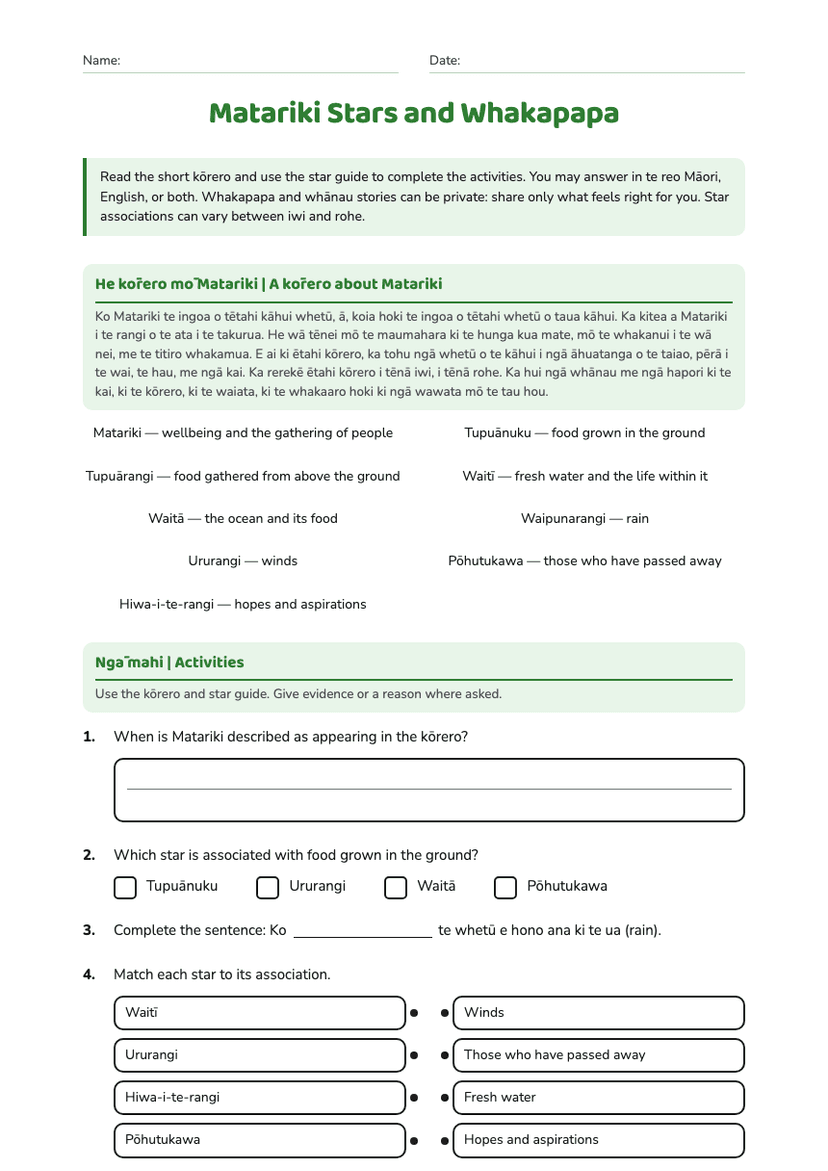
  • Matariki Poetry Workshop, page 1 of 3: Kupu āwhina | Words and model lines

    Page 1

  • Matariki Poetry Workshop, page 2 of 3: 5. Write a metaphor about Matariki in te reo Mā ori or bilingually. A metaphor says one…

    Page 2

  • Matariki Poetry Workshop, page 3 of 3: 8. Write a poem of 6–12 lines about Matariki. Include a vivid sensory image and a…

    Page 3

About This Worksheet

Free in Kuraplan

Sign up free, grab the PDF, and customize it for your class.

Print-Ready

Formatted for standard paper. Clean layout, easy to read.

AI-Generated

Created with Kuraplan's AI, designed for real classroom use.

For Teachers & Parents

Use in classrooms, for homework, tutoring, or homeschool.

Need a custom version of this worksheet?

Kuraplan's AI generates custom worksheets in seconds — differentiated for every learner, aligned to your curriculum.

Generate Custom Worksheets — Free
No credit card Curriculum-aligned Under 60 seconds

Explore more free resources