MathsFreePrintable

Measurement Concepts Practice

A free maths worksheet ready for your classroom. Open in Kuraplan to grab the print-ready PDF, customize it for your students, or generate a fresh version in seconds.

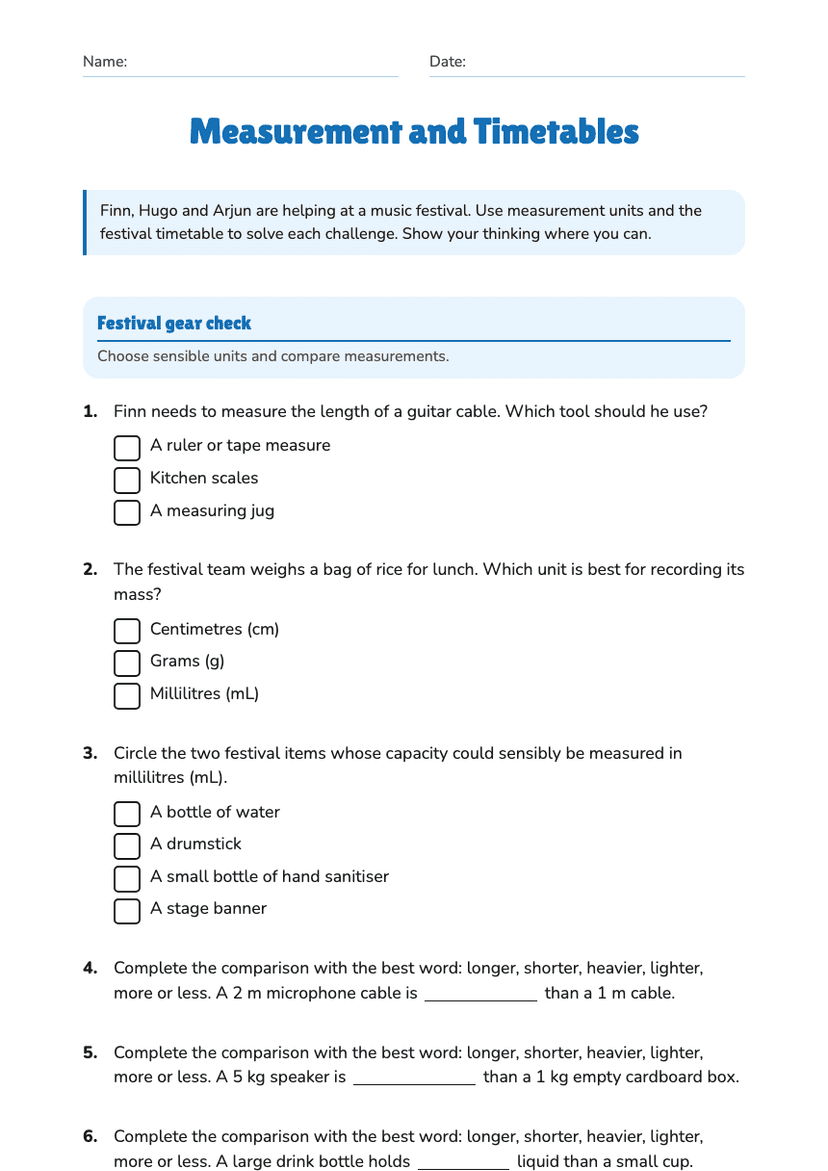
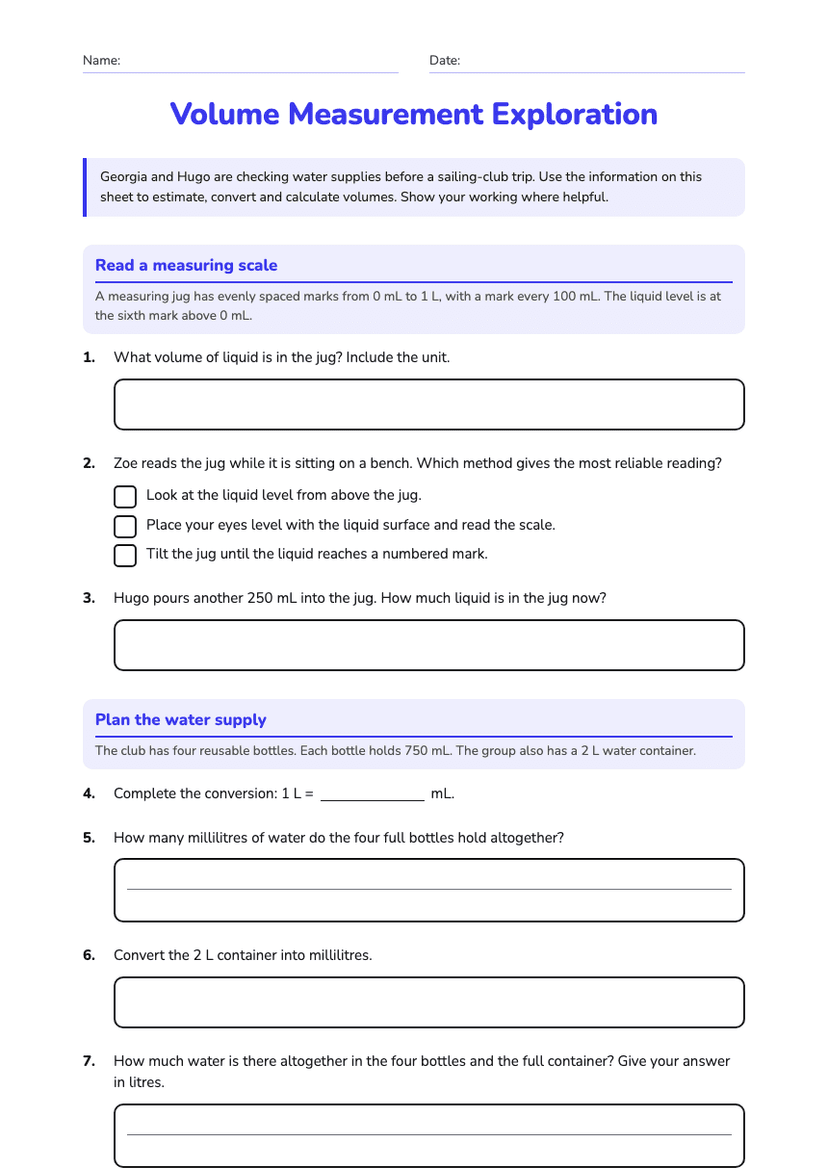
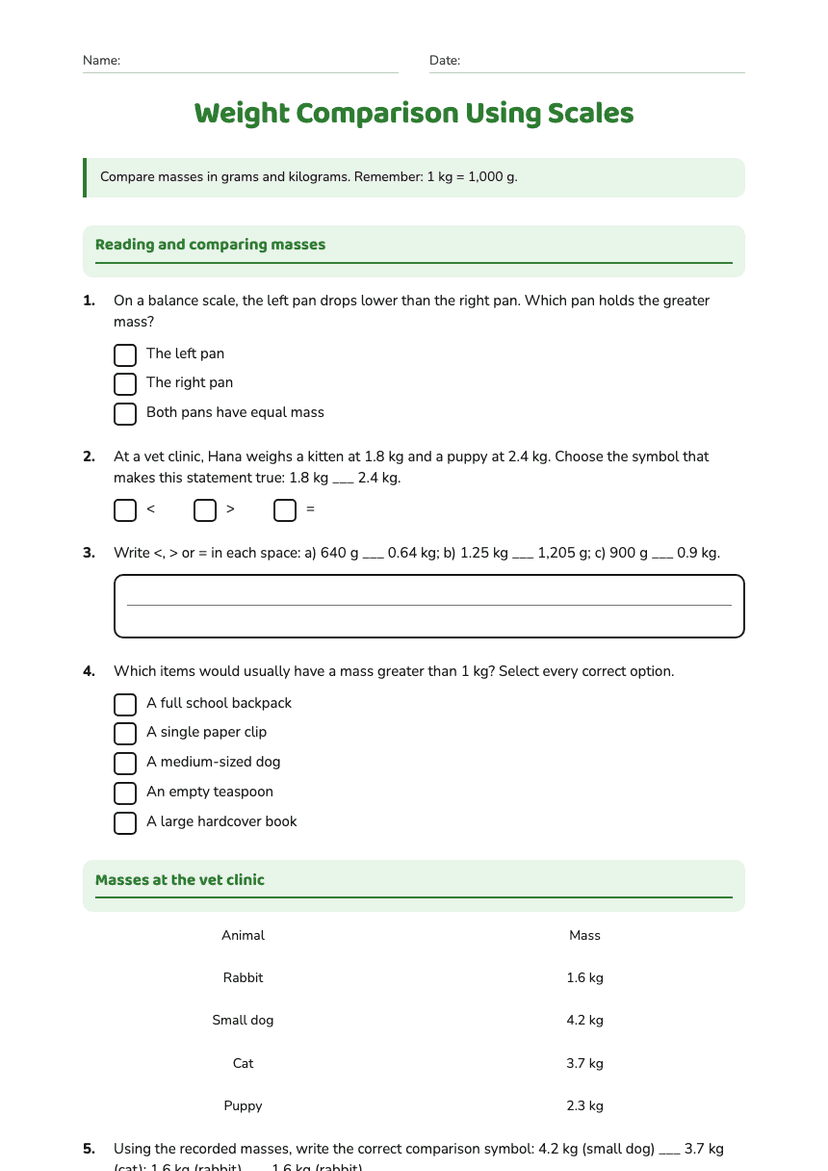
Measurement Concepts Practice worksheet preview
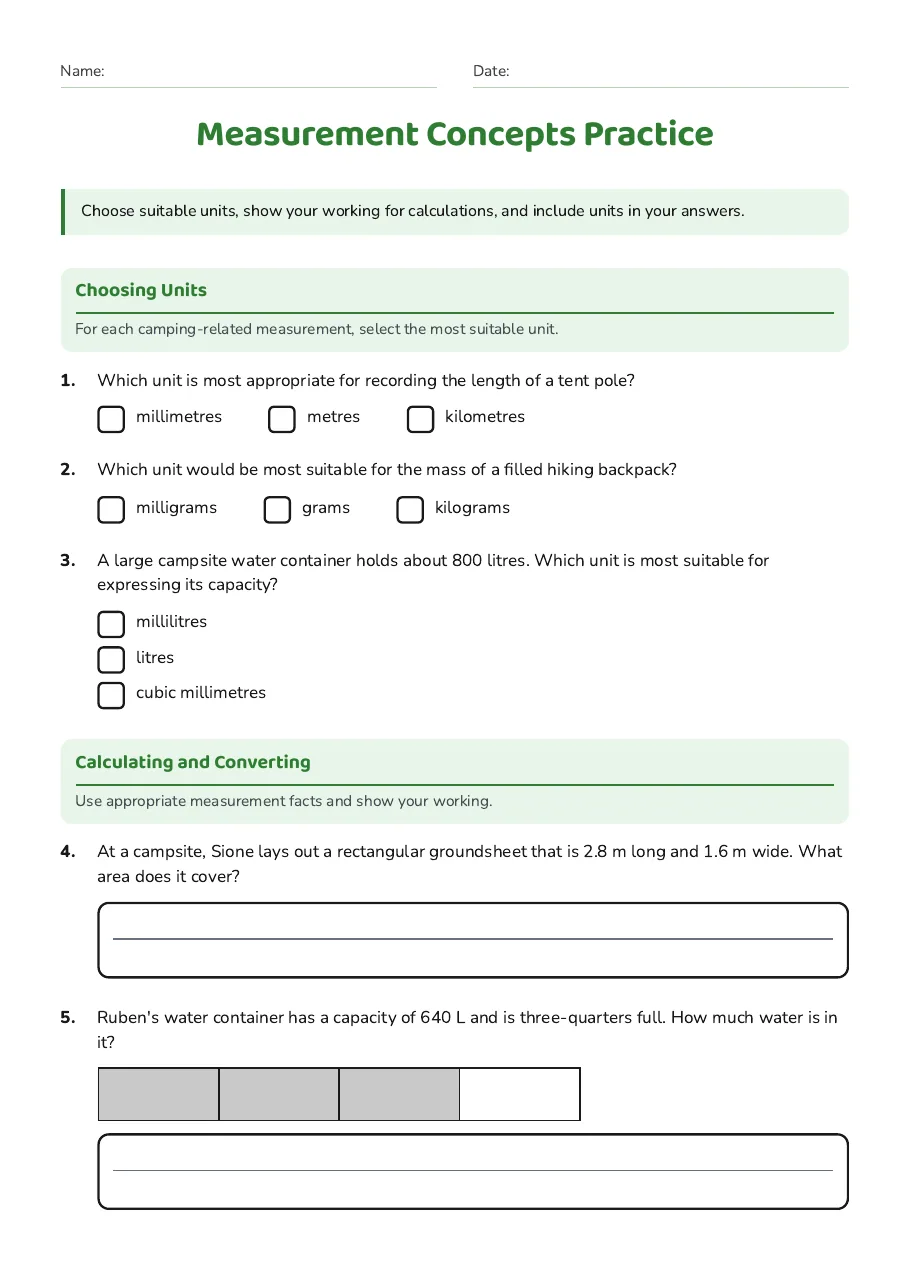
Name:Date:

Measurement Concepts Practice

Choose suitable units, show your working for calculations, and include units in your answers.

Choosing Units

For each camping-related measurement, select the most suitable unit.

1.Which unit is most appropriate for recording the length of a tent pole?
  • millimetres
  • metres
  • kilometres
2.Which unit would be most suitable for the mass of a filled hiking backpack?
  • milligrams
  • grams
  • kilograms
3.A large campsite water container holds about 800 litres. Which unit is most suitable for expressing its capacity?
  • millilitres
  • litres
  • cubic millimetres

Calculating and Converting

Use appropriate measurement facts and show your working.

4.At a campsite, Sione lays out a rectangular groundsheet that is 2.8 m long and 1.6 m wide. What area does it cover?
5.Ruben's water container has a capacity of 640 L and is three-quarters full. How much water is in it?
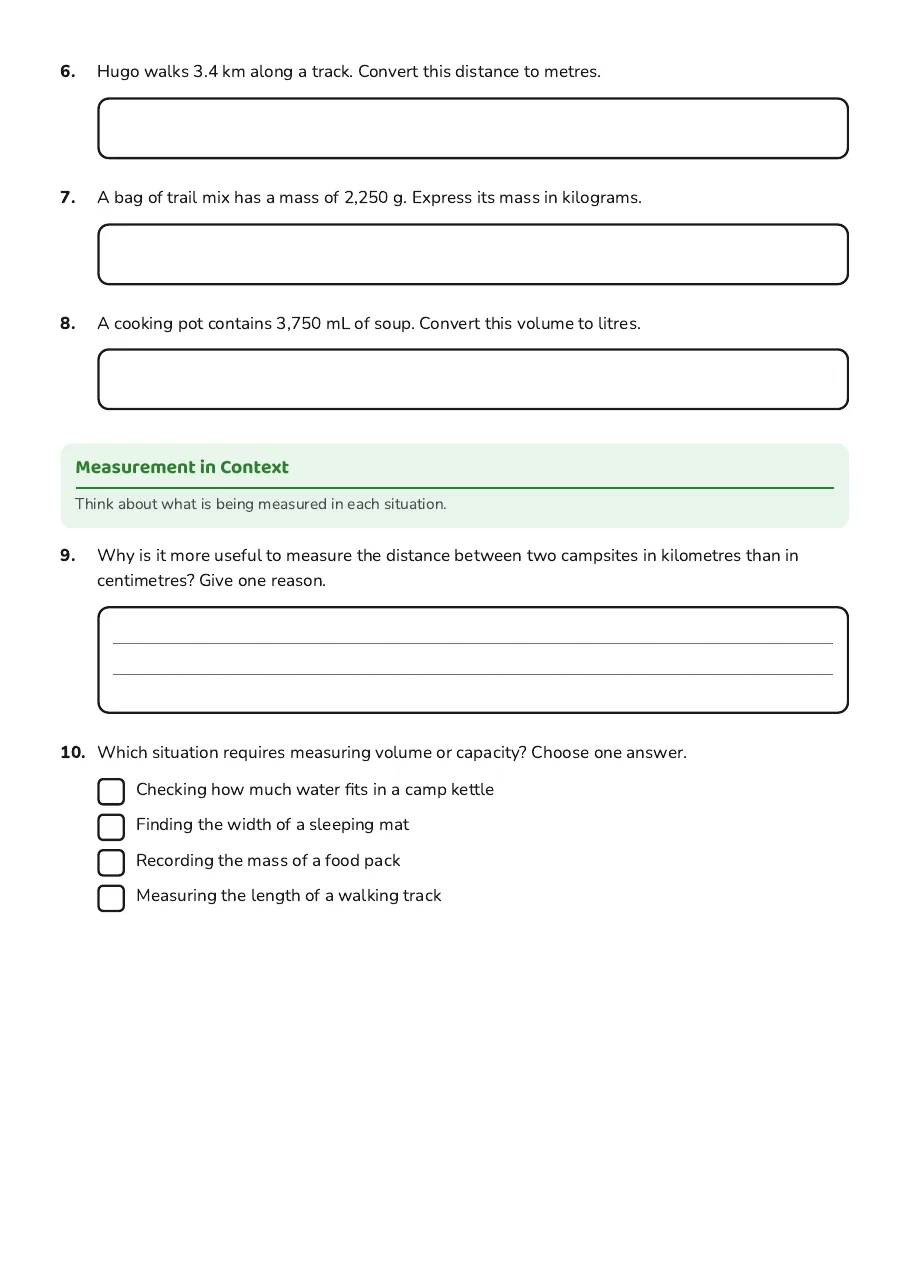
6.Hugo walks 3.4 km along a track. Convert this distance to metres.
7.A bag of trail mix has a mass of 2,250 g. Express its mass in kilograms.
8.A cooking pot contains 3,750 mL of soup. Convert this volume to litres.

Measurement in Context

Think about what is being measured in each situation.

9.Why is it more useful to measure the distance between two campsites in kilometres than in centimetres? Give one reason.
10.Which situation requires measuring volume or capacity? Choose one answer.
  • Checking how much water fits in a camp kettle
  • Finding the width of a sleeping mat
  • Recording the mass of a food pack
  • Measuring the length of a walking track

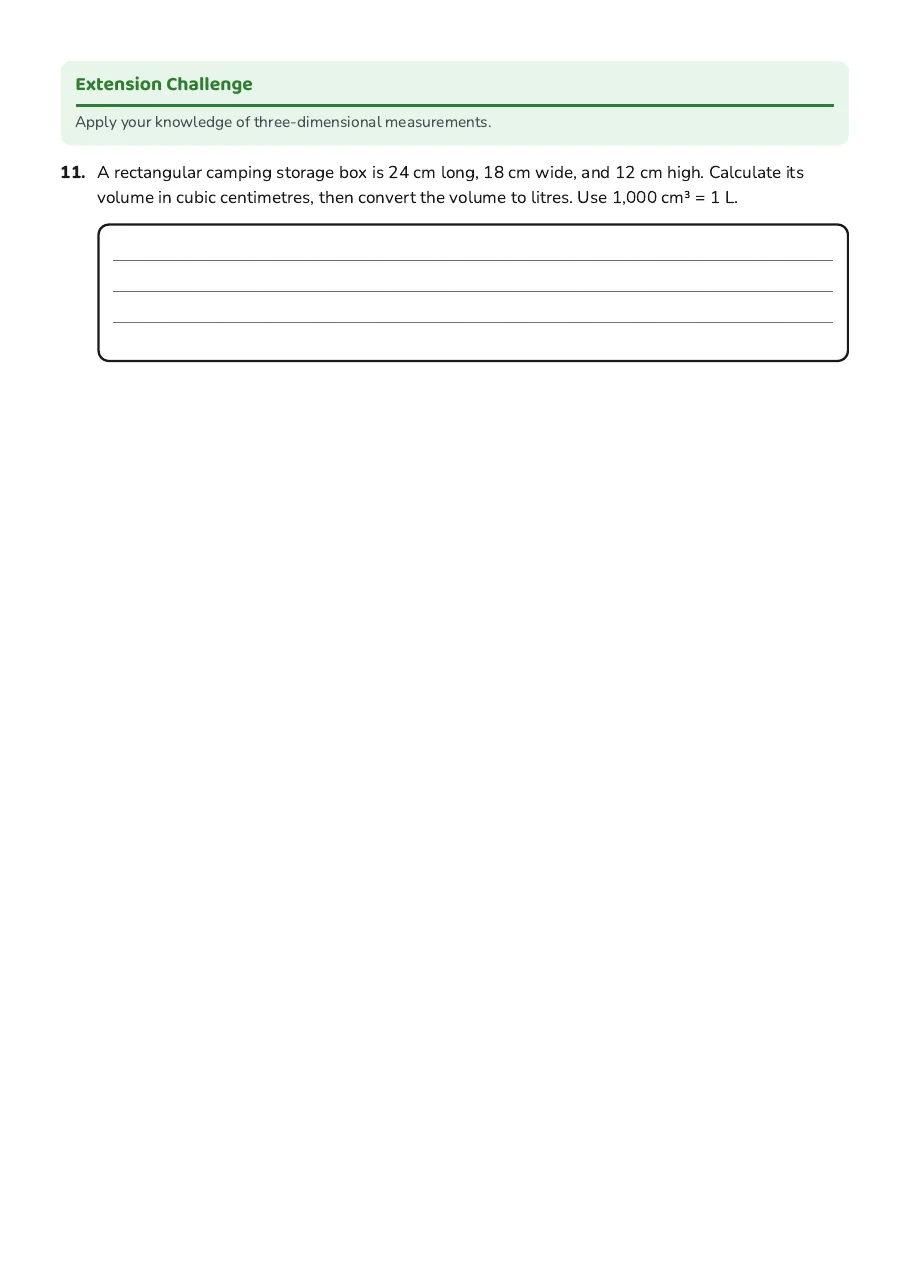
Extension Challenge

Apply your knowledge of three-dimensional measurements.

11.A rectangular camping storage box is 24 cm long, 18 cm wide, and 12 cm high. Calculate its volume in cubic centimetres, then convert the volume to litres. Use 1,000 cm³ = 1 L.

3 printable pages

  • Measurement Concepts Practice, page 1 of 3: Choosing Units, Calculating and Converting

    Page 1

  • Measurement Concepts Practice, page 2 of 3: Measurement in Context

    Page 2

  • Measurement Concepts Practice, page 3 of 3: Extension Challenge

    Page 3

About This Worksheet

Free in Kuraplan

Sign up free, grab the PDF, and customize it for your class.

Print-Ready

Formatted for standard paper. Clean layout, easy to read.

AI-Generated

Created with Kuraplan's AI, designed for real classroom use.

For Teachers & Parents

Use in classrooms, for homework, tutoring, or homeschool.

Need a custom version of this worksheet?

Kuraplan's AI generates custom worksheets in seconds — differentiated for every learner, aligned to your curriculum.

Generate Custom Worksheets — Free
No credit card Curriculum-aligned Under 60 seconds