MathsFreePrintable

Measuring Angles with Protractors

A free maths worksheet ready for your classroom. Open in Kuraplan to grab the print-ready PDF, customize it for your students, or generate a fresh version in seconds.

Measuring Angles with Protractors worksheet preview
Name:Date:

Measuring Angles with Protractors

Help a design team check its angle measurements. Use a protractor where asked. Record angles in degrees (°), and show your calculations for angle problems.

Read and reason

First check your angle vocabulary, then investigate how a protractor is used.

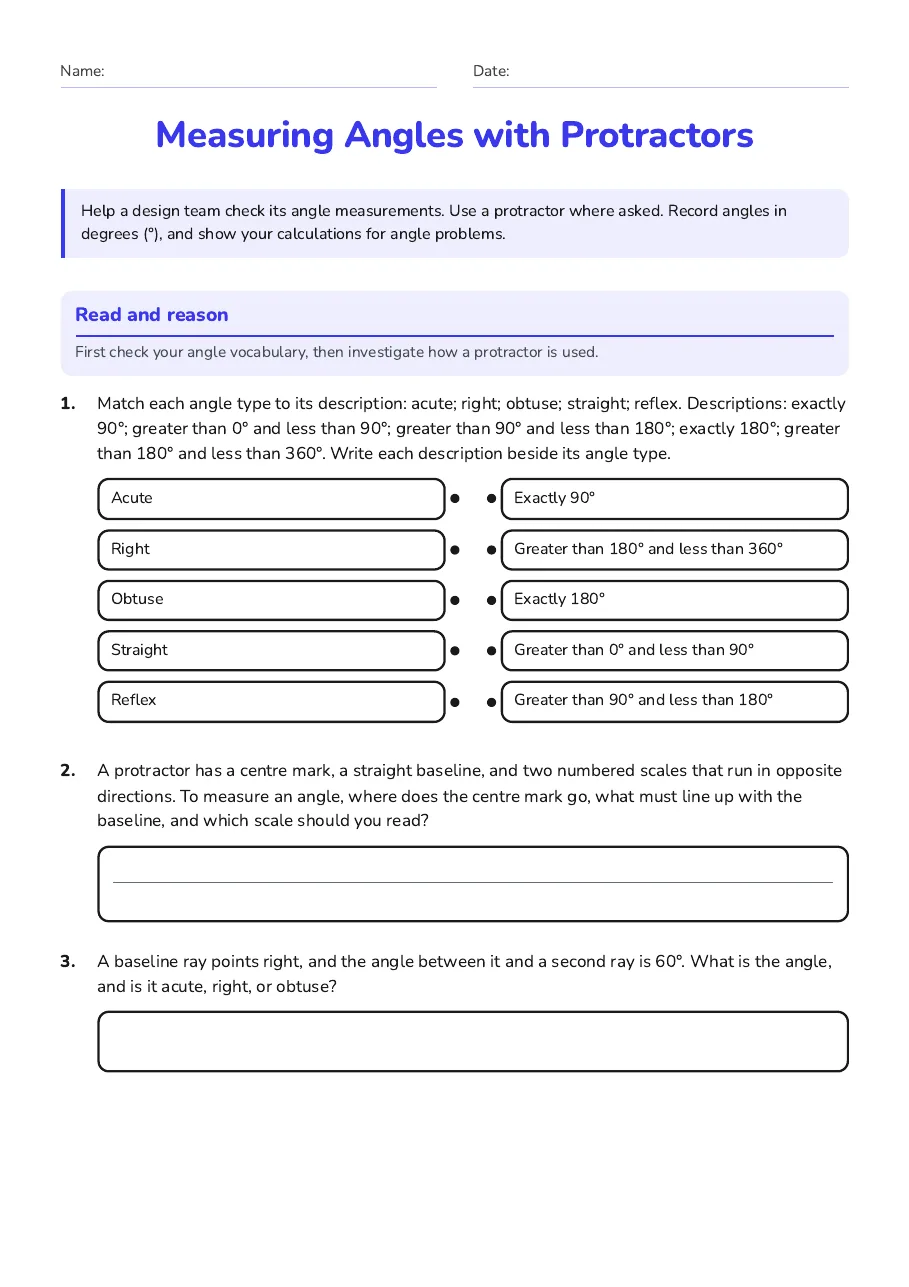
1.Match each angle type to its description: acute; right; obtuse; straight; reflex. Descriptions: exactly 90°; greater than 0° and less than 90°; greater than 90° and less than 180°; exactly 180°; greater than 180° and less than 360°. Write each description beside its angle type.
  • Acute
  • Right
  • Obtuse
  • Straight
  • Reflex
  • Exactly 90°
  • Greater than 180° and less than 360°
  • Exactly 180°
  • Greater than 0° and less than 90°
  • Greater than 90° and less than 180°
2.A protractor has a centre mark, a straight baseline, and two numbered scales that run in opposite directions. To measure an angle, where does the centre mark go, what must line up with the baseline, and which scale should you read?
3.A baseline ray points right, and the angle between it and a second ray is 60°. What is the angle, and is it acute, right, or obtuse?

Measure and make

Take care to choose the scale that begins at zero on the aligned arm.

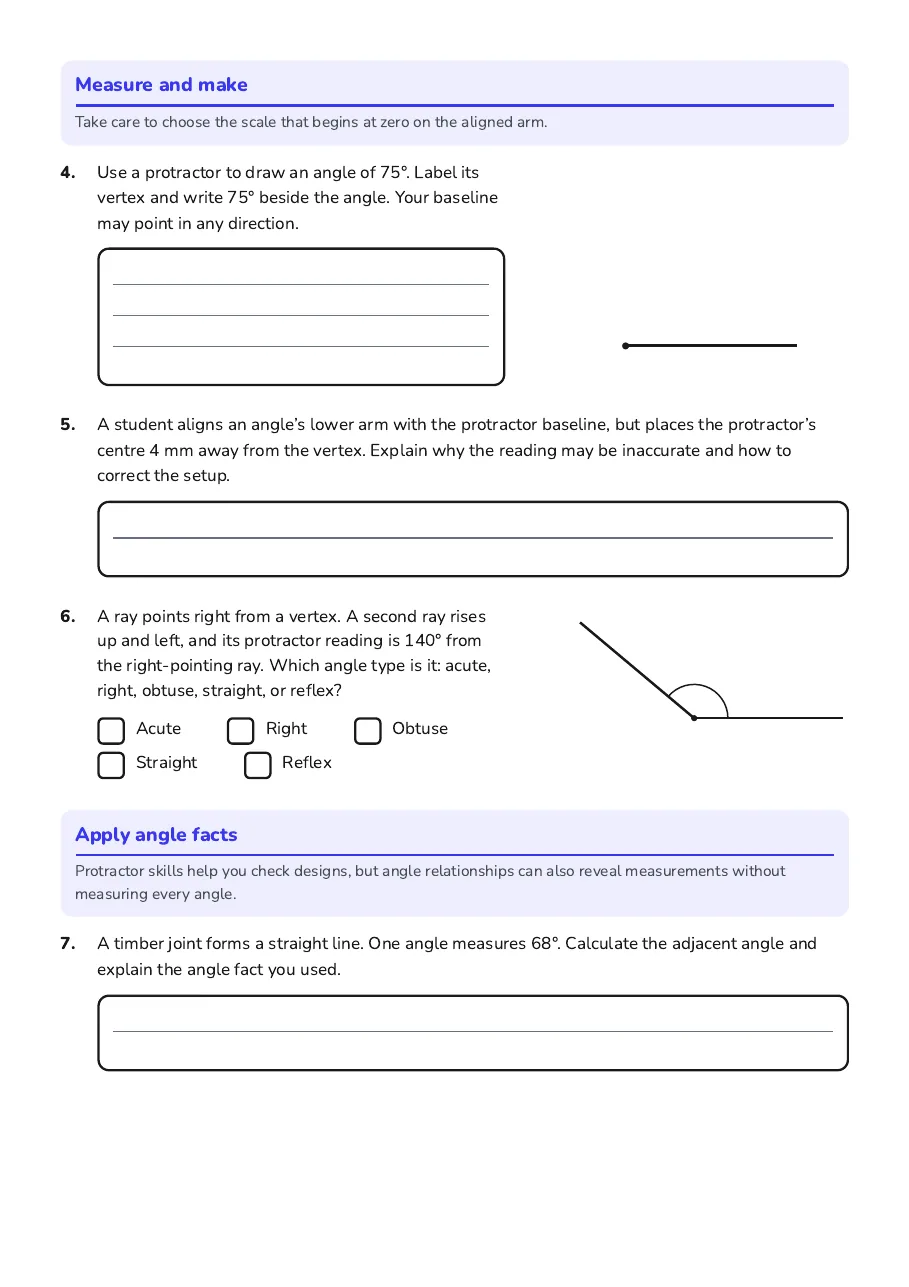
4.Use a protractor to draw an angle of 75°. Label its vertex and write 75° beside the angle. Your baseline may point in any direction.
5.A student aligns an angle’s lower arm with the protractor baseline, but places the protractor’s centre 4 mm away from the vertex. Explain why the reading may be inaccurate and how to correct the setup.
6.A ray points right from a vertex. A second ray rises up and left, and its protractor reading is 140° from the right-pointing ray. Which angle type is it: acute, right, obtuse, straight, or reflex?
  • Acute
  • Right
  • Obtuse
  • Straight
  • Reflex

Apply angle facts

Protractor skills help you check designs, but angle relationships can also reveal measurements without measuring every angle.

7.A timber joint forms a straight line. One angle measures 68°. Calculate the adjacent angle and explain the angle fact you used.
8.Three angles meet at a point: 85°, 140°, and x°. Find x. Show the calculation and name the angle fact used.
9.A triangular frame has angles of 90° and 35°. Find the third angle. Then state whether it is acute, right, or obtuse.
10.A drafter estimates an angle as 90°, then measures it as 84° with a protractor. What is the difference between the estimate and measurement? Name one useful benchmark angle for estimating.
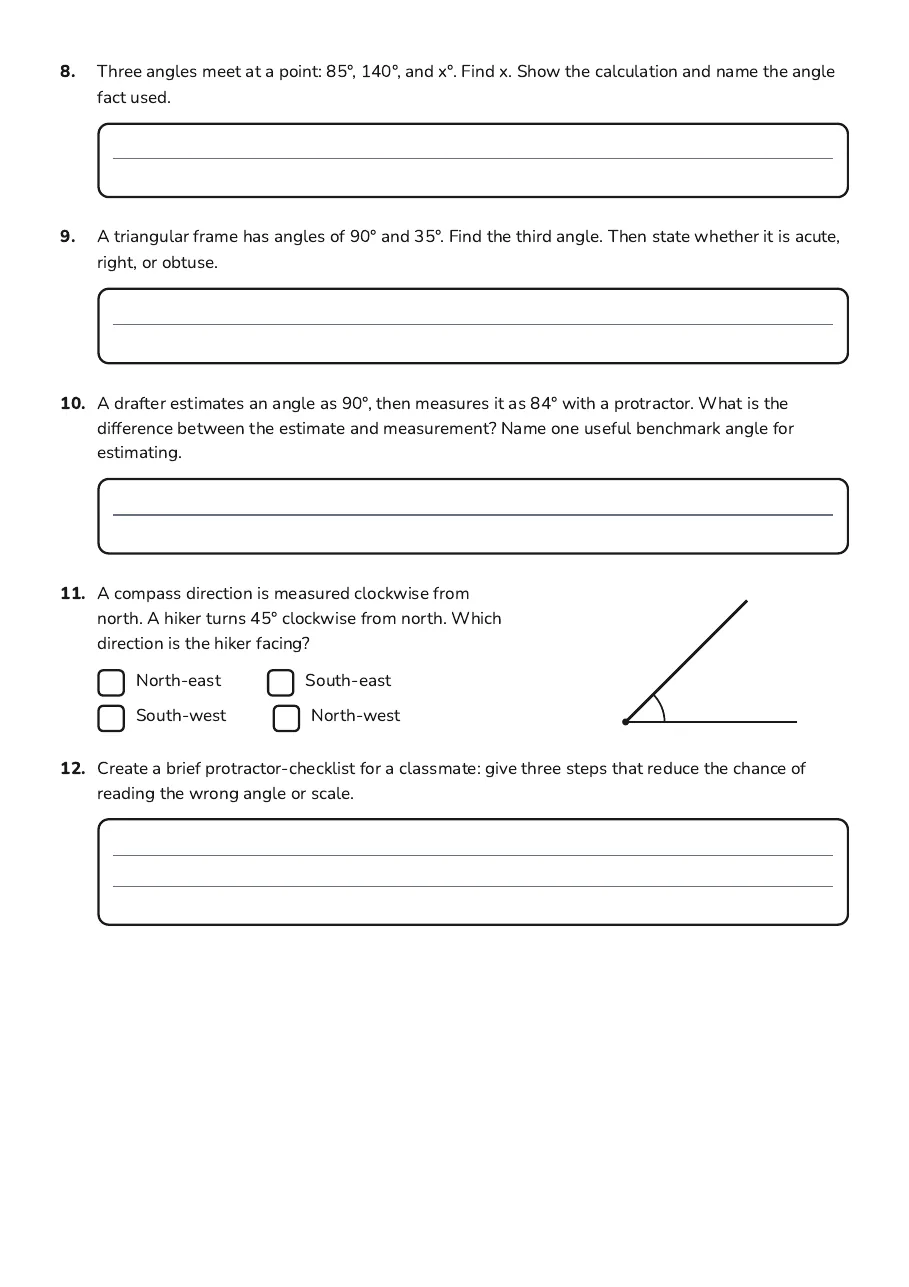
11.A compass direction is measured clockwise from north. A hiker turns 45° clockwise from north. Which direction is the hiker facing?
  • North-east
  • South-east
  • South-west
  • North-west
12.Create a brief protractor-checklist for a classmate: give three steps that reduce the chance of reading the wrong angle or scale.

3 printable pages

  • Measuring Angles with Protractors, page 1 of 3: Read and reason

    Page 1

  • Measuring Angles with Protractors, page 2 of 3: Measure and make, Apply angle facts

    Page 2

  • Measuring Angles with Protractors, page 3 of 3: 8. Three angles meet at a point: 85°, 140°, and x°. Find x. Show the calculation and name…

    Page 3

About This Worksheet

Free in Kuraplan

Sign up free, grab the PDF, and customize it for your class.

Print-Ready

Formatted for standard paper. Clean layout, easy to read.

AI-Generated

Created with Kuraplan's AI, designed for real classroom use.

For Teachers & Parents

Use in classrooms, for homework, tutoring, or homeschool.

Need a custom version of this worksheet?

Kuraplan's AI generates custom worksheets in seconds — differentiated for every learner, aligned to your curriculum.

Generate Custom Worksheets — Free
No credit card Curriculum-aligned Under 60 seconds