MathsFreePrintable
Negative Index Laws Proofs
A free maths worksheet ready for your classroom. Open in Kuraplan to grab the print-ready PDF, customize it for your students, or generate a fresh version in seconds.
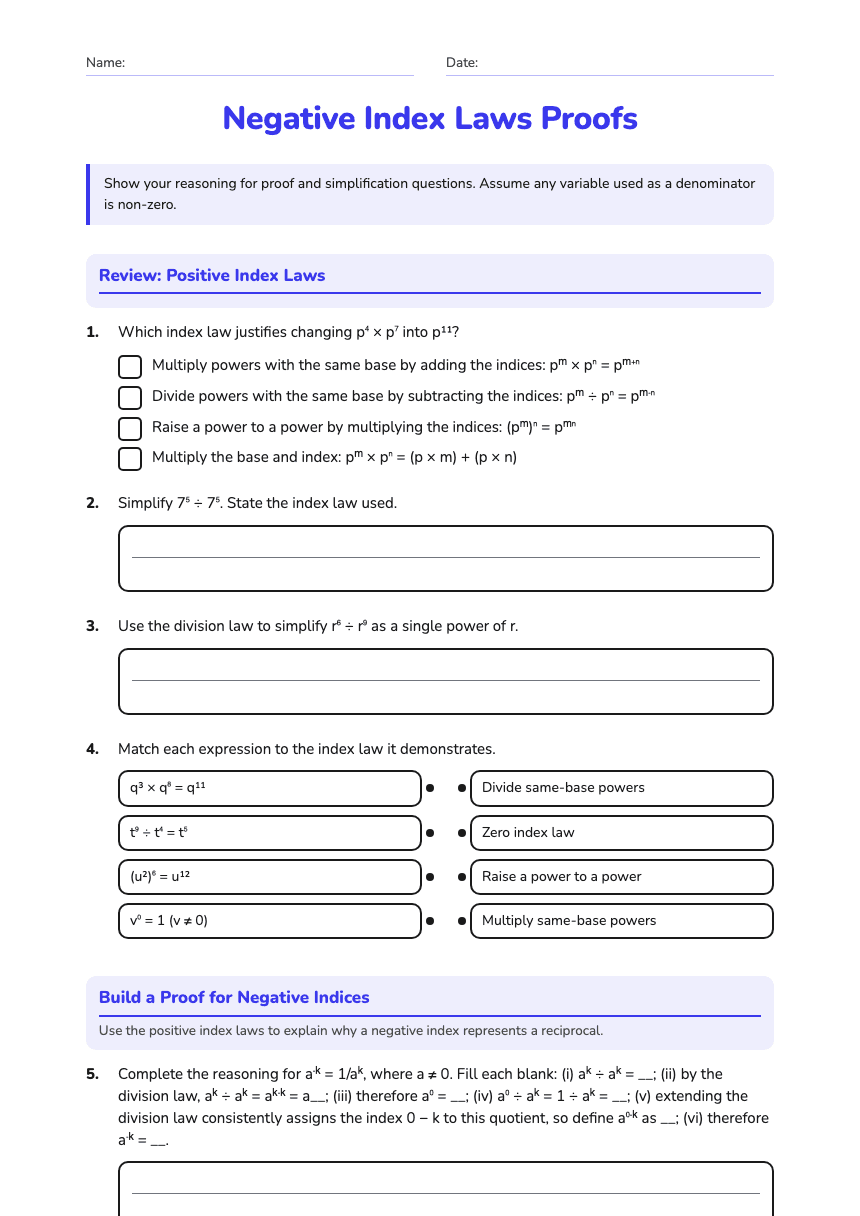
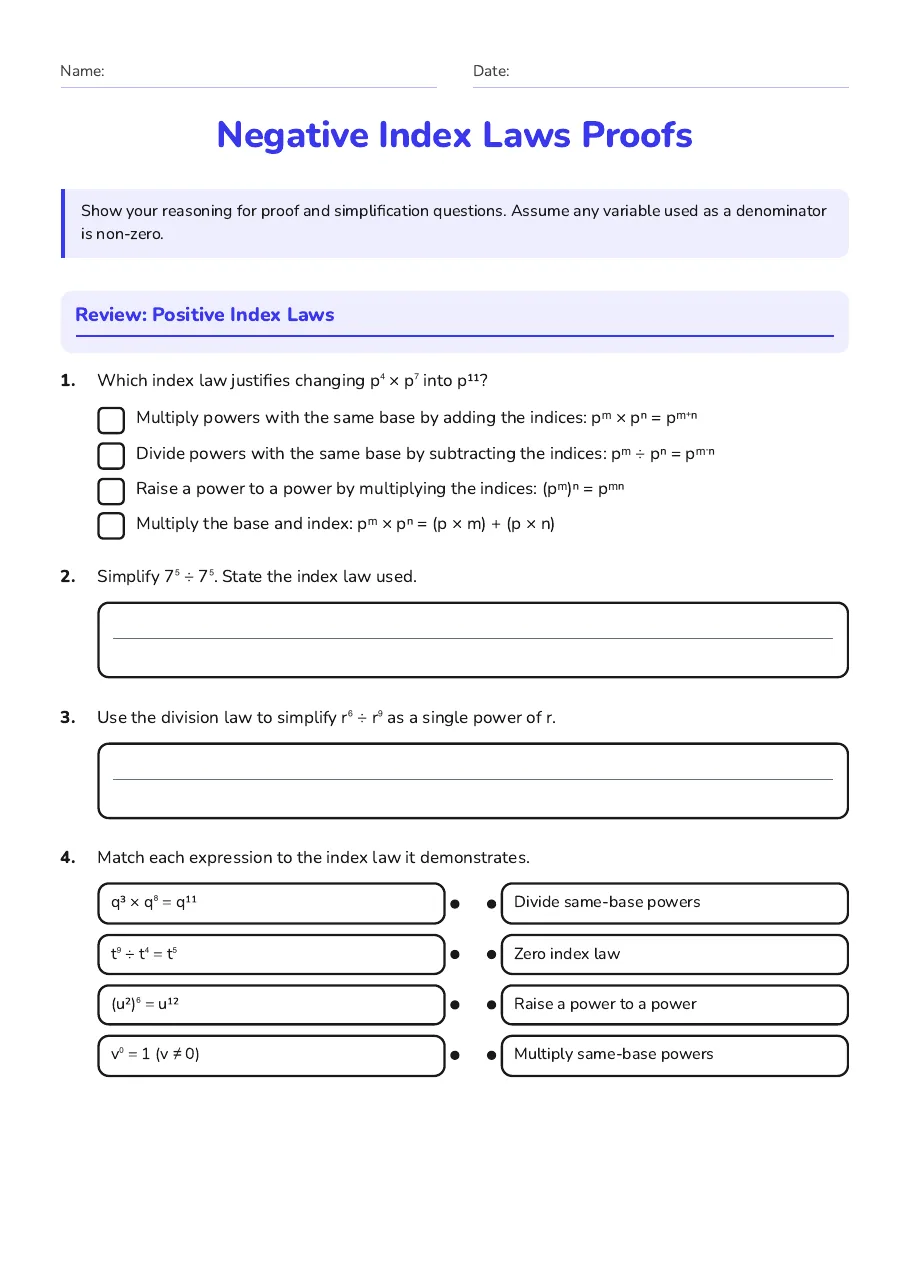
Name:Date:
Negative Index Laws Proofs
Show your reasoning for proof and simplification questions. Assume any variable used as a denominator is non-zero.
Review: Positive Index Laws
1.Which index law justifies changing p⁴ × p⁷ into p¹¹?
- Multiply powers with the same base by adding the indices: pᵐ × pⁿ = pᵐ⁺ⁿ
- Divide powers with the same base by subtracting the indices: pᵐ ÷ pⁿ = pᵐ⁻ⁿ
- Raise a power to a power by multiplying the indices: (pᵐ)ⁿ = pᵐⁿ
- Multiply the base and index: pᵐ × pⁿ = (p × m) + (p × n)
2.Simplify 7⁵ ÷ 7⁵. State the index law used.
3.Use the division law to simplify r⁶ ÷ r⁹ as a single power of r.
4.Match each expression to the index law it demonstrates.
- q³ × q⁸ = q¹¹
- t⁹ ÷ t⁴ = t⁵
- (u²)⁶ = u¹²
- v⁰ = 1 (v ≠ 0)
- Divide same-base powers
- Zero index law
- Raise a power to a power
- Multiply same-base powers
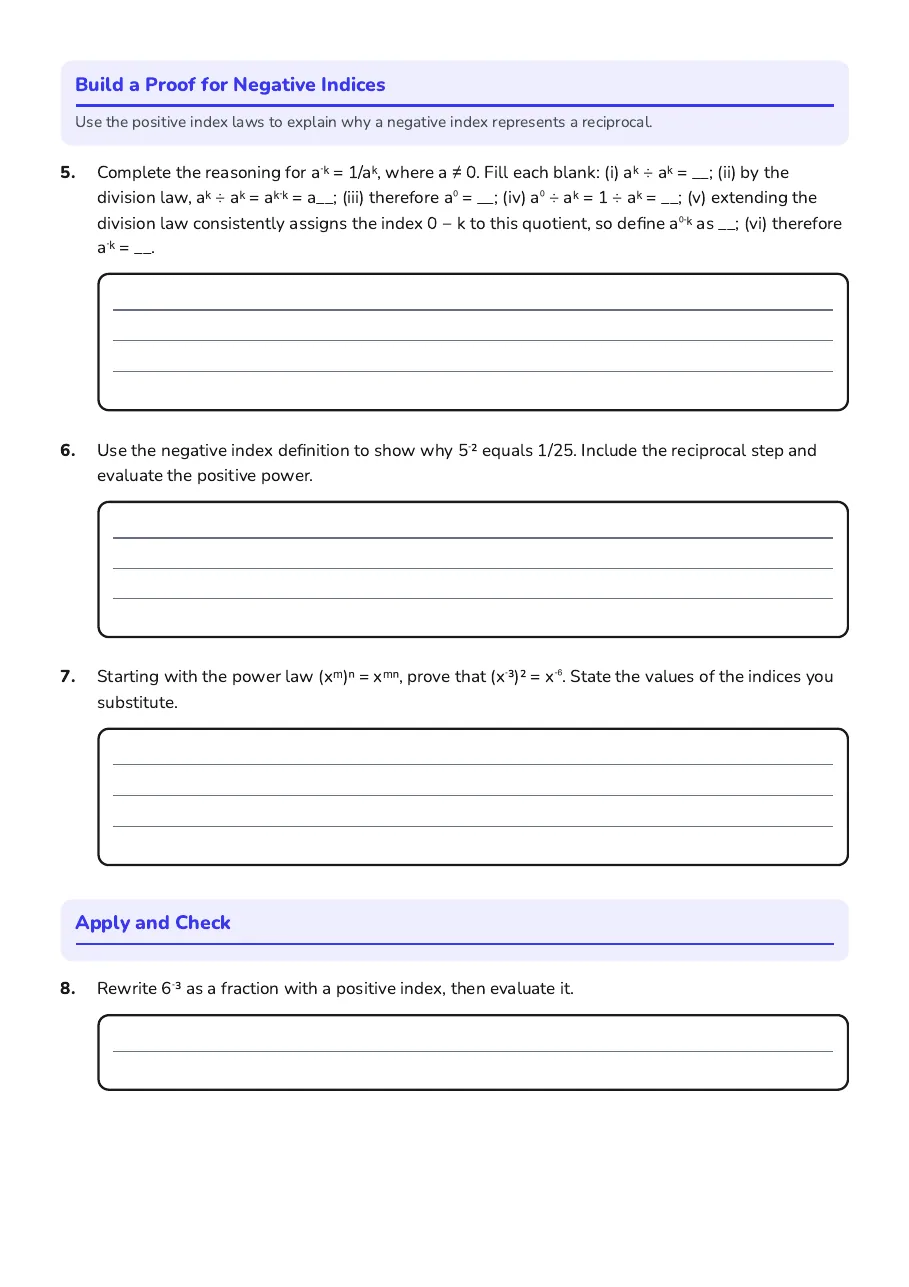
Build a Proof for Negative Indices
Use the positive index laws to explain why a negative index represents a reciprocal.
5.Complete the reasoning for a⁻ᵏ = 1/aᵏ, where a ≠ 0. Fill each blank: (i) aᵏ ÷ aᵏ = __; (ii) by the division law, aᵏ ÷ aᵏ = aᵏ⁻ᵏ = a__; (iii) therefore a⁰ = __; (iv) a⁰ ÷ aᵏ = 1 ÷ aᵏ = __; (v) extending the division law consistently assigns the index 0 − k to this quotient, so define a⁰⁻ᵏ as __; (vi) therefore a⁻ᵏ = __.
6.Use the negative index definition to show why 5⁻² equals 1/25. Include the reciprocal step and evaluate the positive power.
7.Starting with the power law (xᵐ)ⁿ = xᵐⁿ, prove that (x⁻³)² = x⁻⁶. State the values of the indices you substitute.
Apply and Check
8.Rewrite 6⁻³ as a fraction with a positive index, then evaluate it.
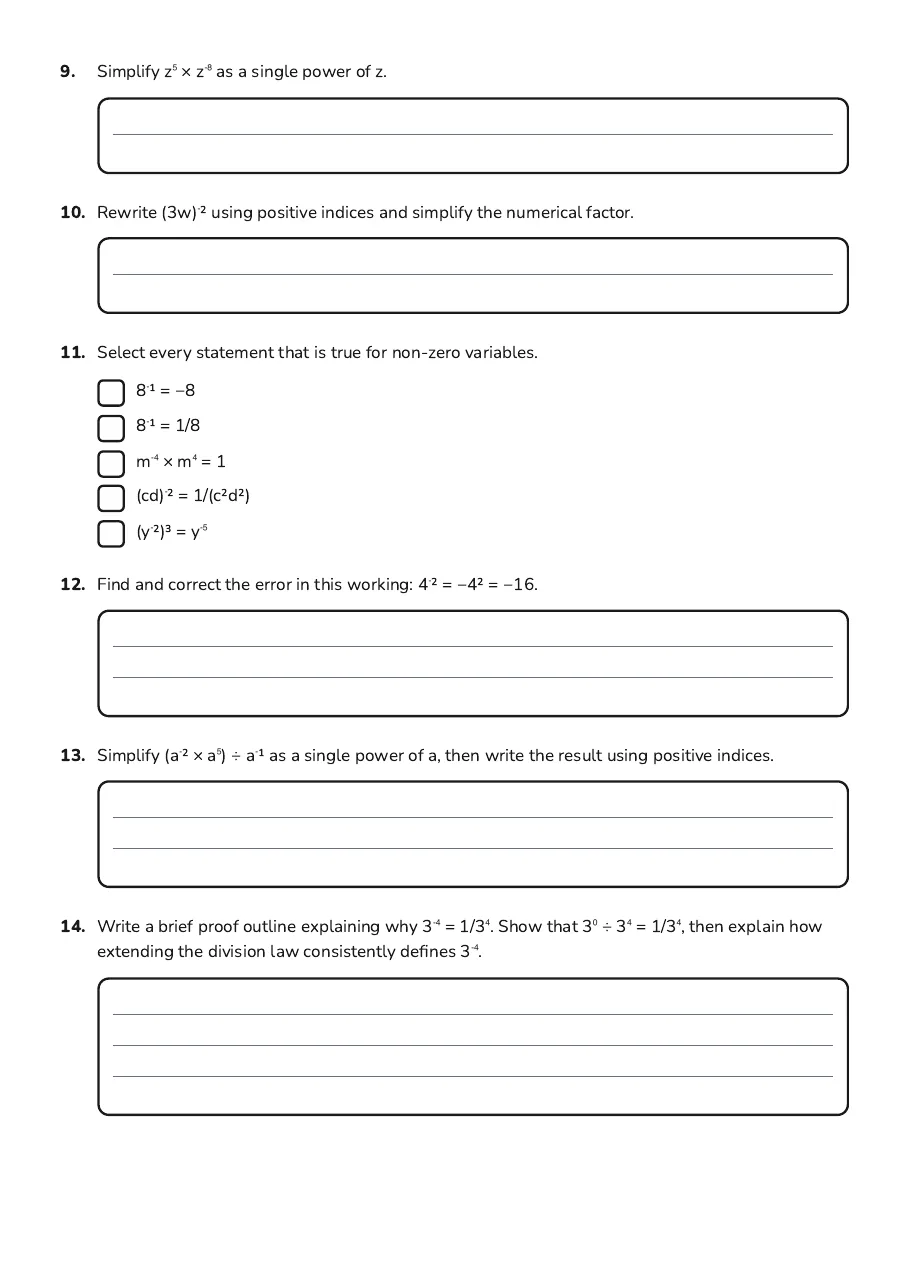
9.Simplify z⁵ × z⁻⁸ as a single power of z.
10.Rewrite (3w)⁻² using positive indices and simplify the numerical factor.
11.Select every statement that is true for non-zero variables.
- 8⁻¹ = −8
- 8⁻¹ = 1/8
- m⁻⁴ × m⁴ = 1
- (cd)⁻² = 1/(c²d²)
- (y⁻²)³ = y⁻⁵
12.Find and correct the error in this working: 4⁻² = −4² = −16.
13.Simplify (a⁻² × a⁵) ÷ a⁻¹ as a single power of a, then write the result using positive indices.
14.Write a brief proof outline explaining why 3⁻⁴ = 1/3⁴. Show that 3⁰ ÷ 3⁴ = 1/3⁴, then explain how extending the division law consistently defines 3⁻⁴.
3 printable pages
Page 1
Page 2
Page 3
About This Worksheet
Free in Kuraplan
Sign up free, grab the PDF, and customize it for your class.
Print-Ready
Formatted for standard paper. Clean layout, easy to read.
AI-Generated
Created with Kuraplan's AI, designed for real classroom use.
For Teachers & Parents
Use in classrooms, for homework, tutoring, or homeschool.
Need a custom version of this worksheet?
Kuraplan's AI generates custom worksheets in seconds — differentiated for every learner, aligned to your curriculum.
Generate Custom Worksheets — Free No credit card Curriculum-aligned Under 60 seconds