Social SciencesFreePrintable

Social Enterprise Business Models

A free social sciences worksheet ready for your classroom. Open in Kuraplan to grab the print-ready PDF, customize it for your students, or generate a fresh version in seconds.

Social Enterprise Business Models worksheet preview
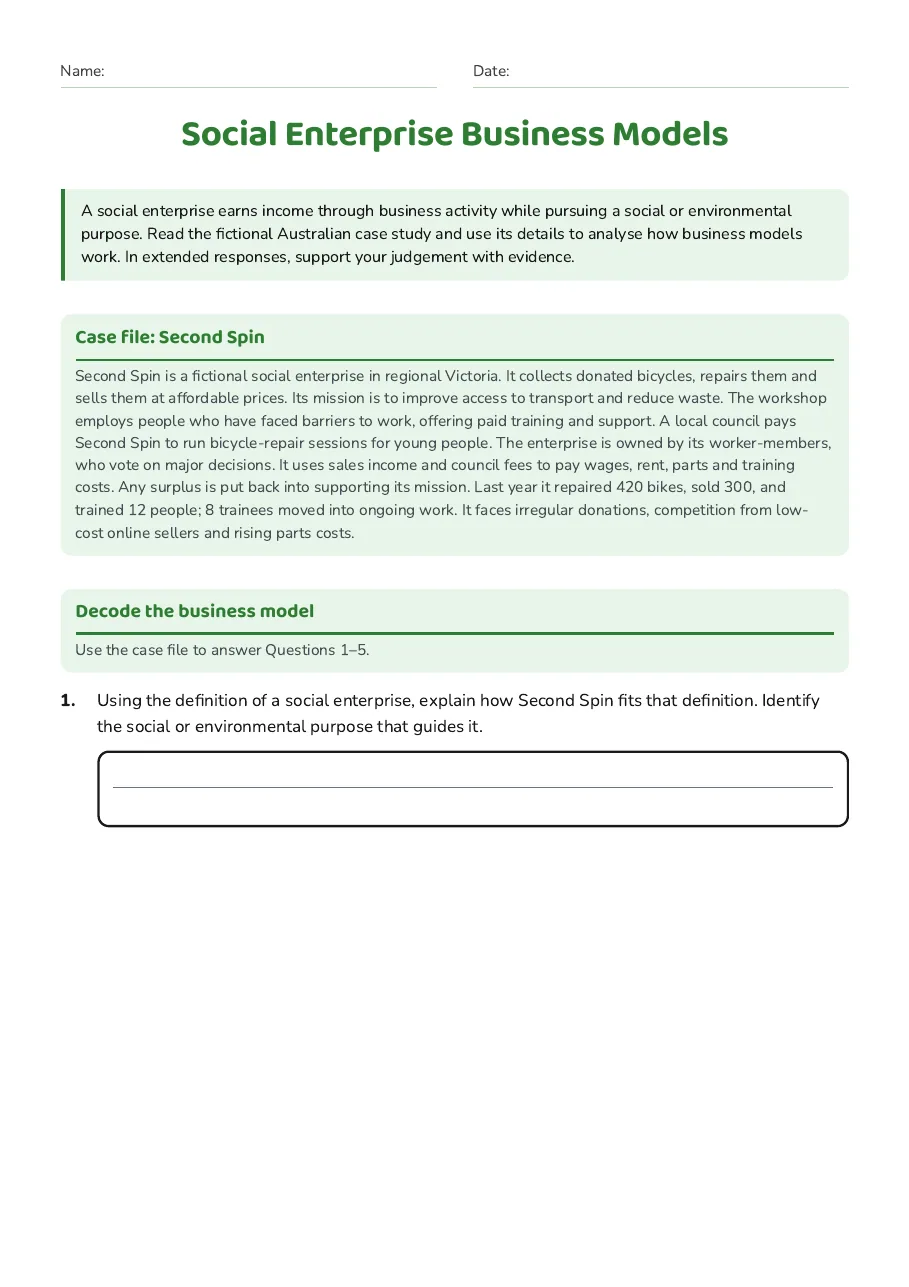
Name:Date:

Social Enterprise Business Models

A social enterprise earns income through business activity while pursuing a social or environmental purpose. Read the fictional Australian case study and use its details to analyse how business models work. In extended responses, support your judgement with evidence.

Case file: Second Spin

Second Spin is a fictional social enterprise in regional Victoria. It collects donated bicycles, repairs them and sells them at affordable prices. Its mission is to improve access to transport and reduce waste. The workshop employs people who have faced barriers to work, offering paid training and support. A local council pays Second Spin to run bicycle-repair sessions for young people. The enterprise is owned by its worker-members, who vote on major decisions. It uses sales income and council fees to pay wages, rent, parts and training costs. Any surplus is put back into supporting its mission. Last year it repaired 420 bikes, sold 300, and trained 12 people; 8 trainees moved into ongoing work. It faces irregular donations, competition from low-cost online sellers and rising parts costs.

Decode the business model

Use the case file to answer Questions 1–5.

1.Using the definition of a social enterprise, explain how Second Spin fits that definition. Identify the social or environmental purpose that guides it.
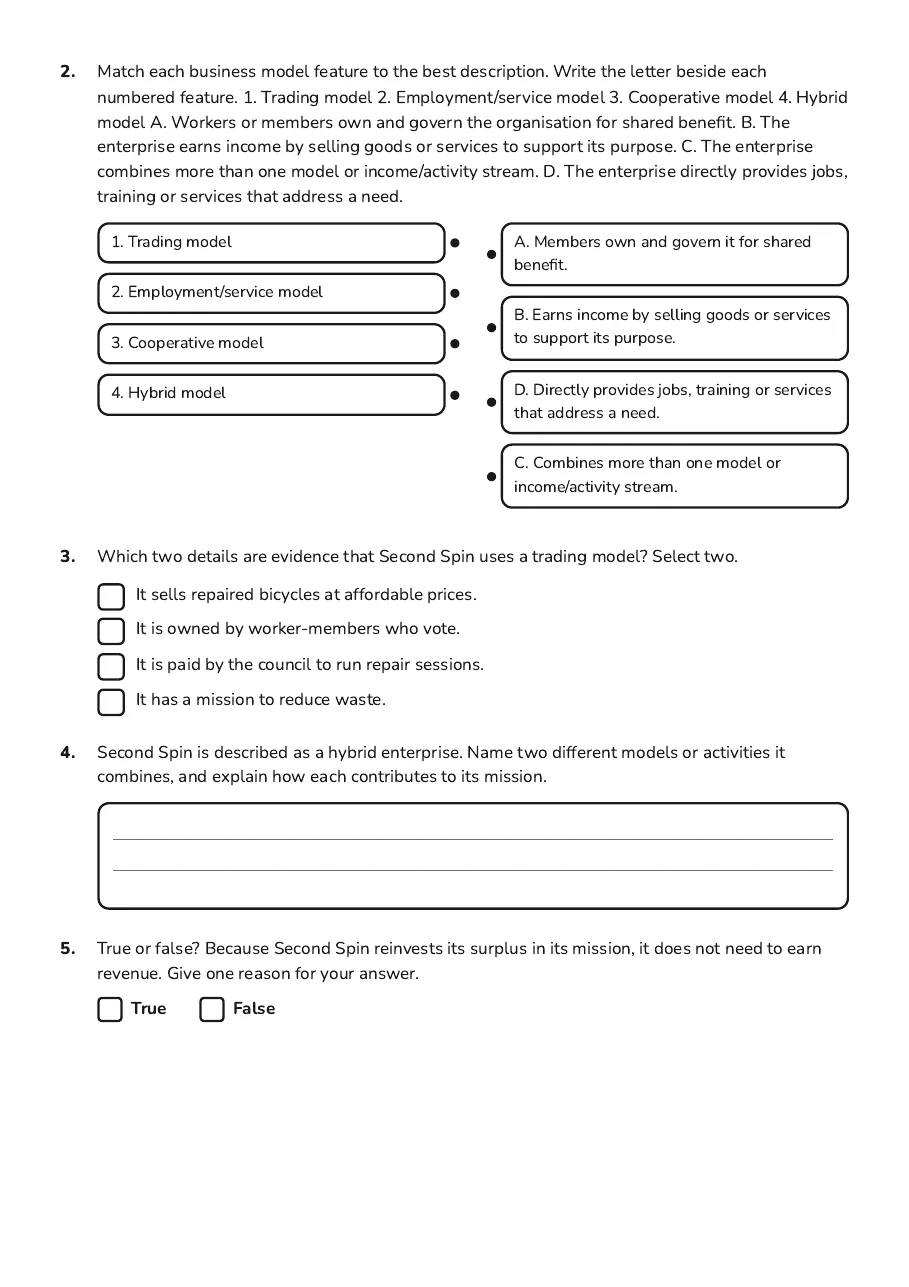
2.Match each business model feature to the best description. Write the letter beside each numbered feature. 1. Trading model 2. Employment/service model 3. Cooperative model 4. Hybrid model A. Workers or members own and govern the organisation for shared benefit. B. The enterprise earns income by selling goods or services to support its purpose. C. The enterprise combines more than one model or income/activity stream. D. The enterprise directly provides jobs, training or services that address a need.
  • 1. Trading model
  • 2. Employment/service model
  • 3. Cooperative model
  • 4. Hybrid model
  • A. Members own and govern it for shared benefit.
  • B. Earns income by selling goods or services to support its purpose.
  • D. Directly provides jobs, training or services that address a need.
  • C. Combines more than one model or income/activity stream.
3.Which two details are evidence that Second Spin uses a trading model? Select two.
  • It sells repaired bicycles at affordable prices.
  • It is owned by worker-members who vote.
  • It is paid by the council to run repair sessions.
  • It has a mission to reduce waste.
4.Second Spin is described as a hybrid enterprise. Name two different models or activities it combines, and explain how each contributes to its mission.
5.True or false? Because Second Spin reinvests its surplus in its mission, it does not need to earn revenue. Give one reason for your answer.
TrueFalse

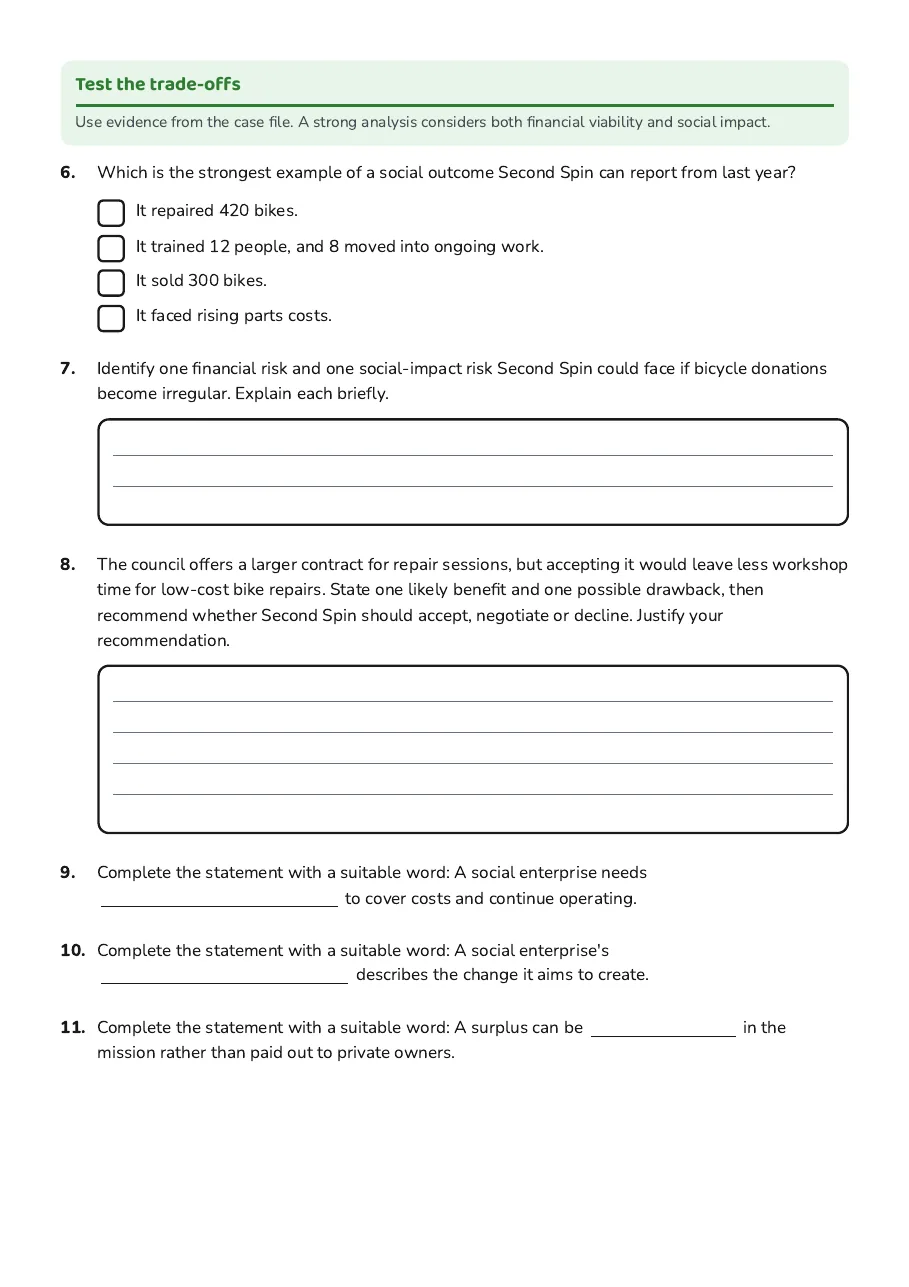
Test the trade-offs

Use evidence from the case file. A strong analysis considers both financial viability and social impact.

6.Which is the strongest example of a social outcome Second Spin can report from last year?
  • It repaired 420 bikes.
  • It trained 12 people, and 8 moved into ongoing work.
  • It sold 300 bikes.
  • It faced rising parts costs.
7.Identify one financial risk and one social-impact risk Second Spin could face if bicycle donations become irregular. Explain each briefly.
8.The council offers a larger contract for repair sessions, but accepting it would leave less workshop time for low-cost bike repairs. State one likely benefit and one possible drawback, then recommend whether Second Spin should accept, negotiate or decline. Justify your recommendation.
9.Complete the statement with a suitable word: A social enterprise needs to cover costs and continue operating.
10.Complete the statement with a suitable word: A social enterprise's describes the change it aims to create.
11.Complete the statement with a suitable word: A surplus can be in the mission rather than paid out to private owners.

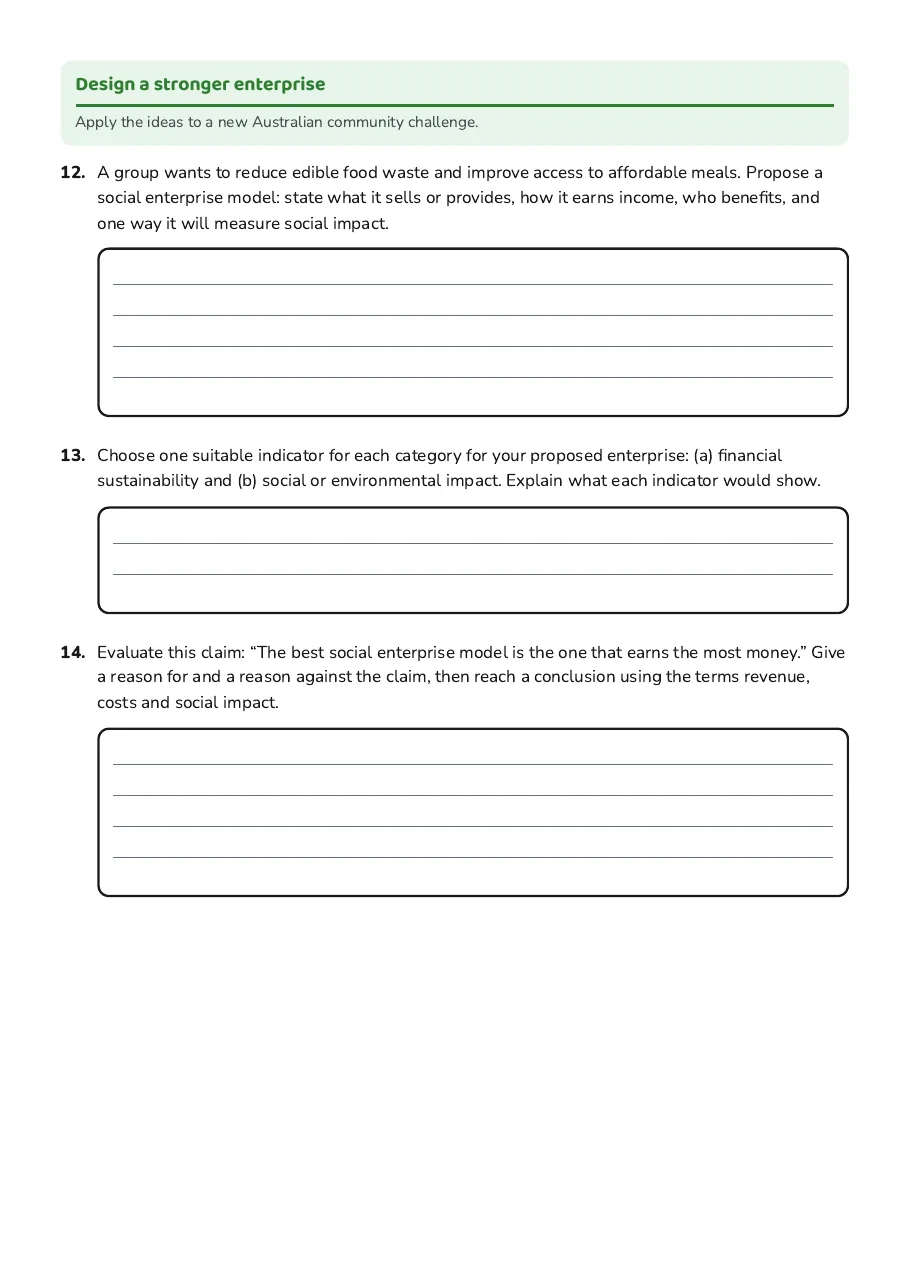
Design a stronger enterprise

Apply the ideas to a new Australian community challenge.

12.A group wants to reduce edible food waste and improve access to affordable meals. Propose a social enterprise model: state what it sells or provides, how it earns income, who benefits, and one way it will measure social impact.
13.Choose one suitable indicator for each category for your proposed enterprise: (a) financial sustainability and (b) social or environmental impact. Explain what each indicator would show.
14.Evaluate this claim: “The best social enterprise model is the one that earns the most money.” Give a reason for and a reason against the claim, then reach a conclusion using the terms revenue, costs and social impact.

4 printable pages

  • Social Enterprise Business Models, page 1 of 4: Case file: Second Spin, Decode the business model

    Page 1

  • Social Enterprise Business Models, page 2 of 4: 2. Match each business model feature to the best description. Write the letter beside each

    Page 2

  • Social Enterprise Business Models, page 3 of 4: Test the trade-offs

    Page 3

  • Social Enterprise Business Models, page 4 of 4: Design a stronger enterprise

    Page 4

About This Worksheet

Free in Kuraplan

Sign up free, grab the PDF, and customize it for your class.

Print-Ready

Formatted for standard paper. Clean layout, easy to read.

AI-Generated

Created with Kuraplan's AI, designed for real classroom use.

For Teachers & Parents

Use in classrooms, for homework, tutoring, or homeschool.

Need a custom version of this worksheet?

Kuraplan's AI generates custom worksheets in seconds — differentiated for every learner, aligned to your curriculum.

Generate Custom Worksheets — Free
No credit card Curriculum-aligned Under 60 seconds