Social Enterprise Funding Options
A free social sciences worksheet ready for your classroom. Open in Kuraplan to grab the print-ready PDF, customize it for your students, or generate a fresh version in seconds.

Social Enterprise Funding Options
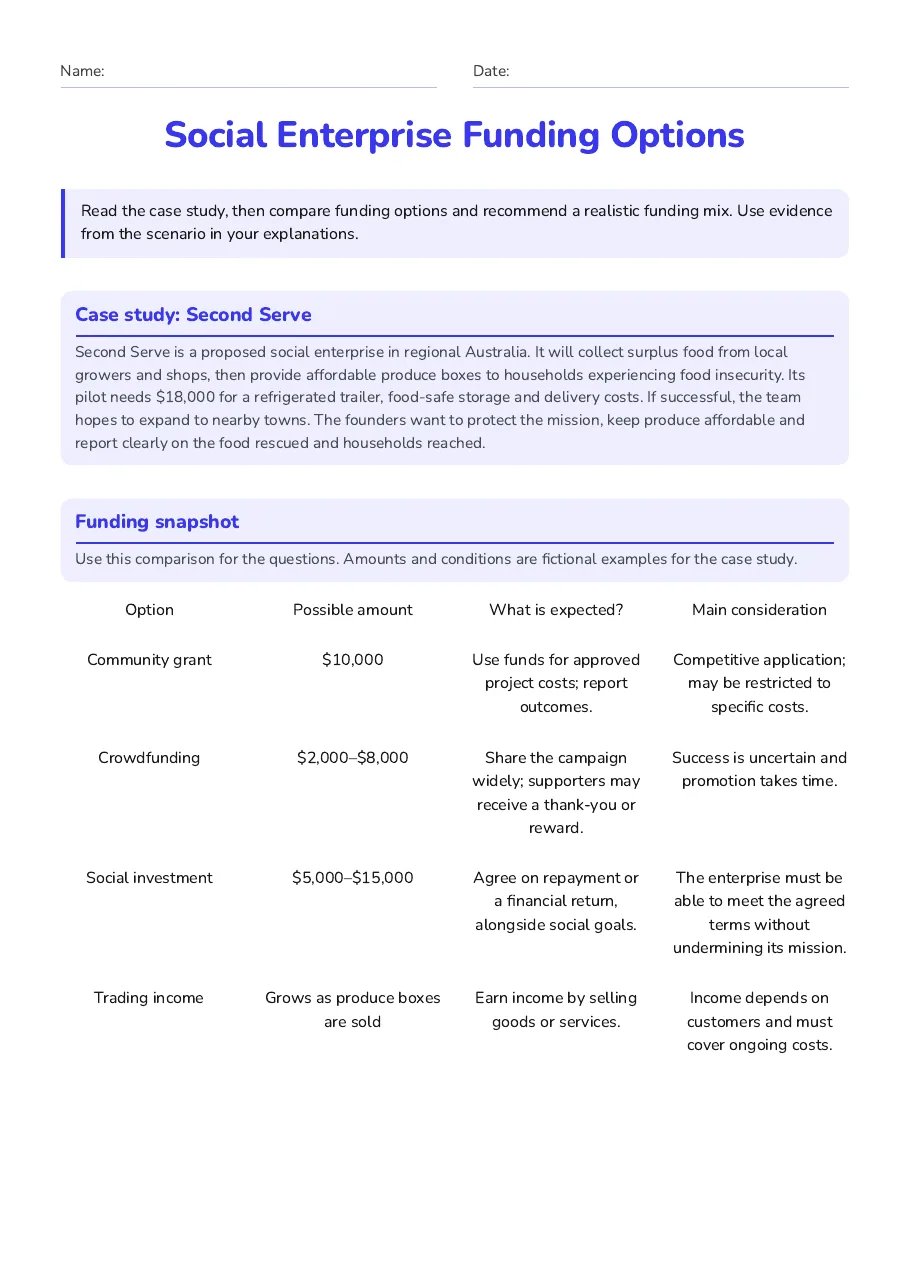
Case study: Second Serve
Second Serve is a proposed social enterprise in regional Australia. It will collect surplus food from local growers and shops, then provide affordable produce boxes to households experiencing food insecurity. Its pilot needs $18,000 for a refrigerated trailer, food-safe storage and delivery costs. If successful, the team hopes to expand to nearby towns. The founders want to protect the mission, keep produce affordable and report clearly on the food rescued and households reached.
Funding snapshot
Use this comparison for the questions. Amounts and conditions are fictional examples for the case study.
Option
Possible amount
What is expected?
Main consideration
Community grant
$10,000
Use funds for approved project costs; report outcomes.
Competitive application; may be restricted to specific costs.
Crowdfunding
$2,000–$8,000
Share the campaign widely; supporters may receive a thank-you or reward.
Success is uncertain and promotion takes time.
Social investment
$5,000–$15,000
Agree on repayment or a financial return, alongside social goals.
The enterprise must be able to meet the agreed terms without undermining its mission.
Trading income
Grows as produce boxes are sold
Earn income by selling goods or services.
Income depends on customers and must cover ongoing costs.
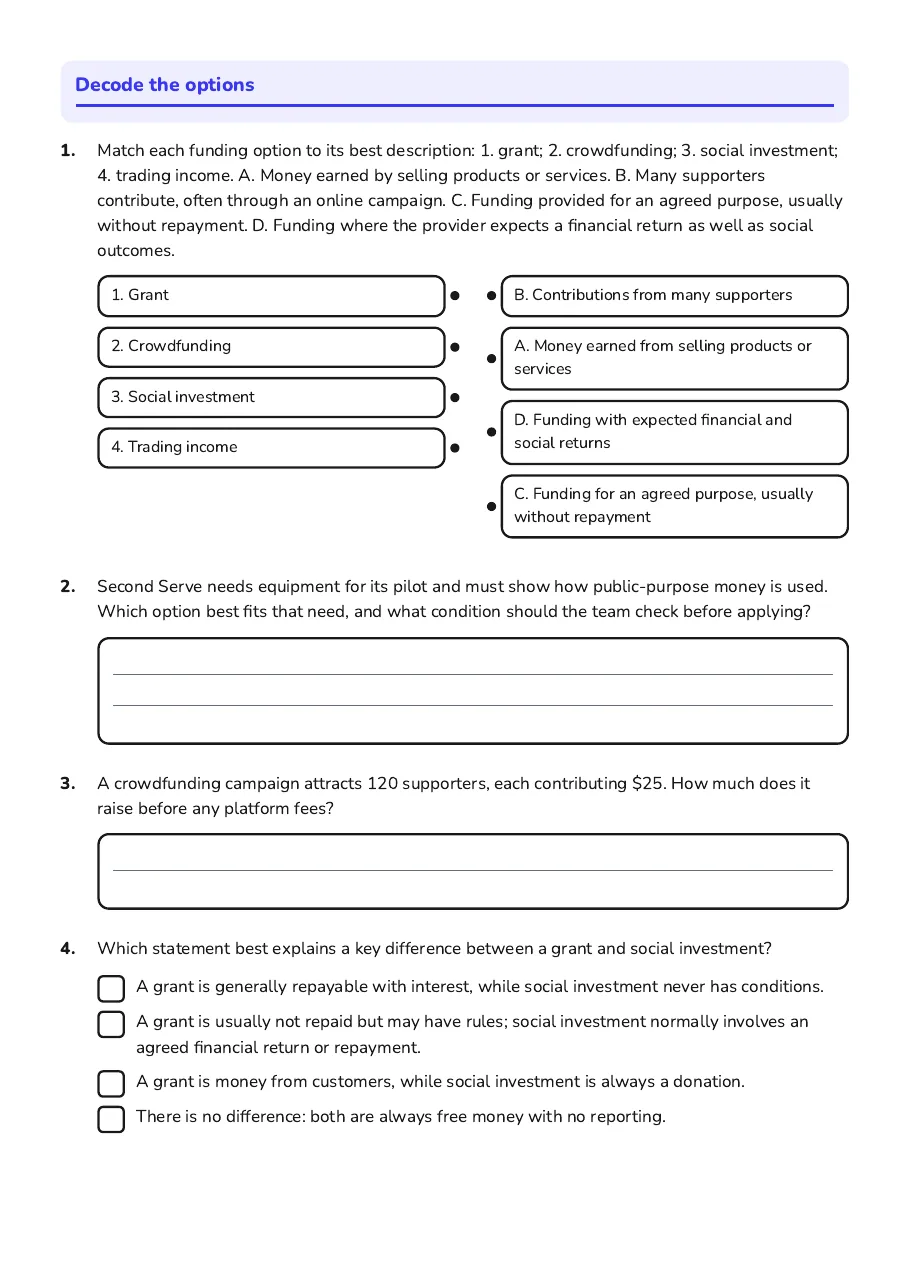
Decode the options
- 1. Grant
- 2. Crowdfunding
- 3. Social investment
- 4. Trading income
- B. Contributions from many supporters
- A. Money earned from selling products or services
- D. Funding with expected financial and social returns
- C. Funding for an agreed purpose, usually without repayment
- A grant is generally repayable with interest, while social investment never has conditions.
- A grant is usually not repaid but may have rules; social investment normally involves an agreed financial return or repayment.
- A grant is money from customers, while social investment is always a donation.
- There is no difference: both are always free money with no reporting.
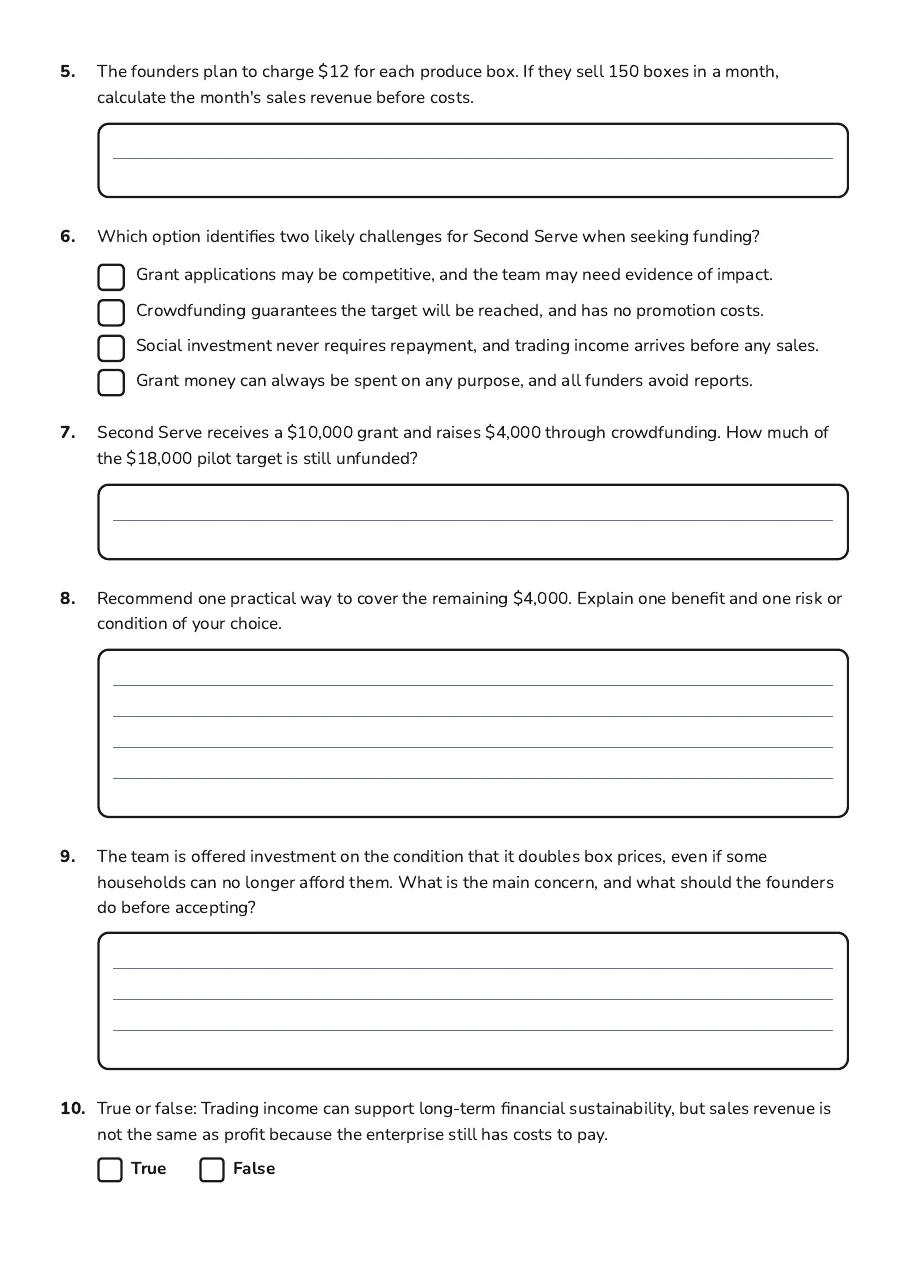
- Grant applications may be competitive, and the team may need evidence of impact.
- Crowdfunding guarantees the target will be reached, and has no promotion costs.
- Social investment never requires repayment, and trading income arrives before any sales.
- Grant money can always be spent on any purpose, and all funders avoid reports.
4 printable pages
Page 1
Page 2
Page 3

Page 4
About This Worksheet
Free in Kuraplan
Sign up free, grab the PDF, and customize it for your class.
Print-Ready
Formatted for standard paper. Clean layout, easy to read.
AI-Generated
Created with Kuraplan's AI, designed for real classroom use.
For Teachers & Parents
Use in classrooms, for homework, tutoring, or homeschool.
Need a custom version of this worksheet?
Kuraplan's AI generates custom worksheets in seconds — differentiated for every learner, aligned to your curriculum.
Generate Custom Worksheets — Free