Te Reo MāoriFreePrintable

Te Ao Māori Greetings

A free te reo māori worksheet ready for your classroom. Open in Kuraplan to grab the print-ready PDF, customize it for your students, or generate a fresh version in seconds.
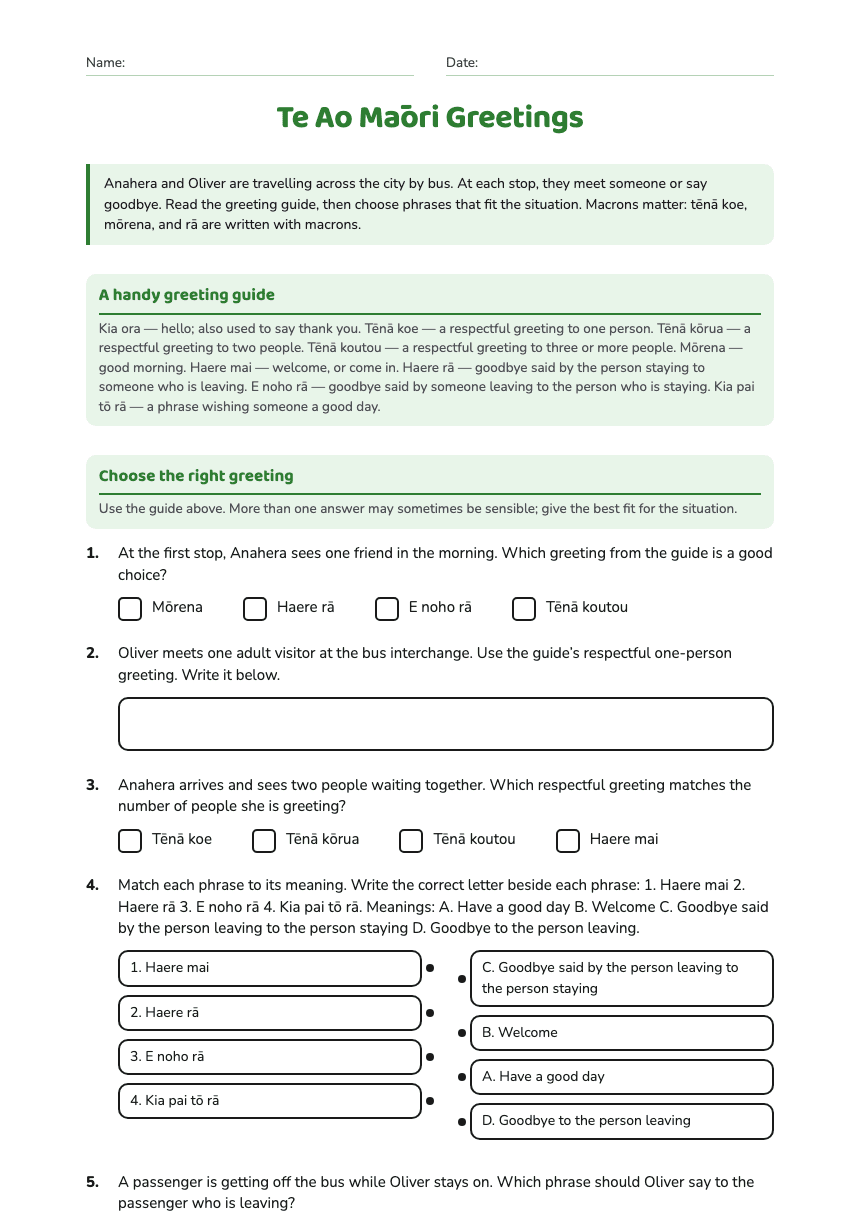
Te Ao Māori Greetings worksheet preview
Name:Date:

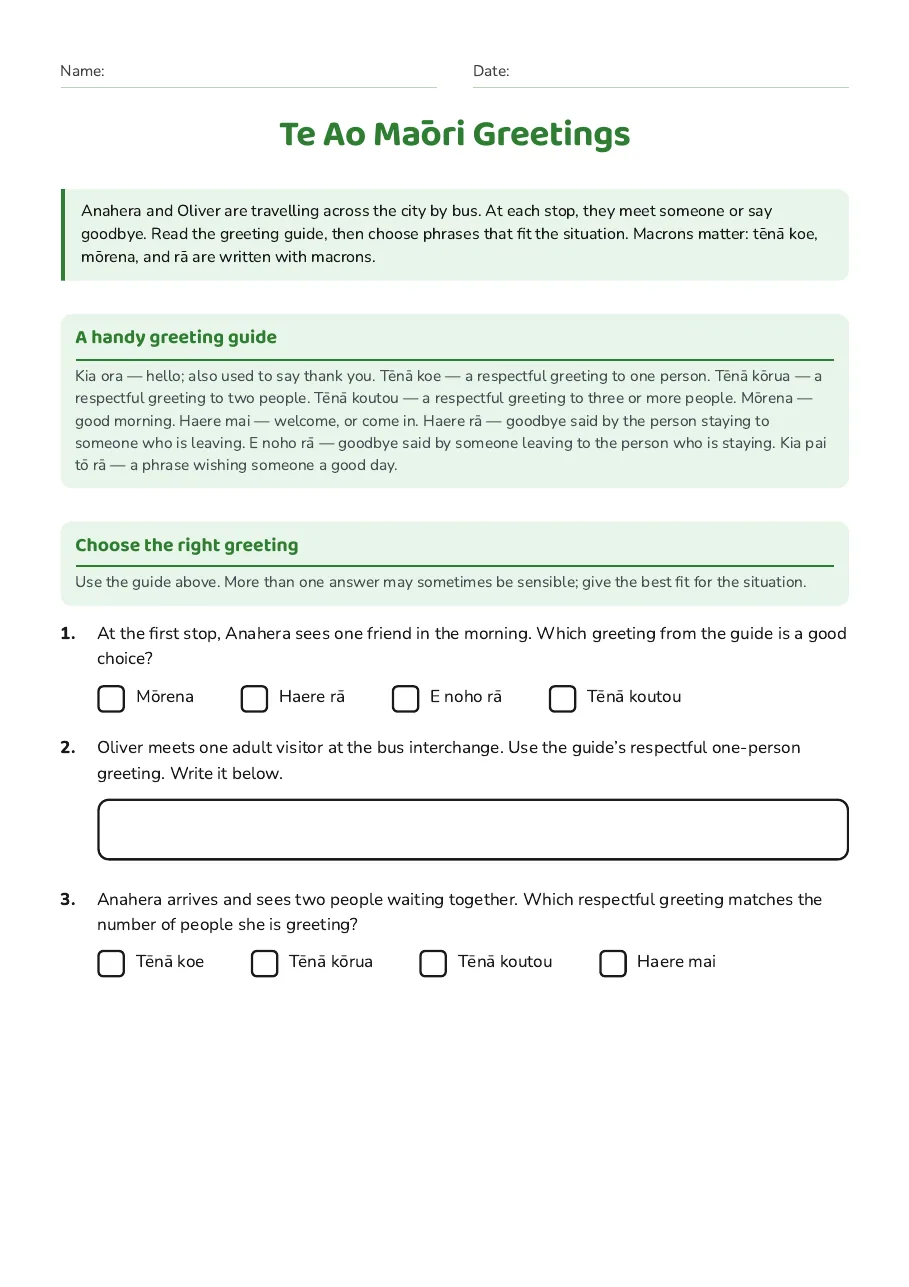
Te Ao Māori Greetings

Anahera and Oliver are travelling across the city by bus. At each stop, they meet someone or say goodbye. Read the greeting guide, then choose phrases that fit the situation. Macrons matter: tēnā koe, mōrena, and rā are written with macrons.

A handy greeting guide

Kia ora — hello; also used to say thank you. Tēnā koe — a respectful greeting to one person. Tēnā kōrua — a respectful greeting to two people. Tēnā koutou — a respectful greeting to three or more people. Mōrena — good morning. Haere mai — welcome, or come in. Haere rā — goodbye said by the person staying to someone who is leaving. E noho rā — goodbye said by someone leaving to the person who is staying. Kia pai tō rā — a phrase wishing someone a good day.

Choose the right greeting

Use the guide above. More than one answer may sometimes be sensible; give the best fit for the situation.

1.At the first stop, Anahera sees one friend in the morning. Which greeting from the guide is a good choice?
  • Mōrena
  • Haere rā
  • E noho rā
  • Tēnā koutou
2.Oliver meets one adult visitor at the bus interchange. Use the guide’s respectful one-person greeting. Write it below.
3.Anahera arrives and sees two people waiting together. Which respectful greeting matches the number of people she is greeting?
  • Tēnā koe
  • Tēnā kōrua
  • Tēnā koutou
  • Haere mai
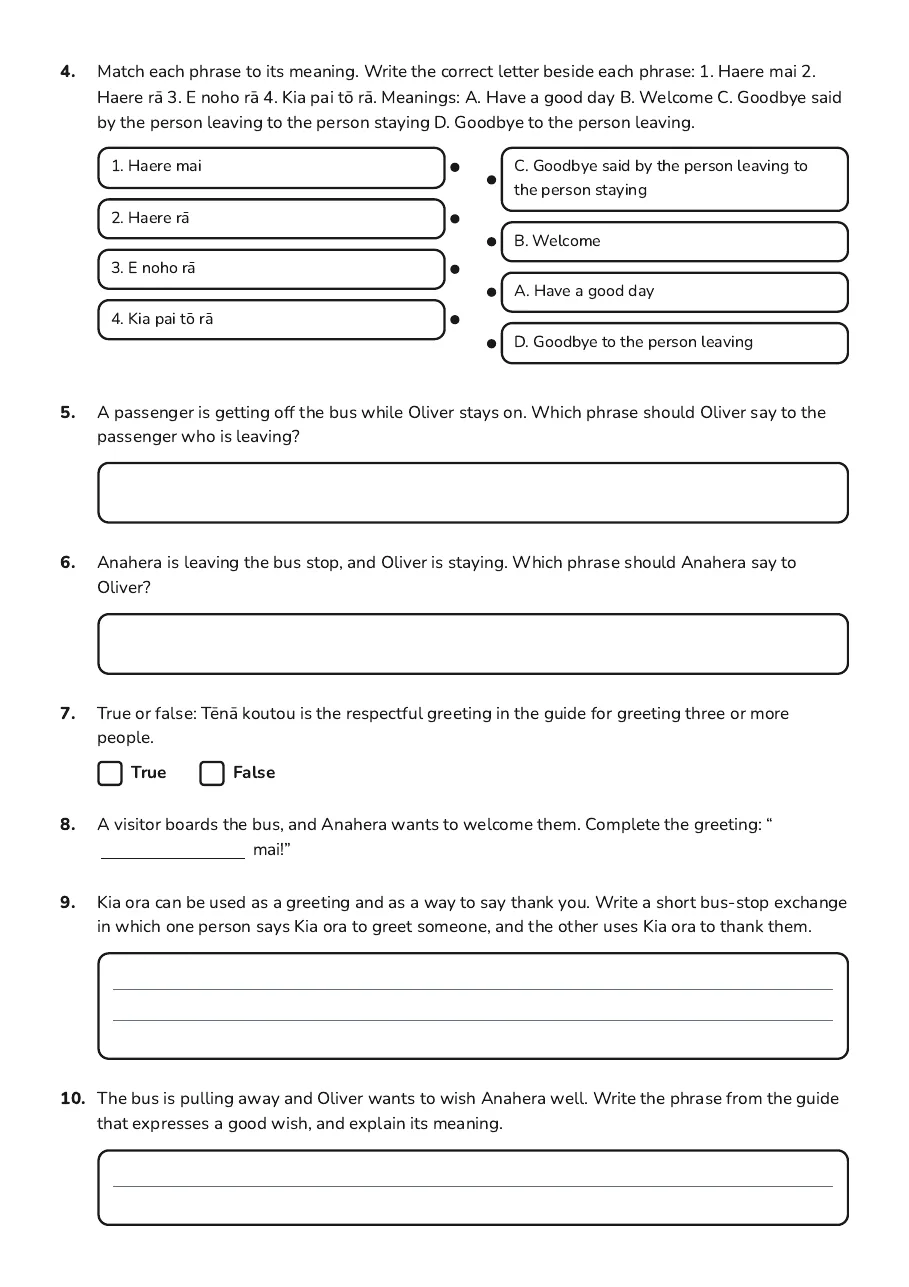
4.Match each phrase to its meaning. Write the correct letter beside each phrase: 1. Haere mai 2. Haere rā 3. E noho rā 4. Kia pai tō rā. Meanings: A. Have a good day B. Welcome C. Goodbye said by the person leaving to the person staying D. Goodbye to the person leaving.
  • 1. Haere mai
  • 2. Haere rā
  • 3. E noho rā
  • 4. Kia pai tō rā
  • C. Goodbye said by the person leaving to the person staying
  • B. Welcome
  • A. Have a good day
  • D. Goodbye to the person leaving
5.A passenger is getting off the bus while Oliver stays on. Which phrase should Oliver say to the passenger who is leaving?
6.Anahera is leaving the bus stop, and Oliver is staying. Which phrase should Anahera say to Oliver?
7.True or false: Tēnā koutou is the respectful greeting in the guide for greeting three or more people.
TrueFalse
8.A visitor boards the bus, and Anahera wants to welcome them. Complete the greeting: “ mai!”
9.Kia ora can be used as a greeting and as a way to say thank you. Write a short bus-stop exchange in which one person says Kia ora to greet someone, and the other uses Kia ora to thank them.
10.The bus is pulling away and Oliver wants to wish Anahera well. Write the phrase from the guide that expresses a good wish, and explain its meaning.
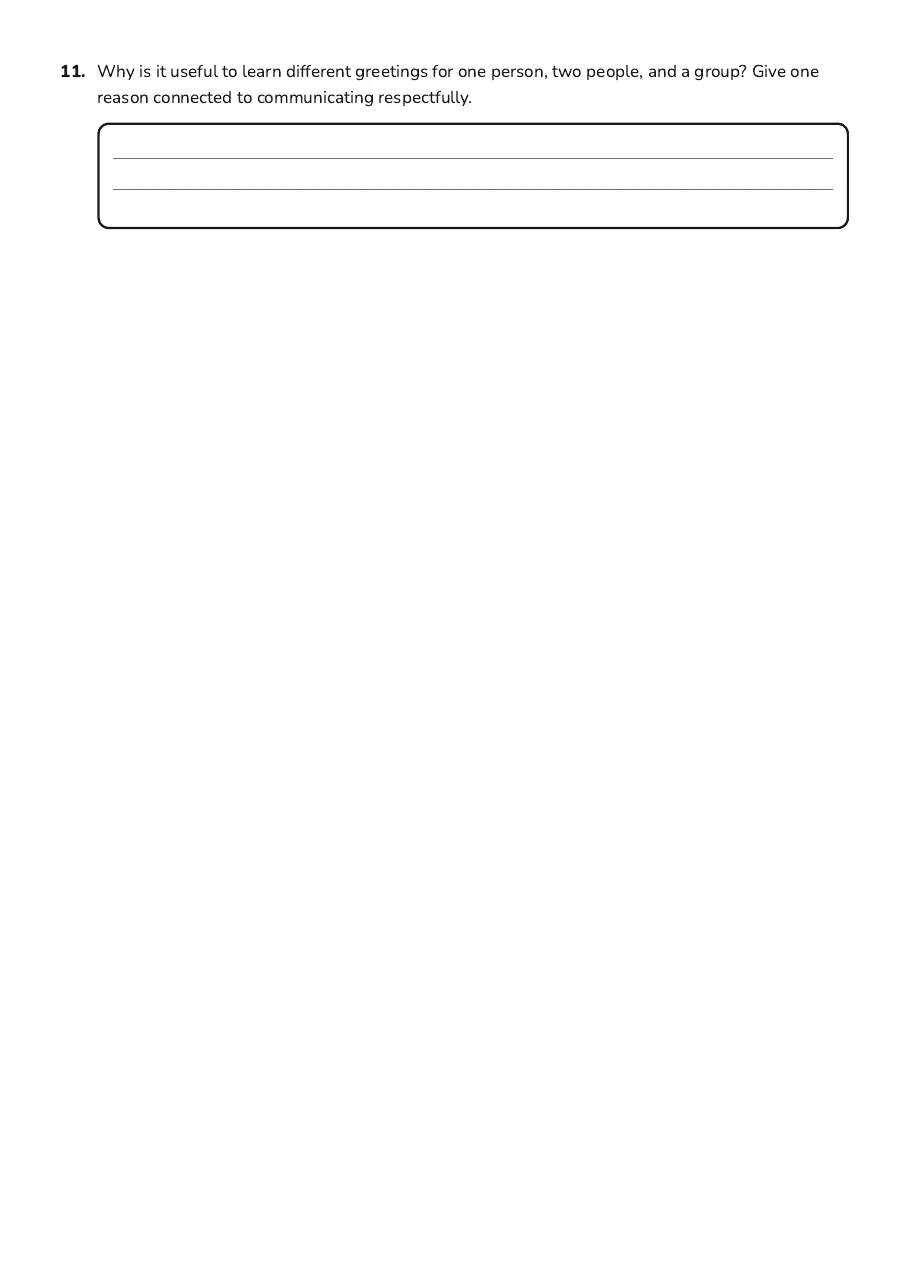
11.Why is it useful to learn different greetings for one person, two people, and a group? Give one reason connected to communicating respectfully.

3 printable pages

  • Te Ao Māori Greetings, page 1 of 3: A handy greeting guide, Choose the right greeting

    Page 1

  • Te Ao Māori Greetings, page 2 of 3: 4. Match each phrase to its meaning. Write the correct letter beside each phrase: 1.…

    Page 2

  • Te Ao Māori Greetings, page 3 of 3: 11. Why is it useful to learn different greetings for one person, two people, and a…

    Page 3

About This Worksheet

Free in Kuraplan

Sign up free, grab the PDF, and customize it for your class.

Print-Ready

Formatted for standard paper. Clean layout, easy to read.

AI-Generated

Created with Kuraplan's AI, designed for real classroom use.

For Teachers & Parents

Use in classrooms, for homework, tutoring, or homeschool.

Need a custom version of this worksheet?

Kuraplan's AI generates custom worksheets in seconds — differentiated for every learner, aligned to your curriculum.

Generate Custom Worksheets — Free
No credit card Curriculum-aligned Under 60 seconds

Explore more free resources