Te Reo MāoriFreePrintable

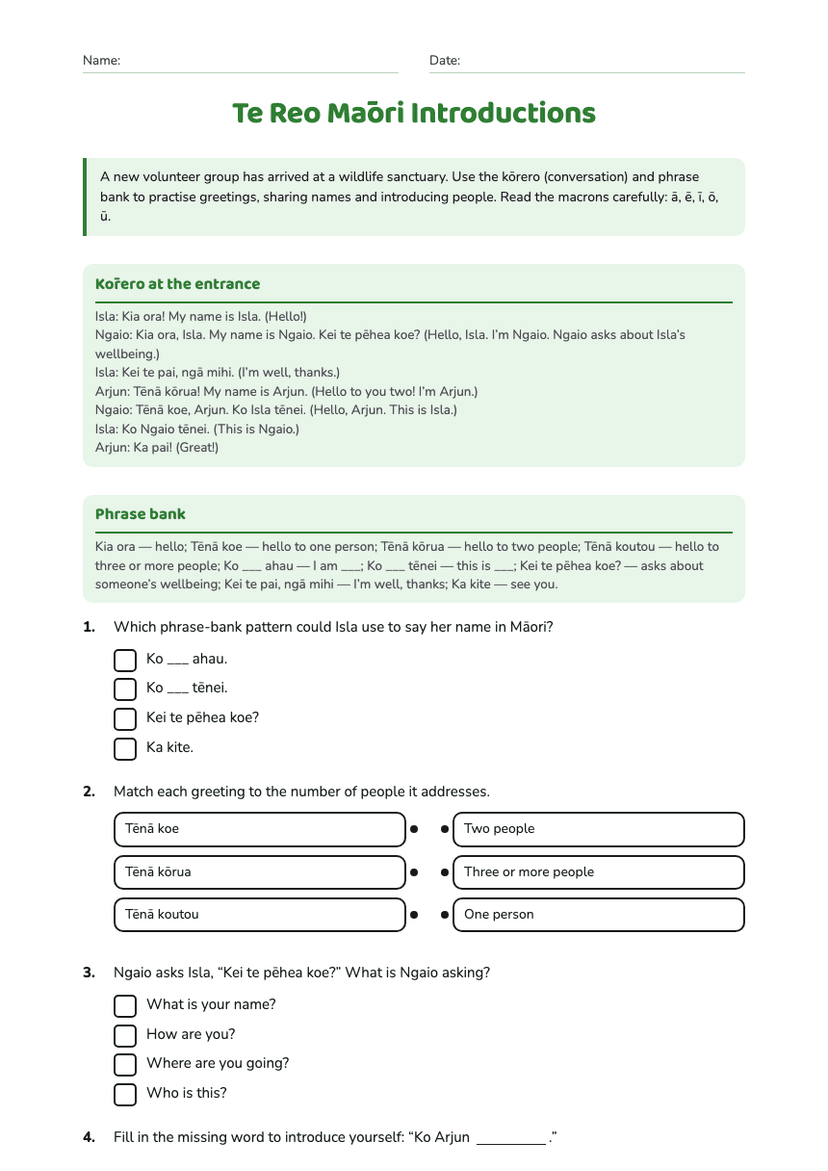
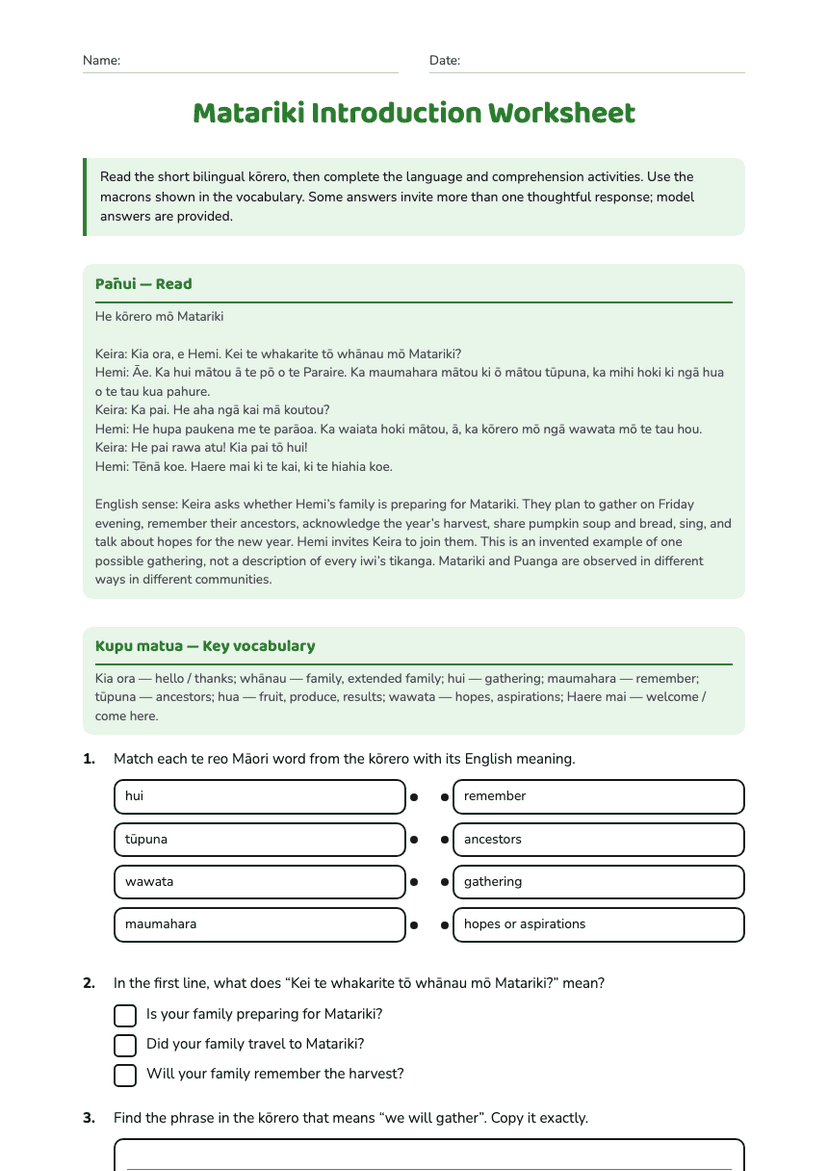
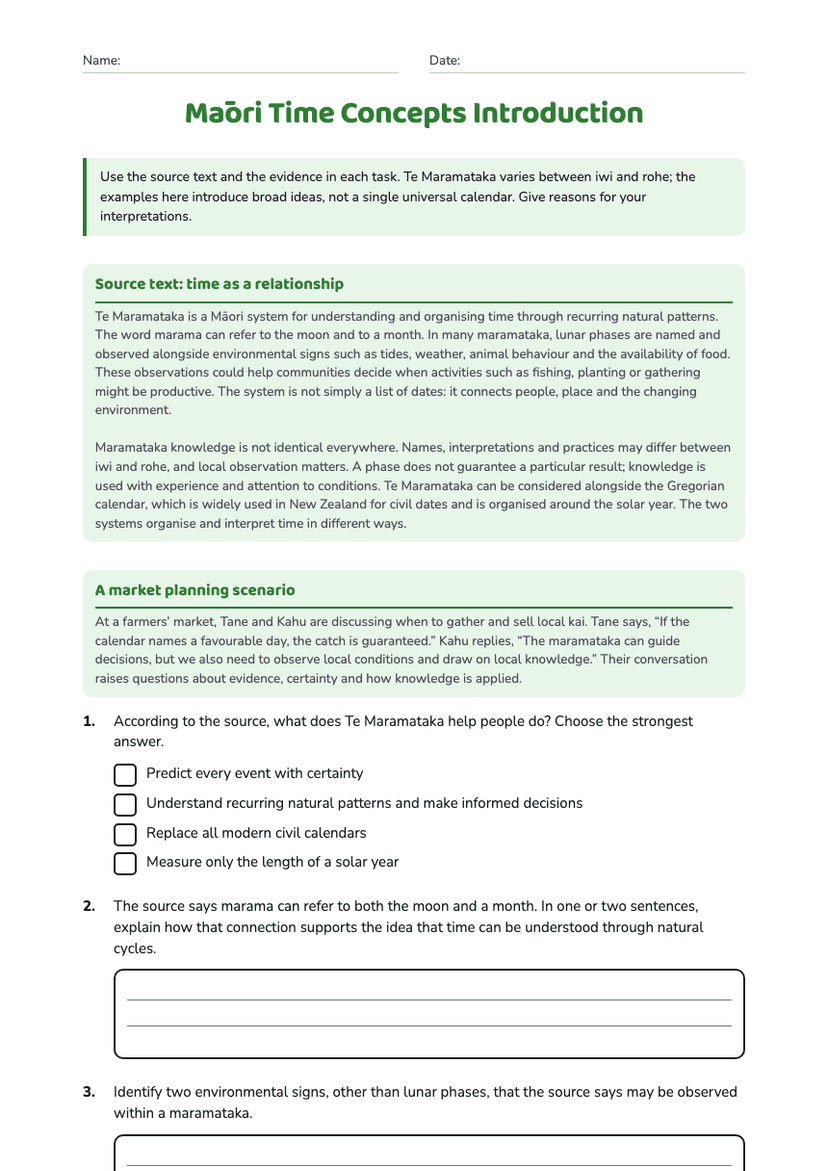
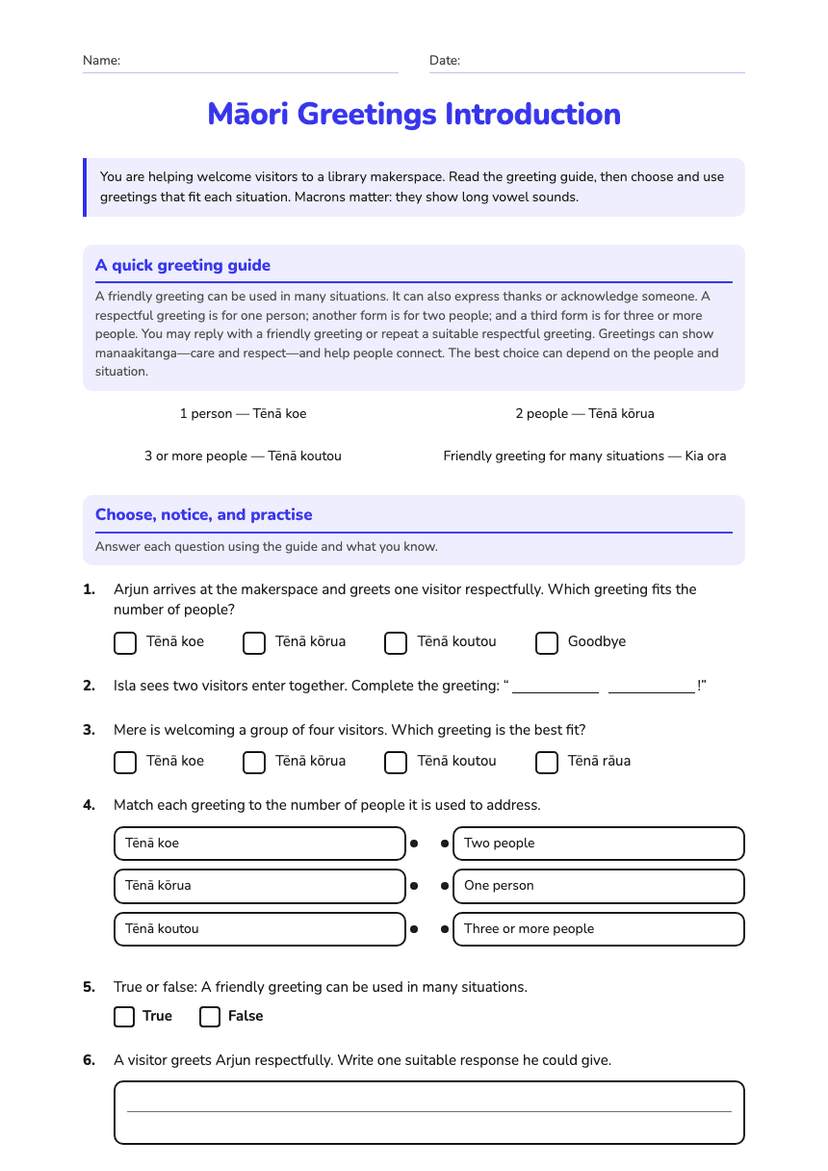
Te Reo Māori Introductions

A free te reo māori worksheet ready for your classroom. Open in Kuraplan to grab the print-ready PDF, customize it for your students, or generate a fresh version in seconds.
Te Reo Māori Introductions worksheet preview
Name:Date:

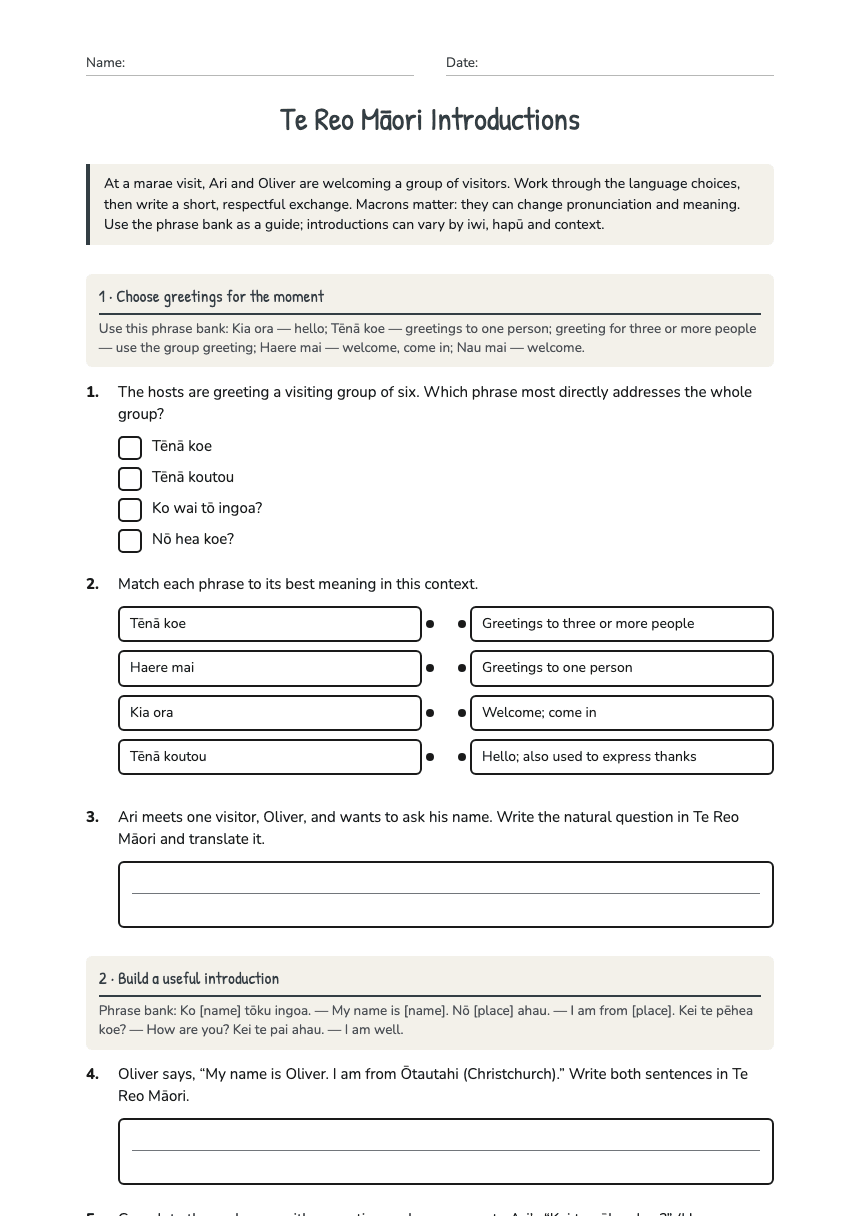
Te Reo Māori Introductions

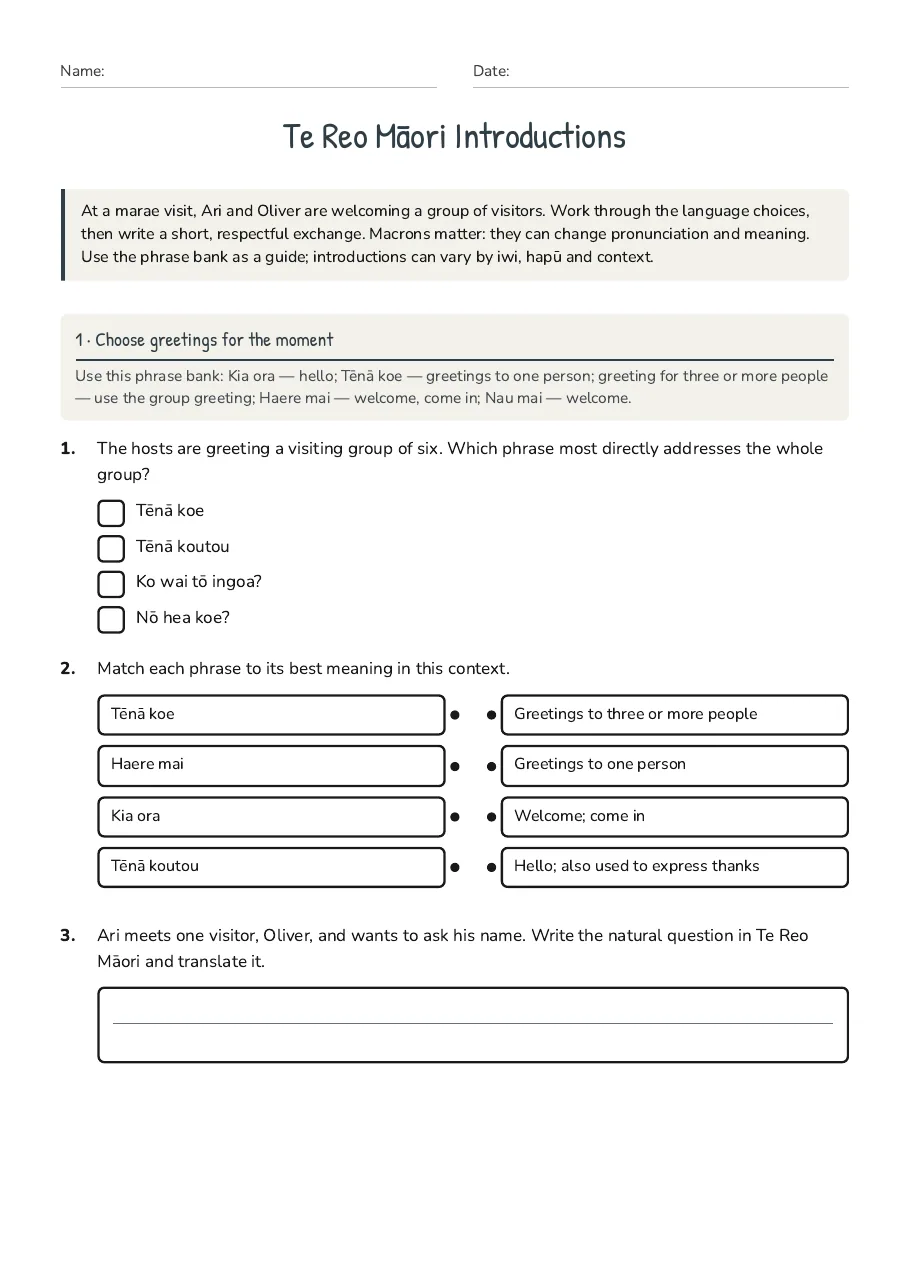
At a marae visit, Ari and Oliver are welcoming a group of visitors. Work through the language choices, then write a short, respectful exchange. Macrons matter: they can change pronunciation and meaning. Use the phrase bank as a guide; introductions can vary by iwi, hapū and context.

1 · Choose greetings for the moment

Use this phrase bank: Kia ora — hello; Tēnā koe — greetings to one person; greeting for three or more people — use the group greeting; Haere mai — welcome, come in; Nau mai — welcome.

1.The hosts are greeting a visiting group of six. Which phrase most directly addresses the whole group?
  • Tēnā koe
  • Tēnā koutou
  • Ko wai tō ingoa?
  • Nō hea koe?
2.Match each phrase to its best meaning in this context.
  • Tēnā koe
  • Haere mai
  • Kia ora
  • Tēnā koutou
  • Greetings to three or more people
  • Greetings to one person
  • Welcome; come in
  • Hello; also used to express thanks
3.Ari meets one visitor, Oliver, and wants to ask his name. Write the natural question in Te Reo Māori and translate it.

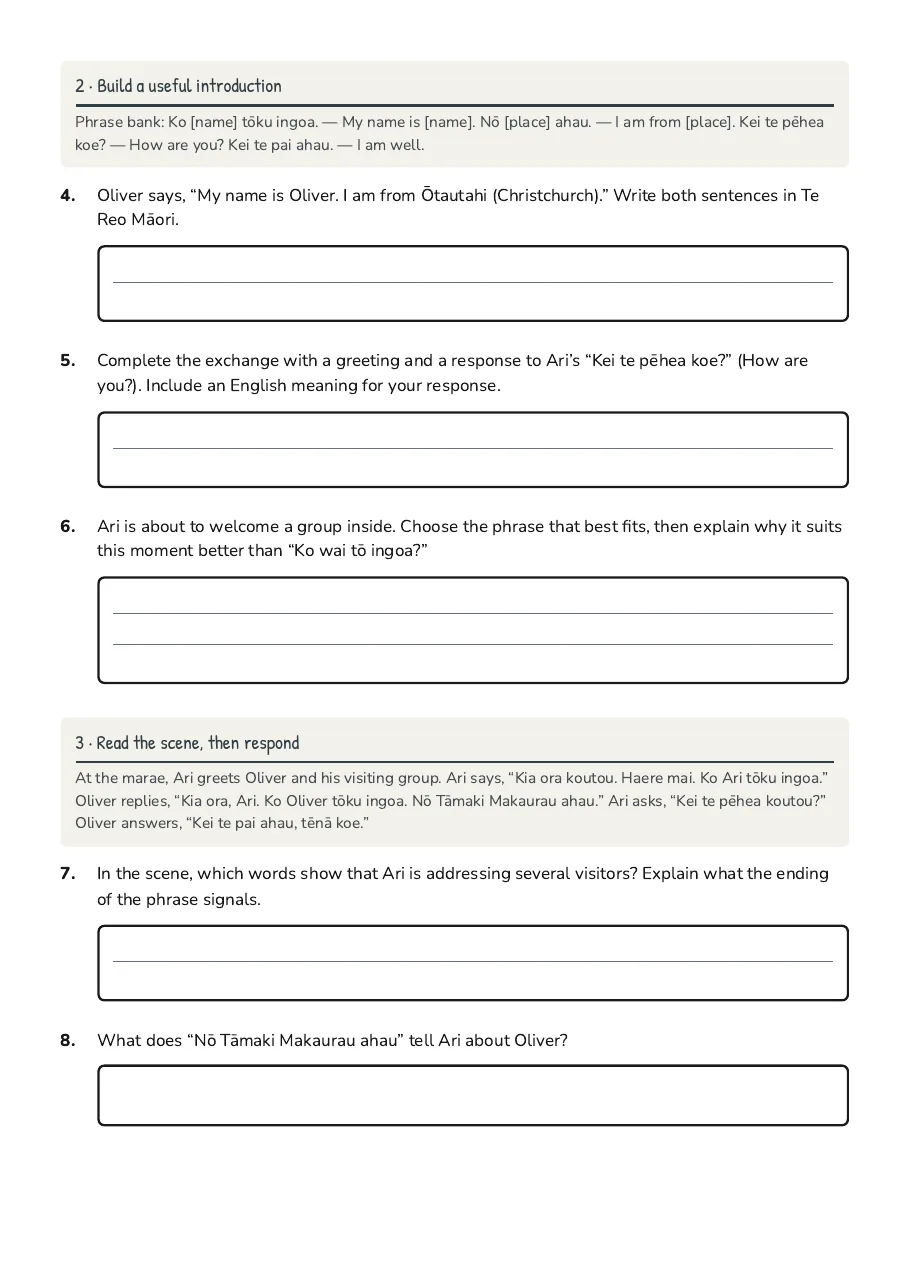
2 · Build a useful introduction

Phrase bank: Ko [name] tōku ingoa. — My name is [name]. Nō [place] ahau. — I am from [place]. Kei te pēhea koe? — How are you? Kei te pai ahau. — I am well.

4.Oliver says, “My name is Oliver. I am from Ōtautahi (Christchurch).” Write both sentences in Te Reo Māori.
5.Complete the exchange with a greeting and a response to Ari’s “Kei te pēhea koe?” (How are you?). Include an English meaning for your response.
6.Ari is about to welcome a group inside. Choose the phrase that best fits, then explain why it suits this moment better than “Ko wai tō ingoa?”

3 · Read the scene, then respond

At the marae, Ari greets Oliver and his visiting group. Ari says, “Kia ora koutou. Haere mai. Ko Ari tōku ingoa.” Oliver replies, “Kia ora, Ari. Ko Oliver tōku ingoa. Nō Tāmaki Makaurau ahau.” Ari asks, “Kei te pēhea koutou?” Oliver answers, “Kei te pai ahau, tēnā koe.”

7.In the scene, which words show that Ari is addressing several visitors? Explain what the ending of the phrase signals.
8.What does “Nō Tāmaki Makaurau ahau” tell Ari about Oliver?
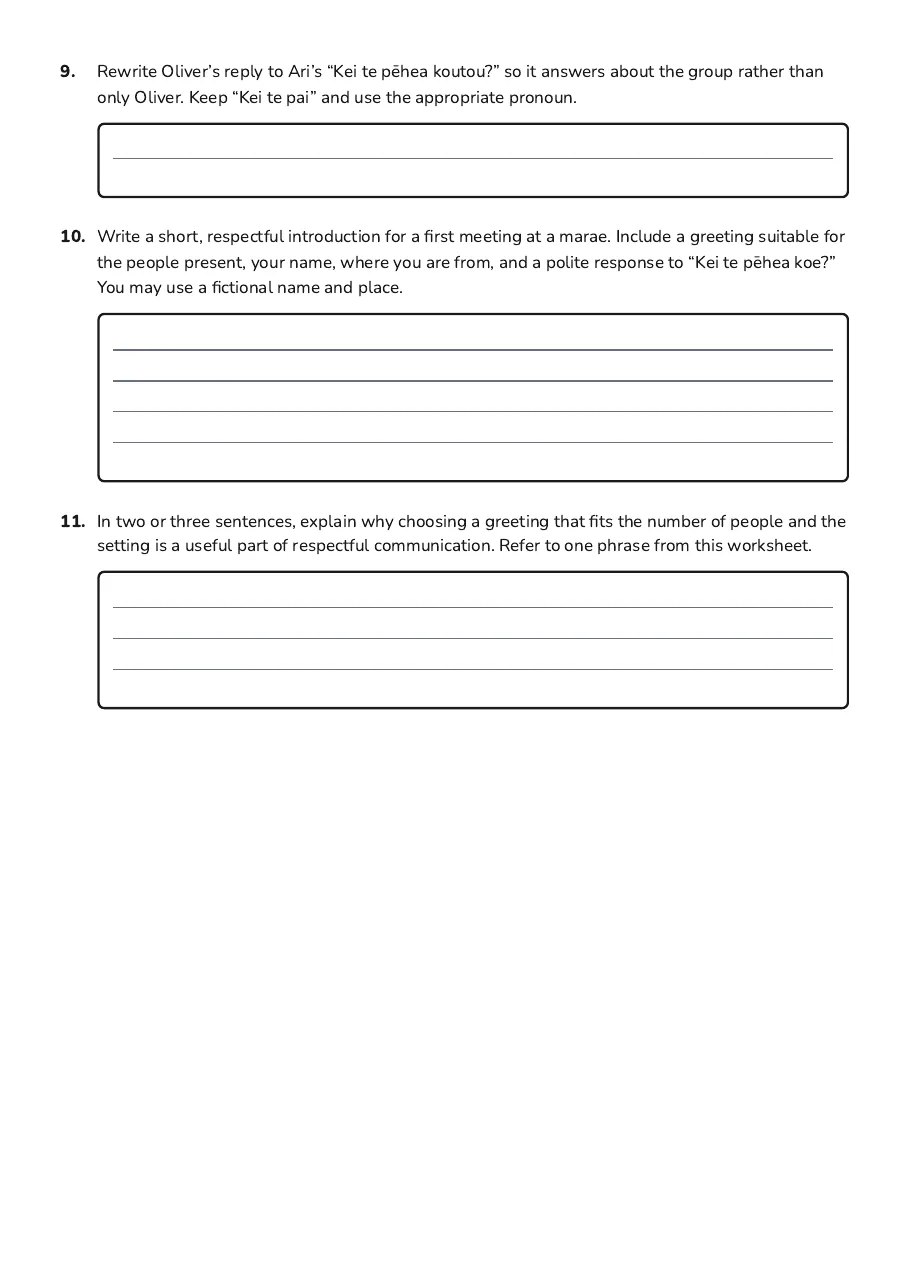
9.Rewrite Oliver’s reply to Ari’s “Kei te pēhea koutou?” so it answers about the group rather than only Oliver. Keep “Kei te pai” and use the appropriate pronoun.
10.Write a short, respectful introduction for a first meeting at a marae. Include a greeting suitable for the people present, your name, where you are from, and a polite response to “Kei te pēhea koe?” You may use a fictional name and place.
11.In two or three sentences, explain why choosing a greeting that fits the number of people and the setting is a useful part of respectful communication. Refer to one phrase from this worksheet.

3 printable pages

  • Te Reo Māori Introductions, page 1 of 3: 1 · Choose greetings for the moment

    Page 1

  • Te Reo Māori Introductions, page 2 of 3: 2 · Build a useful introduction, 3 · Read the scene, then respond

    Page 2

  • Te Reo Māori Introductions, page 3 of 3: 9. Rewrite Oliver’s reply to Ari’s “Kei te pē hea koutou?” so it answers about the group…

    Page 3

About This Worksheet

Free in Kuraplan

Sign up free, grab the PDF, and customize it for your class.

Print-Ready

Formatted for standard paper. Clean layout, easy to read.

AI-Generated

Created with Kuraplan's AI, designed for real classroom use.

For Teachers & Parents

Use in classrooms, for homework, tutoring, or homeschool.

Need a custom version of this worksheet?

Kuraplan's AI generates custom worksheets in seconds — differentiated for every learner, aligned to your curriculum.

Generate Custom Worksheets — Free
No credit card Curriculum-aligned Under 60 seconds

Explore more free resources