MathsFreePrintable
Tessellation Pattern Exploration
A free maths worksheet ready for your classroom. Open in Kuraplan to grab the print-ready PDF, customize it for your students, or generate a fresh version in seconds.
Name:Date:
Tessellation Pattern Exploration
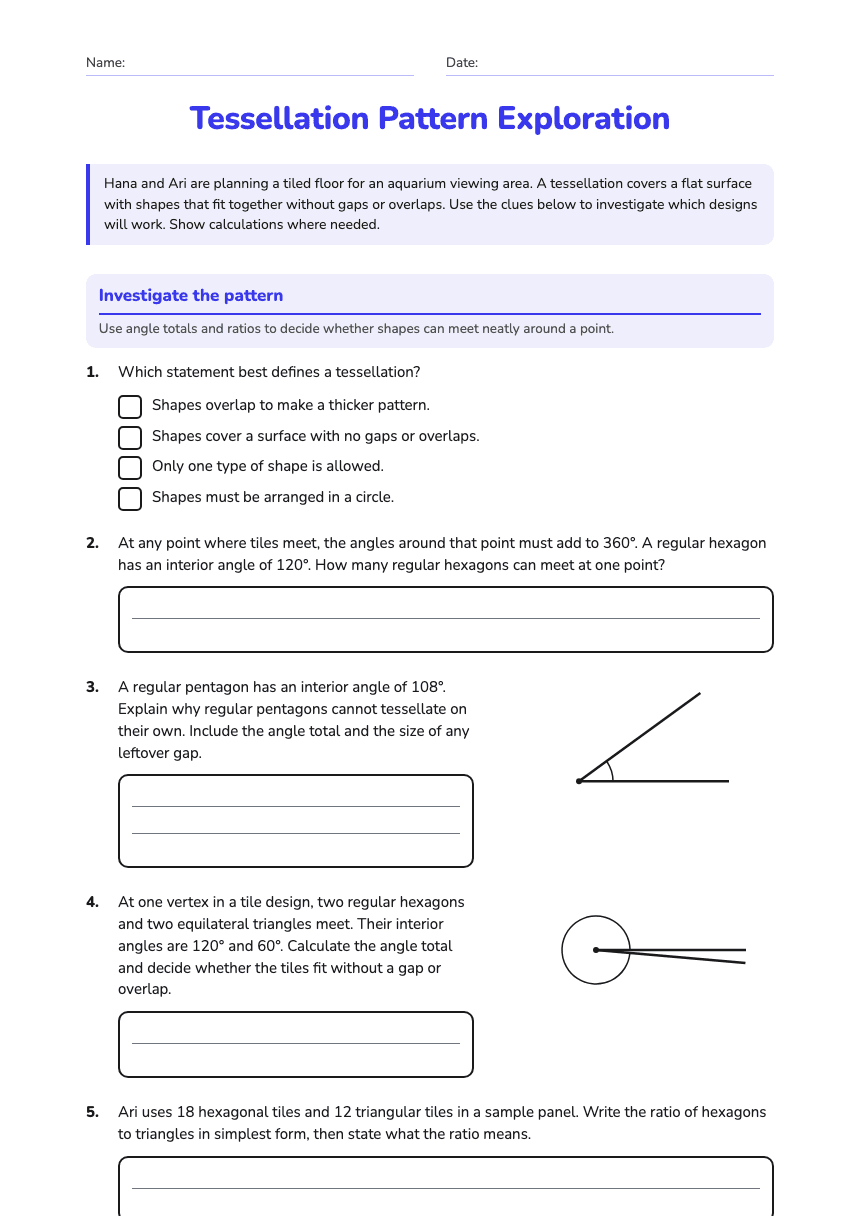
Hana and Ari are planning a tiled floor for an aquarium viewing area. A tessellation covers a flat surface with shapes that fit together without gaps or overlaps. Use the clues below to investigate which designs will work. Show calculations where needed.
Investigate the pattern
Use angle totals and ratios to decide whether shapes can meet neatly around a point.
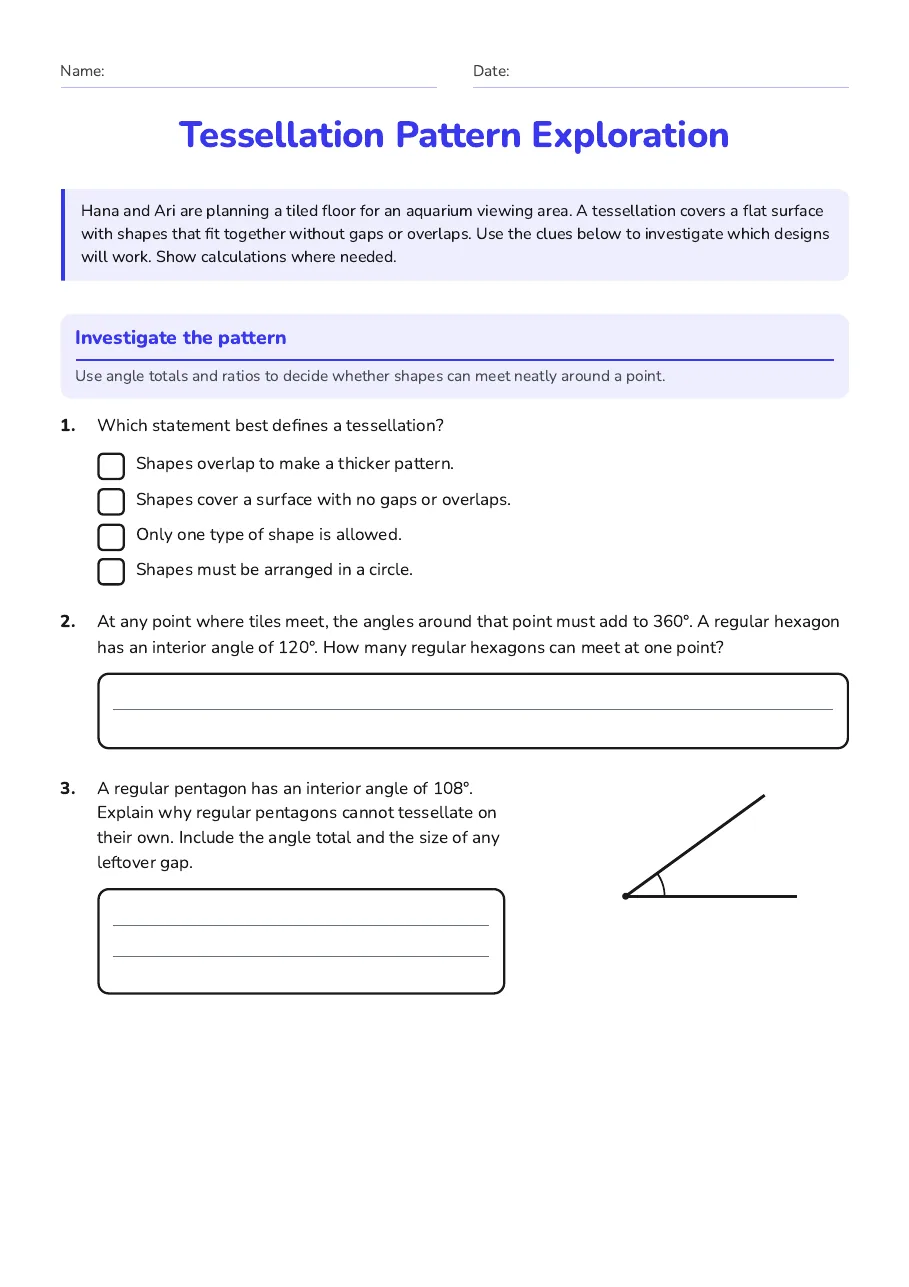
1.Which statement best defines a tessellation?
- Shapes overlap to make a thicker pattern.
- Shapes cover a surface with no gaps or overlaps.
- Only one type of shape is allowed.
- Shapes must be arranged in a circle.
2.At any point where tiles meet, the angles around that point must add to 360°. A regular hexagon has an interior angle of 120°. How many regular hexagons can meet at one point?
3.A regular pentagon has an interior angle of 108°. Explain why regular pentagons cannot tessellate on their own. Include the angle total and the size of any leftover gap.
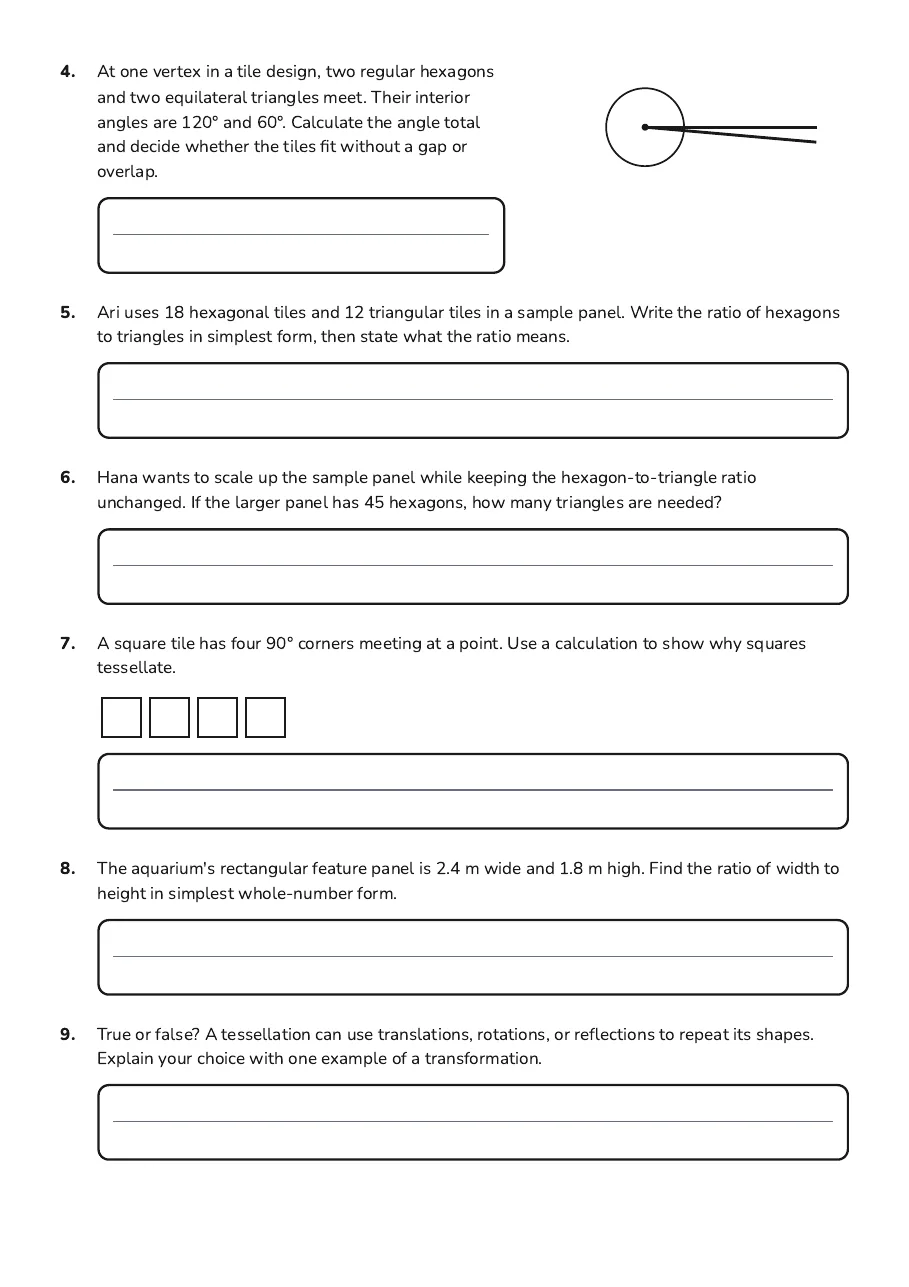
4.At one vertex in a tile design, two regular hexagons and two equilateral triangles meet. Their interior angles are 120° and 60°. Calculate the angle total and decide whether the tiles fit without a gap or overlap.
5.Ari uses 18 hexagonal tiles and 12 triangular tiles in a sample panel. Write the ratio of hexagons to triangles in simplest form, then state what the ratio means.
6.Hana wants to scale up the sample panel while keeping the hexagon-to-triangle ratio unchanged. If the larger panel has 45 hexagons, how many triangles are needed?
7.A square tile has four 90° corners meeting at a point. Use a calculation to show why squares tessellate.
8.The aquarium's rectangular feature panel is 2.4 m wide and 1.8 m high. Find the ratio of width to height in simplest whole-number form.
9.True or false? A tessellation can use translations, rotations, or reflections to repeat its shapes. Explain your choice with one example of a transformation.
10.Design a small tessellation using at least two different shapes. Sketch at least 8 tiles, mark one point where the shapes meet, and write the angle calculation that shows the tiles fit there. Label one transformation used to repeat the pattern.
3 printable pages
Page 1
Page 2
Page 3
About This Worksheet
Free in Kuraplan
Sign up free, grab the PDF, and customize it for your class.
Print-Ready
Formatted for standard paper. Clean layout, easy to read.
AI-Generated
Created with Kuraplan's AI, designed for real classroom use.
For Teachers & Parents
Use in classrooms, for homework, tutoring, or homeschool.
Need a custom version of this worksheet?
Kuraplan's AI generates custom worksheets in seconds — differentiated for every learner, aligned to your curriculum.
Generate Custom Worksheets — Free No credit card Curriculum-aligned Under 60 seconds
More Maths Worksheets
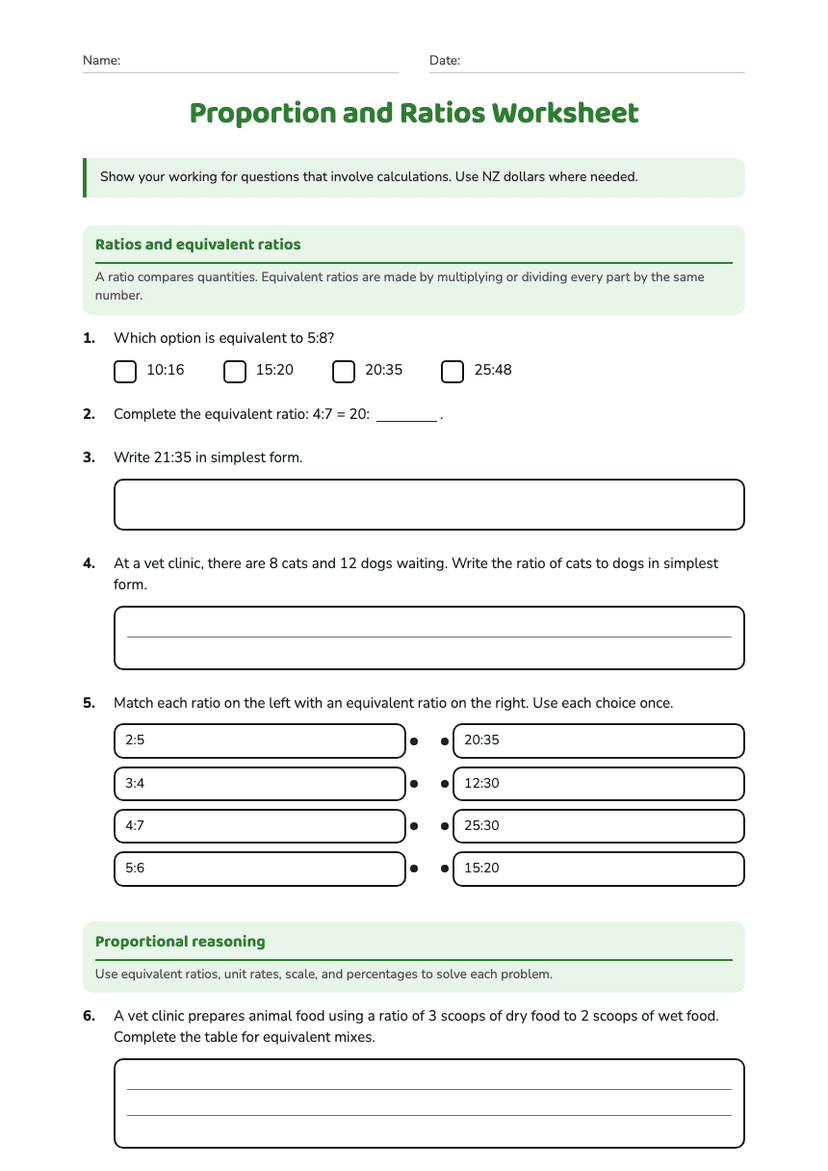
Year 7
Proportion and Ratios Worksheet
Free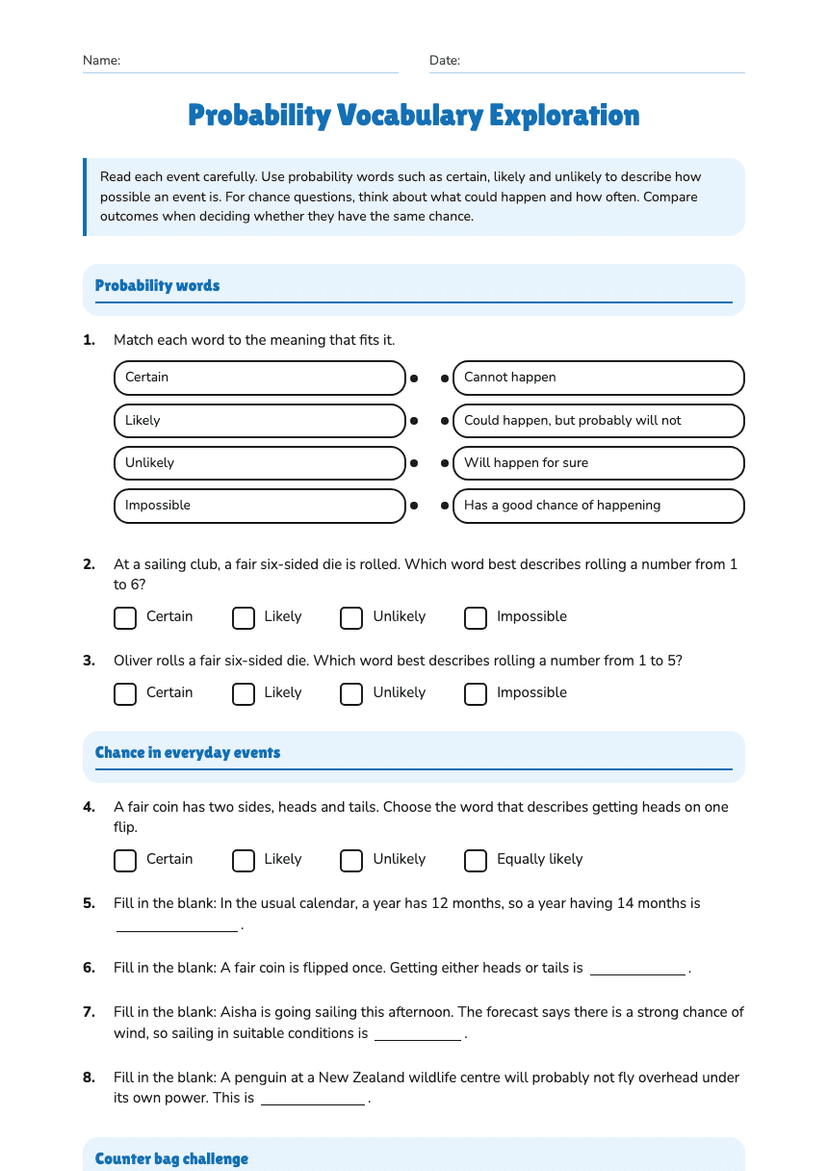
Year 4
Probability Vocabulary Exploration
Free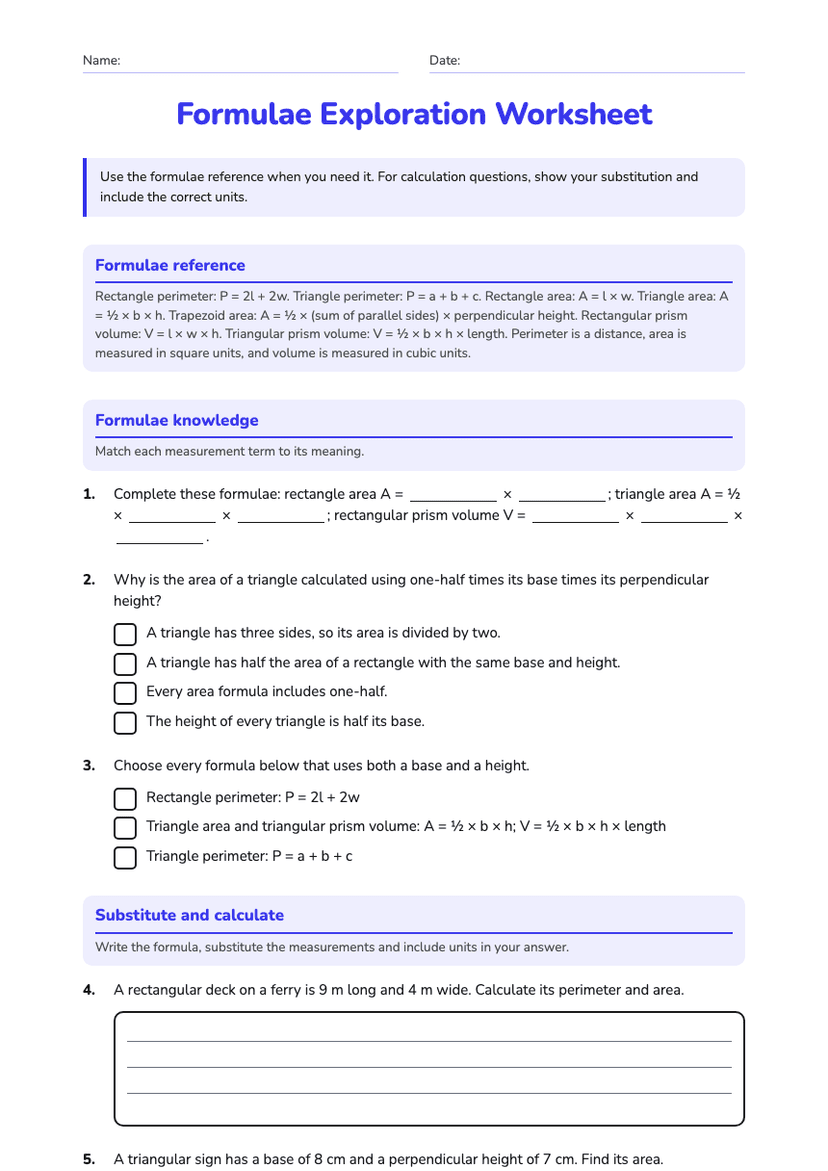
Year 8
Formulae Exploration Worksheet
Free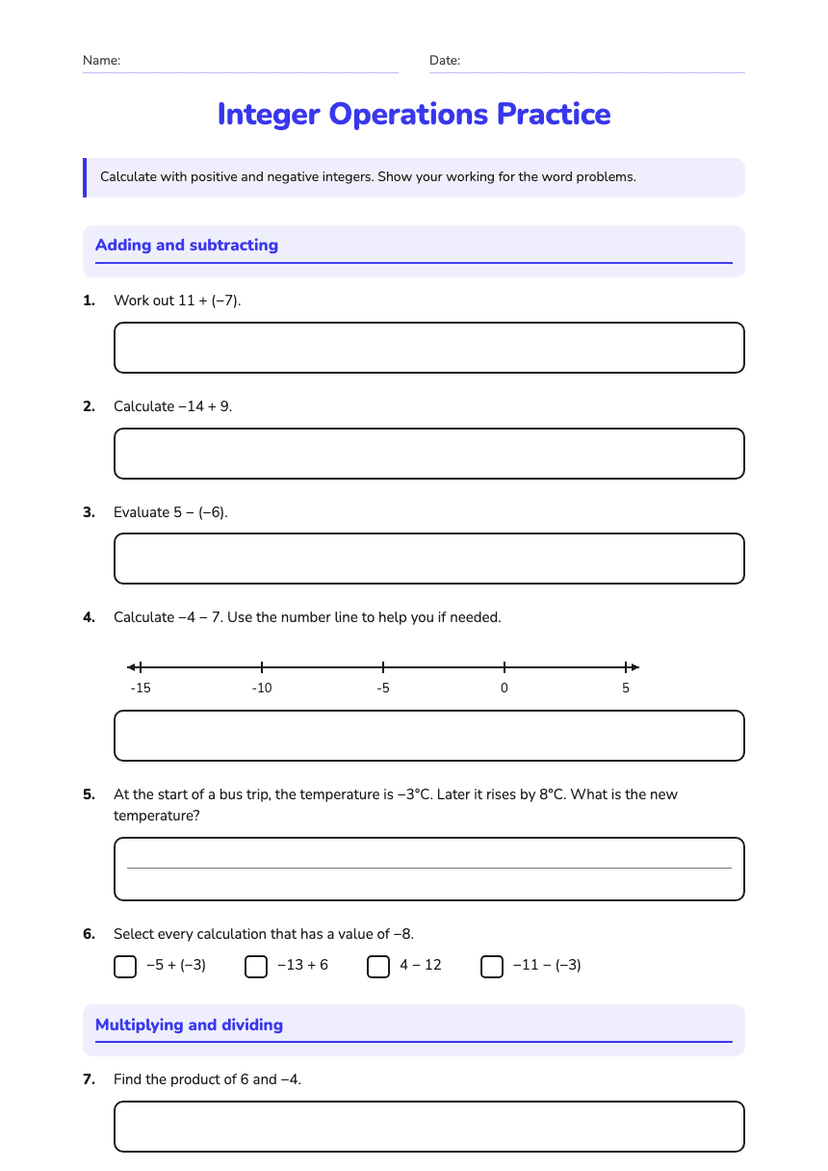
Year 9
Integer Operations Practice
Free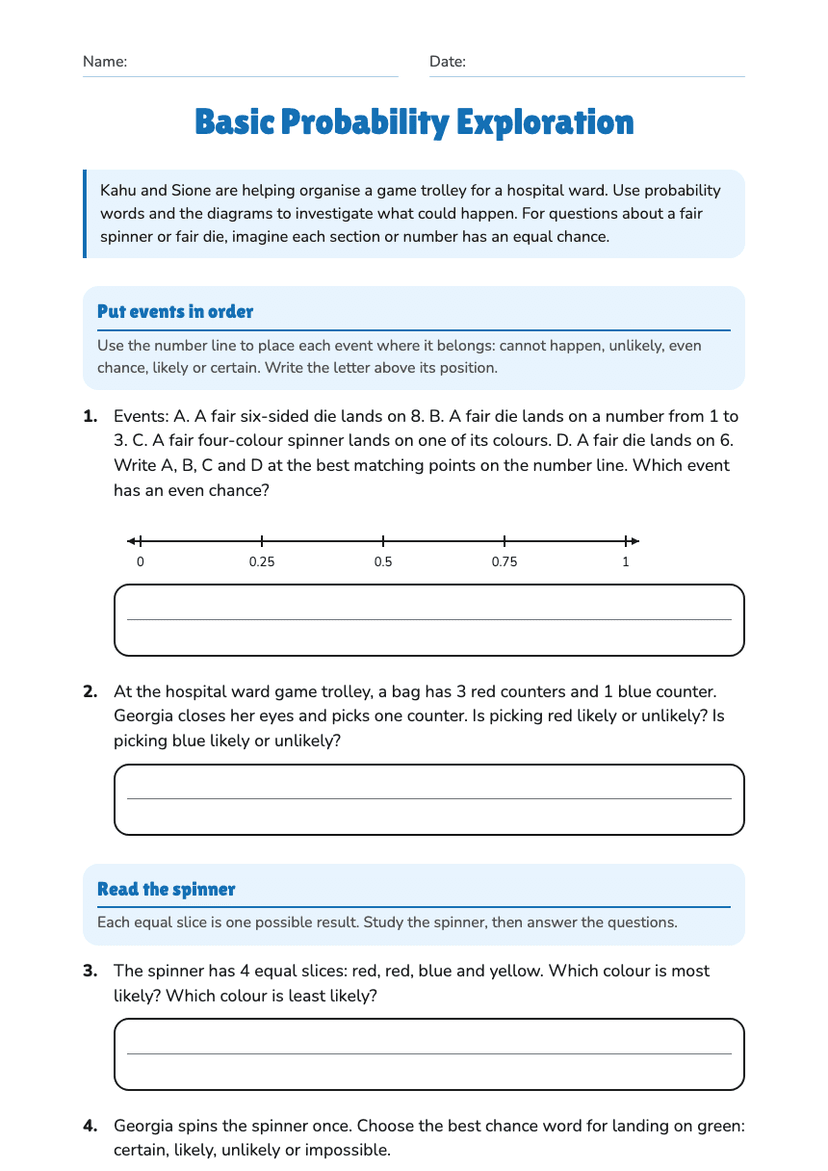
Year 3–4
Basic Probability Exploration
Free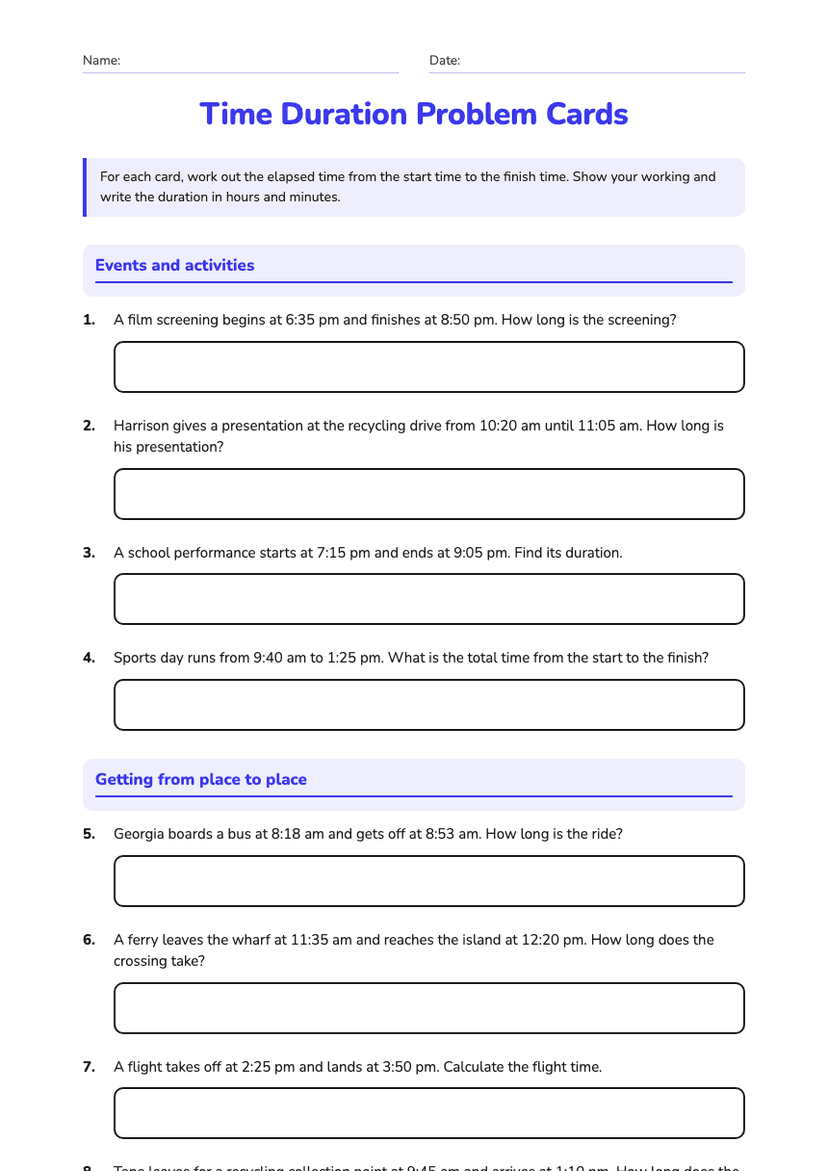
Year 7
Time Duration Problem Cards
Free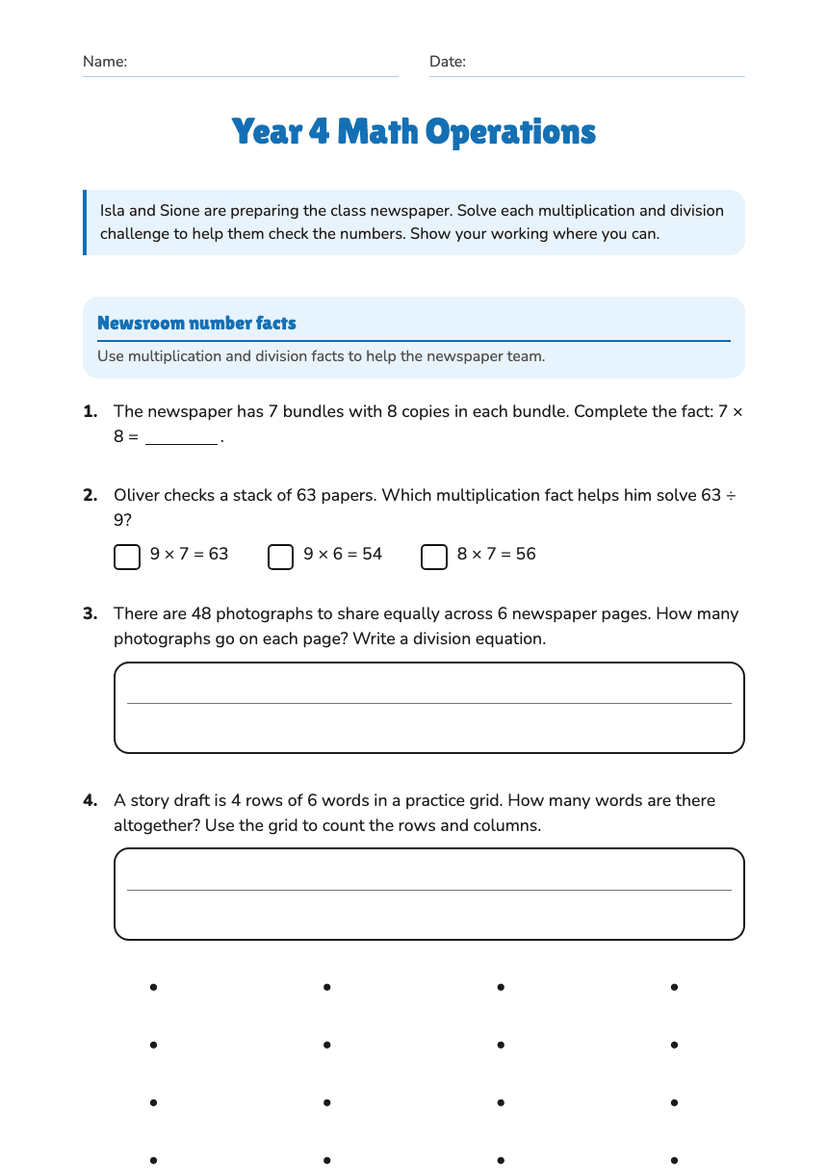
Year 4
Year 4 Math Operations
Free
Year 7–8