Volcano Eruptions Explained
A free geography worksheet ready for your classroom. Open in Kuraplan to grab the print-ready PDF, customize it for your students, or generate a fresh version in seconds.
Volcano Eruptions Explained
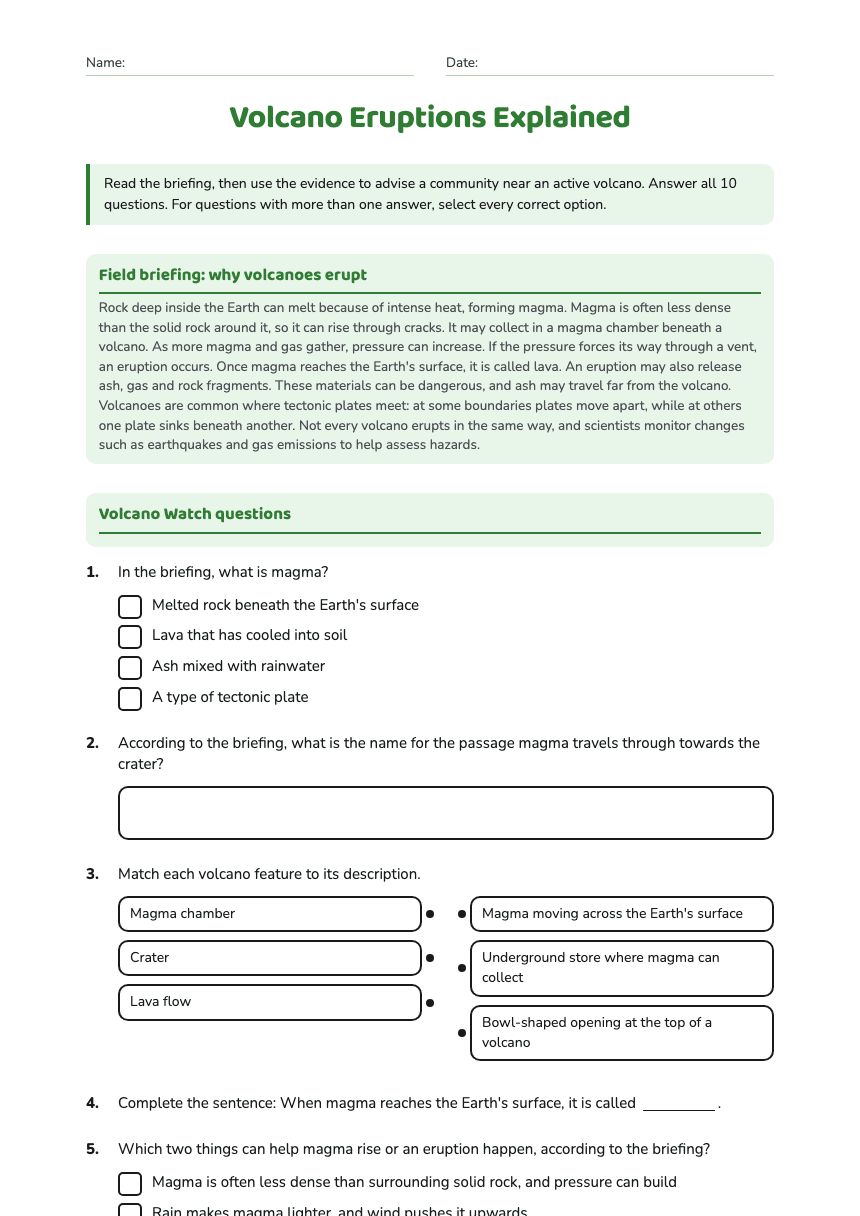
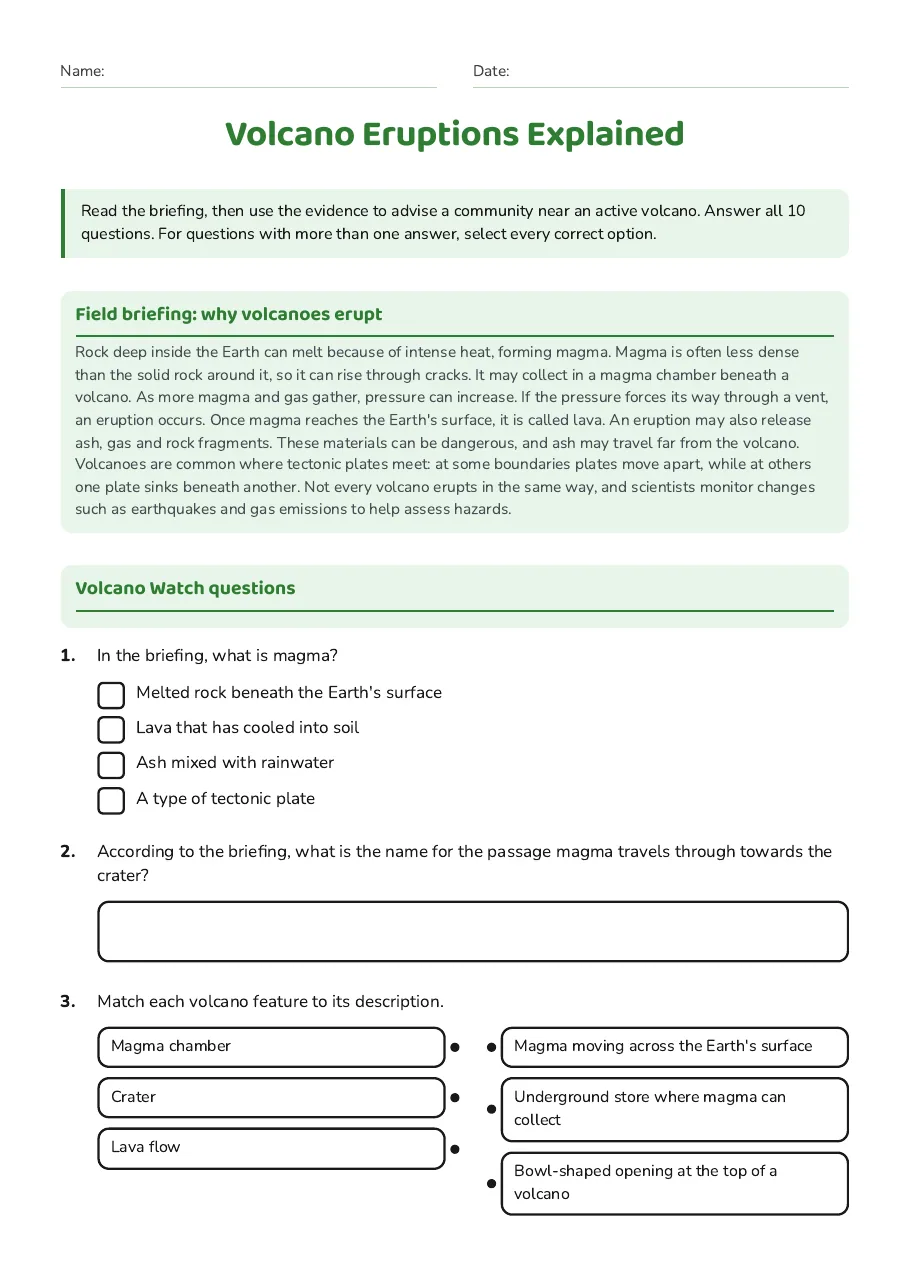
Field briefing: why volcanoes erupt
Rock deep inside the Earth can melt because of intense heat, forming magma. Magma is often less dense than the solid rock around it, so it can rise through cracks. It may collect in a magma chamber beneath a volcano. As more magma and gas gather, pressure can increase. If the pressure forces its way through a vent, an eruption occurs. Once magma reaches the Earth's surface, it is called lava. An eruption may also release ash, gas and rock fragments. These materials can be dangerous, and ash may travel far from the volcano. Volcanoes are common where tectonic plates meet: at some boundaries plates move apart, while at others one plate sinks beneath another. Not every volcano erupts in the same way, and scientists monitor changes such as earthquakes and gas emissions to help assess hazards.
Volcano Watch questions
- Melted rock beneath the Earth's surface
- Lava that has cooled into soil
- Ash mixed with rainwater
- A type of tectonic plate
- Magma chamber
- Crater
- Lava flow
- Magma moving across the Earth's surface
- Underground store where magma can collect
- Bowl-shaped opening at the top of a volcano
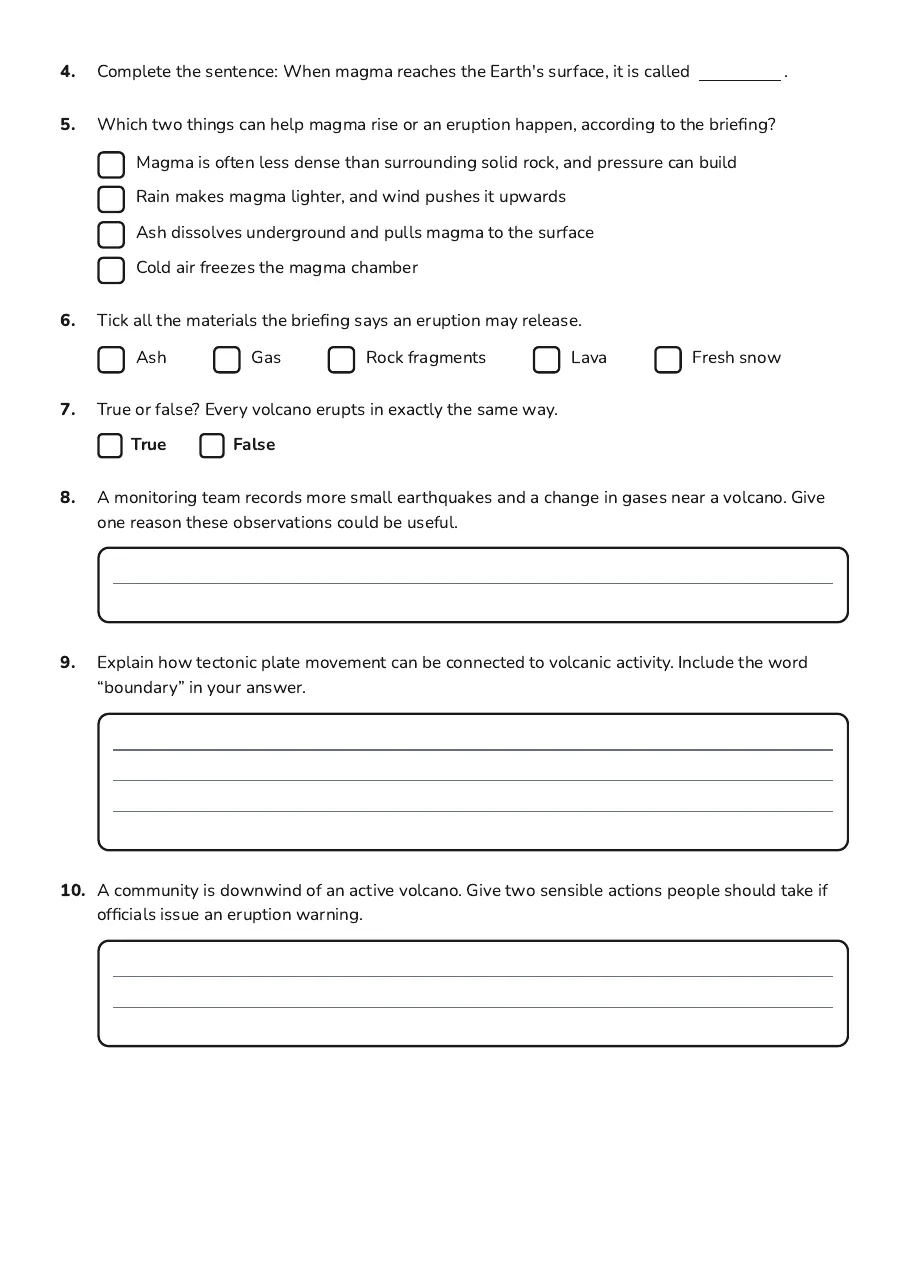
- Magma is often less dense than surrounding solid rock, and pressure can build
- Rain makes magma lighter, and wind pushes it upwards
- Ash dissolves underground and pulls magma to the surface
- Cold air freezes the magma chamber
- Ash
- Gas
- Rock fragments
- Lava
- Fresh snow
2 printable pages
Page 1
Page 2
About This Worksheet
Free in Kuraplan
Sign up free, grab the PDF, and customize it for your class.
Print-Ready
Formatted for standard paper. Clean layout, easy to read.
AI-Generated
Created with Kuraplan's AI, designed for real classroom use.
For Teachers & Parents
Use in classrooms, for homework, tutoring, or homeschool.
Need a custom version of this worksheet?
Kuraplan's AI generates custom worksheets in seconds — differentiated for every learner, aligned to your curriculum.
Generate Custom Worksheets — Free