GeographyFreePrintable

Waves and Coastal Erosion

A free geography worksheet ready for your classroom. Open in Kuraplan to grab the print-ready PDF, customize it for your students, or generate a fresh version in seconds.
Waves and Coastal Erosion worksheet preview
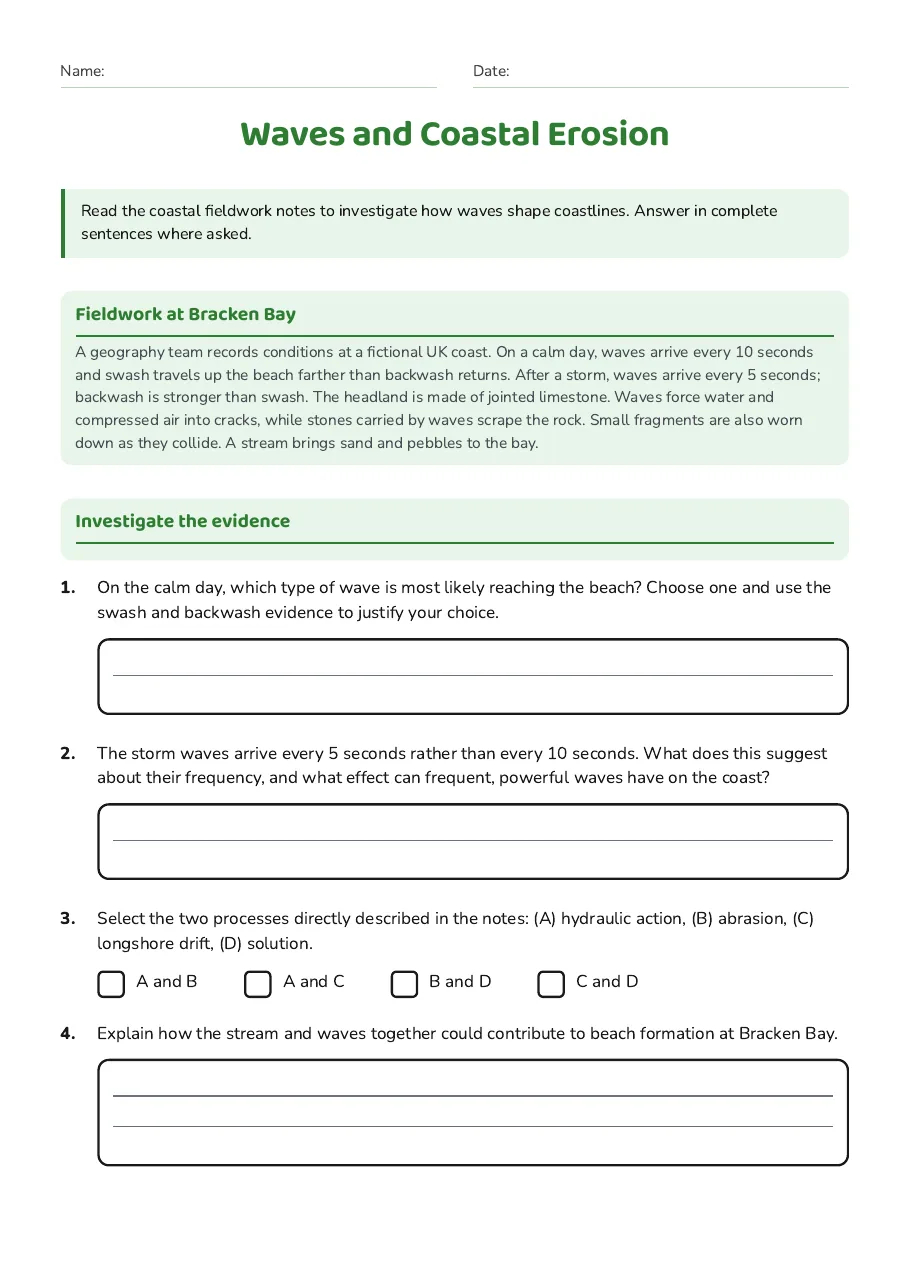
Name:Date:

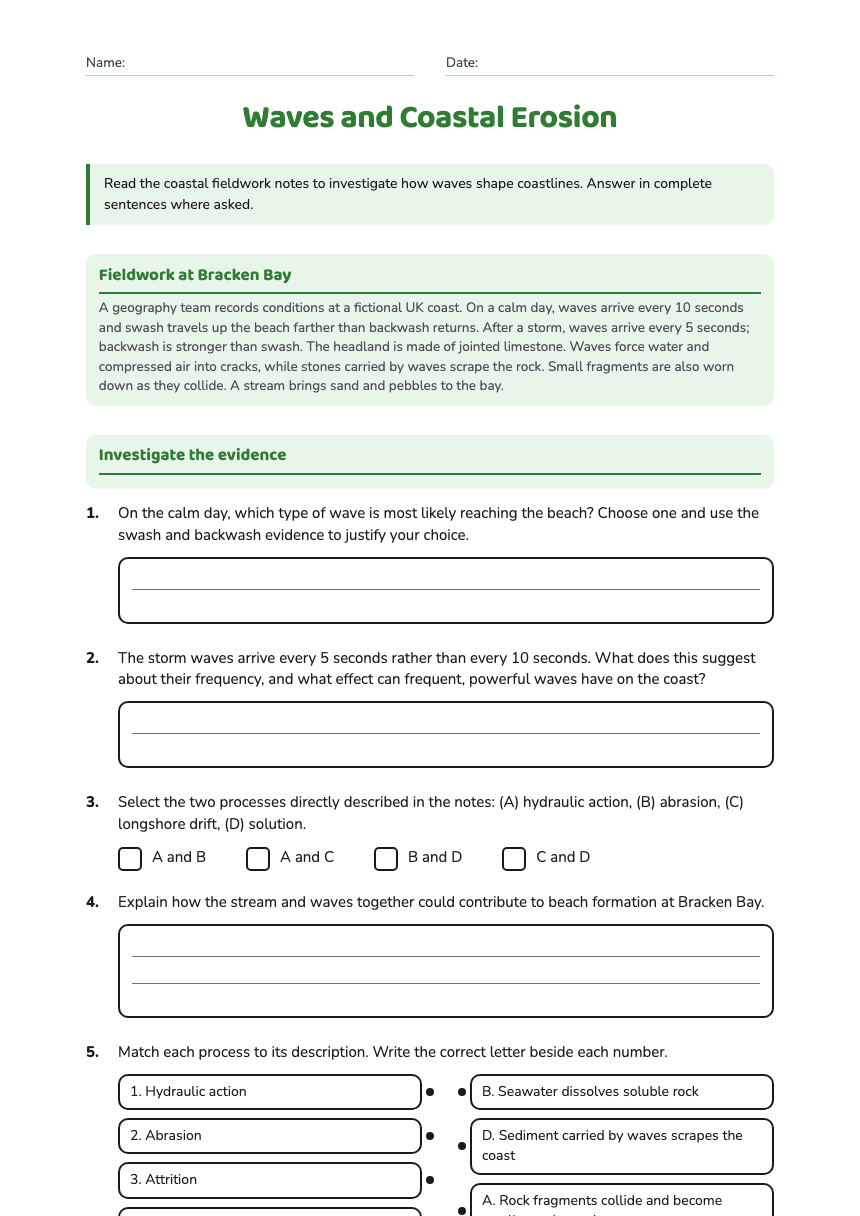
Waves and Coastal Erosion

Read the coastal fieldwork notes to investigate how waves shape coastlines. Answer in complete sentences where asked.

Fieldwork at Bracken Bay

A geography team records conditions at a fictional UK coast. On a calm day, waves arrive every 10 seconds and swash travels up the beach farther than backwash returns. After a storm, waves arrive every 5 seconds; backwash is stronger than swash. The headland is made of jointed limestone. Waves force water and compressed air into cracks, while stones carried by waves scrape the rock. Small fragments are also worn down as they collide. A stream brings sand and pebbles to the bay.

Investigate the evidence

1.On the calm day, which type of wave is most likely reaching the beach? Choose one and use the swash and backwash evidence to justify your choice.
2.The storm waves arrive every 5 seconds rather than every 10 seconds. What does this suggest about their frequency, and what effect can frequent, powerful waves have on the coast?
3.Select the two processes directly described in the notes: (A) hydraulic action, (B) abrasion, (C) longshore drift, (D) solution.
  • A and B
  • A and C
  • B and D
  • C and D
4.Explain how the stream and waves together could contribute to beach formation at Bracken Bay.
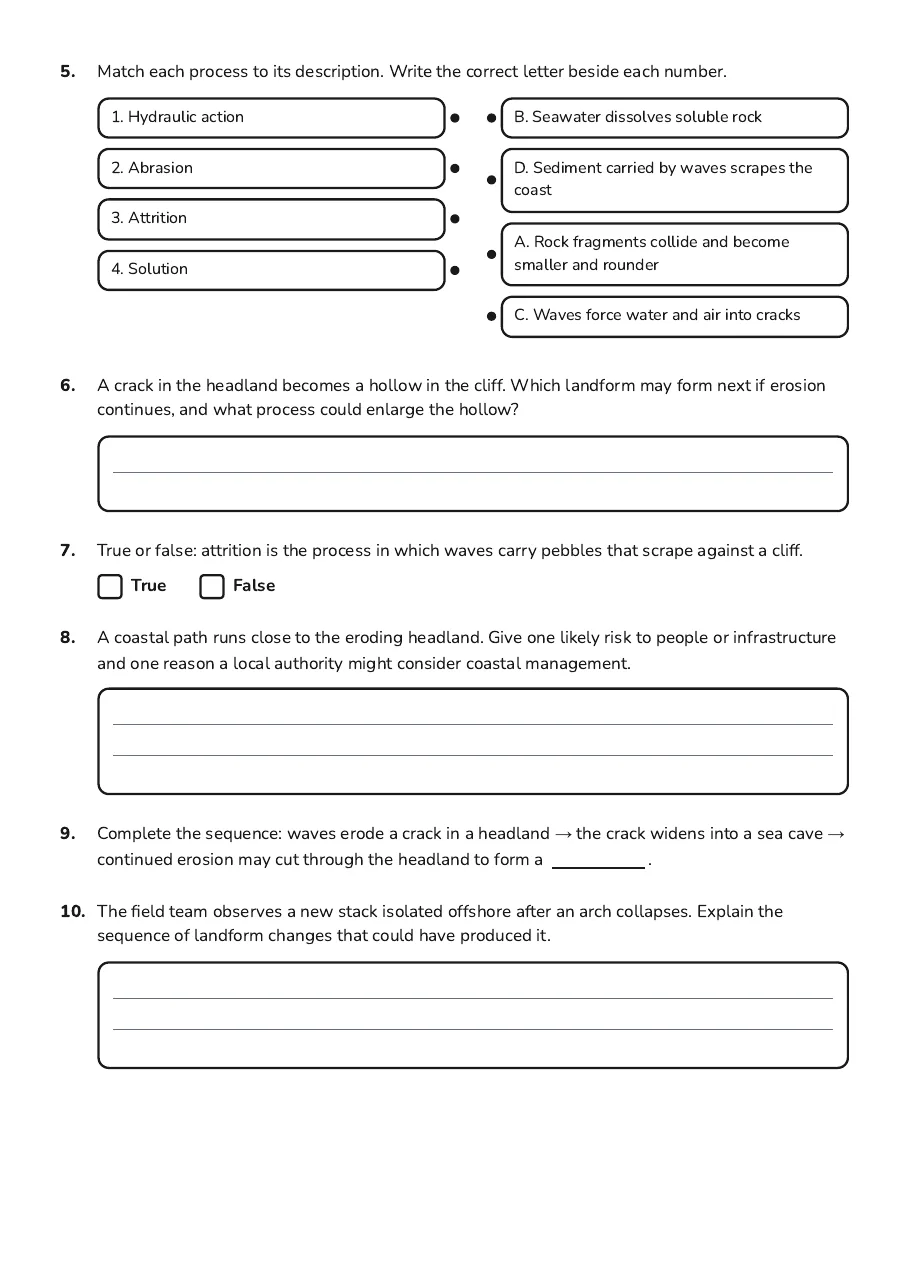
5.Match each process to its description. Write the correct letter beside each number.
  • 1. Hydraulic action
  • 2. Abrasion
  • 3. Attrition
  • 4. Solution
  • B. Seawater dissolves soluble rock
  • D. Sediment carried by waves scrapes the coast
  • A. Rock fragments collide and become smaller and rounder
  • C. Waves force water and air into cracks
6.A crack in the headland becomes a hollow in the cliff. Which landform may form next if erosion continues, and what process could enlarge the hollow?
7.True or false: attrition is the process in which waves carry pebbles that scrape against a cliff.
TrueFalse
8.A coastal path runs close to the eroding headland. Give one likely risk to people or infrastructure and one reason a local authority might consider coastal management.
9.Complete the sequence: waves erode a crack in a headland → the crack widens into a sea cave → continued erosion may cut through the headland to form a .
10.The field team observes a new stack isolated offshore after an arch collapses. Explain the sequence of landform changes that could have produced it.

2 printable pages

  • Fieldwork notes and questions about wave type and erosion evidence at Bracken Bay.

    Page 1

  • Questions on coastal erosion, landforms and coastal risk.

    Page 2

About This Worksheet

Free in Kuraplan

Sign up free, grab the PDF, and customize it for your class.

Print-Ready

Formatted for standard paper. Clean layout, easy to read.

AI-Generated

Created with Kuraplan's AI, designed for real classroom use.

For Teachers & Parents

Use in classrooms, for homework, tutoring, or homeschool.

Need a custom version of this worksheet?

Kuraplan's AI generates custom worksheets in seconds — differentiated for every learner, aligned to your curriculum.

Generate Custom Worksheets — Free
No credit card Curriculum-aligned Under 60 seconds