Waves and Coastal Erosion
A free geography worksheet ready for your classroom. Open in Kuraplan to grab the print-ready PDF, customize it for your students, or generate a fresh version in seconds.
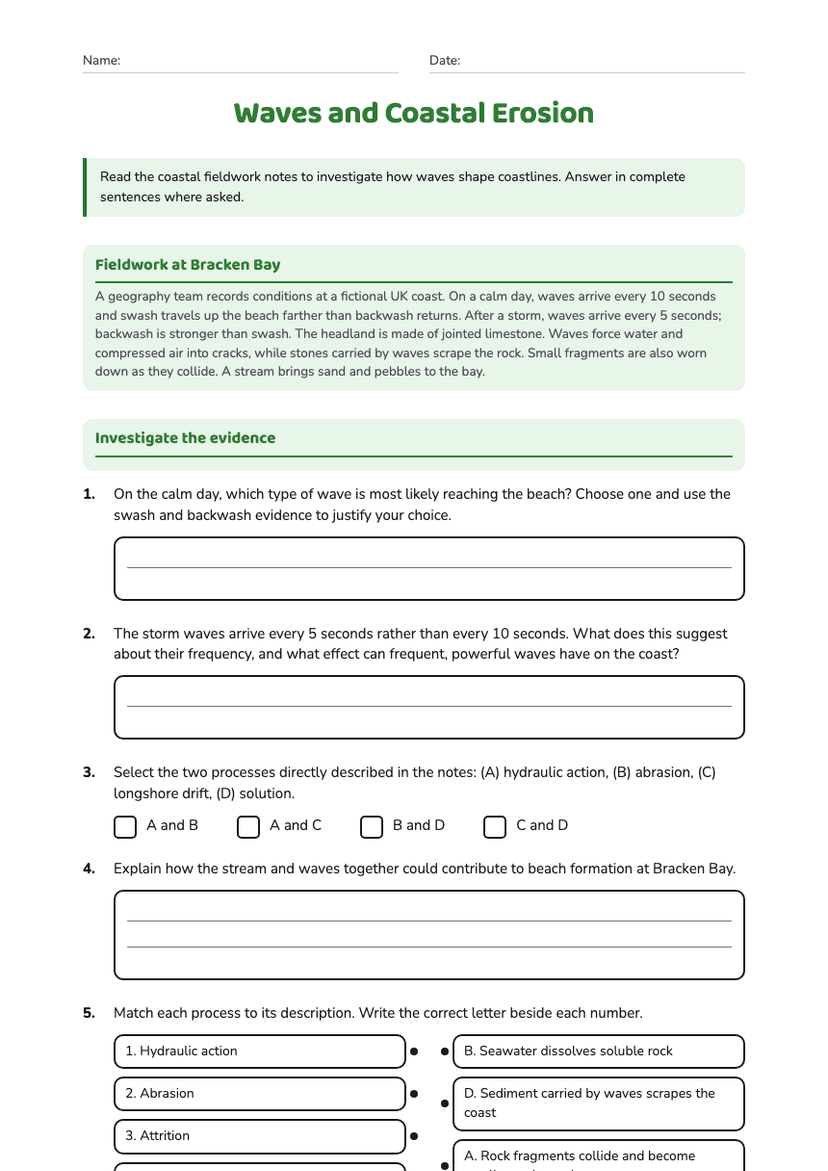
Waves and Coastal Erosion
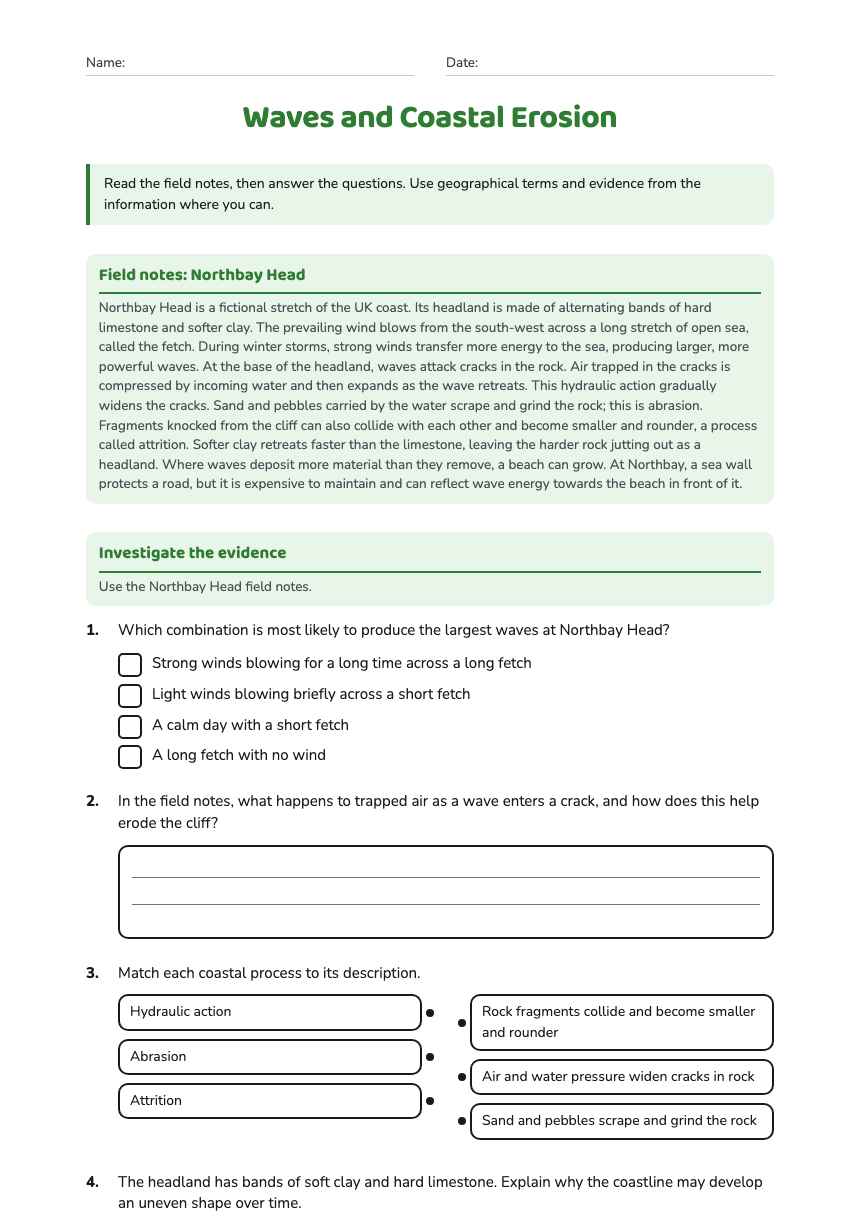
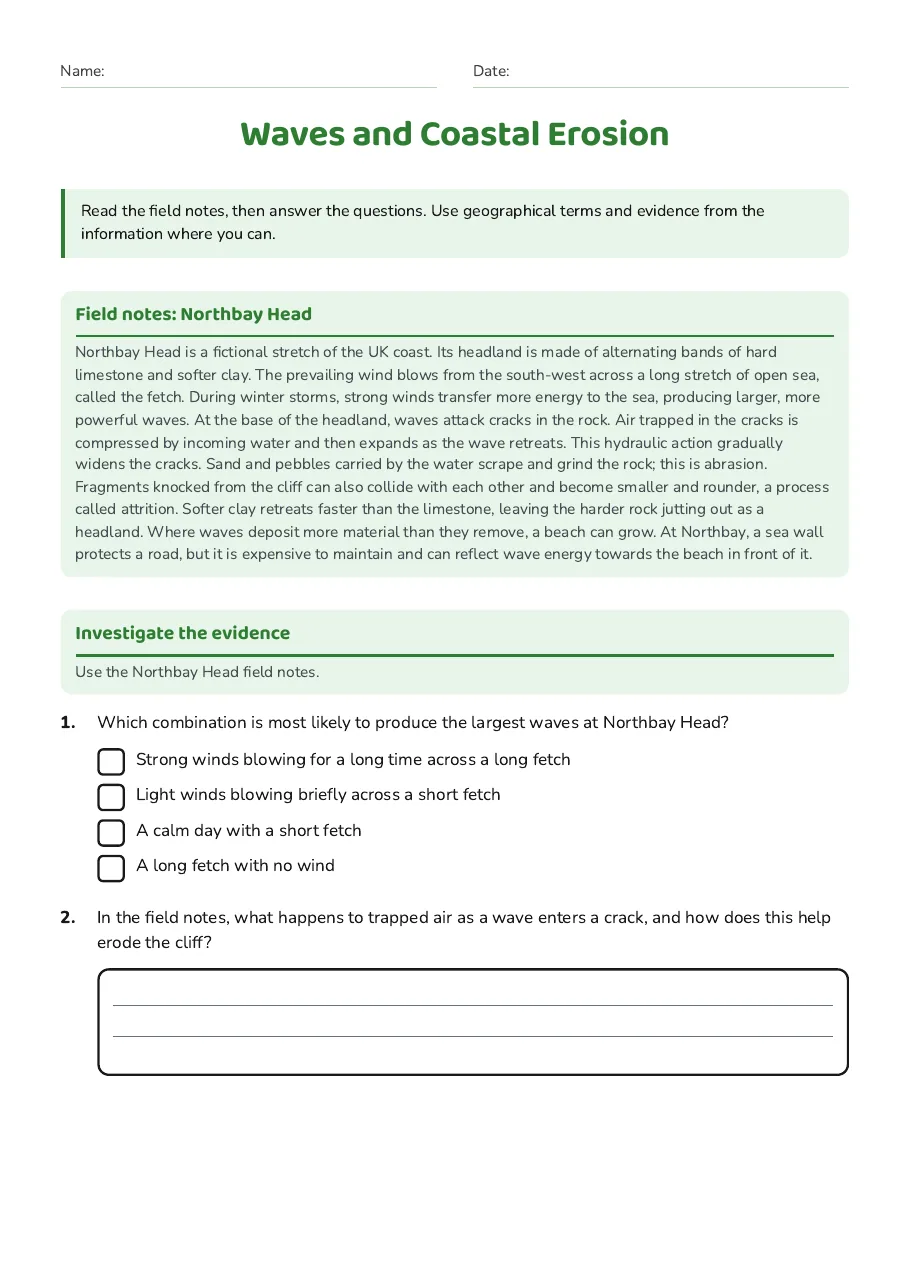
Field notes: Northbay Head
Northbay Head is a fictional stretch of the UK coast. Its headland is made of alternating bands of hard limestone and softer clay. The prevailing wind blows from the south-west across a long stretch of open sea, called the fetch. During winter storms, strong winds transfer more energy to the sea, producing larger, more powerful waves. At the base of the headland, waves attack cracks in the rock. Air trapped in the cracks is compressed by incoming water and then expands as the wave retreats. This hydraulic action gradually widens the cracks. Sand and pebbles carried by the water scrape and grind the rock; this is abrasion. Fragments knocked from the cliff can also collide with each other and become smaller and rounder, a process called attrition. Softer clay retreats faster than the limestone, leaving the harder rock jutting out as a headland. Where waves deposit more material than they remove, a beach can grow. At Northbay, a sea wall protects a road, but it is expensive to maintain and can reflect wave energy towards the beach in front of it.
Investigate the evidence
Use the Northbay Head field notes.
- Strong winds blowing for a long time across a long fetch
- Light winds blowing briefly across a short fetch
- A calm day with a short fetch
- A long fetch with no wind
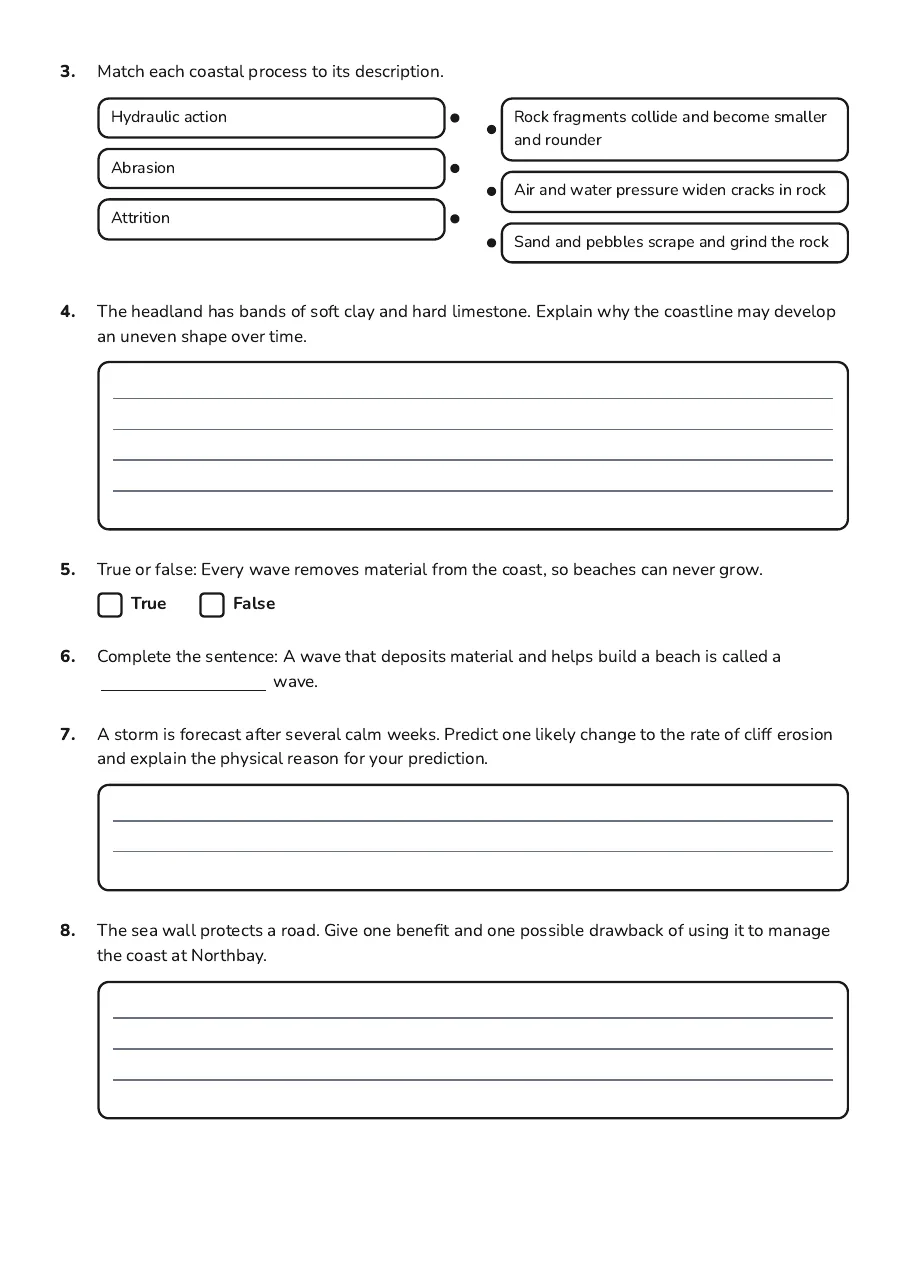
- Hydraulic action
- Abrasion
- Attrition
- Rock fragments collide and become smaller and rounder
- Air and water pressure widen cracks in rock
- Sand and pebbles scrape and grind the rock
3 printable pages
Page 1
Page 2

Page 3
About This Worksheet
Free in Kuraplan
Sign up free, grab the PDF, and customize it for your class.
Print-Ready
Formatted for standard paper. Clean layout, easy to read.
AI-Generated
Created with Kuraplan's AI, designed for real classroom use.
For Teachers & Parents
Use in classrooms, for homework, tutoring, or homeschool.
Need a custom version of this worksheet?
Kuraplan's AI generates custom worksheets in seconds — differentiated for every learner, aligned to your curriculum.
Generate Custom Worksheets — Free