Year 7 History Exploration: Britain Through Time
A free history worksheet ready for your classroom. Open in Kuraplan to grab the print-ready PDF, customize it for your students, or generate a fresh version in seconds.
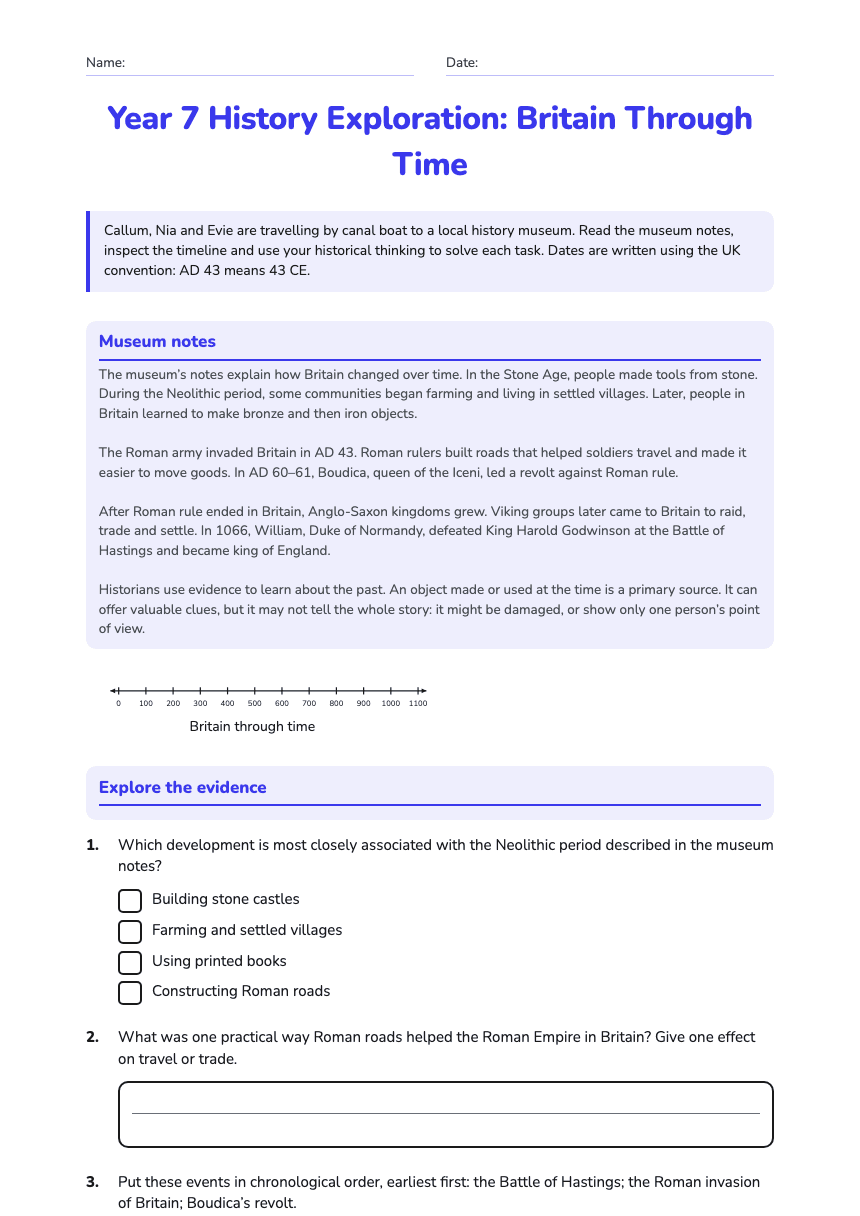
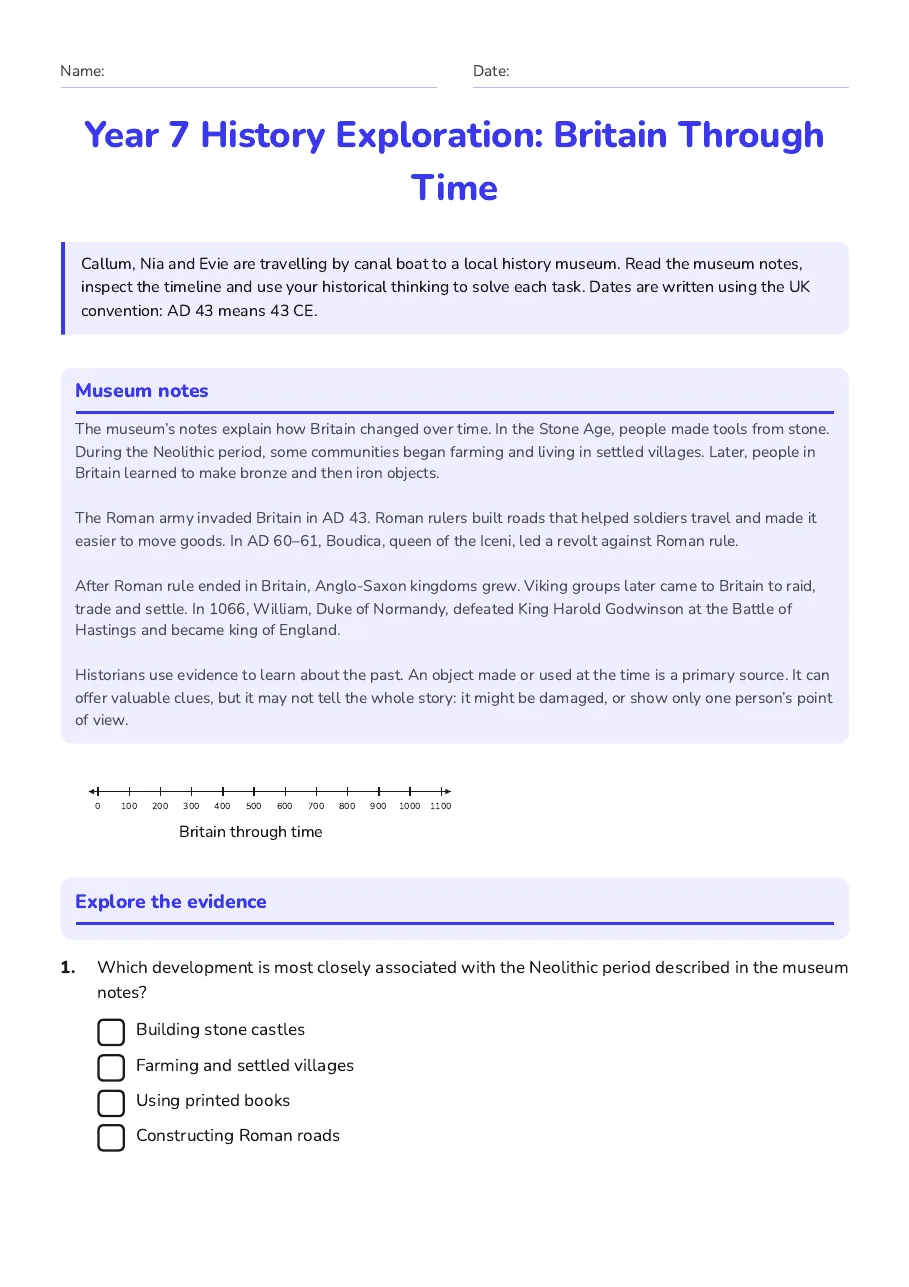
Year 7 History Exploration: Britain Through Time
Museum notes
The museum’s notes explain how Britain changed over time. In the Stone Age, people made tools from stone. During the Neolithic period, some communities began farming and living in settled villages. Later, people in Britain learned to make bronze and then iron objects. The Roman army invaded Britain in AD 43. Roman rulers built roads that helped soldiers travel and made it easier to move goods. In AD 60–61, Boudica, queen of the Iceni, led a revolt against Roman rule. After Roman rule ended in Britain, Anglo-Saxon kingdoms grew. Viking groups later came to Britain to raid, trade and settle. In 1066, William, Duke of Normandy, defeated King Harold Godwinson at the Battle of Hastings and became king of England. Historians use evidence to learn about the past. An object made or used at the time is a primary source. It can offer valuable clues, but it may not tell the whole story: it might be damaged, or show only one person’s point of view.
Britain through time
Explore the evidence
- Building stone castles
- Farming and settled villages
- Using printed books
- Constructing Roman roads
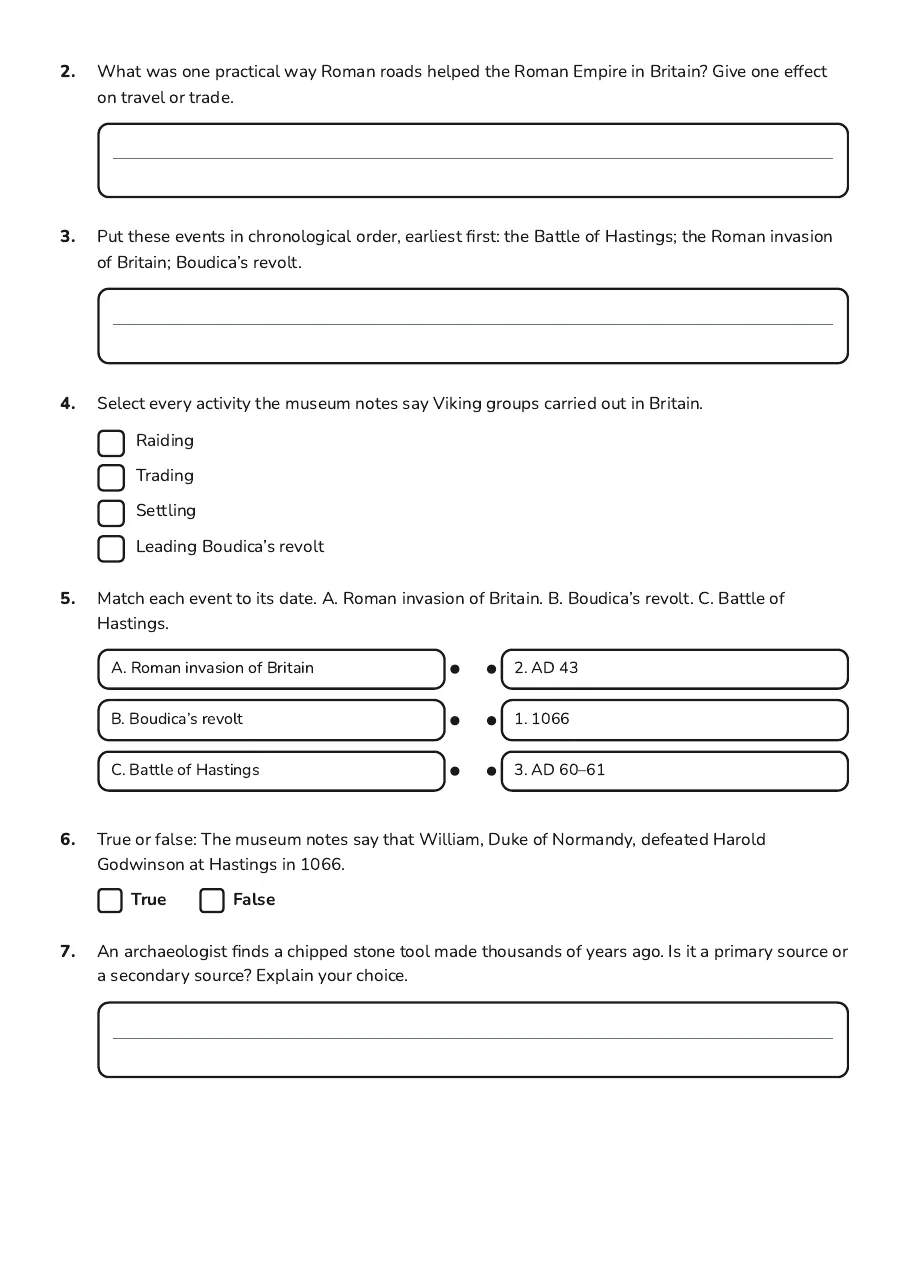
- Raiding
- Trading
- Settling
- Leading Boudica’s revolt
- A. Roman invasion of Britain
- B. Boudica’s revolt
- C. Battle of Hastings
- 2. AD 43
- 1. 1066
- 3. AD 60–61
3 printable pages
Page 1
Page 2
Page 3
About This Worksheet
Free in Kuraplan
Sign up free, grab the PDF, and customize it for your class.
Print-Ready
Formatted for standard paper. Clean layout, easy to read.
AI-Generated
Created with Kuraplan's AI, designed for real classroom use.
For Teachers & Parents
Use in classrooms, for homework, tutoring, or homeschool.
Need a custom version of this worksheet?
Kuraplan's AI generates custom worksheets in seconds — differentiated for every learner, aligned to your curriculum.
Generate Custom Worksheets — Free