It's Thursday after lunch, the stack of opinion drafts is still on the corner of your desk, and recess duty starts in twelve minutes. One paper argues for longer recess with three reasons and a messy ending. The next one has beautiful handwriting and almost no claim. A third has a sharp idea buried under sentences you have to read twice. You need a 4th grade writing rubric that tells you what to notice, what to say, and what to leave for the next draft, not a grade you can't defend in a conference.
A usable rubric is a short routine you run while students are still revising. The levels name what a reader can see on the page. The feedback names one move the writer can make before the piece is finished.
Four Levels of Criteria Every Fourth-Grade Rubric Needs
Score five things, and only those five, on every fourth-grade piece: focus and purpose, organization, development of ideas, word choice and voice, and sentences and conventions. Four levels are enough. Exceeds is 4 points, Meets is 3, Developing is 2, and Beginning is 1. Five criteria put a piece between 5 and 20.
Why four levels and not six? Because you will run this rubric mid-draft, while a writer still has time to act on it, and four levels is a ladder a nine-year-old can climb. For comparison, NAEP's scoring model for fourth-grade writing uses a six-point scale. On the NAEP writing performance page, a top-level response shows competent skill, with elements generally controlled and clearly supporting the writer's purpose and audience, while lower levels show adequate, uneven, or marginal-to-insufficient control. National results on that scale spread across the lower and middle levels, which is the same spread you will see on a Thursday afternoon in your own class.
That spread is why Meets has to mean something different from Developing. If those two levels blur, most of the class lands in a mushy middle and your comments all sound the same.
The rubric you can use tonight
| Criterion | Exceeds | Meets | Developing | Beginning |
|---|---|---|---|---|
| Focus and purpose | Clear claim or story goal held from start to finish | Clear purpose with minor drift | Purpose visible but often lost | Purpose unclear or missing |
| Organization | Ideas grouped logically with varied transitions | Logical order with transitions for most events or reasons | Some grouping; sequence breaks in places | No discernible order |
| Development of ideas | Several specific reasons, details or examples, each explained | Two or three supported reasons or events | One reason or detail, thinly explained | Ideas listed without support |
| Word choice and voice | Precise, varied vocabulary; the writer's voice comes through | Mostly precise words; some voice | General words; little voice | Vocabulary too limited to convey meaning |
| Sentences and conventions | Varied sentences; few errors that do not interfere with meaning | Mostly controlled sentences; occasional errors | Frequent errors that sometimes blur meaning | Errors block meaning throughout |
Meets is the grade-level target. Exceeds is a stretch, not the bar you hold over every nine-year-old. Beginning marks where instruction starts; it is an entry point for targeted support, and it says nothing about the writer's ability or effort.
One row against one paragraph
Take this recess draft and score only development of ideas.
We should get more recess. Kids need to run. Also my friend Sam says recess is the best part of school. If we had longer recess we would be better at paying attention after.
You can check that row in under a minute.
- The writer names two reasons, running and attention, and one appeal to a friend.
- "Kids need to run" is named, not explained. There is no fact, example, or because-clause.
- "Better at paying attention" is a result with no detail showing how that would work.
That is one thinly explained reason plus a list. It matches Developing on development; it falls short of Meets. You don't need the other rows to know the next comment: add one explained reason.
Why the wording has to point at the page
Each cell names evidence. "Two or three supported reasons" is something you can count. "Varied transitions" is something you can underline. "A conclusion connected to the topic" is either on the last lines or it isn't.
Practical rule: If you can't point to a sentence that earns the level, drop one level.
Vague praise such as "good organization" doesn't survive a parent question. "Your three reasons sit in three chunks, and two of them have a because-sentence" does. Descriptors work only when a colleague, reading the same paragraph, would land on the same cell.
Evidence-based wording also keeps the scoring honest for writers whose English doesn't sound like the textbook. A cell like "few errors that do not interfere with meaning" measures whether the reader can follow the piece, which is a different question from whether the sentences match one dialect. Pointing at the page means you score what the writing does, and a student whose grammar is consistent and clear doesn't lose a level for sounding like home.
What Each Writing Type Must Show
An opinion paragraph and a story can both reach Meets on organization and look completely different doing it. The shared criteria stay put. The moves inside them change by genre. Grade 4 writing in the Common Core asks for three purposes: opinion, informative or explanatory, and narrative.
For opinion writing, the Oakland Unified fourth-grade standards page spells out the job. The writer introduces the topic, states a point of view, groups related ideas, supports reasons with facts and details, links ideas with words such as "for instance" and "in addition," and closes with a conclusion tied to the opinion. Informative writing on those same standards introduces and groups information, develops it with facts, definitions, concrete details, quotations, or examples, uses precise and domain-specific vocabulary, and concludes.
Narrative carries its own list. Oregon's grade 4 ELA standards expect students to establish a situation, introduce a narrator and/or characters, organize events in a natural sequence, use dialogue and description to develop experiences or show how characters respond, and use varied transitional words and phrases. Every item is something a reader can locate in the draft.
Progressions like this also appear outside English language arts. The Cultural Association exam level advice from the German Cultural Association Hong Kong lays out essay and exam formats at CEFR levels A2 through B2 for German learners, and the ladder looks familiar. Early levels reward a clear purpose and simple sequence. Later levels ask for grouped reasons, precise vocabulary, and a conclusion that closes the task. Fourth grade is the year those habits begin for young writers in English.
Three checklists, same five criteria
Keep focus, organization, development, word choice, and sentences as the scoring rows on every assignment. Change only the moves you look for inside those rows. Students then see the same expectations whether the prompt is a letter, a report, or a story, and they can run the right row as a self-check while they draft. A persuasive writing guide is a useful companion when the unit is opinion, because the claim-reason-evidence chain is the whole genre.
| Writing type | Required moves | What to check in the text |
|---|---|---|
| Opinion | Clear claim, grouped reasons, facts and details, linking words, concluding statement | Claim stated early; each reason backed by evidence |
| Informative or explanatory | Introduced topic, grouped information, facts, definitions or examples, precise vocabulary, concluding statement | Key terms used accurately and explained |
| Narrative | Situation, narrator or characters, sequenced events, dialogue, description, transitions | Events move in order and transitions mark each shift |
Opinion, marked on the page
Here is the recess prompt again, this time as a finished opinion paragraph.
Our class should get ten more minutes of recess. First, we sit for long math blocks, and a longer break would give us time to move before reading. For instance, last Tuesday three kids put their heads down before the read-aloud. In addition, the playground is less crowded after the younger grades go in, so we could actually use the field. That is why ten extra minutes would help us learn, not just play.
Mark it like this.
- Claim, early. "Our class should get ten more minutes of recess." Stated in sentence one.
- Reasons, grouped. Reason one is movement before reading. Reason two is space on the field. Each sits in its own chunk.
- Evidence. "Last Tuesday three kids put their heads down" is a detail tied to reason one. The field reason is still thin. It names a condition without showing what students would do with the space.
- Linking words. "First," "For instance," and "In addition" are doing real work.
- Ending. The last sentence returns to the opinion and frames recess as a learning issue.
On the shared criteria, focus is Meets (clear purpose, with the field reason drifting a little), organization is Meets, and development is Developing until the field reason earns a fact the way the movement reason did. You don't build a separate opinion rubric. You score the same rows with a genre checklist beside them, and the note to the writer is one line: show us the field in action.
Narrative elements, three ratings
Rate each narrative move as missing, emerging, or consistently effective, and run the rating on a first draft so the writer can still act on it. An opening that only describes the weather is missing. One that names a setting without introducing a character is emerging. One that puts a character in a problem by the second sentence is effective.
Check the opening before you check the dialogue. If the reader doesn't know who is in trouble, pretty conversation can't save the score.
Ask four questions while you read. Does the opening orient the reader? Do words such as "later," "meanwhile," or "after that" connect events? Does dialogue show what a character says or feels? Does description help you see the setting or the action? Score one feature, send the writer back to that feature, and leave the rest for the next pass.
How to Score a Draft and Weigh Conventions
Read for meaning before you hunt for mistakes. Conventions are one part of quality. They are not the evaluation.
A California fourth-grade writing rubric, reprinted in a WAC Clearinghouse rubric collection, uses a four-point scale. It looks at purpose, consistent point of view, focus, organizational structure, paragraphing when appropriate, sentence variety, and conventions, including grammar, punctuation, capitalization, and spelling. The top description expects few, if any, errors in English conventions, and it also requires real control of ideas and structure. That order is the one to copy. Content and organization first, then sentences, then the errors that get in the way. The same analytic split is what you want when you build a standards-aligned task or a set of differentiated practice pages in a planning platform such as Kuraplan.
The flow below is the order to protect, so language never erases what the draft was trying to do.
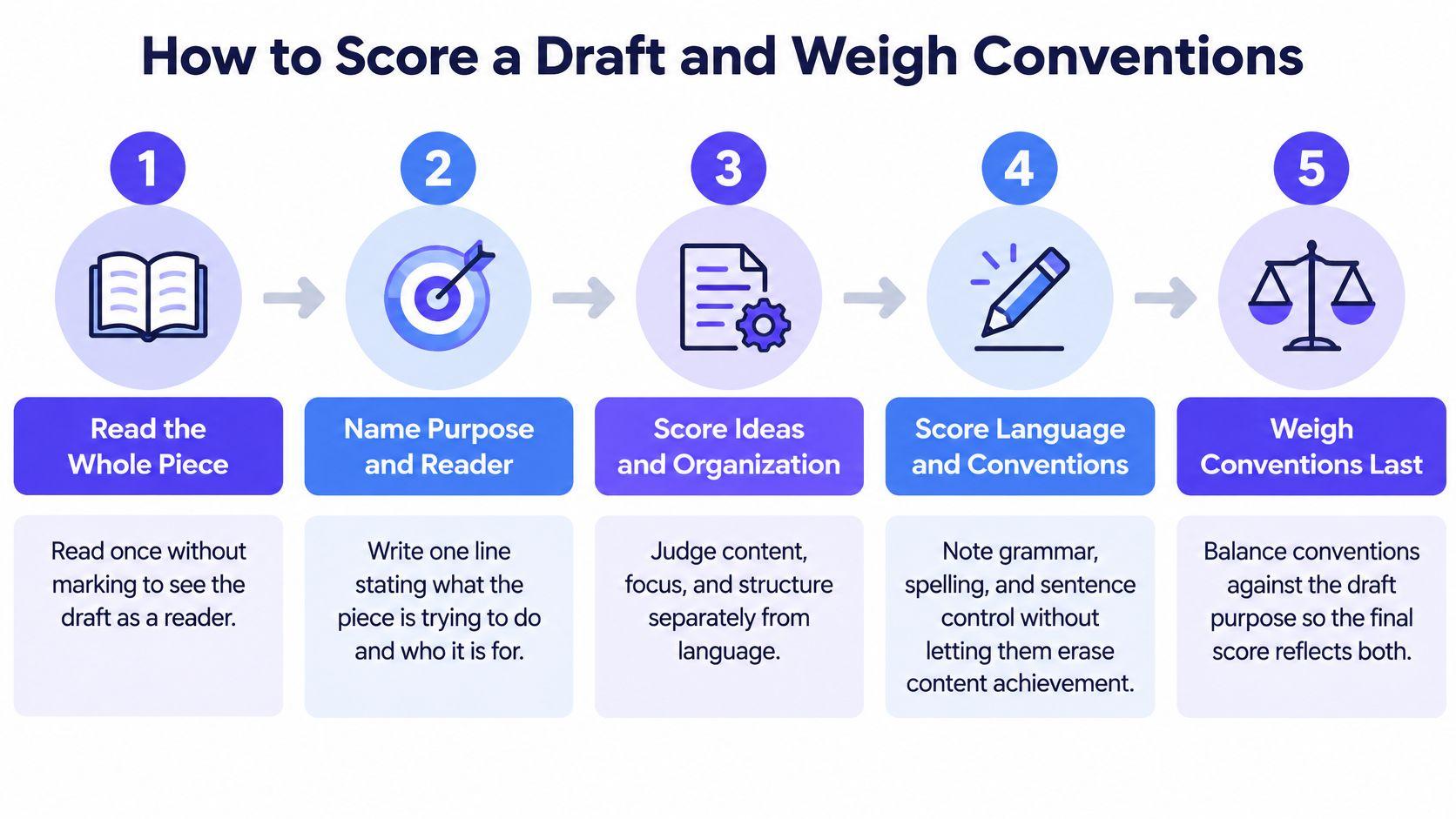
Five short passes
Keep each pass under a couple of minutes. A finished note for one draft holds five levels, five short quotes, and one next step.
- Read once, unmarked. Write a single line: purpose and reader. "Opinion for the principal about recess." You score the piece that exists, not the piece you hoped the prompt would produce.
- Circle the goal and draw arrows. On the second read, circle the claim or story goal. Draw arrows from each reason or event back to that goal. Broken arrows are your focus and organization evidence.
- Count what is explained. Tally reasons, details, or events. Star the ones that are explained. A bare list is not development.
- Mark language in two colors. Note two or three spots where word choice, voice, or sentence variety helps. Mark one spot where language blocks you.
- Score conventions last. Mark only errors that block meaning or that repeat. Ignore the rest for this draft.
A missing comma after an introductory phrase counts less than a run-on that makes the order of events unclear. A misspelling you can decode counts less than one that changes the word.
If you want a short model of how a teacher talks through a draft out loud before scoring it, this walkthrough is worth six minutes between classes.
Two papers, same ideas, different sentences
Paper A and Paper B both argue for a class pet. Both have a claim, two grouped reasons, and one explained example. Organization and development match.
Paper A uses mostly controlled sentences. There is an occasional missing comma. You never lose the point. Conventions sit at Meets.
Paper B repeats the same run-on three times, so you can't tell whether the hamster escaped before or after lunch. Meaning blurs in those sentences and nowhere else. Conventions sit at Developing.
The content scores stay level with each other. Only the conventions row moves. That is the whole point of weighing conventions last. If you had started with the red pen, Paper B would have looked like a weaker thinker. It isn't. The writer needs a sentence boundary, not a new idea.
Record the quote, not your impression. "Run-on hides whether the hamster escaped before lunch" is evidence. "Careless" is not.
Turning Levels Into Grades
A level becomes a grade only after you attach points, and the points have to follow the descriptors. They don't get to override them.
Give every criterion the same fixed value. Exceeds earns 4, Meets earns 3, Developing earns 2, and Beginning earns 1. Five criteria make 20 the ceiling and 5 the floor. Add the five levels, then place the total in a band.
| Level | Points per criterion | Total out of 20 | What it signals |
|---|---|---|---|
| Exceeds | 4 | 18-20 | Above the grade-level target |
| Meets | 3 | 14-17 | On the grade-level target |
| Developing | 2 | 10-13 | Approaching target; needs targeted support |
| Beginning | 1 | 5-9 | Entry point; needs intensive support |
How to read a total without punishing the bottom band
Meets is the grade-level target, so a piece in the 14 to 17 band is on track. It is not a near miss and it doesn't need a speech about "room to grow" unless one row is clearly lagging.
A total in the 5 to 9 band means the writer needs intensive, narrow support. Treat it as an entry point. Say which one or two rows produced the 1s, and teach those. A 7 that comes from strong ideas and blocked sentences is a different conference from a 7 that comes from no claim at all.
When the number goes in the gradebook
Keep formative totals off the gradebook while drafts are still moving. Students will pad, hide, or stop revising if every check becomes a mark. Record totals at the end of the unit, when you want a trail of growth across assignments, not a punishment for an early draft.
If your school uses its own letters or percentages, swap the band labels and keep the point values. A 3 on organization in your room should mean the same thing as a 3 next door. Otherwise you can't talk about student work across classes without translating the whole scale. A grade calculator helps when you have to show families how five rubric rows become the number on the report, without you redoing the arithmetic on a sticky note.
Don't average the rows into a single word and throw the rows away. The total is a summary. The five levels are the information.
Scoring Multilingual and Dialect-Speaking Writers Fairly
A single rubric score lies when a student's ideas are ahead of their control of standardized English. Many rubrics press hard on ideas, organization, and conventions, and treat voice, sentence fluency, and word choice as optional. That tilt favors the language patterns of the scoring guide, not the quality of the thinking. A study of early-childhood assessment practice notes that novice assessors are more accurate on surface linguistic features than on content and organization, and that they may grade syntax and cohesion more strictly and less consistently than expert raters.

The rubric can look objective and still carry language bias if nobody has practiced reading its categories. The question to ask before you drop any score is the one that piece of research leaves hanging. "How can a teacher distinguish developing English from weak thinking without lowering expectations?"
Split the score before you lower it
Write the content levels first: focus, organization, development. On a separate line, note language needs. Don't let that note pull the content levels down.
Then sort each language feature into one of two piles.
- Variation to note, not to penalize. A dialect feature used the same way all the way through the piece, a missing article that never hides the noun, or a verb form that is consistent and understandable. Name it for later language instruction. Leave the conventions level where the meaning sits.
- A meaning problem to score. A sentence you cannot follow, a word that could be three different words, or cohesion so broken you lose the reason. That can move sentences and conventions, and only that row, unless the gap also erases the claim.
Say a student writes, "We was going to the field after lunch and the ball gone over the fence, so we ask the custodian." The verb pattern is consistent. You know the sequence, the problem, and the response. That is language variation plus a clear narrative. It is not weak thinking, and it is not a Beginning conventions paper. Compare that with "We going field ball custodian because." There the reader cannot recover the event. That is a meaning block, and it belongs on the conventions row.
A ten-minute moderation check
Before you lower a score on a multilingual writer's paper, run this check with a colleague.
- Pull the same three pieces, including at least one from a multilingual student and one from a dialect speaker.
- Score them separately on the five criteria. Bring one quoted line per criterion.
- Compare only the rows where you disagree.
- If one of you docked points for a surface pattern the other could read straight through, put the point back.
Accommodations can stay in place without softening the criteria. A draft of key points in the home language, with a short translation beside them, lets you score the ideas. Sentence frames and a bilingual word bank support word choice without you writing the piece. Oral planning before drafting often reveals a structure the first written version doesn't show yet. The bar for a clear claim and supported reasons stays where it is.
Turning Scores Into Feedback Students Can Use
Rubric pages are good at levels and bad at the next move. Teachers who use them often call the scoring stressful, time-consuming, and hard to explain at first. Elementary writing research links a better result to a different habit. Students who study model papers, help name the criteria, and self-assess a first draft tend to write stronger essays in third and fourth grade. The rubric matters less than the routine around it. With more state tasks leaning on evidence and shorter responses, and with some of that writing at least partly scored by AI, compact criteria students can use mid-draft matter more than a beautiful end-of-unit grid. The write-up of those teacher and student perspectives is blunt about the paperwork trap. More comments don't produce more revision.
A drafting routine that stays short
Use the rubric while the piece is still open on the desk.
- Self-check first. Students read two model papers, name the criteria they can see, and score themselves on one row before they sit with you.
- Your mark is tiny. A check and one evidence word. "Arrows: reason 2 is off the claim." Not a paragraph.
- Three students, one lesson. When three or more drafts share a signal, teach a ten-minute mini-lesson, then send everyone back to their own paper.
- One or two targets per conference. If you assign five fixes, you get none.
A set of formative assessment examples is worth keeping beside the conferring table so the check stays a teaching move, not a surprise grade.
| Rubric signal | Next step for the student | Feedback line |
|---|---|---|
| Organization at Developing | Reorder events or reasons with a planning frame | Your strongest reason is in the middle; move it to the front. |
| Weak evidence | Add one quoted or paraphrased detail and explain it | Show me where the text supports this idea. |
| Conventions obscure meaning | Fix only the two most frequent error patterns | Let's fix the two errors that make this sentence hard to follow. |
| Missing narrative transitions | Mark each event and add a transition word | Add 'later' or 'after that' before your third event. |
| Focus drifting | Underline the claim and cut one off-topic sentence | Your claim is clear; which sentence doesn't help it? |
One conference, two reasons
Maya's recess piece has a clear claim and two real reasons, and the stronger reason is buried in the middle. You don't mention spelling. You don't redesign the introduction.
You say, "Your strongest reason is in the middle. Move it to the front." She reorders the two reasons on a planning frame, reads the new order aloud, and stops. That is the conference. Tomorrow you can look at evidence. Today the organization row is the only thing that moves.
If the student can't repeat the next step in their own words before they leave the table, the feedback was for you, not for them.
Start Scoring Your Next Writing Unit
Pick one writing type for the unit in front of you. Opinion, informative, or narrative. Don't run all three. Keep the five criteria, and run the five short passes on three student drafts before you score the pile. Those three will show you which row the class needs.
Scores and feedback do different jobs. Scores, recorded at the end, show whether the writing moved across the unit. Feedback, given in the middle, decides the next revision. Mix them and students chase the number. Separate them and the number has something honest to measure.
Finish the unit against a short list, not a feeling that you "did writing."
- Type chosen. One genre, named in the plan.
- Three drafts scored with the five passes before the whole-class scoring.
- One feedback move taught to the group, taken from a signal you saw.
- One end-of-unit score recorded per student, with the five levels still attached.
If the criteria live in a separate file, they won't be there when you plan Thursday's mini-lesson. Put them in the unit itself. Our lesson plans include differentiated instruction and assessment rubrics, so the rows sit next to the task. Worksheets are generated with one click from any lesson and are ready to print or share, which is handy when half the class needs the planning frame and the other half needs a clean draft page.
Score the unfamiliar paper first. Start with the student whose writing you know least. A rubric earns its keep when it shows you a claim, a gap, or a language pattern you would have missed because you thought you already knew that writer.
Kuraplan builds standards-aligned lesson and unit plans that carry assessment rubrics, differentiated tasks, and printable worksheets for the writing you are about to teach. Drop your fourth-grade criteria into the plan, generate the draft pages your students need, and spend the conference time on one revision move instead of on formatting. Visit Kuraplan and set up your next writing unit with the rubric already inside it.