3D Objects and Capacity Pre-Test
A free maths worksheet ready for your classroom. Open in Kuraplan to grab the print-ready PDF, customize it for your students, or generate a fresh version in seconds.
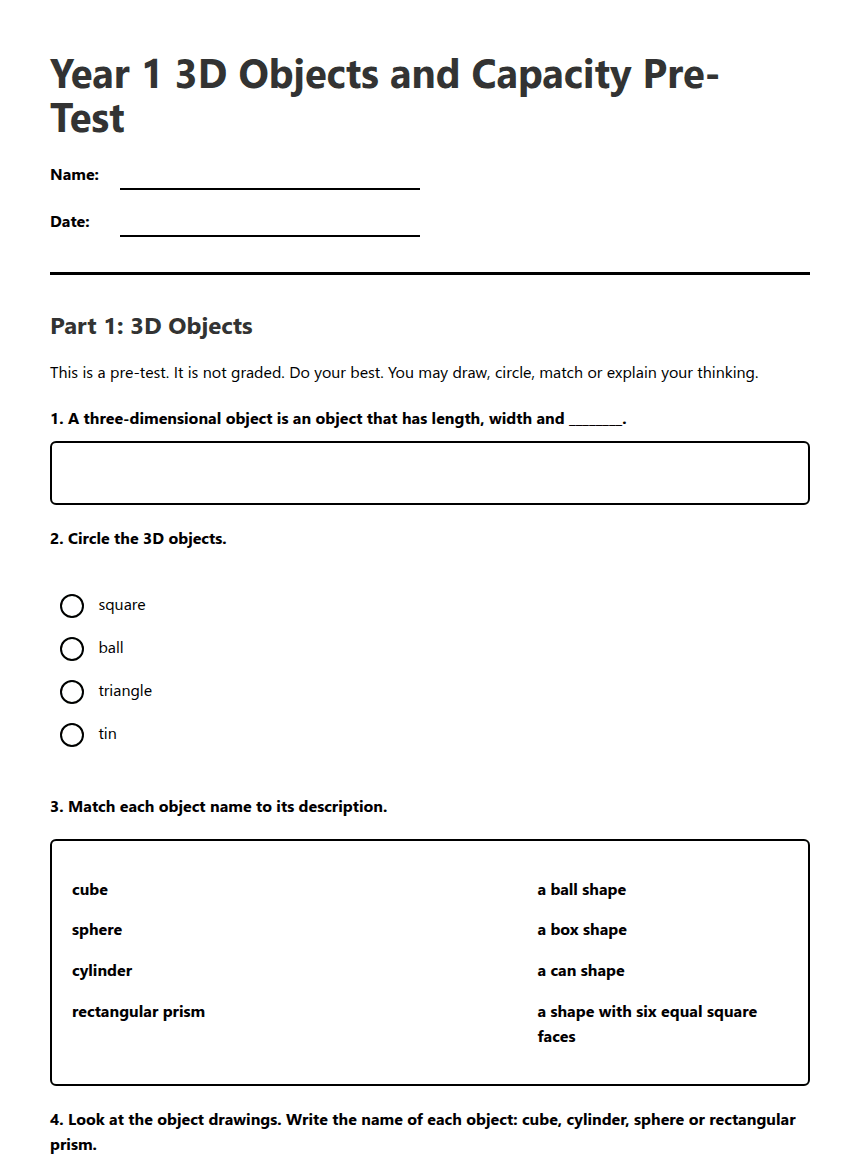
Year 1 3D Objects and Capacity Pre-Test
Part 1: 3D Objects
This is a pre-test. It is not graded. Do your best. You may draw, circle, match or explain your thinking.
Part 2: Capacity and Packing
My estimate: ________ cups
I used ________ cups.
Teacher-Only Answer Guide
Diagnostic purpose: This pre-test identifies prior knowledge. It is not graded. Accept drawings and explanations that show developing understanding. Record strategies, language and misconceptions.
1. Height, depth or another suitable word describing the third dimension.
2. Ball and tin.
3. Cube: six equal square faces; sphere: ball shape; cylinder: can shape; rectangular prism: box shape.
4. Expected names are cube, cylinder, sphere and rectangular prism in the order shown.
5. Sphere.
6. Cube and rectangular prism have only flat faces. Ball and tin have a curved surface.
7. Cylinder.
8. No single fixed answer without the drawings being specified. Observe whether the student compares the containers using size, shape or a capacity test rather than height alone.
9. Fill both using the same-sized cup and compare the number of cups, or pour one container into the other.
10. Cups of water.
11–12. Answers depend on the container. Observe whether the student estimates, uses a consistent unit and counts accurately when checking.
13. The student should explain that the cups are different sizes, so the numbers cannot be compared fairly unless the same unit is used.
14. More.
15. Cubes in straight rows with no gaps.
16. Cubes have flat faces and fit together closely. Balls leave spaces between them.
17. The count may not be accurate because the gaps take up space.
18. Cubes should be arranged in rows with no gaps, where possible. Observe spatial reasoning and whether the student recognises that equal-sized cubes can be counted as informal units.
Observe for MA1-WM-01: Does the student explain ideas, make estimates, choose a useful strategy, compare results and check whether an answer is reasonable?
Observe for MA1-3DS-01: Does the student recognise, name, describe and sort familiar 3D objects by surfaces and faces?
Observe for MA1-3DS-02: Does the student compare and measure capacity using uniform informal units, understand the effect of unit size, and recognise the importance of avoiding gaps?
About This Worksheet
Free in Kuraplan
Sign up free, grab the PDF, and customize it for your class.
Print-Ready
Formatted for standard paper. Clean layout, easy to read.
AI-Generated
Created with Kuraplan's AI, designed for real classroom use.
For Teachers & Parents
Use in classrooms, for homework, tutoring, or homeschool.
Need a custom version of this worksheet?
Kuraplan's AI generates custom worksheets in seconds — differentiated for every learner, aligned to your curriculum.
Generate Custom Worksheets — Free