ScienceFreePrintable
Algebra and Reaction Rates
A free science worksheet ready for your classroom. Open in Kuraplan to grab the print-ready PDF, customize it for your students, or generate a fresh version in seconds.
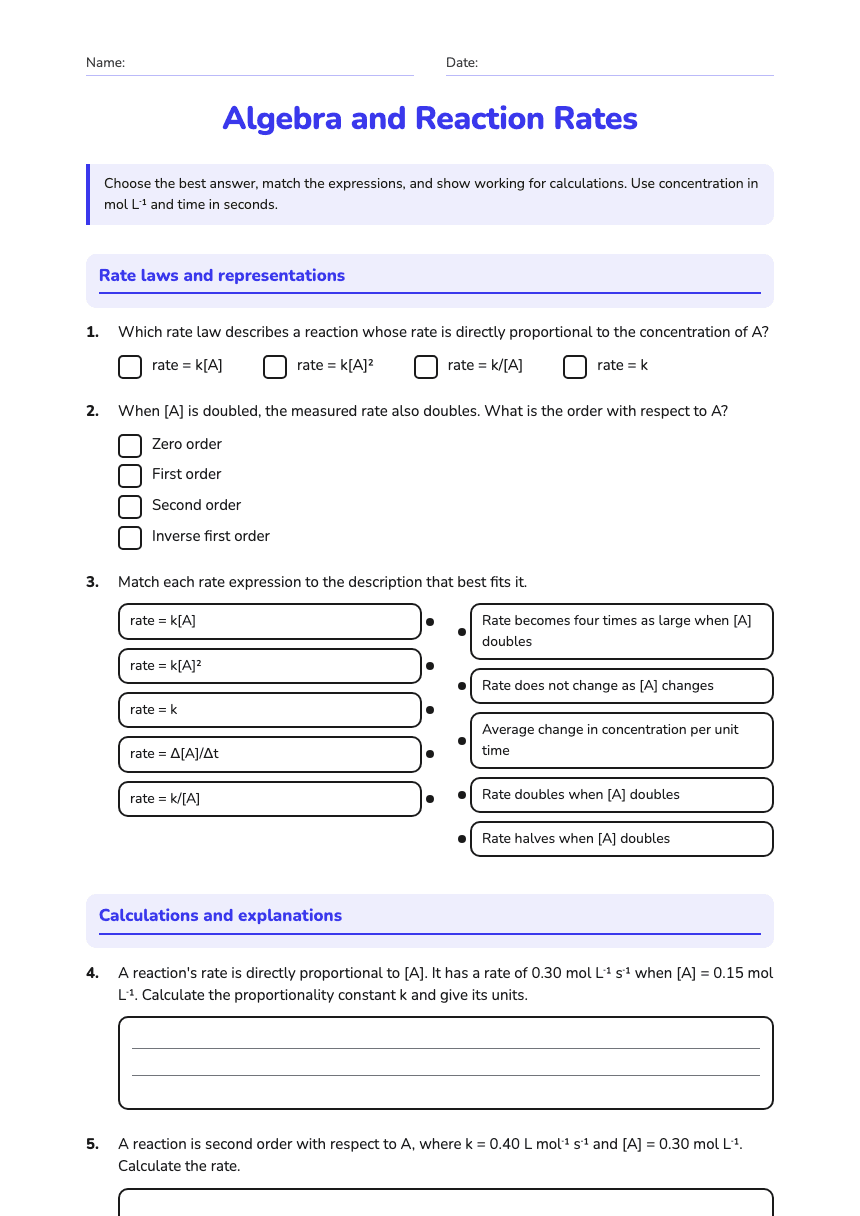
Name:Date:
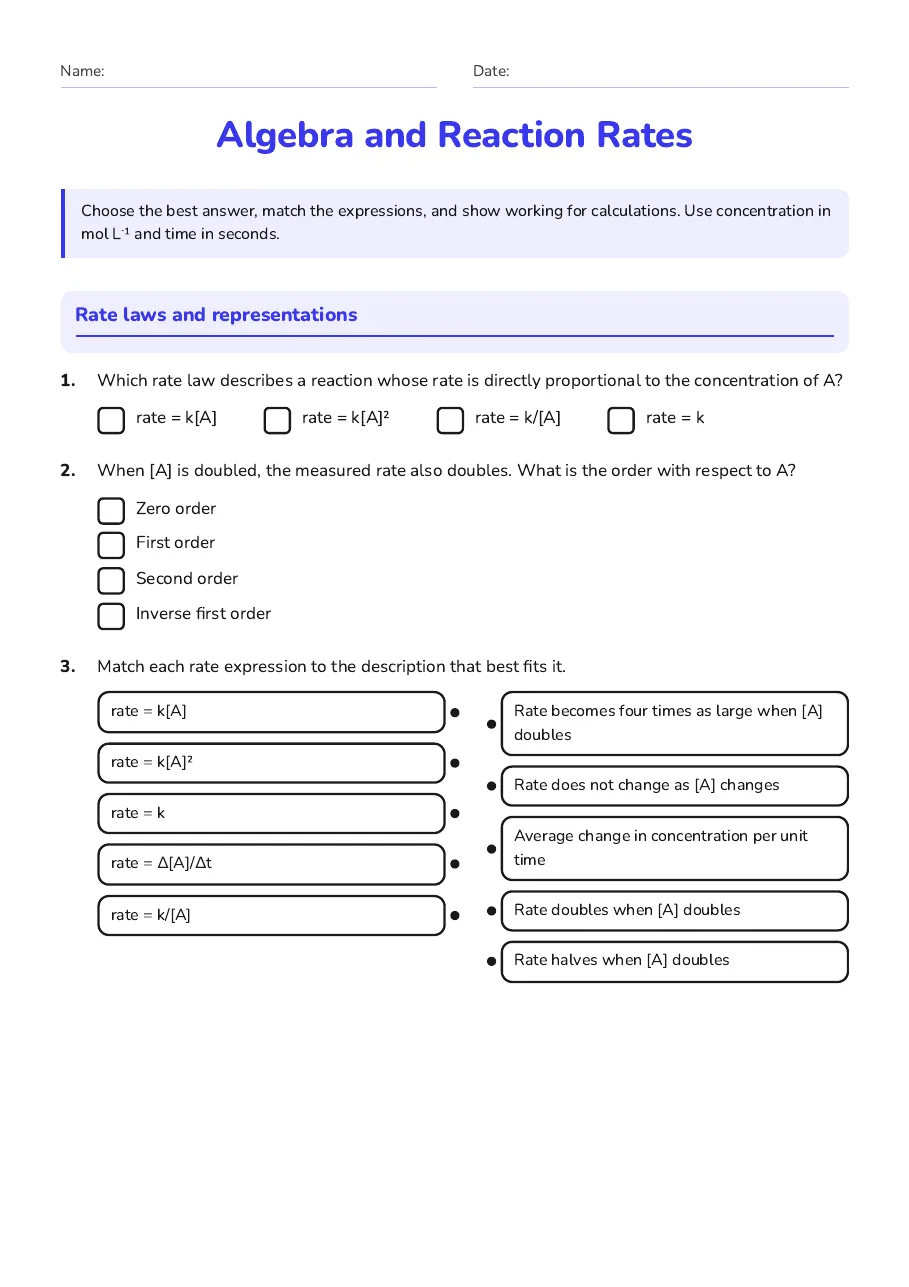
Algebra and Reaction Rates
Choose the best answer, match the expressions, and show working for calculations. Use concentration in mol L⁻¹ and time in seconds.
Rate laws and representations
1.Which rate law describes a reaction whose rate is directly proportional to the concentration of A?
- rate = k[A]
- rate = k[A]²
- rate = k/[A]
- rate = k
2.When [A] is doubled, the measured rate also doubles. What is the order with respect to A?
- Zero order
- First order
- Second order
- Inverse first order
3.Match each rate expression to the description that best fits it.
- rate = k[A]
- rate = k[A]²
- rate = k
- rate = Δ[A]/Δt
- rate = k/[A]
- Rate becomes four times as large when [A] doubles
- Rate does not change as [A] changes
- Average change in concentration per unit time
- Rate doubles when [A] doubles
- Rate halves when [A] doubles
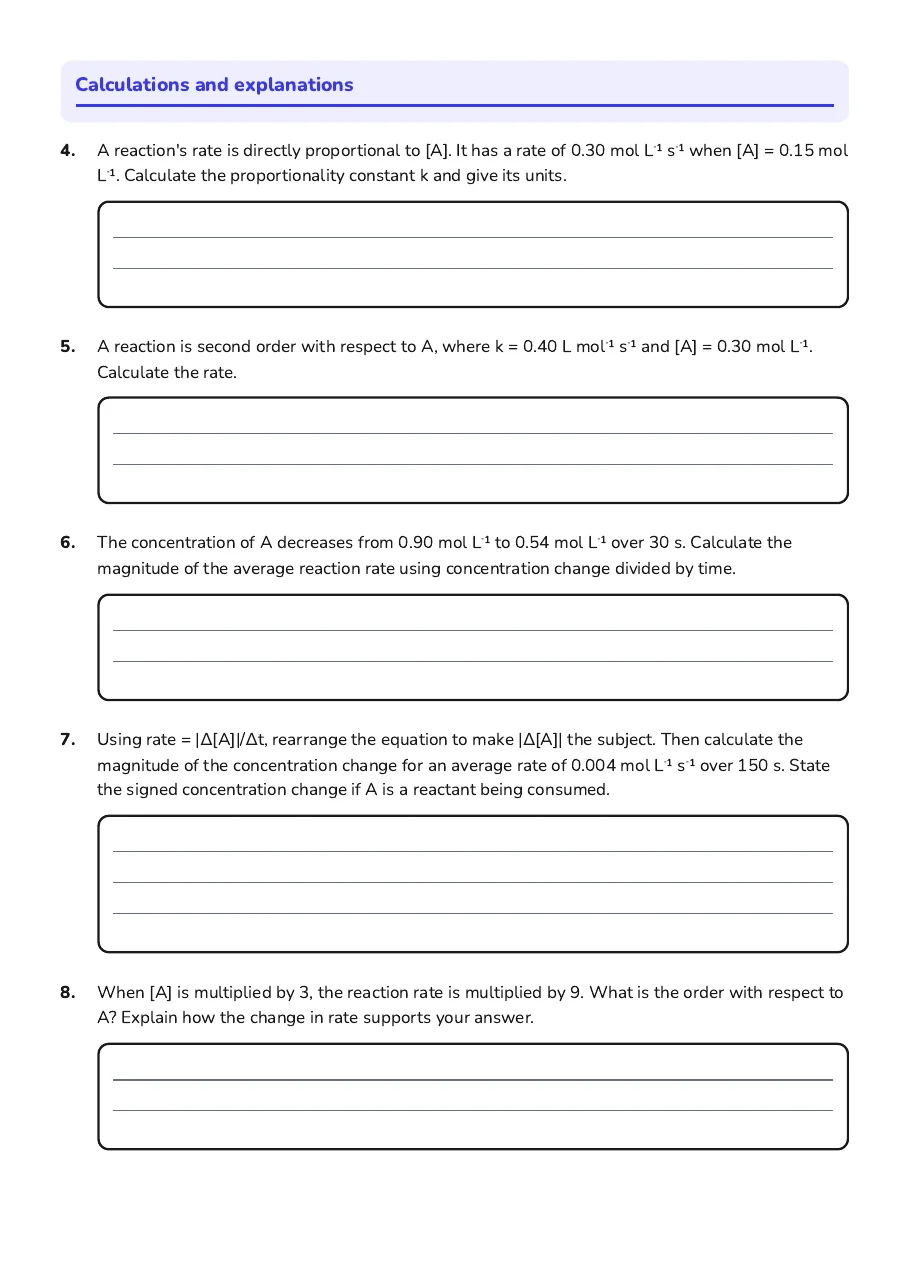
Calculations and explanations
4.A reaction's rate is directly proportional to [A]. It has a rate of 0.30 mol L⁻¹ s⁻¹ when [A] = 0.15 mol L⁻¹. Calculate the proportionality constant k and give its units.
5.A reaction is second order with respect to A, where k = 0.40 L mol⁻¹ s⁻¹ and [A] = 0.30 mol L⁻¹. Calculate the rate.
6.The concentration of A decreases from 0.90 mol L⁻¹ to 0.54 mol L⁻¹ over 30 s. Calculate the magnitude of the average reaction rate using concentration change divided by time.
7.Using rate = |Δ[A]|/Δt, rearrange the equation to make |Δ[A]| the subject. Then calculate the magnitude of the concentration change for an average rate of 0.004 mol L⁻¹ s⁻¹ over 150 s. State the signed concentration change if A is a reactant being consumed.
8.When [A] is multiplied by 3, the reaction rate is multiplied by 9. What is the order with respect to A? Explain how the change in rate supports your answer.
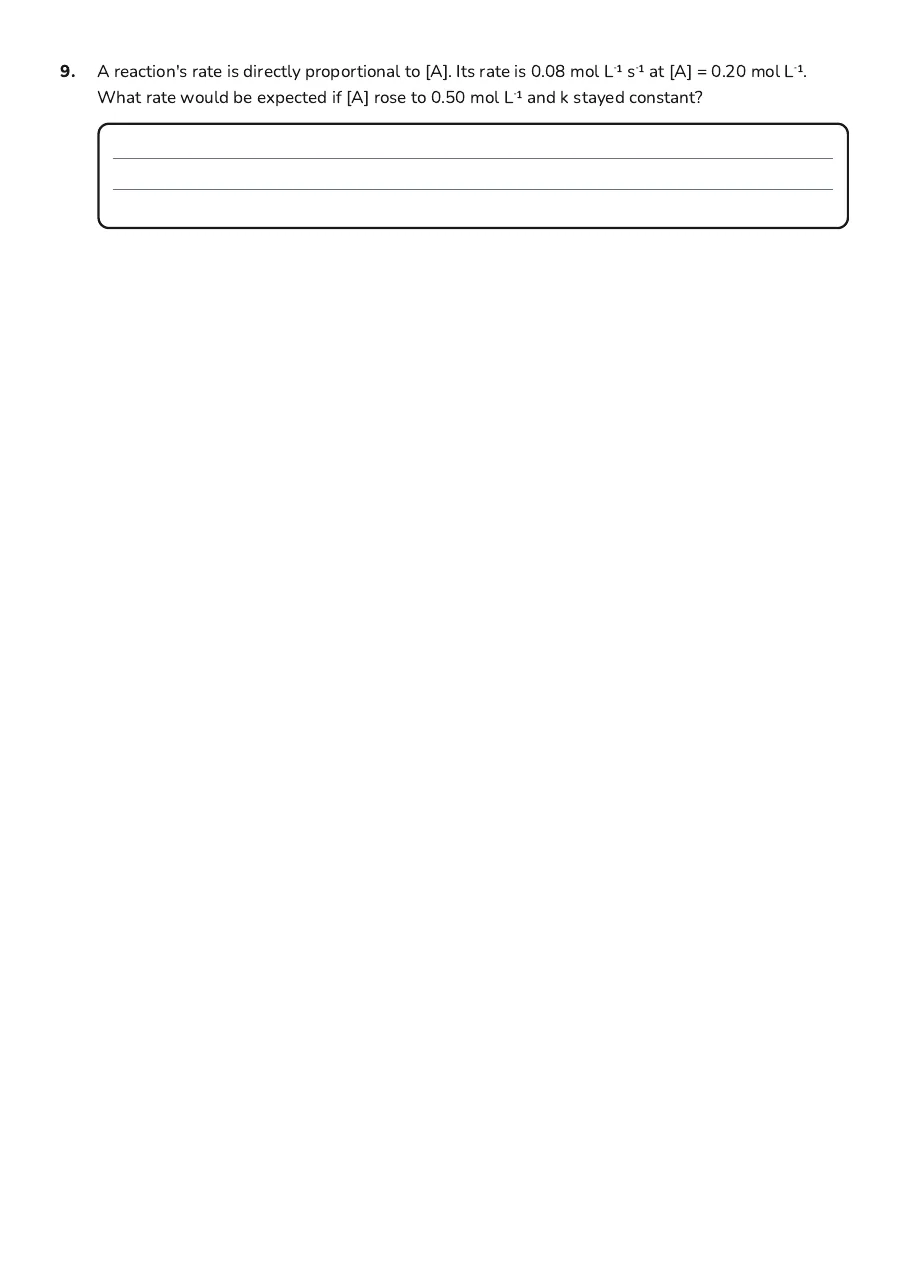
9.A reaction's rate is directly proportional to [A]. Its rate is 0.08 mol L⁻¹ s⁻¹ at [A] = 0.20 mol L⁻¹. What rate would be expected if [A] rose to 0.50 mol L⁻¹ and k stayed constant?
3 printable pages
Page 1
Page 2
Page 3
About This Worksheet
Free in Kuraplan
Sign up free, grab the PDF, and customize it for your class.
Print-Ready
Formatted for standard paper. Clean layout, easy to read.
AI-Generated
Created with Kuraplan's AI, designed for real classroom use.
For Teachers & Parents
Use in classrooms, for homework, tutoring, or homeschool.
Need a custom version of this worksheet?
Kuraplan's AI generates custom worksheets in seconds — differentiated for every learner, aligned to your curriculum.
Generate Custom Worksheets — Free No credit card Curriculum-aligned Under 60 seconds