Social SciencesFreePrintable

Archaeological Tools Worksheet

A free social sciences worksheet ready for your classroom. Open in Kuraplan to grab the print-ready PDF, customize it for your students, or generate a fresh version in seconds.
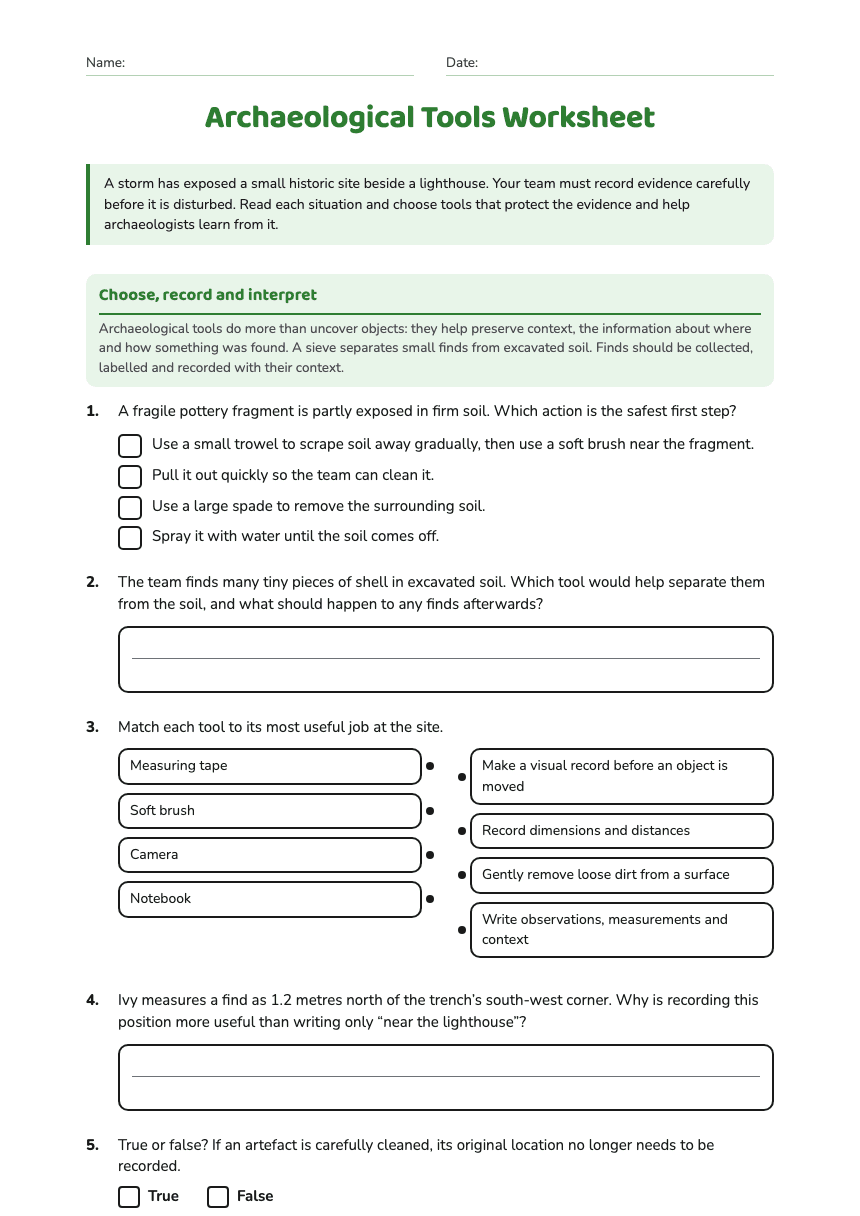
Archaeological Tools Worksheet worksheet preview
Name:Date:

Archaeological Tools Worksheet

A storm has exposed a small historic site beside a lighthouse. Your team must record evidence carefully before it is disturbed. Read each situation and choose tools that protect the evidence and help archaeologists learn from it.

Choose, record and interpret

Archaeological tools do more than uncover objects: they help preserve context, the information about where and how something was found. A sieve separates small finds from excavated soil. Finds should be collected, labelled and recorded with their context.

1.A fragile pottery fragment is partly exposed in firm soil. Which action is the safest first step?
  • Use a small trowel to scrape soil away gradually, then use a soft brush near the fragment.
  • Pull it out quickly so the team can clean it.
  • Use a large spade to remove the surrounding soil.
  • Spray it with water until the soil comes off.
2.The team finds many tiny pieces of shell in excavated soil. Which tool would help separate them from the soil, and what should happen to any finds afterwards?
3.Match each tool to its most useful job at the site.
  • Measuring tape
  • Soft brush
  • Camera
  • Notebook
  • Make a visual record before an object is moved
  • Record dimensions and distances
  • Gently remove loose dirt from a surface
  • Write observations, measurements and context
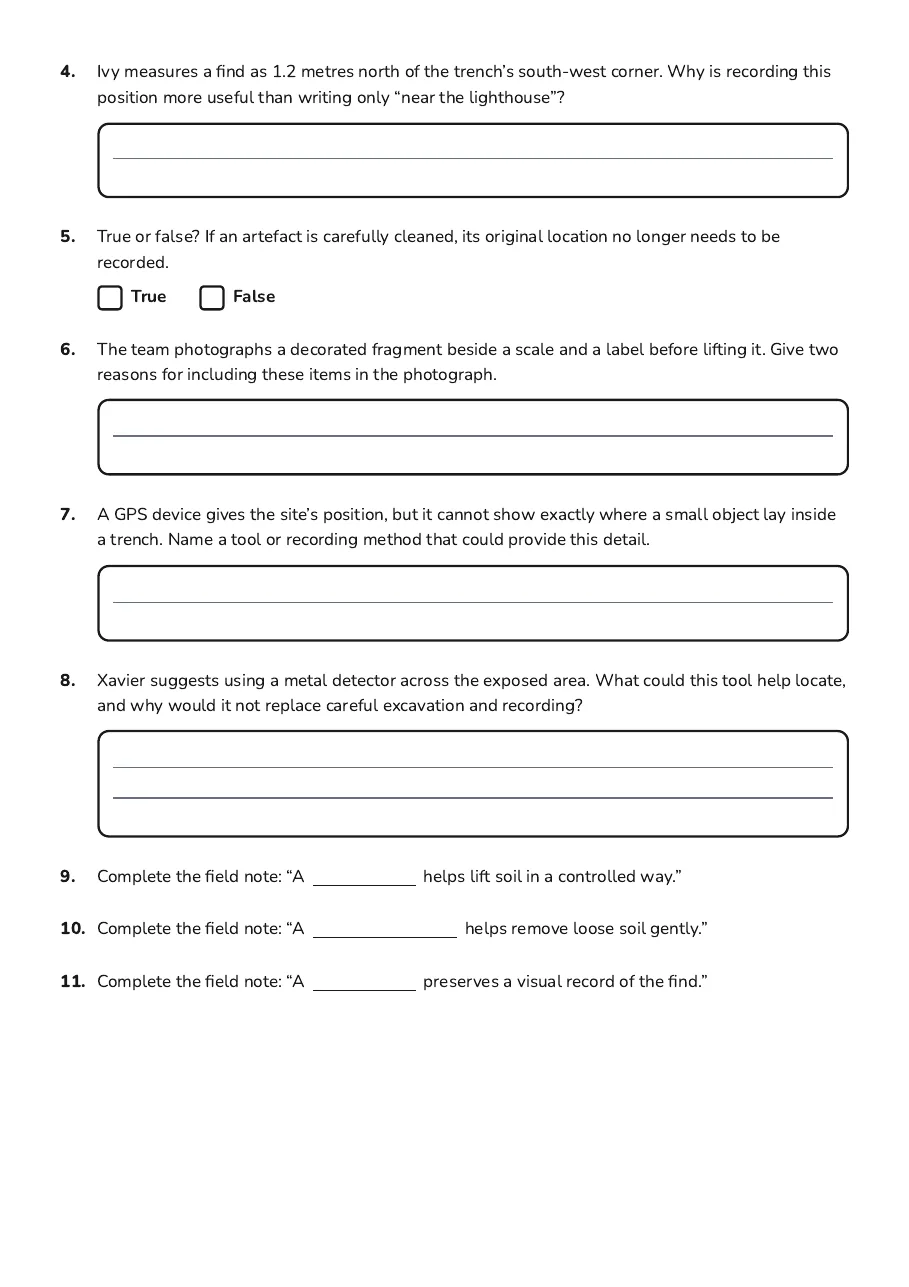
4.Ivy measures a find as 1.2 metres north of the trench’s south-west corner. Why is recording this position more useful than writing only “near the lighthouse”?
5.True or false? If an artefact is carefully cleaned, its original location no longer needs to be recorded.
TrueFalse
6.The team photographs a decorated fragment beside a scale and a label before lifting it. Give two reasons for including these items in the photograph.
7.A GPS device gives the site’s position, but it cannot show exactly where a small object lay inside a trench. Name a tool or recording method that could provide this detail.
8.Xavier suggests using a metal detector across the exposed area. What could this tool help locate, and why would it not replace careful excavation and recording?
9.Complete the field note: “A helps lift soil in a controlled way.”
10.Complete the field note: “A helps remove loose soil gently.”
11.Complete the field note: “A preserves a visual record of the find.”
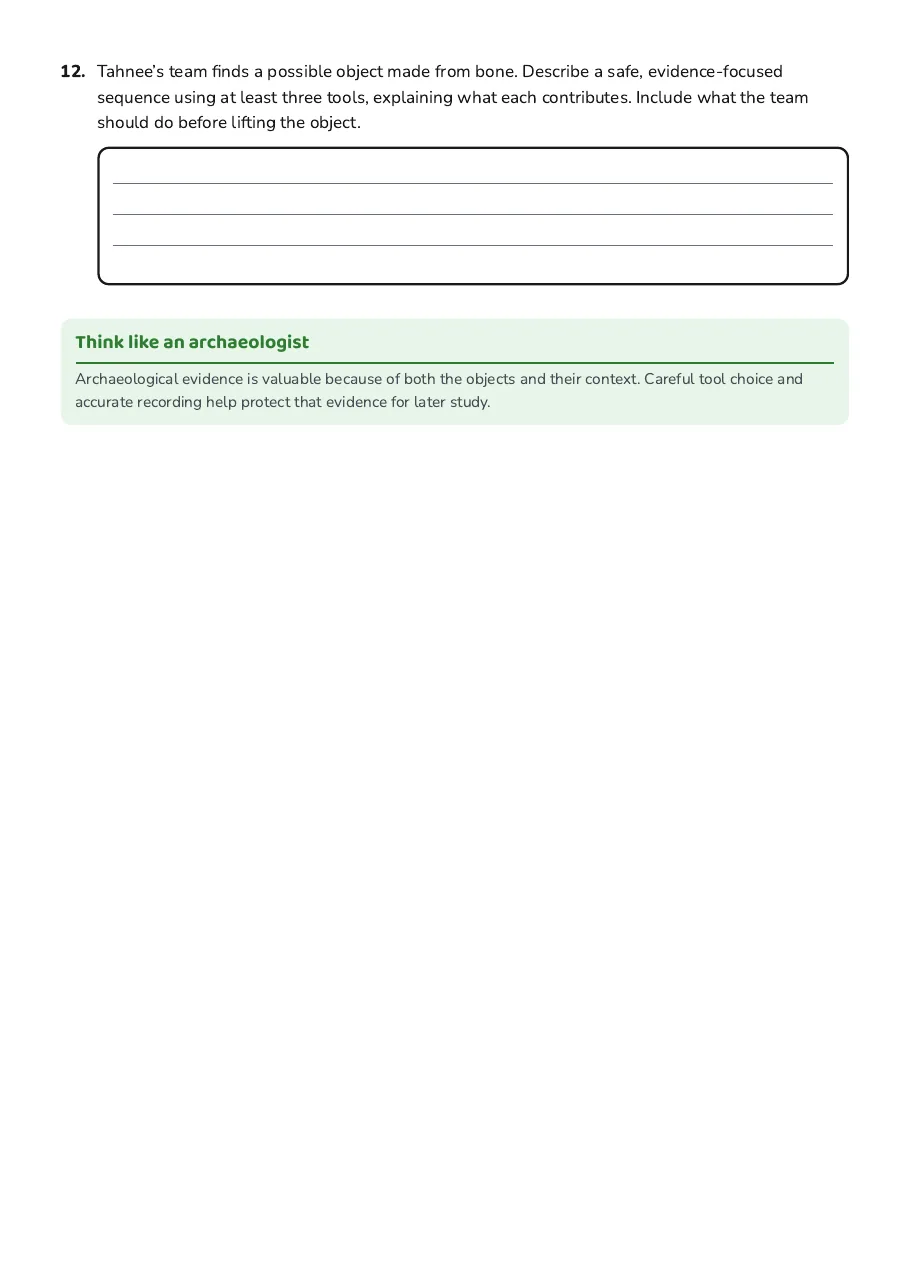
12.Tahnee’s team finds a possible object made from bone. Describe a safe, evidence-focused sequence using at least three tools, explaining what each contributes. Include what the team should do before lifting the object.

Think like an archaeologist

Archaeological evidence is valuable because of both the objects and their context. Careful tool choice and accurate recording help protect that evidence for later study.

3 printable pages
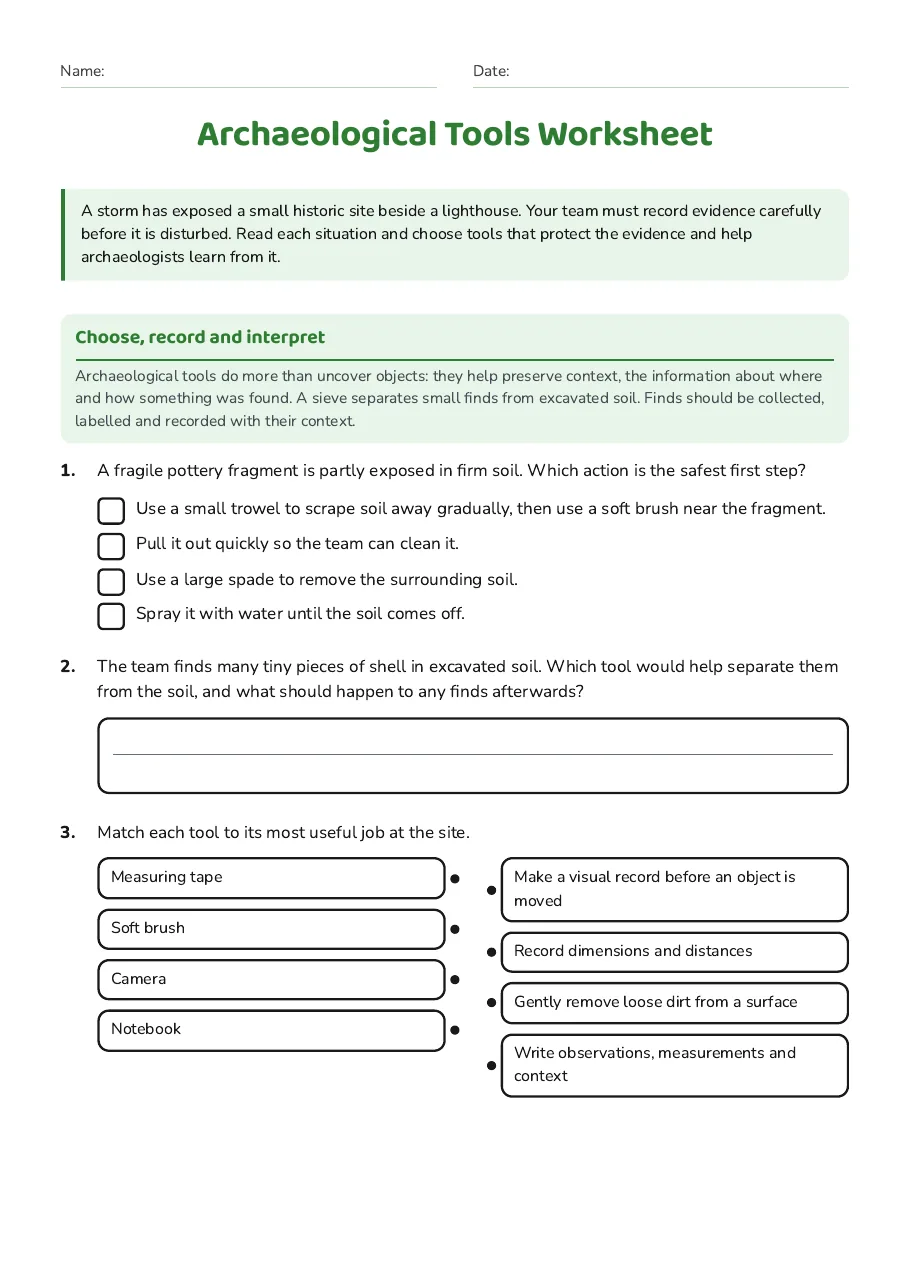
  • Archaeological Tools Worksheet, page 1 of 3: Choose, record and interpret

    Page 1

  • Archaeological Tools Worksheet, page 2 of 3: 4. Ivy measures a find as 1.2 metres north of the trench’s south-west corner. Why is…

    Page 2

  • Archaeological Tools Worksheet, page 3 of 3: Think like an archaeologist

    Page 3

About This Worksheet

Free in Kuraplan

Sign up free, grab the PDF, and customize it for your class.

Print-Ready

Formatted for standard paper. Clean layout, easy to read.

AI-Generated

Created with Kuraplan's AI, designed for real classroom use.

For Teachers & Parents

Use in classrooms, for homework, tutoring, or homeschool.

Need a custom version of this worksheet?

Kuraplan's AI generates custom worksheets in seconds — differentiated for every learner, aligned to your curriculum.

Generate Custom Worksheets — Free
No credit card Curriculum-aligned Under 60 seconds