Australian Deaf History Articles
A free languages worksheet ready for your classroom. Open in Kuraplan to grab the print-ready PDF, customize it for your students, or generate a fresh version in seconds.

Australian Deaf History Articles
📚 Part 1: Choose Your Article
Instructions: Read all three articles below. Choose one article that interests you most for your research and writing task. Use the visual supports and ask for help with any unfamiliar words.
Article 1: The First Deaf Schools in Australia
In 1860, the first school for deaf children opened in Sydney, New South Wales. It was called the New South Wales Institution for the Deaf and Dumb. Thomas Pattison, a deaf teacher from Scotland, helped start this important school. Before this school existed, many deaf children in Australia could not get a proper education.
The school taught children how to communicate using sign language and also how to read and write English. Students lived at the school during the week and went home on weekends. Many families travelled hundreds of kilometres to bring their deaf children to this school because it was the only one in Australia at that time.
By 1875, more deaf schools opened in Melbourne and Adelaide. These schools became the foundation of Deaf education in Australia and helped create the strong Deaf community we see today.
Article 2: Australian Sign Language (Auslan) - Our Visual Language
Australian Sign Language, known as Auslan, is the main language used by the Australian Deaf community. Auslan developed from British Sign Language when deaf people first came to Australia in the 1800s. Over time, it grew and changed to become uniquely Australian.
Auslan uses hand shapes, movements, facial expressions, and body language to communicate. It is a complete language with its own grammar rules, just like English or any other spoken language. About 16,000 people in Australia use Auslan as their first language.
In 1991, Auslan was officially recognised as a community language by the Australian government. This was a huge victory for the Deaf community because it meant their language was respected and valued. Today, Auslan is taught in many schools across Australia, helping hearing people learn to communicate with their deaf friends and family members.
Article 3: Deaf Sports and the Deaflympics
Deaf people have always been excellent athletes. The first international sports competition for deaf athletes was held in 1924 in Paris, France. This competition later became known as the Deaflympics - the Olympics for deaf athletes.
Australia first competed in the Deaflympics in 1953 and has won many medals over the years. Australian deaf athletes have excelled in swimming, athletics, basketball, and tennis. One famous Australian deaf athlete is Danni Di Toro, who won medals in both wheelchair racing and wheelchair tennis.
The Deaflympics are special because all communication during the games happens visually. Starting signals use lights instead of sounds, and sign language interpreters help athletes communicate with coaches and officials. These games celebrate both athletic excellence and Deaf culture, bringing together deaf athletes from around the world.
✏️ Part 2: Comprehension Questions
Instructions: Answer the questions for the article you chose to read and research.
Questions for Article 1: The First Deaf Schools
Questions for Article 2: Australian Sign Language (Auslan)
Questions for Article 3: Deaf Sports and the Deaflympics
🔍 Part 3: Research Planning
1. _________________________________________________
2. _________________________________________________
3. _________________________________________________
Visual Supports Available: Auslan dictionary, picture cards, historical photos, and sign language videos
Next Steps: Use your answers above to help you write your research report about Australian Deaf history!
About This Worksheet
Free in Kuraplan
Sign up free, grab the PDF, and customize it for your class.
Print-Ready
Formatted for standard paper. Clean layout, easy to read.
AI-Generated
Created with Kuraplan's AI, designed for real classroom use.
For Teachers & Parents
Use in classrooms, for homework, tutoring, or homeschool.
Need a custom version of this worksheet?
Kuraplan's AI generates custom worksheets in seconds — differentiated for every learner, aligned to your curriculum.
Generate Custom Worksheets — FreeMore Languages Worksheets
Year 7 History Worksheet
Free
Australian Diversity Categories
Free
Australian Federation Fun Facts
Free
Australian History Texts
Free
Fossil Hunters: Digging Into History
Free
Personal History Drawing Sheet
Free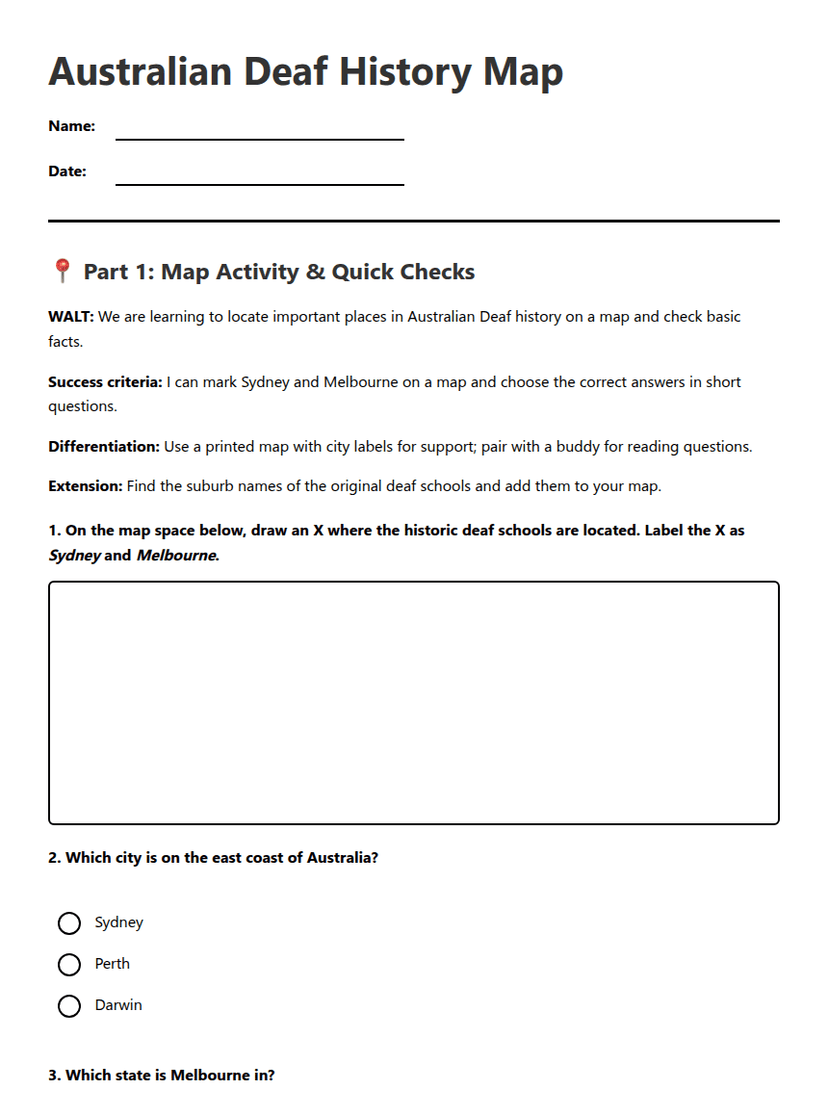
Australian Deaf History Map
Free