Australian Environments Assessment Rubric
A free social sciences worksheet ready for your classroom. Open in Kuraplan to grab the print-ready PDF, customize it for your students, or generate a fresh version in seconds.
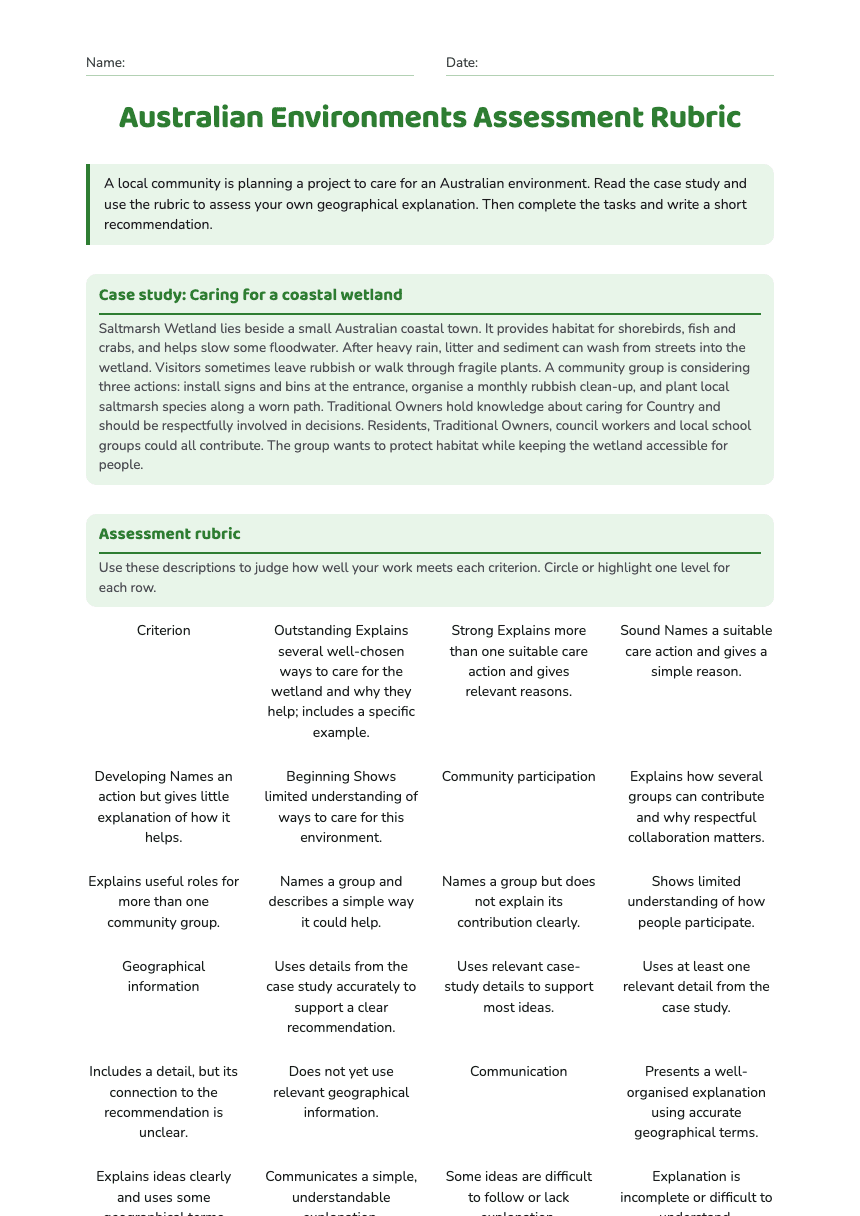
Australian Environments Assessment Rubric
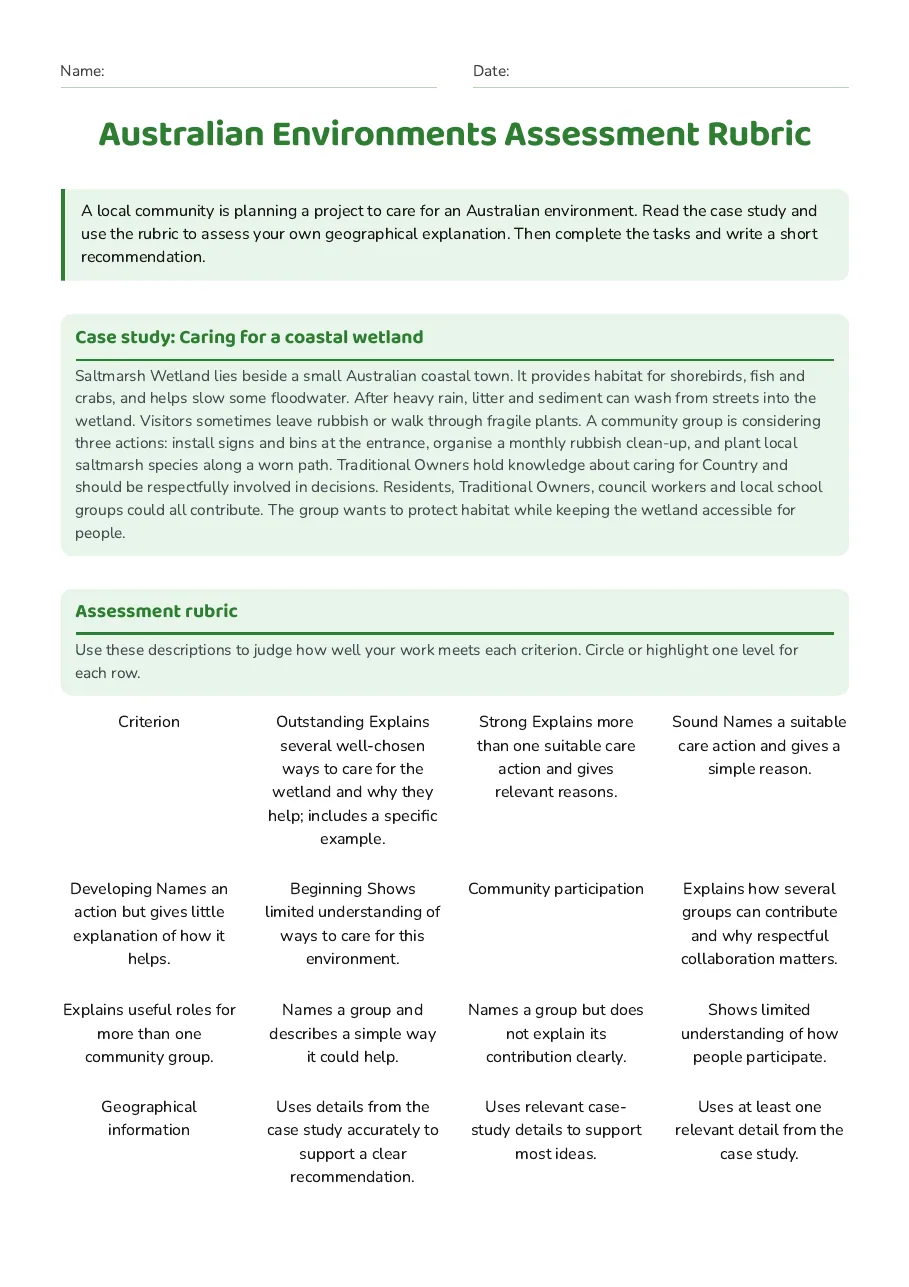
Case study: Caring for a coastal wetland
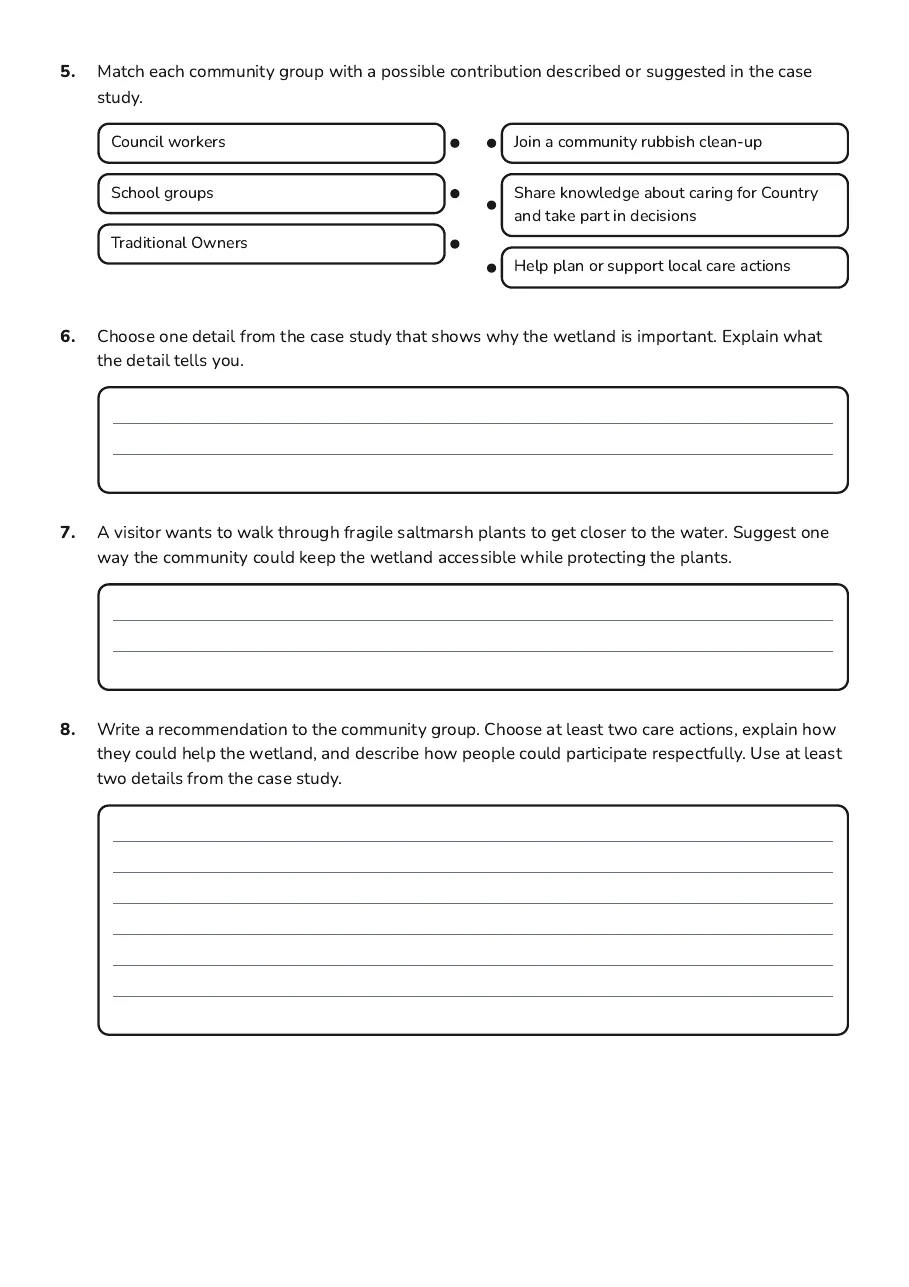
Saltmarsh Wetland lies beside a small Australian coastal town. It provides habitat for shorebirds, fish and crabs, and helps slow some floodwater. After heavy rain, litter and sediment can wash from streets into the wetland. Visitors sometimes leave rubbish or walk through fragile plants. A community group is considering three actions: install signs and bins at the entrance, organise a monthly rubbish clean-up, and plant local saltmarsh species along a worn path. Traditional Owners hold knowledge about caring for Country and should be respectfully involved in decisions. Residents, Traditional Owners, council workers and local school groups could all contribute. The group wants to protect habitat while keeping the wetland accessible for people.
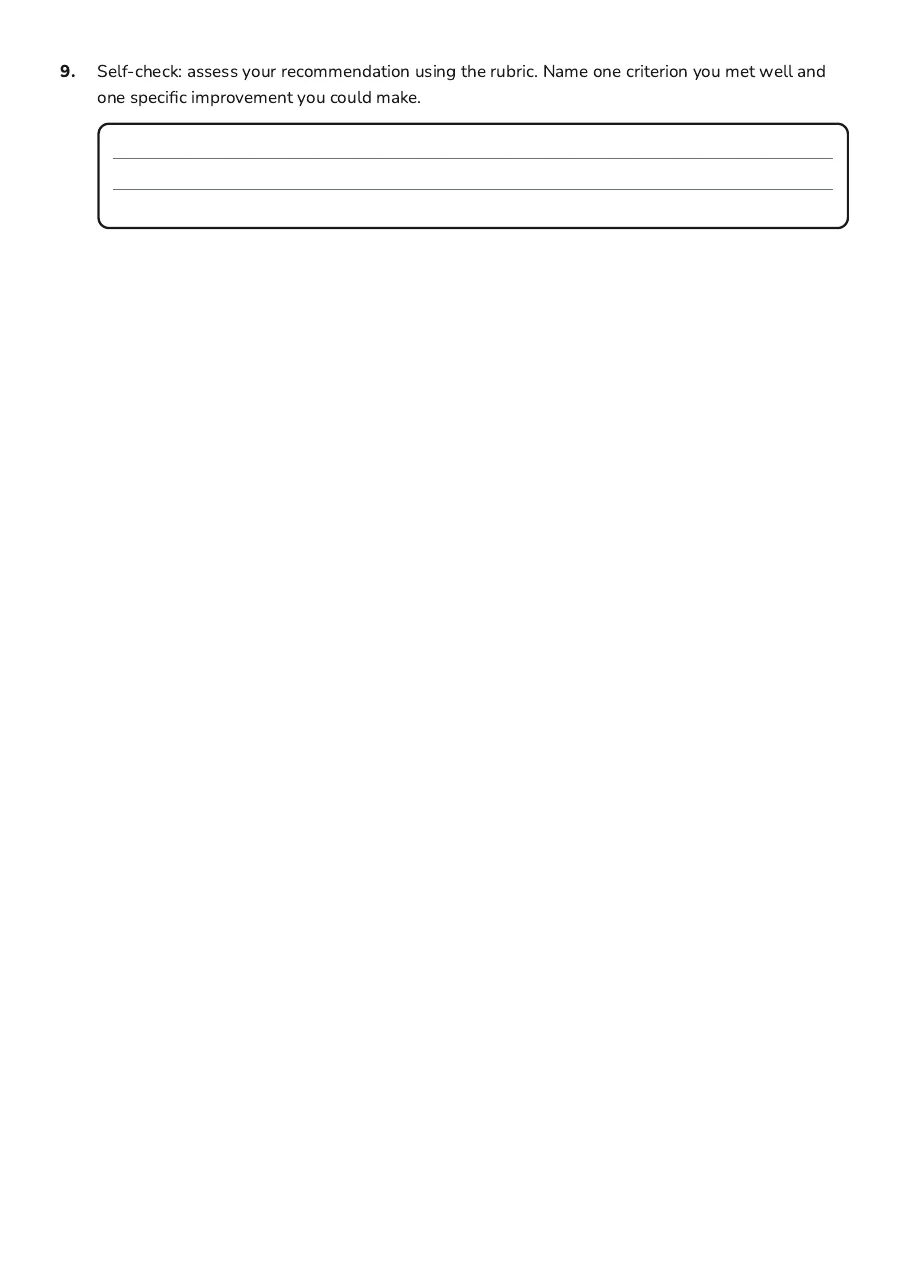
Assessment rubric
Use these descriptions to judge how well your work meets each criterion. Circle or highlight one level for each row.
Criterion
Outstanding Explains several well-chosen ways to care for the wetland and why they help; includes a specific example.
Strong Explains more than one suitable care action and gives relevant reasons.
Sound Names a suitable care action and gives a simple reason.
Developing Names an action but gives little explanation of how it helps.
Beginning Shows limited understanding of ways to care for this environment.
Community participation
Explains how several groups can contribute and why respectful collaboration matters.
Explains useful roles for more than one community group.
Names a group and describes a simple way it could help.
Names a group but does not explain its contribution clearly.
Shows limited understanding of how people participate.
Geographical information
Uses details from the case study accurately to support a clear recommendation.
Uses relevant case-study details to support most ideas.
Uses at least one relevant detail from the case study.
Includes a detail, but its connection to the recommendation is unclear.
Does not yet use relevant geographical information.
Communication
Presents a well-organised explanation using accurate geographical terms.
Explains ideas clearly and uses some geographical terms correctly.
Communicates a simple, understandable explanation.
Some ideas are difficult to follow or lack explanation.
Explanation is incomplete or difficult to understand.
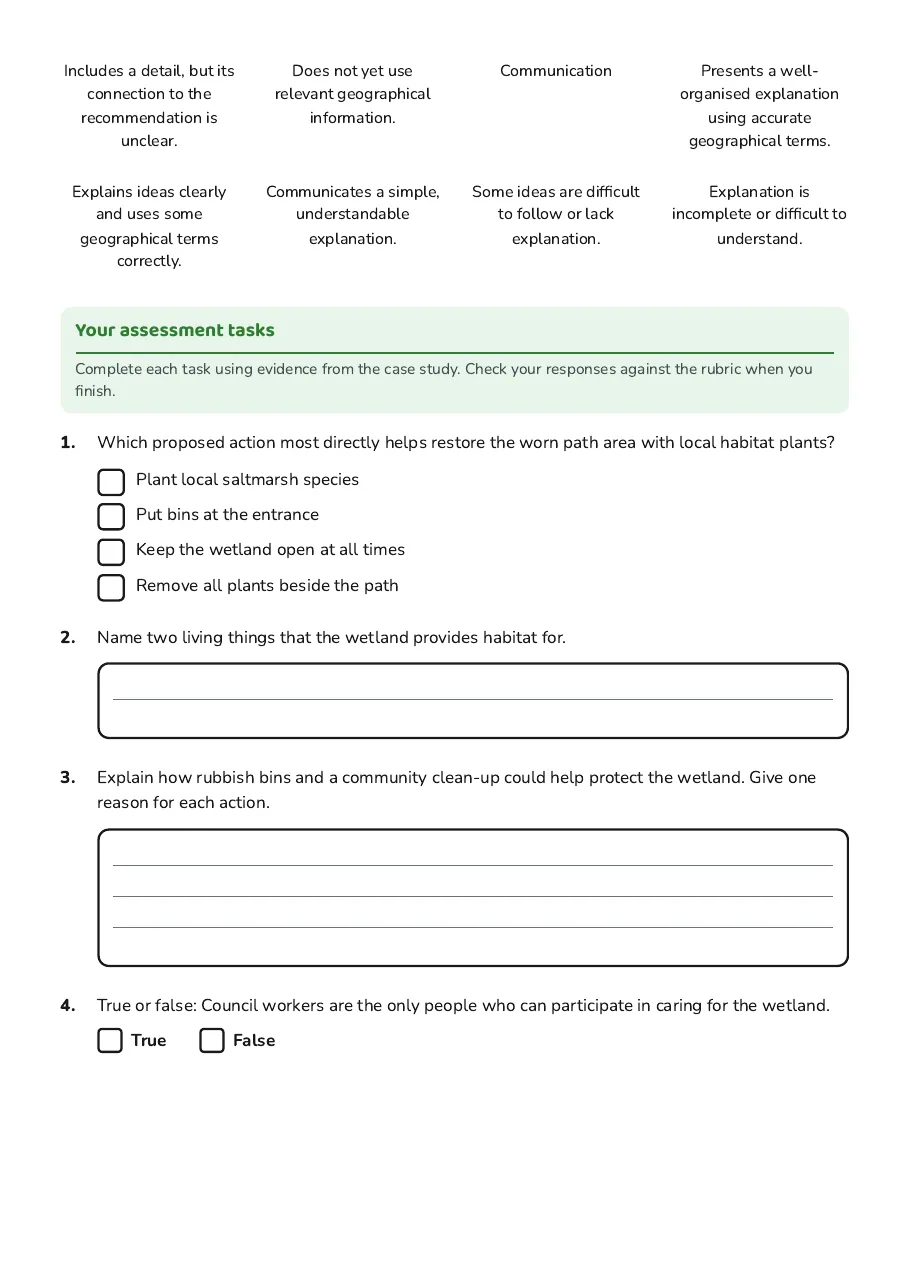
Your assessment tasks
Complete each task using evidence from the case study. Check your responses against the rubric when you finish.
- Plant local saltmarsh species
- Put bins at the entrance
- Keep the wetland open at all times
- Remove all plants beside the path
- Council workers
- School groups
- Traditional Owners
- Join a community rubbish clean-up
- Share knowledge about caring for Country and take part in decisions
- Help plan or support local care actions
4 printable pages
Page 1
Page 2
Page 3
Page 4
About This Worksheet
Free in Kuraplan
Sign up free, grab the PDF, and customize it for your class.
Print-Ready
Formatted for standard paper. Clean layout, easy to read.
AI-Generated
Created with Kuraplan's AI, designed for real classroom use.
For Teachers & Parents
Use in classrooms, for homework, tutoring, or homeschool.
Need a custom version of this worksheet?
Kuraplan's AI generates custom worksheets in seconds — differentiated for every learner, aligned to your curriculum.
Generate Custom Worksheets — FreeMore Social Sciences Worksheets
Magnetic Island Sustainability Practices
Free
Indigenous Water Cultural Significance
Free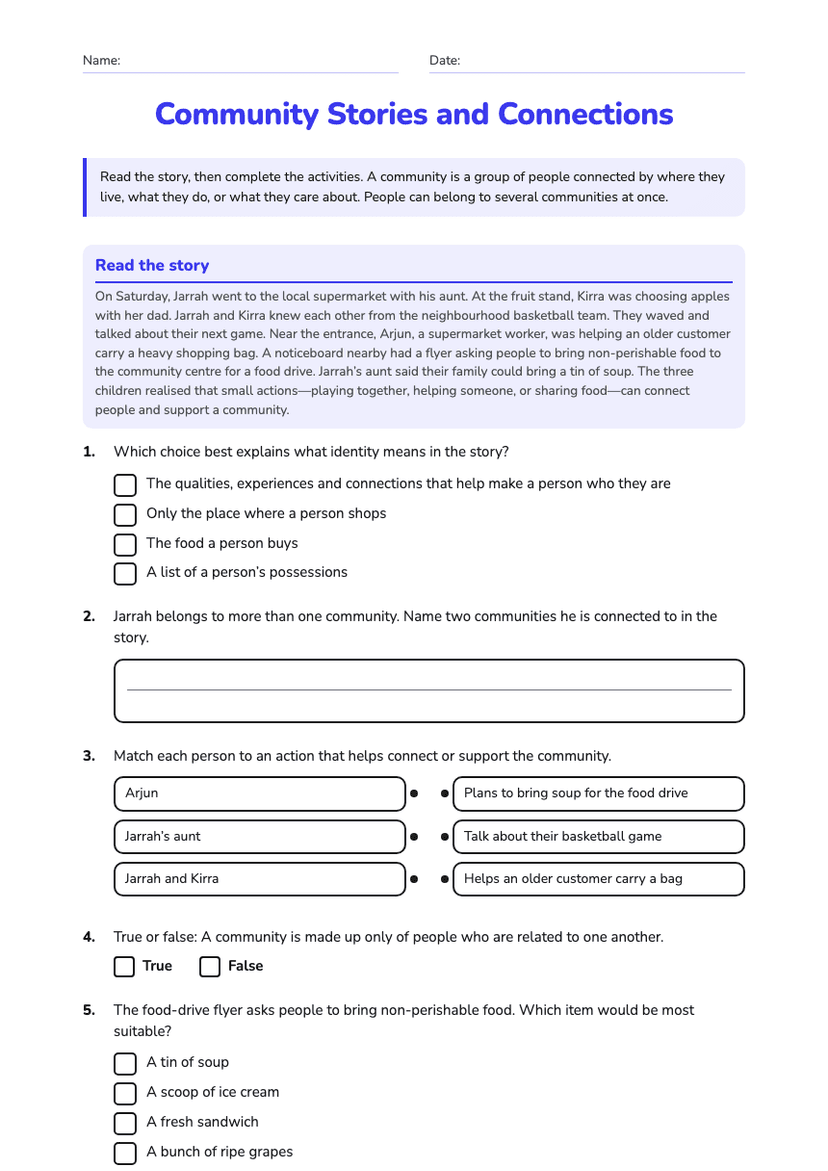
Community Stories and Connections
Free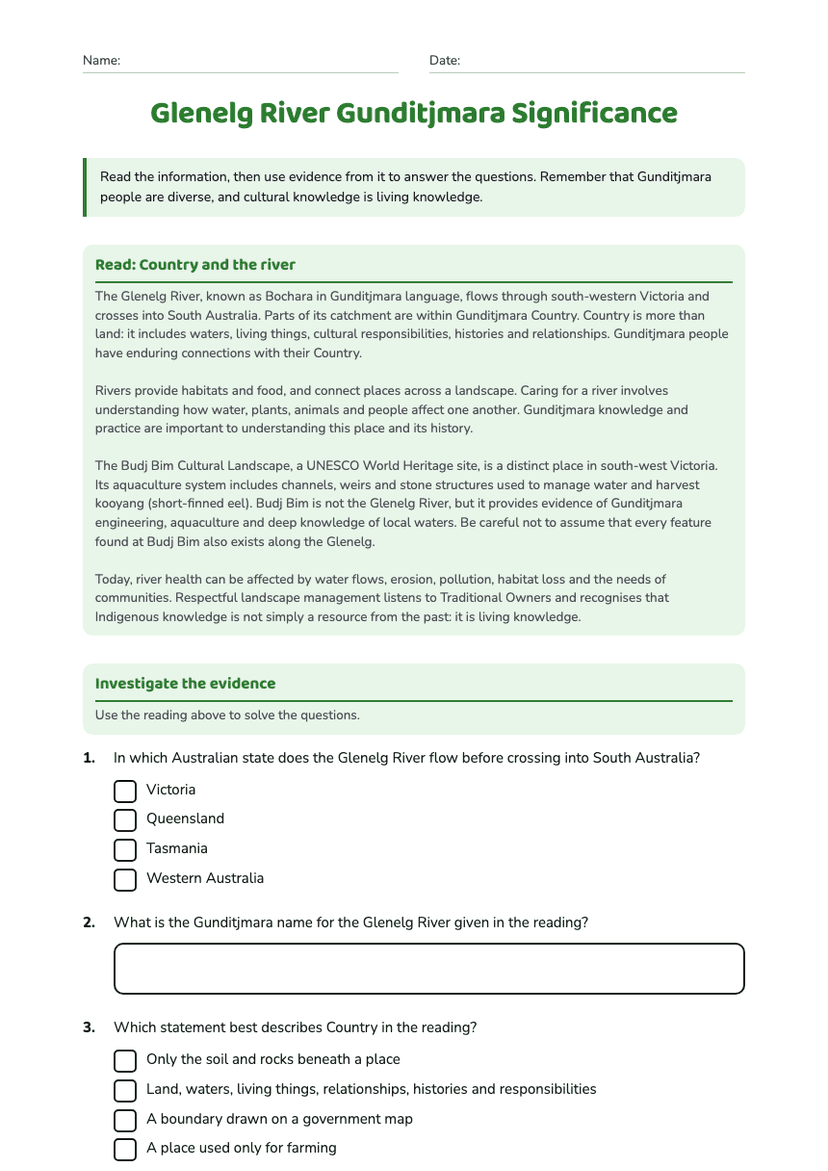
Glenelg River Gunditjmara Significance
Free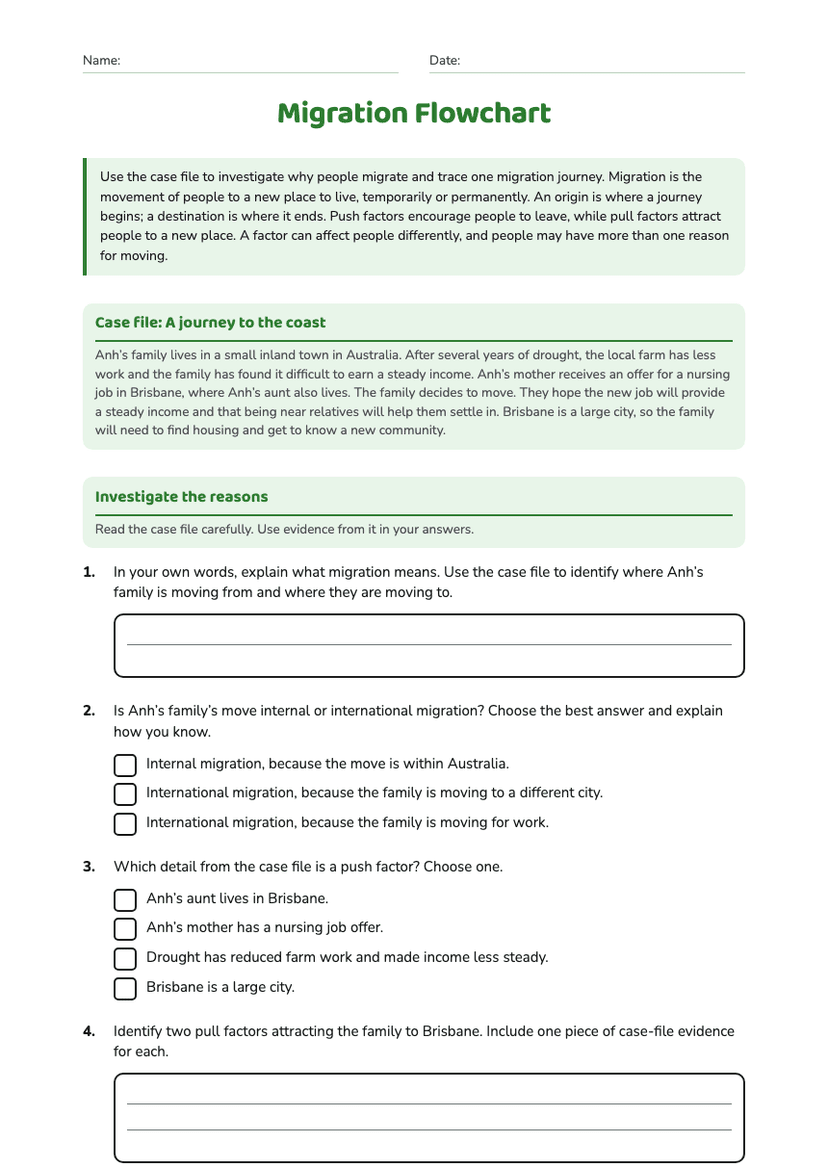
Migration Flowchart
Free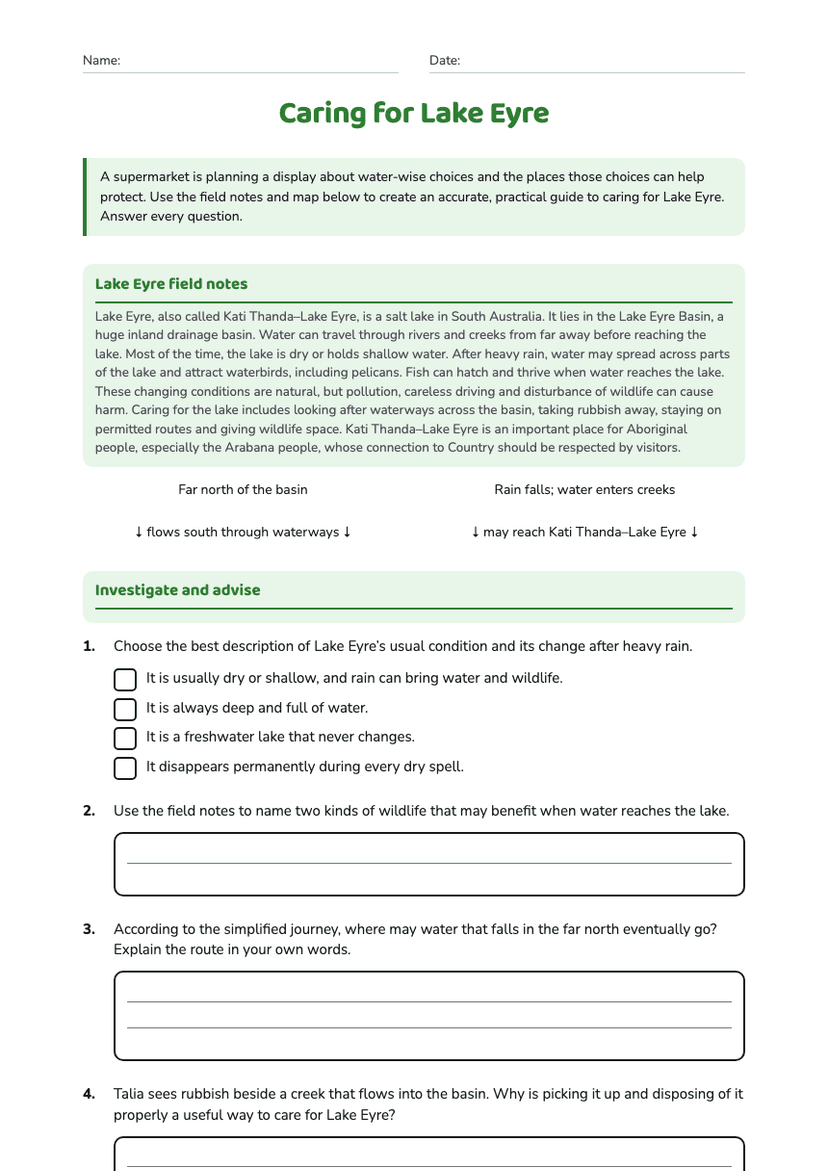
Caring for Lake Eyre
Free
Hamilton Island Environmental Features
Free