Australian Referendum Process
A free social sciences worksheet ready for your classroom. Open in Kuraplan to grab the print-ready PDF, customize it for your students, or generate a fresh version in seconds.
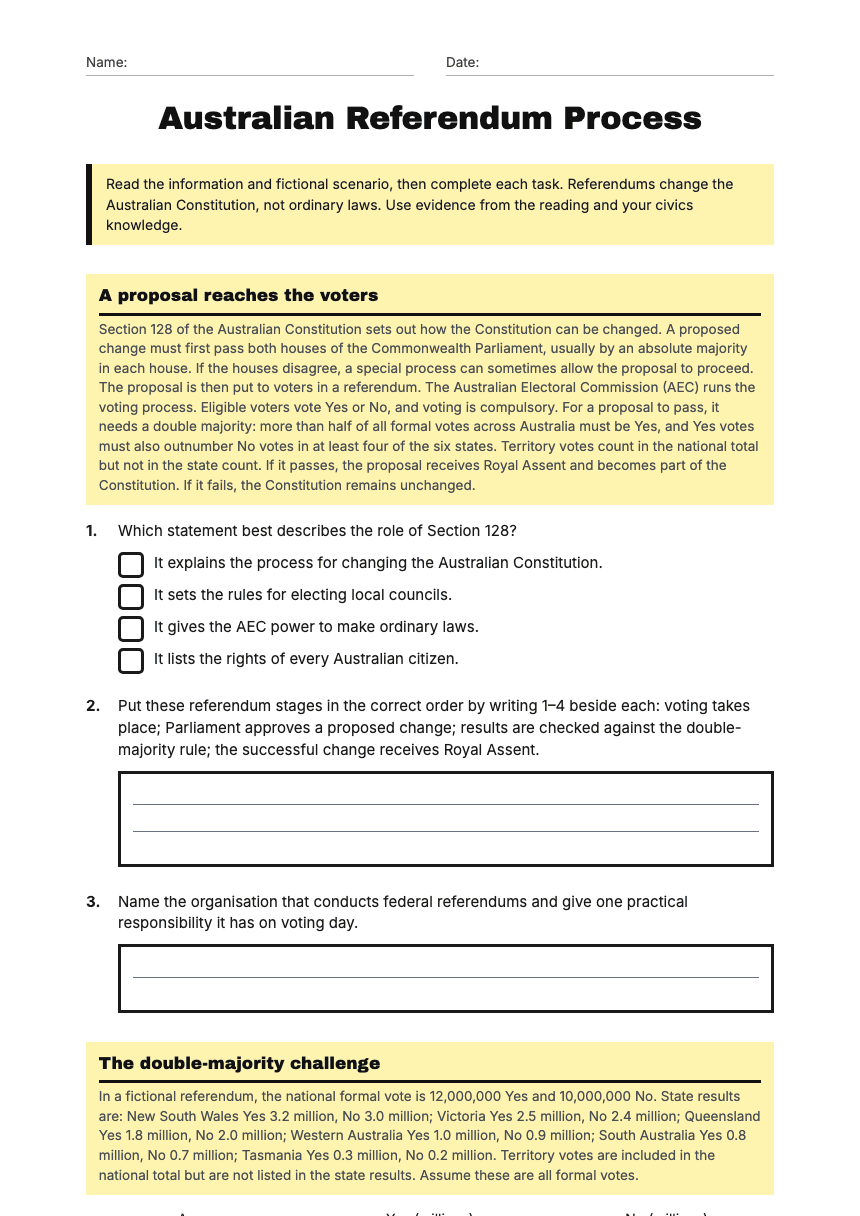
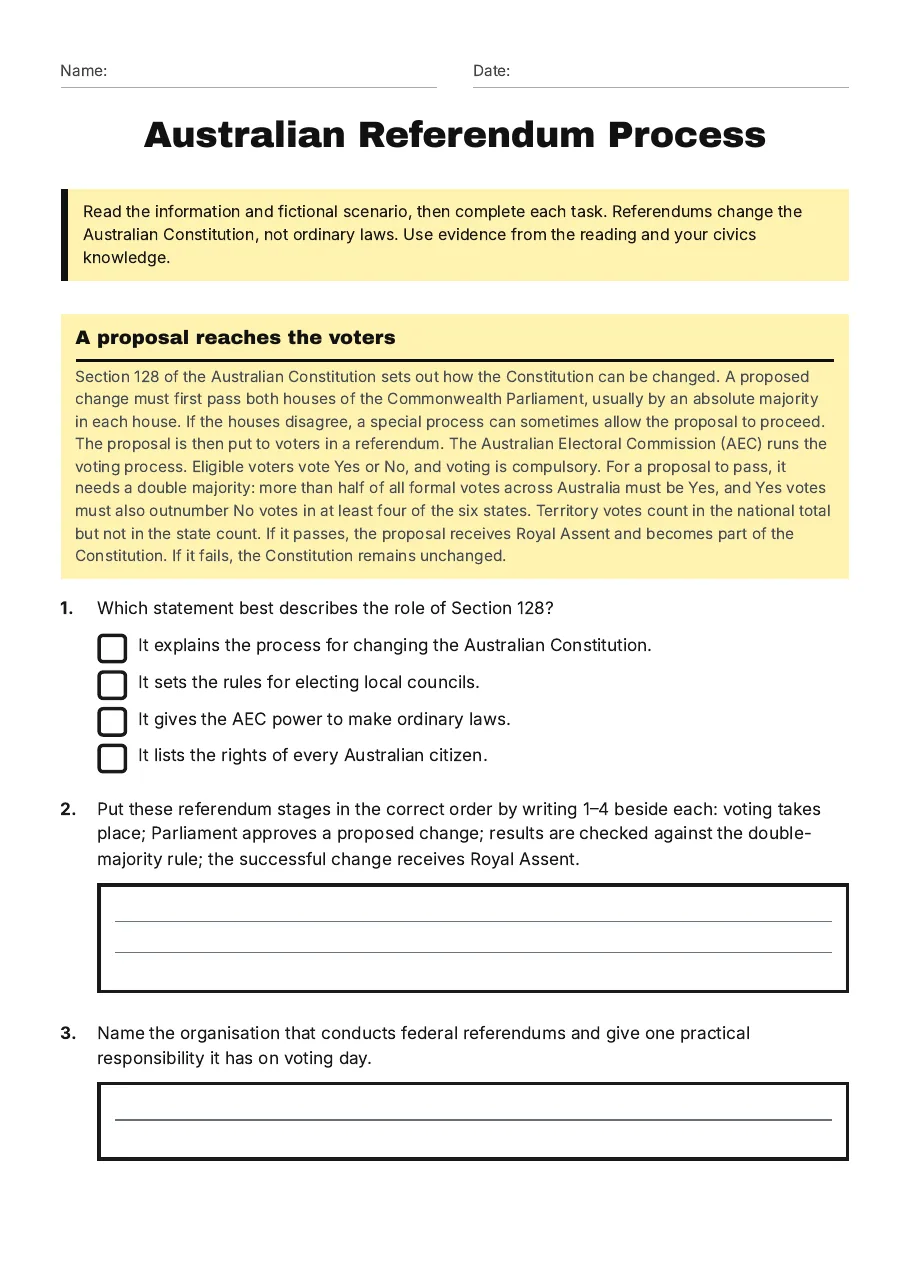
Australian Referendum Process
A proposal reaches the voters
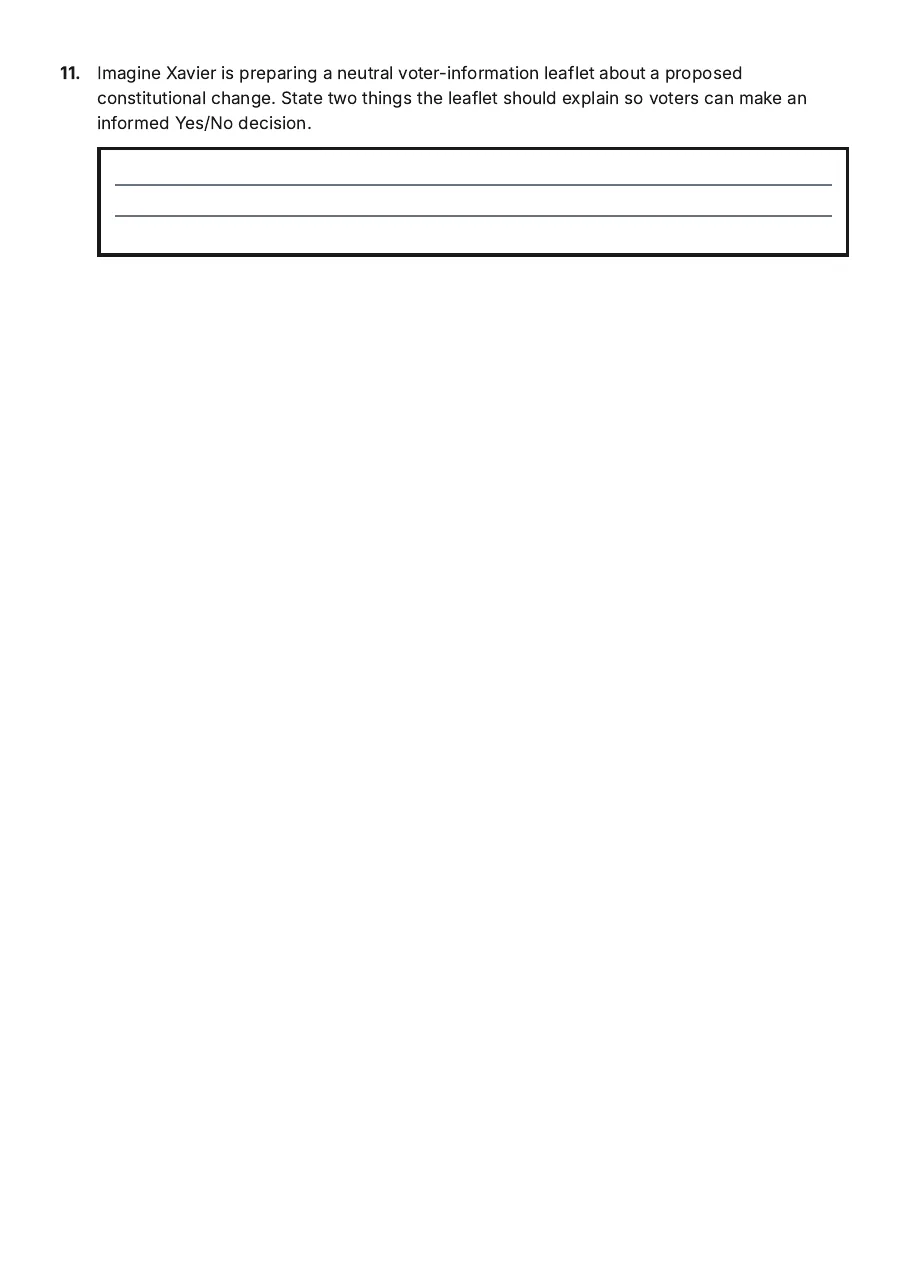
Section 128 of the Australian Constitution sets out how the Constitution can be changed. A proposed change must first pass both houses of the Commonwealth Parliament, usually by an absolute majority in each house. If the houses disagree, a special process can sometimes allow the proposal to proceed. The proposal is then put to voters in a referendum. The Australian Electoral Commission (AEC) runs the voting process. Eligible voters vote Yes or No, and voting is compulsory. For a proposal to pass, it needs a double majority: more than half of all formal votes across Australia must be Yes, and Yes votes must also outnumber No votes in at least four of the six states. Territory votes count in the national total but not in the state count. If it passes, the proposal receives Royal Assent and becomes part of the Constitution. If it fails, the Constitution remains unchanged.
- It explains the process for changing the Australian Constitution.
- It sets the rules for electing local councils.
- It gives the AEC power to make ordinary laws.
- It lists the rights of every Australian citizen.
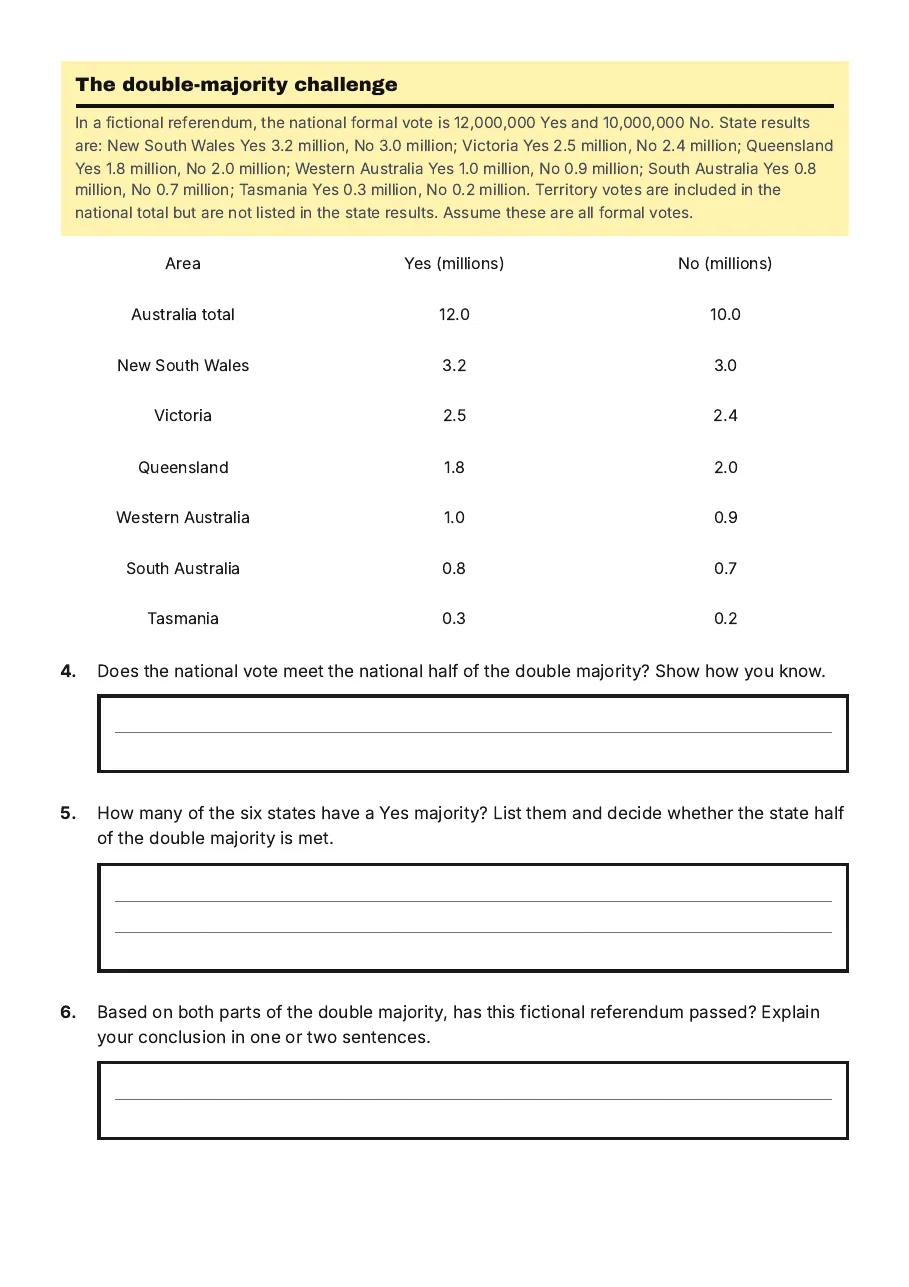
The double-majority challenge
In a fictional referendum, the national formal vote is 12,000,000 Yes and 10,000,000 No. State results are: New South Wales Yes 3.2 million, No 3.0 million; Victoria Yes 2.5 million, No 2.4 million; Queensland Yes 1.8 million, No 2.0 million; Western Australia Yes 1.0 million, No 0.9 million; South Australia Yes 0.8 million, No 0.7 million; Tasmania Yes 0.3 million, No 0.2 million. Territory votes are included in the national total but are not listed in the state results. Assume these are all formal votes.
Area
Yes (millions)
No (millions)
Australia total
12.0
10.0
New South Wales
3.2
3.0
Victoria
2.5
2.4
Queensland
1.8
2.0
Western Australia
1.0
0.9
South Australia
0.8
0.7
Tasmania
0.3
0.2
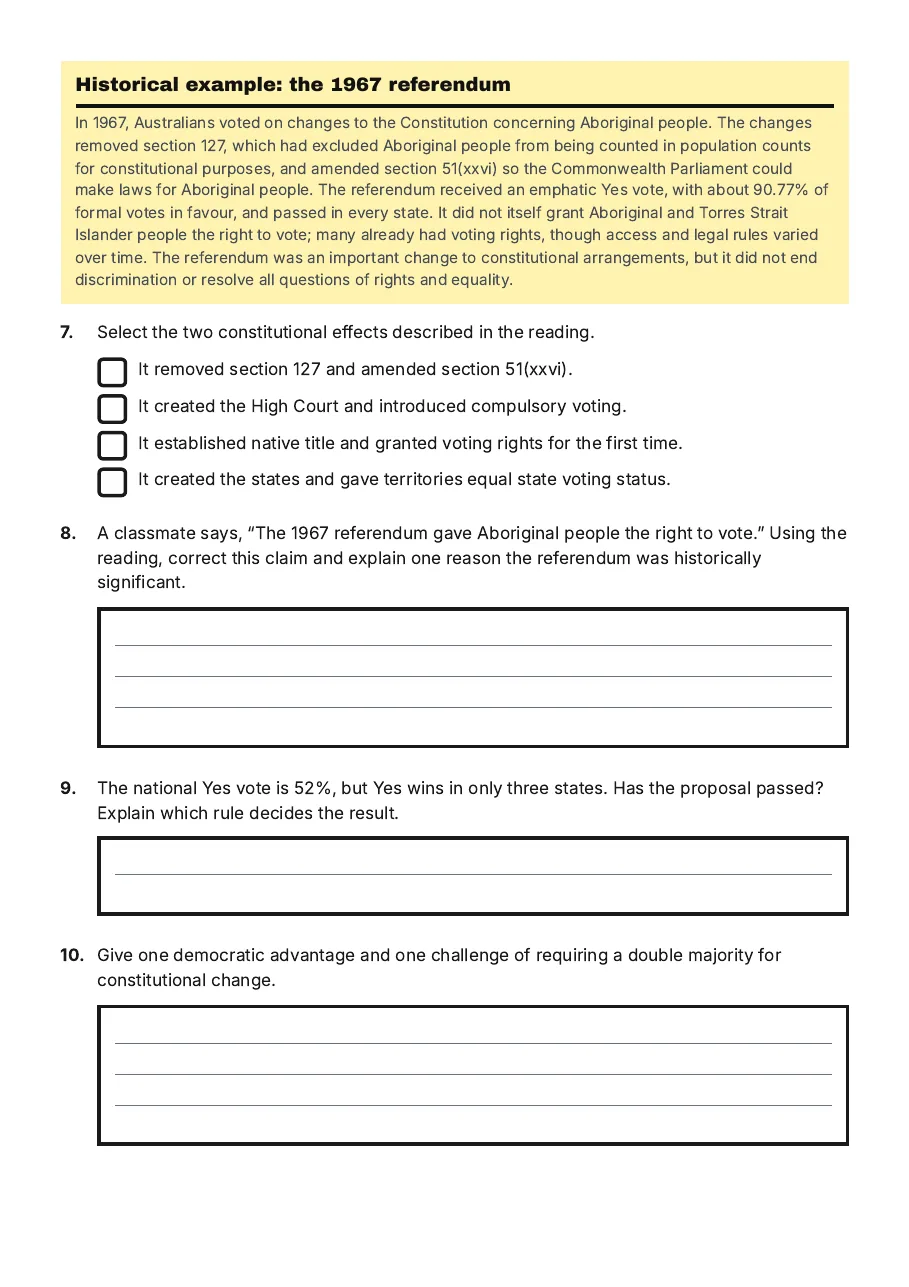
Historical example: the 1967 referendum
In 1967, Australians voted on changes to the Constitution concerning Aboriginal people. The changes removed section 127, which had excluded Aboriginal people from being counted in population counts for constitutional purposes, and amended section 51(xxvi) so the Commonwealth Parliament could make laws for Aboriginal people. The referendum received an emphatic Yes vote, with about 90.77% of formal votes in favour, and passed in every state. It did not itself grant Aboriginal and Torres Strait Islander people the right to vote; many already had voting rights, though access and legal rules varied over time. The referendum was an important change to constitutional arrangements, but it did not end discrimination or resolve all questions of rights and equality.
- It removed section 127 and amended section 51(xxvi).
- It created the High Court and introduced compulsory voting.
- It established native title and granted voting rights for the first time.
- It created the states and gave territories equal state voting status.
4 printable pages
Page 1
Page 2
Page 3
Page 4
About This Worksheet
Free in Kuraplan
Sign up free, grab the PDF, and customize it for your class.
Print-Ready
Formatted for standard paper. Clean layout, easy to read.
AI-Generated
Created with Kuraplan's AI, designed for real classroom use.
For Teachers & Parents
Use in classrooms, for homework, tutoring, or homeschool.
Need a custom version of this worksheet?
Kuraplan's AI generates custom worksheets in seconds — differentiated for every learner, aligned to your curriculum.
Generate Custom Worksheets — FreeMore Social Sciences Worksheets
Community Project Planning
Free
Australian Law Reform Fact Sheets
Free
Human Rights Debate Rubric
Free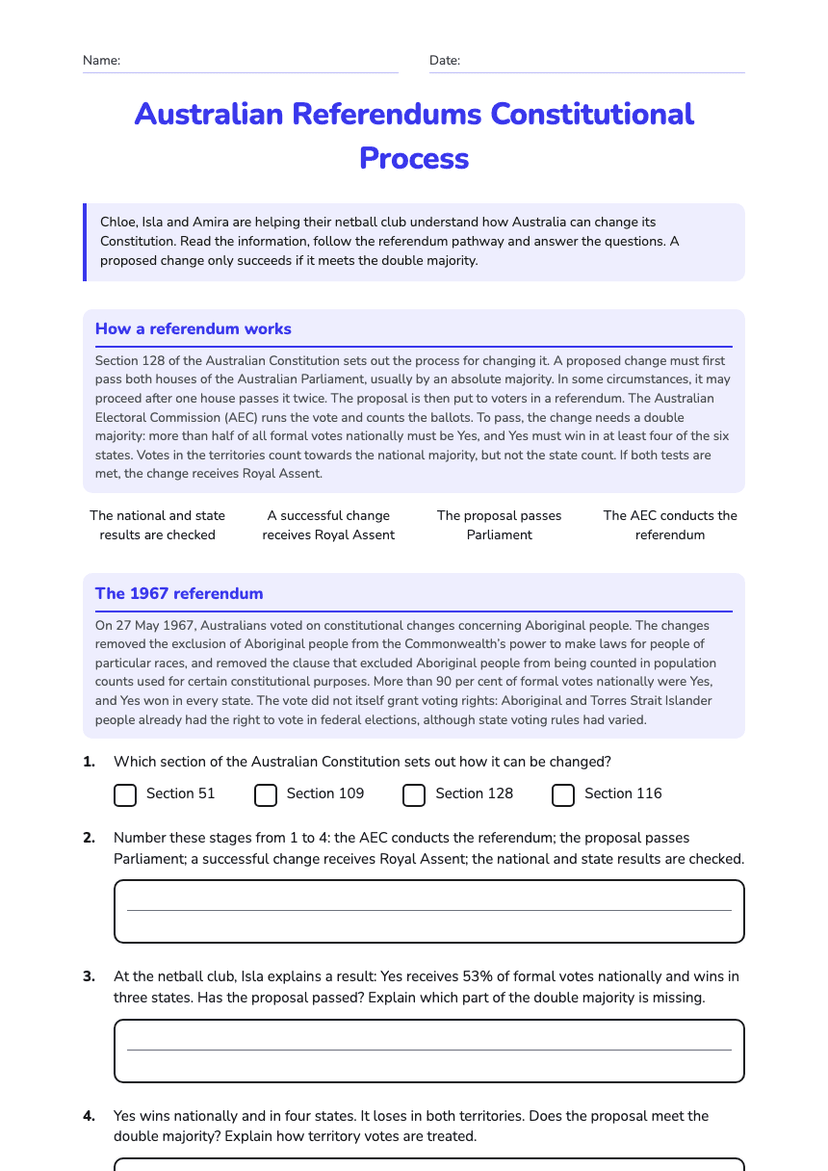
Australian Referendums Constitutional Process
Free
Media and Law Reform
Free
Australian Constitution Fundamentals
Free
Commonwealth Constitution Overview
Free