Australian Voices: Reading Comprehension
A free english worksheet ready for your classroom. Open in Kuraplan to grab the print-ready PDF, customize it for your students, or generate a fresh version in seconds.
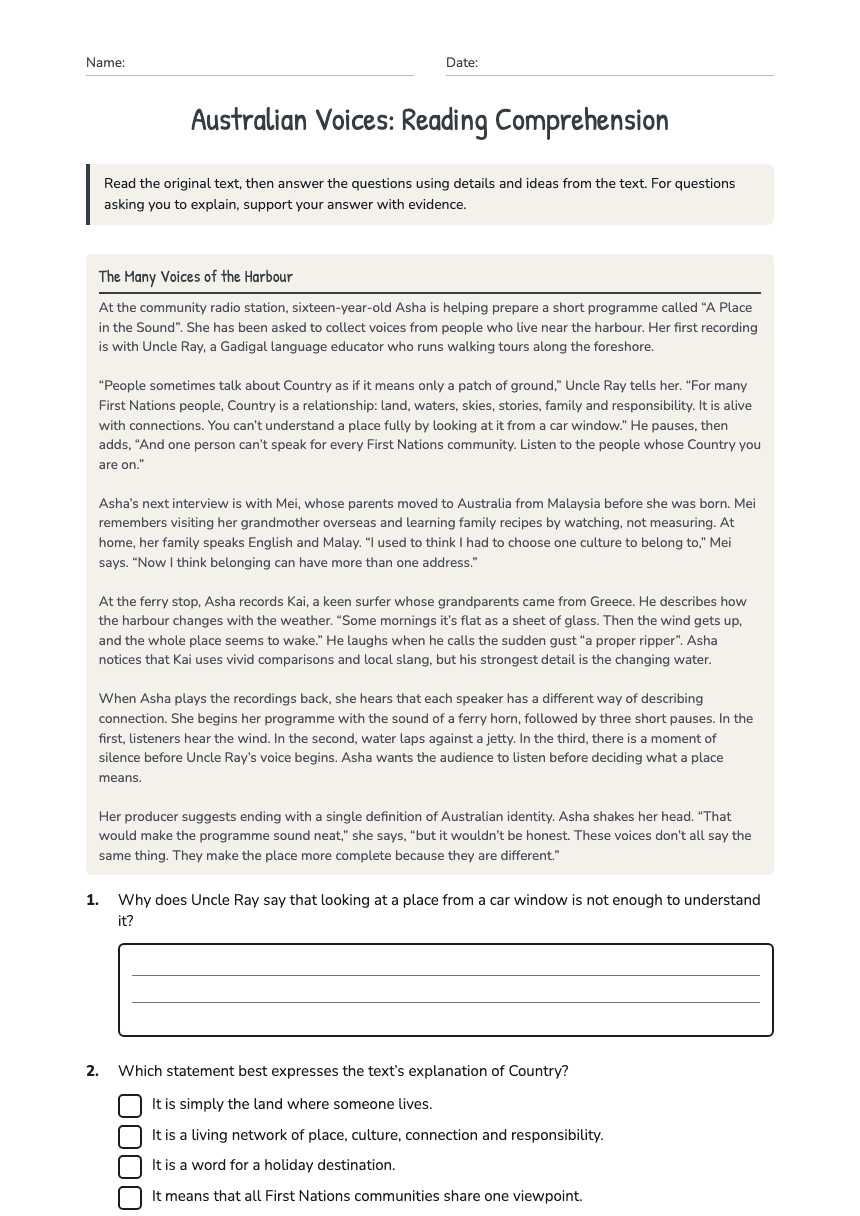
Australian Voices: Reading Comprehension
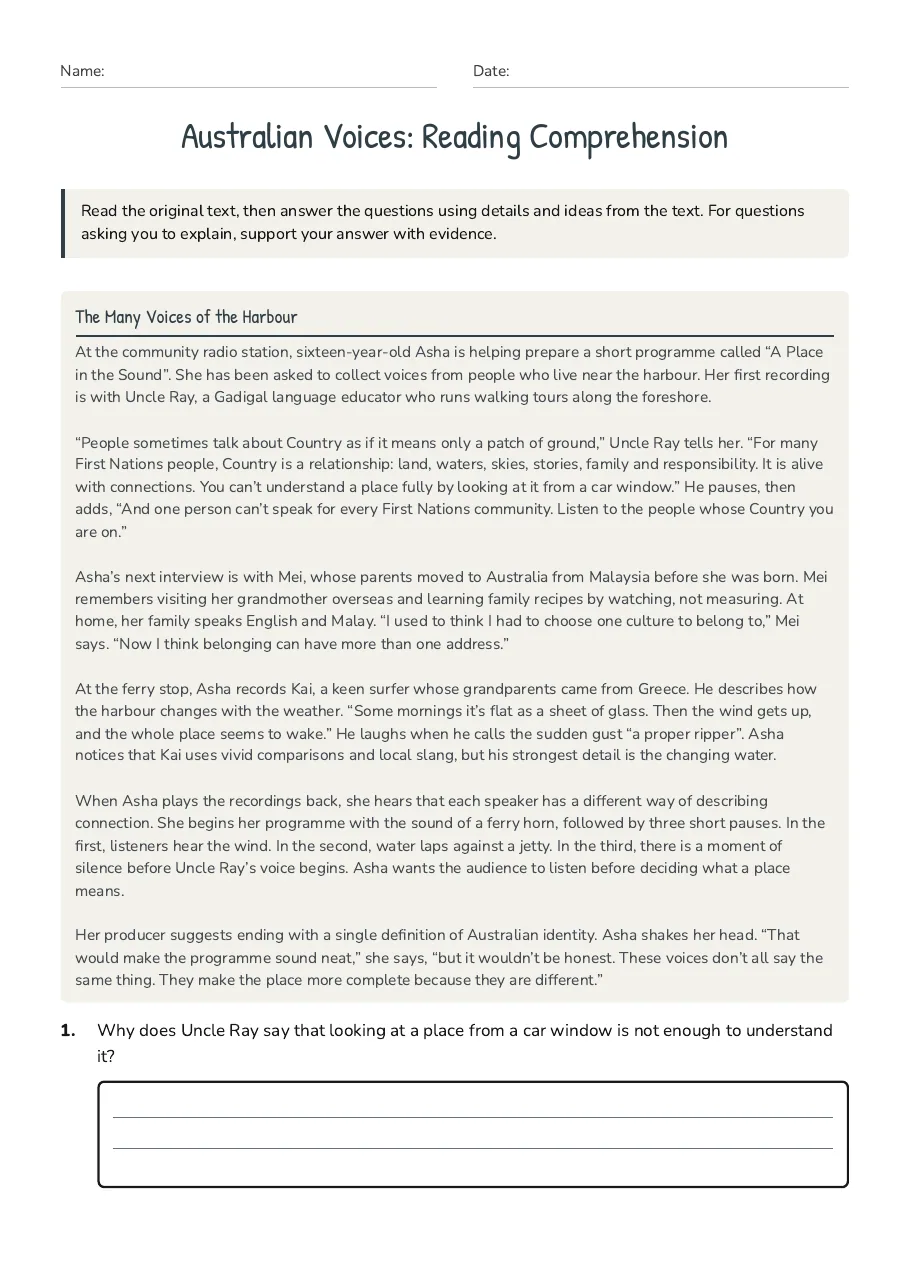
The Many Voices of the Harbour
At the community radio station, sixteen-year-old Asha is helping prepare a short programme called “A Place in the Sound”. She has been asked to collect voices from people who live near the harbour. Her first recording is with Uncle Ray, a Gadigal language educator who runs walking tours along the foreshore. “People sometimes talk about Country as if it means only a patch of ground,” Uncle Ray tells her. “For many First Nations people, Country is a relationship: land, waters, skies, stories, family and responsibility. It is alive with connections. You can’t understand a place fully by looking at it from a car window.” He pauses, then adds, “And one person can’t speak for every First Nations community. Listen to the people whose Country you are on.” Asha’s next interview is with Mei, whose parents moved to Australia from Malaysia before she was born. Mei remembers visiting her grandmother overseas and learning family recipes by watching, not measuring. At home, her family speaks English and Malay. “I used to think I had to choose one culture to belong to,” Mei says. “Now I think belonging can have more than one address.” At the ferry stop, Asha records Kai, a keen surfer whose grandparents came from Greece. He describes how the harbour changes with the weather. “Some mornings it’s flat as a sheet of glass. Then the wind gets up, and the whole place seems to wake.” He laughs when he calls the sudden gust “a proper ripper”. Asha notices that Kai uses vivid comparisons and local slang, but his strongest detail is the changing water. When Asha plays the recordings back, she hears that each speaker has a different way of describing connection. She begins her programme with the sound of a ferry horn, followed by three short pauses. In the first, listeners hear the wind. In the second, water laps against a jetty. In the third, there is a moment of silence before Uncle Ray’s voice begins. Asha wants the audience to listen before deciding what a place means. Her producer suggests ending with a single definition of Australian identity. Asha shakes her head. “That would make the programme sound neat,” she says, “but it wouldn’t be honest. These voices don’t all say the same thing. They make the place more complete because they are different.”
- It is simply the land where someone lives.
- It is a living network of place, culture, connection and responsibility.
- It is a word for a holiday destination.
- It means that all First Nations communities share one viewpoint.
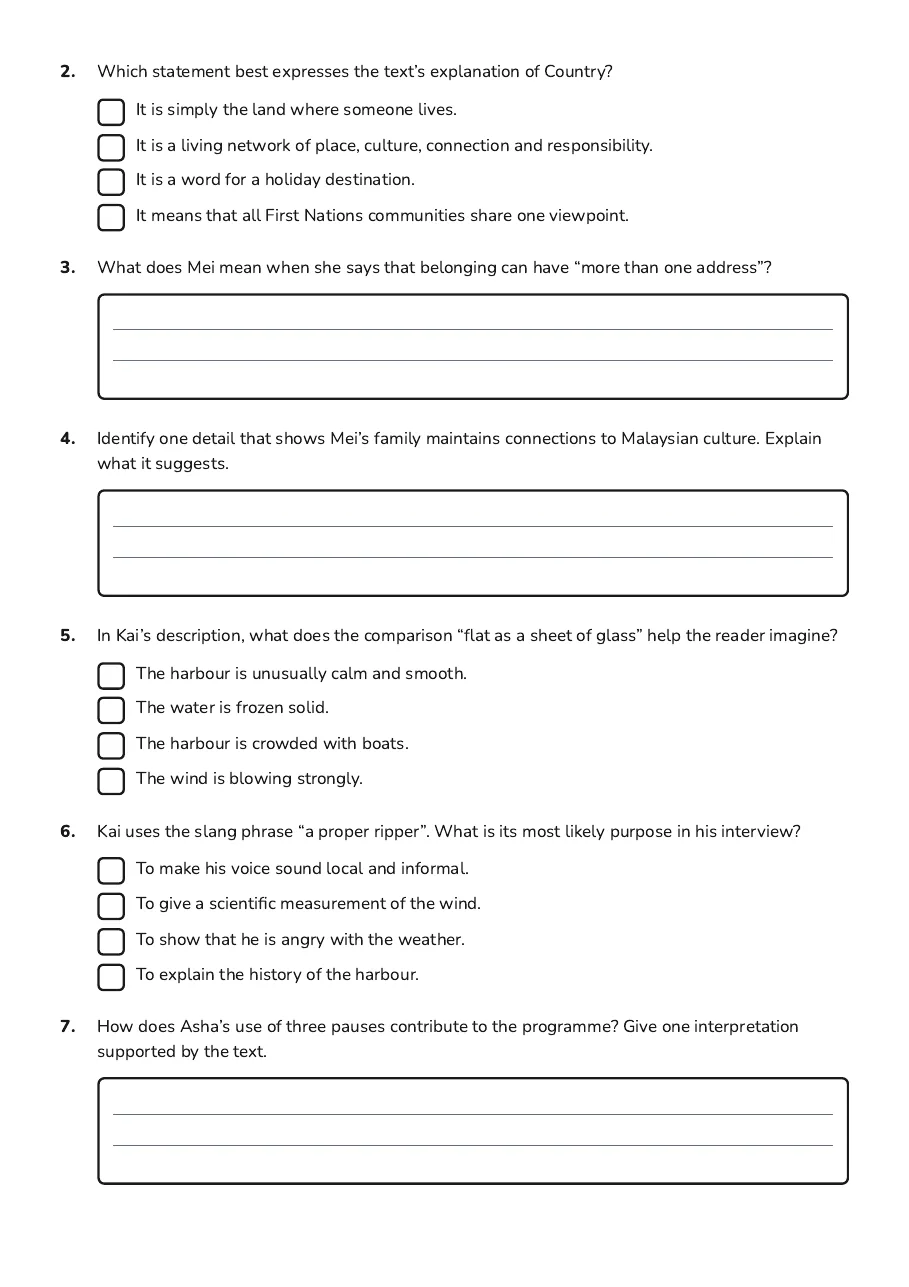
- The harbour is unusually calm and smooth.
- The water is frozen solid.
- The harbour is crowded with boats.
- The wind is blowing strongly.
- To make his voice sound local and informal.
- To give a scientific measurement of the wind.
- To show that he is angry with the weather.
- To explain the history of the harbour.
3 printable pages
Page 1
Page 2
Page 3
About This Worksheet
Free in Kuraplan
Sign up free, grab the PDF, and customize it for your class.
Print-Ready
Formatted for standard paper. Clean layout, easy to read.
AI-Generated
Created with Kuraplan's AI, designed for real classroom use.
For Teachers & Parents
Use in classrooms, for homework, tutoring, or homeschool.
Need a custom version of this worksheet?
Kuraplan's AI generates custom worksheets in seconds — differentiated for every learner, aligned to your curriculum.
Generate Custom Worksheets — Free