Australia's WWI Story
A free english worksheet ready for your classroom. Open in Kuraplan to grab the print-ready PDF, customize it for your students, or generate a fresh version in seconds.
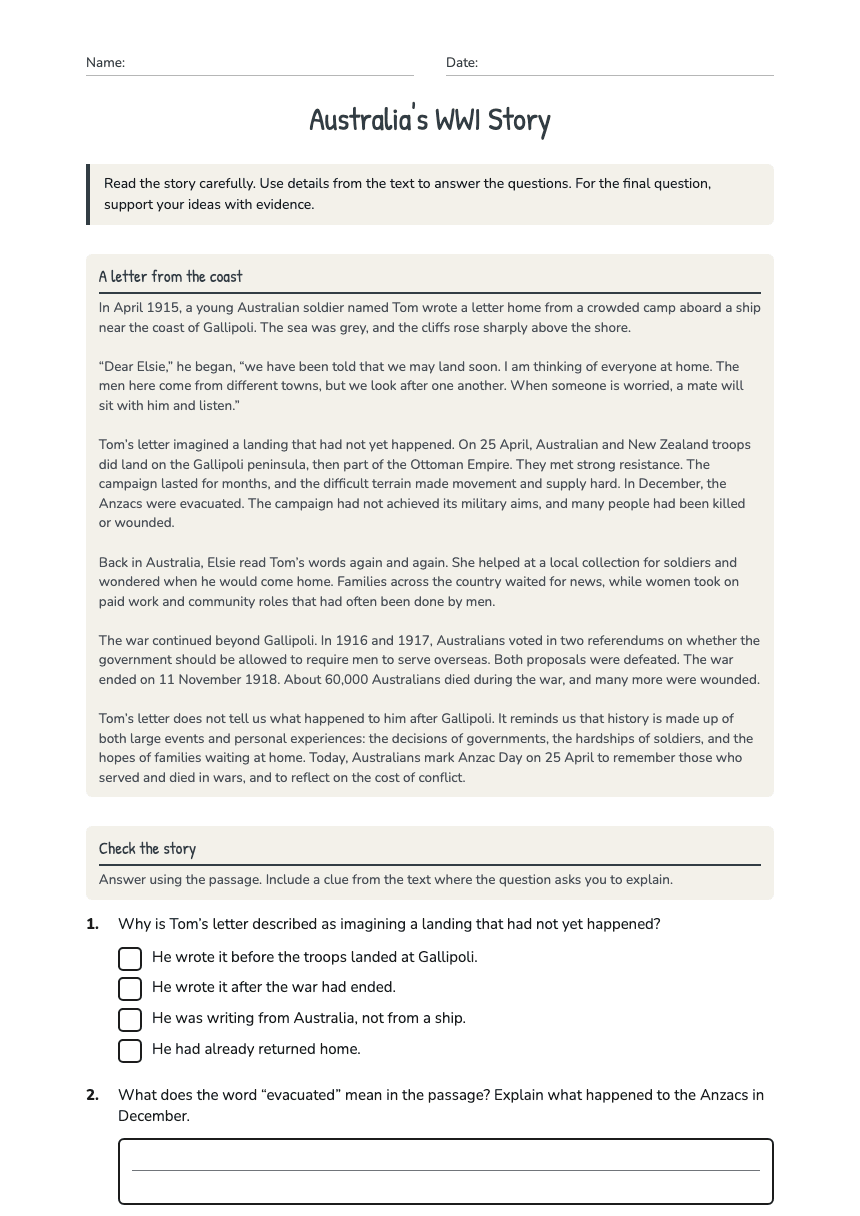
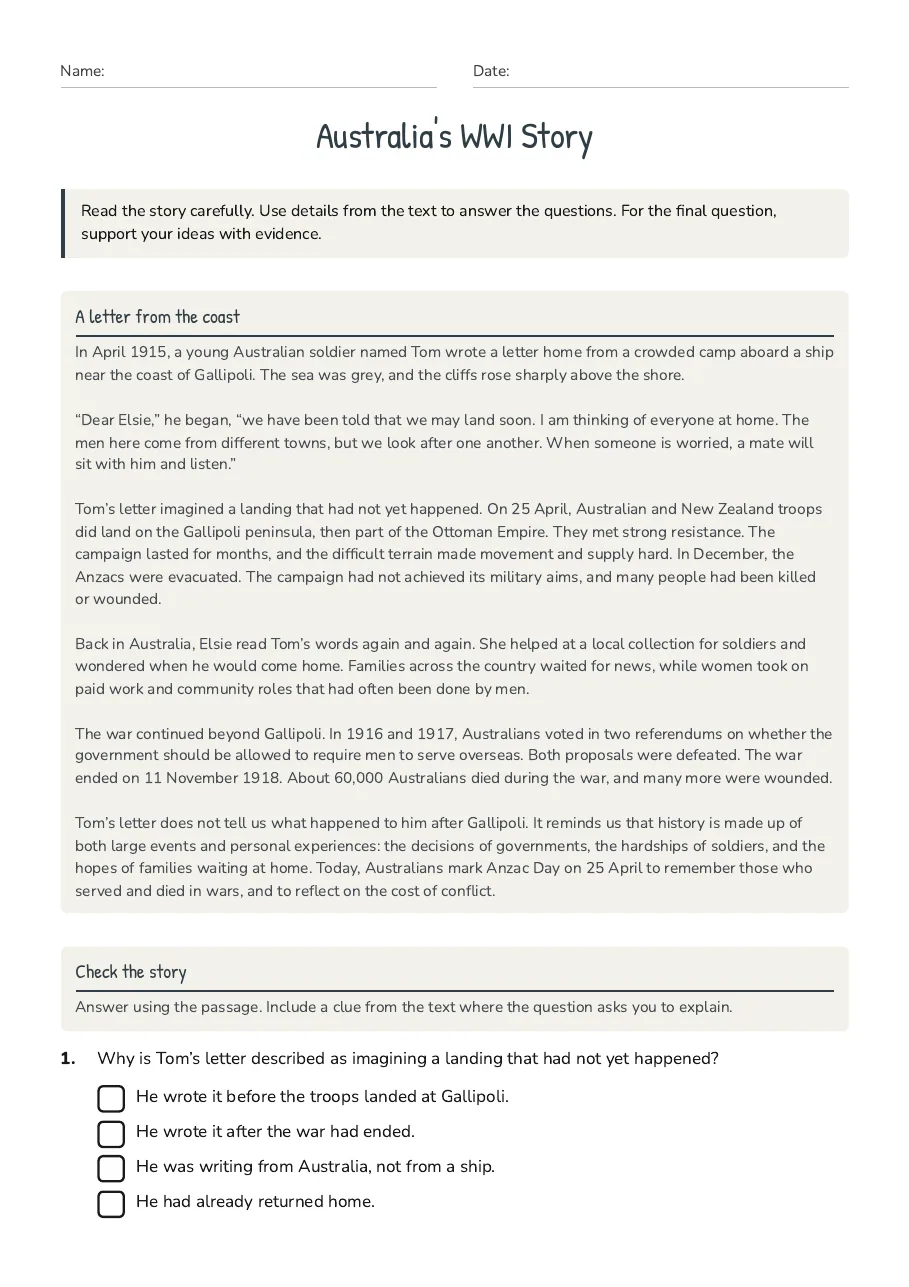
Australia's WWI Story
A letter from the coast
In April 1915, a young Australian soldier named Tom wrote a letter home from a crowded camp aboard a ship near the coast of Gallipoli. The sea was grey, and the cliffs rose sharply above the shore. “Dear Elsie,” he began, “we have been told that we may land soon. I am thinking of everyone at home. The men here come from different towns, but we look after one another. When someone is worried, a mate will sit with him and listen.” Tom’s letter imagined a landing that had not yet happened. On 25 April, Australian and New Zealand troops did land on the Gallipoli peninsula, then part of the Ottoman Empire. They met strong resistance. The campaign lasted for months, and the difficult terrain made movement and supply hard. In December, the Anzacs were evacuated. The campaign had not achieved its military aims, and many people had been killed or wounded. Back in Australia, Elsie read Tom’s words again and again. She helped at a local collection for soldiers and wondered when he would come home. Families across the country waited for news, while women took on paid work and community roles that had often been done by men. The war continued beyond Gallipoli. In 1916 and 1917, Australians voted in two referendums on whether the government should be allowed to require men to serve overseas. Both proposals were defeated. The war ended on 11 November 1918. About 60,000 Australians died during the war, and many more were wounded. Tom’s letter does not tell us what happened to him after Gallipoli. It reminds us that history is made up of both large events and personal experiences: the decisions of governments, the hardships of soldiers, and the hopes of families waiting at home. Today, Australians mark Anzac Day on 25 April to remember those who served and died in wars, and to reflect on the cost of conflict.
Check the story
Answer using the passage. Include a clue from the text where the question asks you to explain.
- He wrote it before the troops landed at Gallipoli.
- He wrote it after the war had ended.
- He was writing from Australia, not from a ship.
- He had already returned home.
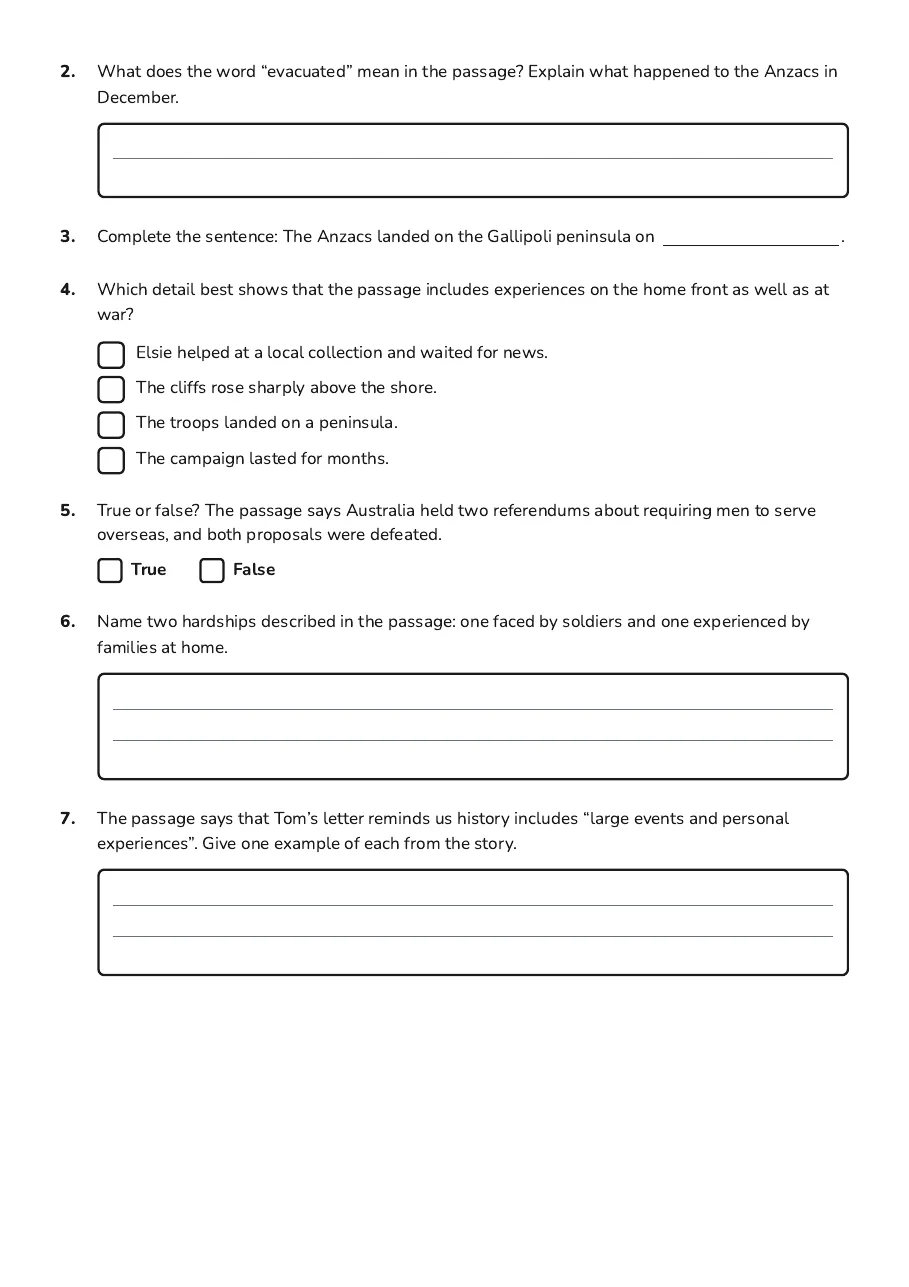
- Elsie helped at a local collection and waited for news.
- The cliffs rose sharply above the shore.
- The troops landed on a peninsula.
- The campaign lasted for months.
3 printable pages
Page 1
Page 2
Page 3
About This Worksheet
Free in Kuraplan
Sign up free, grab the PDF, and customize it for your class.
Print-Ready
Formatted for standard paper. Clean layout, easy to read.
AI-Generated
Created with Kuraplan's AI, designed for real classroom use.
For Teachers & Parents
Use in classrooms, for homework, tutoring, or homeschool.
Need a custom version of this worksheet?
Kuraplan's AI generates custom worksheets in seconds — differentiated for every learner, aligned to your curriculum.
Generate Custom Worksheets — Free