Balancing Chemical Equations
A free science worksheet ready for your classroom. Open in Kuraplan to grab the print-ready PDF, customize it for your students, or generate a fresh version in seconds.
Balancing Chemical Equations
⚗️ Part 1: Writing Chemical Equations from Word Equations
a) Hydrogen + Oxygen → Water
b) Methane + Oxygen → Carbon dioxide + Water
c) Nitrogen + Hydrogen → Ammonia
d) Iron + Oxygen → Iron oxide
Water:
Carbon dioxide:
⚖️ Part 2: Balancing Chemical Equations
a) _____ H₂ + _____ O₂ → _____ H₂O
b) _____ CH₄ + _____ O₂ → _____ CO₂ + _____ H₂O
c) _____ N₂ + _____ H₂ → _____ NH₃
d) _____ Fe + _____ O₂ → _____ Fe₂O₃
🔬 Part 3: Conservation of Mass
In a chemical reaction, mass cannot be _____________ or _____________. This means that the total mass of _____________ must equal the total mass of _____________. When we balance chemical equations, we ensure that the same number of _____________ of each element appears on both sides of the equation.
🧪 Part 4: Advanced Practice
a) Magnesium + Hydrochloric acid → Magnesium chloride + Hydrogen
b) Calcium carbonate → Calcium oxide + Carbon dioxide
c) Aluminium + Copper sulfate → Aluminium sulfate + Copper
a) In a balanced equation, the number of atoms of each element is the same on both sides.
b) Coefficients can be changed to balance equations, but subscripts cannot.
c) The arrow in a chemical equation means "produces" or "yields".
About This Worksheet
Free in Kuraplan
Sign up free, grab the PDF, and customize it for your class.
Print-Ready
Formatted for standard paper. Clean layout, easy to read.
AI-Generated
Created with Kuraplan's AI, designed for real classroom use.
For Teachers & Parents
Use in classrooms, for homework, tutoring, or homeschool.
Need a custom version of this worksheet?
Kuraplan's AI generates custom worksheets in seconds — differentiated for every learner, aligned to your curriculum.
Generate Custom Worksheets — FreeMore Science Worksheets
Atomic Theory Research Worksheet
Free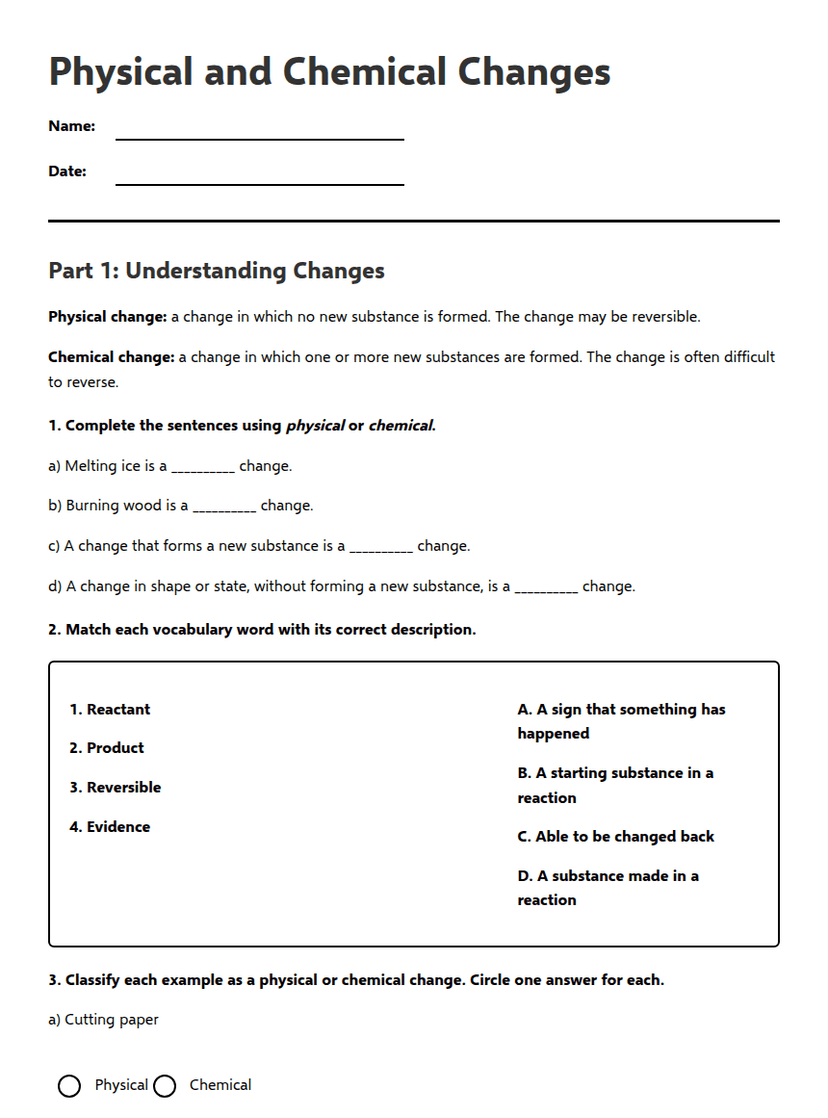
Physical and Chemical Changes
Free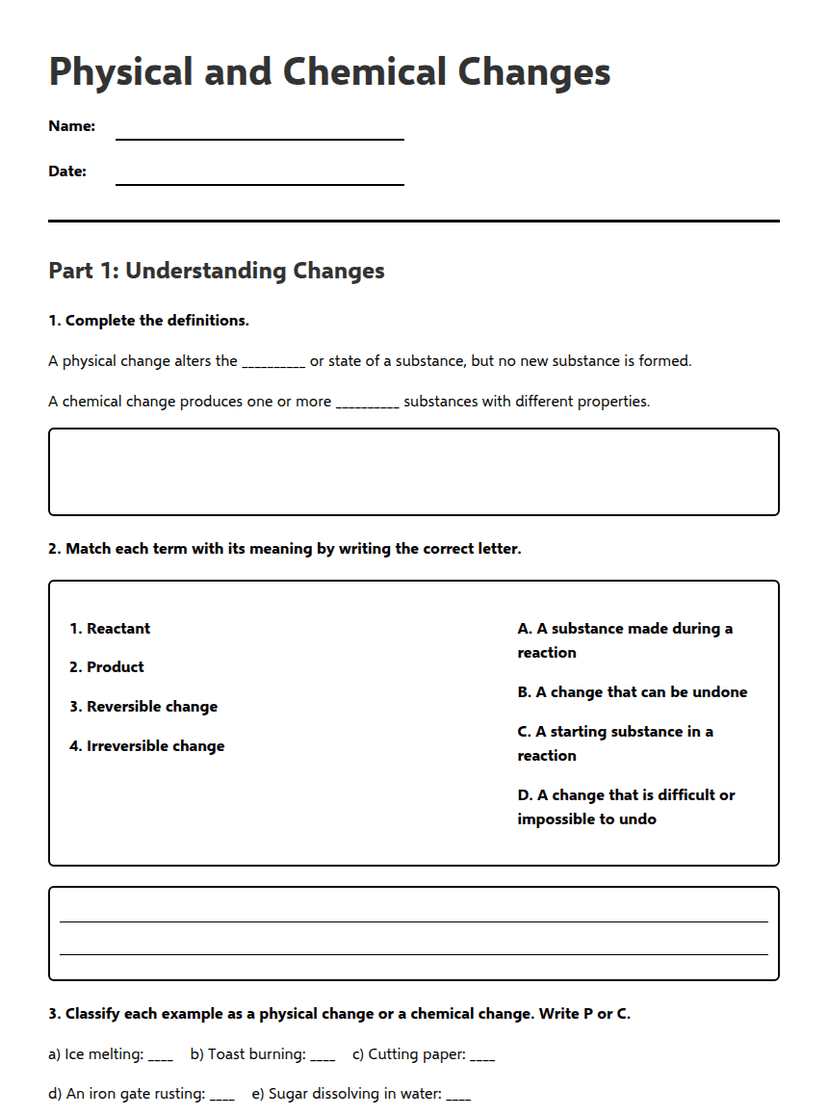
Physical and Chemical Changes
Free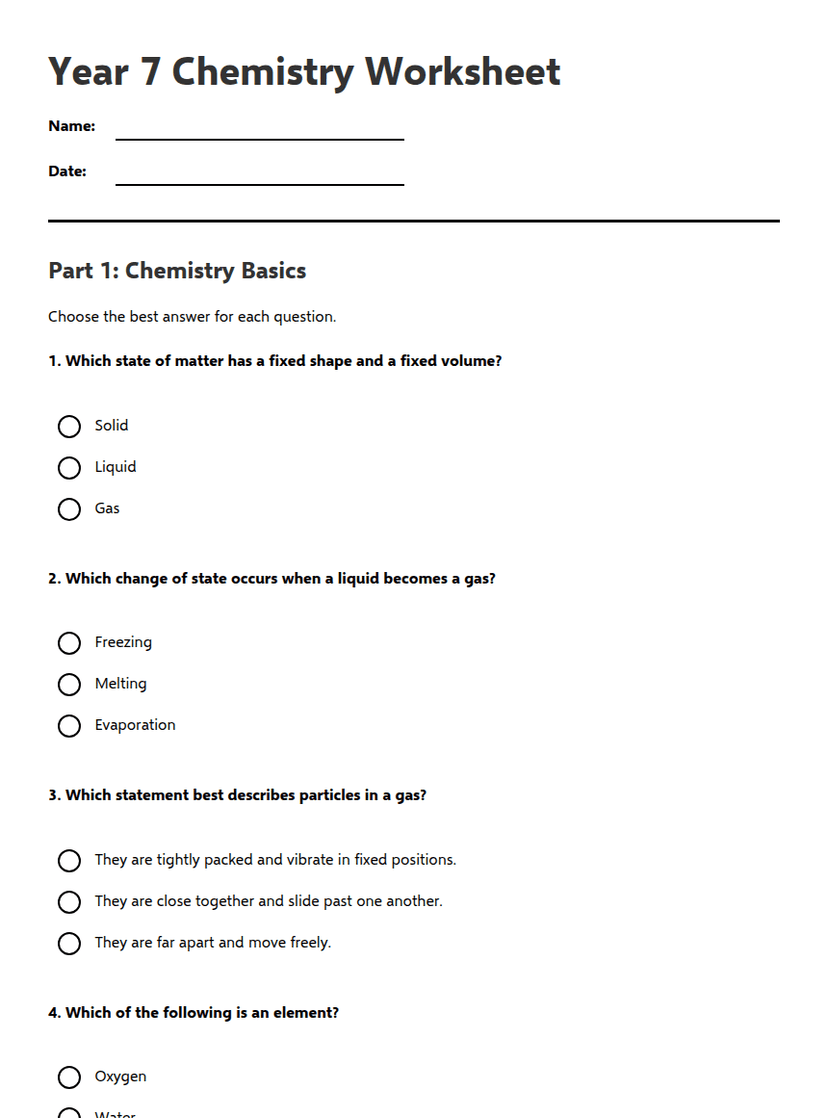
Year 7 Chemistry Worksheet
Free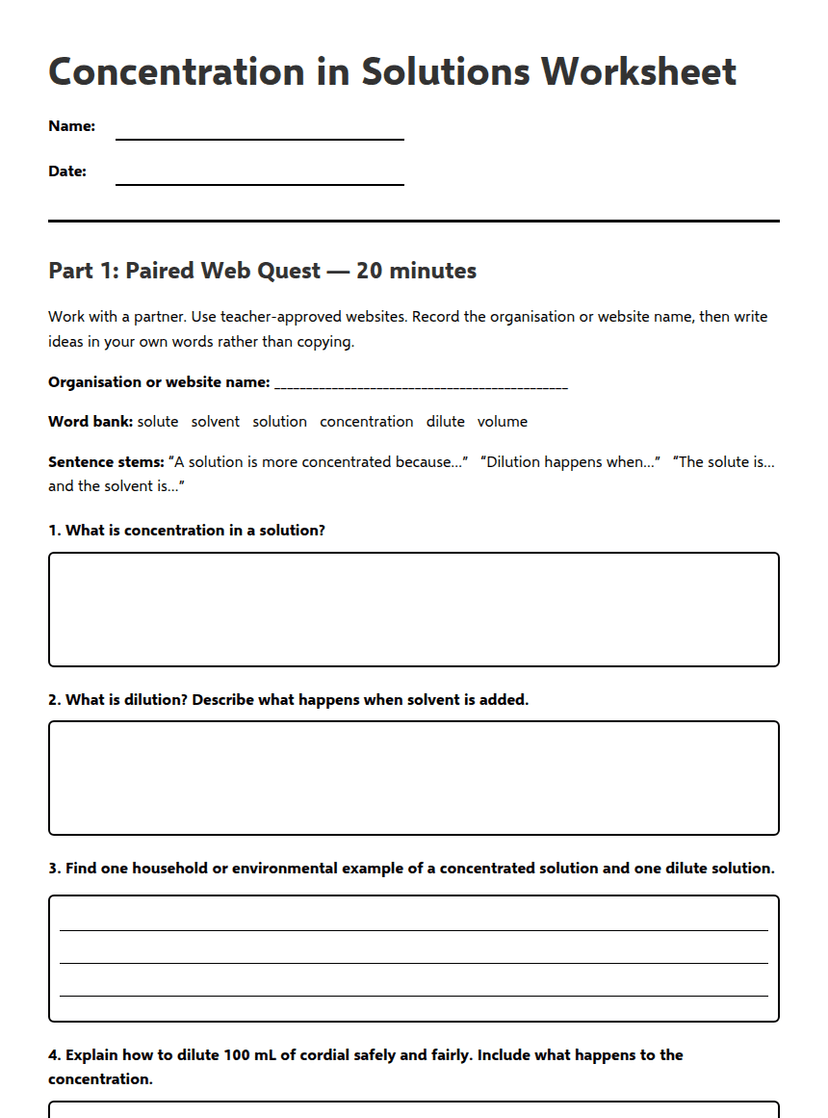
Concentration in Solutions Worksheet
Free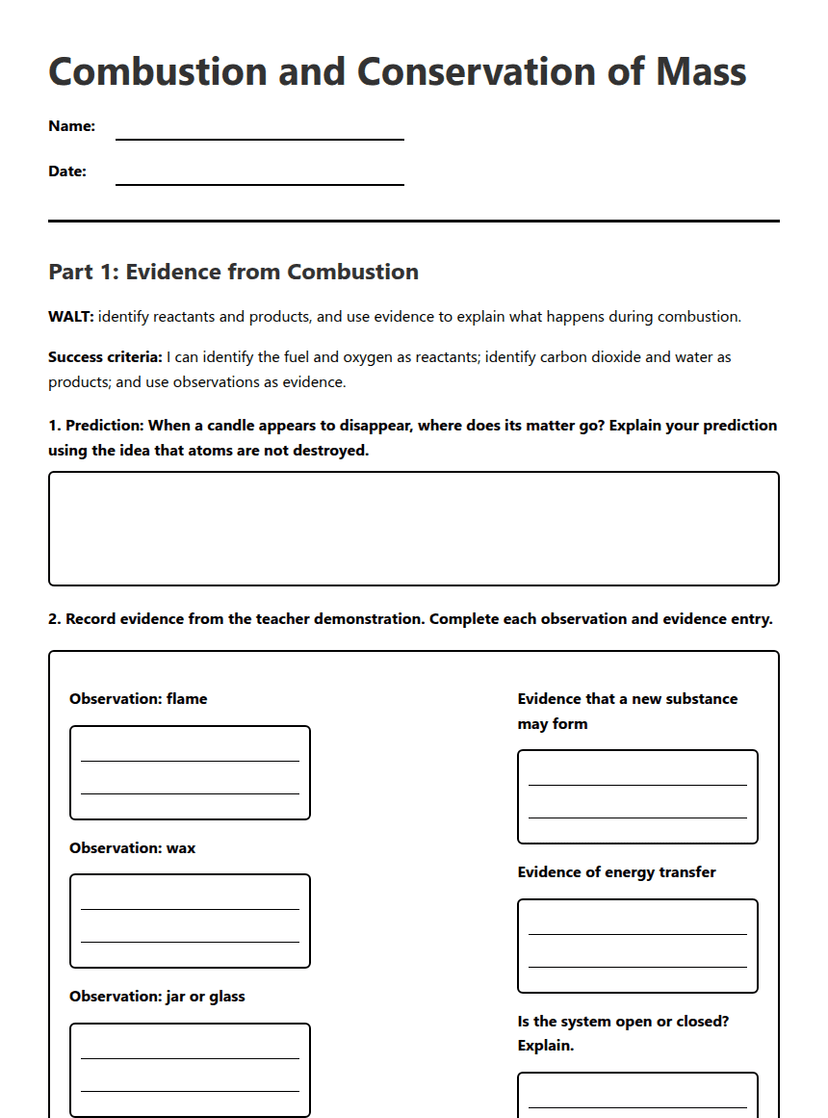
Combustion and Conservation of Mass
Free
Collision Theory and Reaction Rates
Free