ScienceFreePrintable

Balancing Chemical Equations

A free science worksheet ready for your classroom. Open in Kuraplan to grab the print-ready PDF, customize it for your students, or generate a fresh version in seconds.
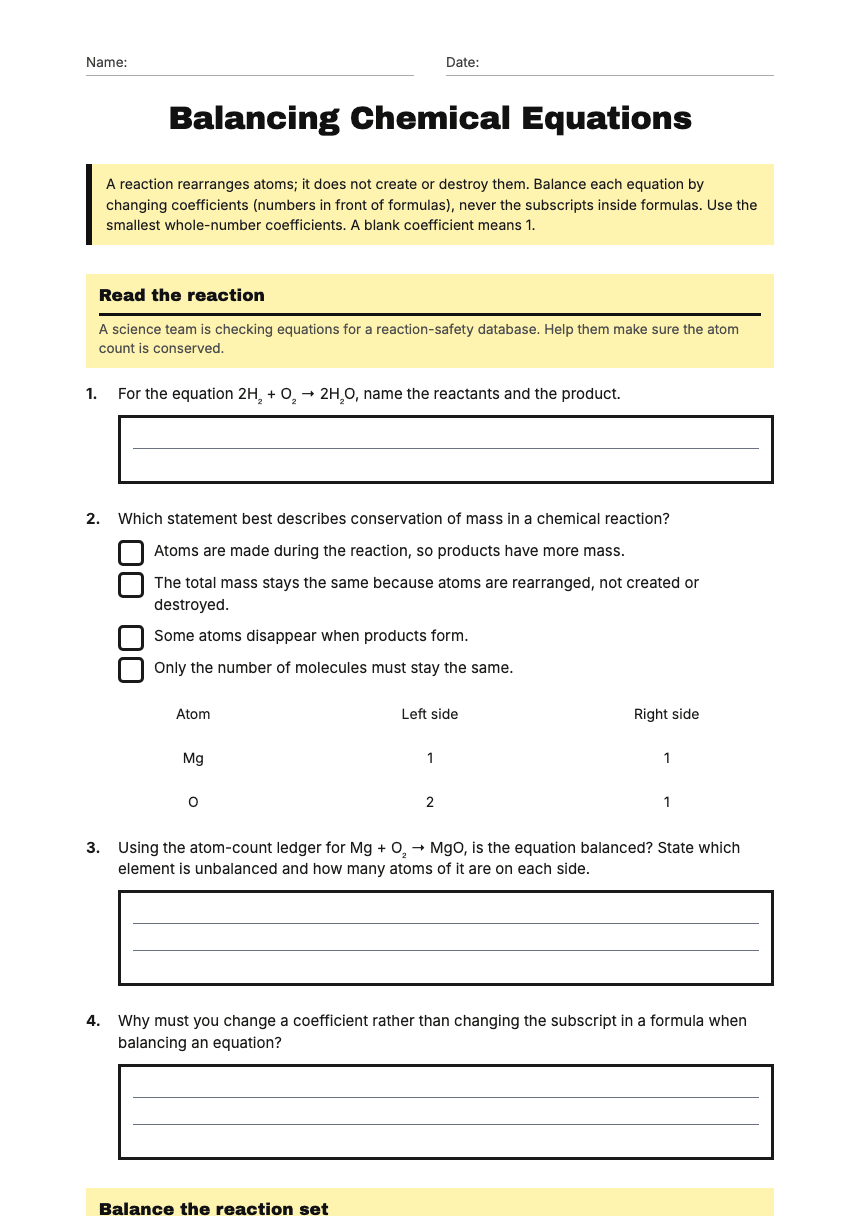
Balancing Chemical Equations worksheet preview
Name:Date:

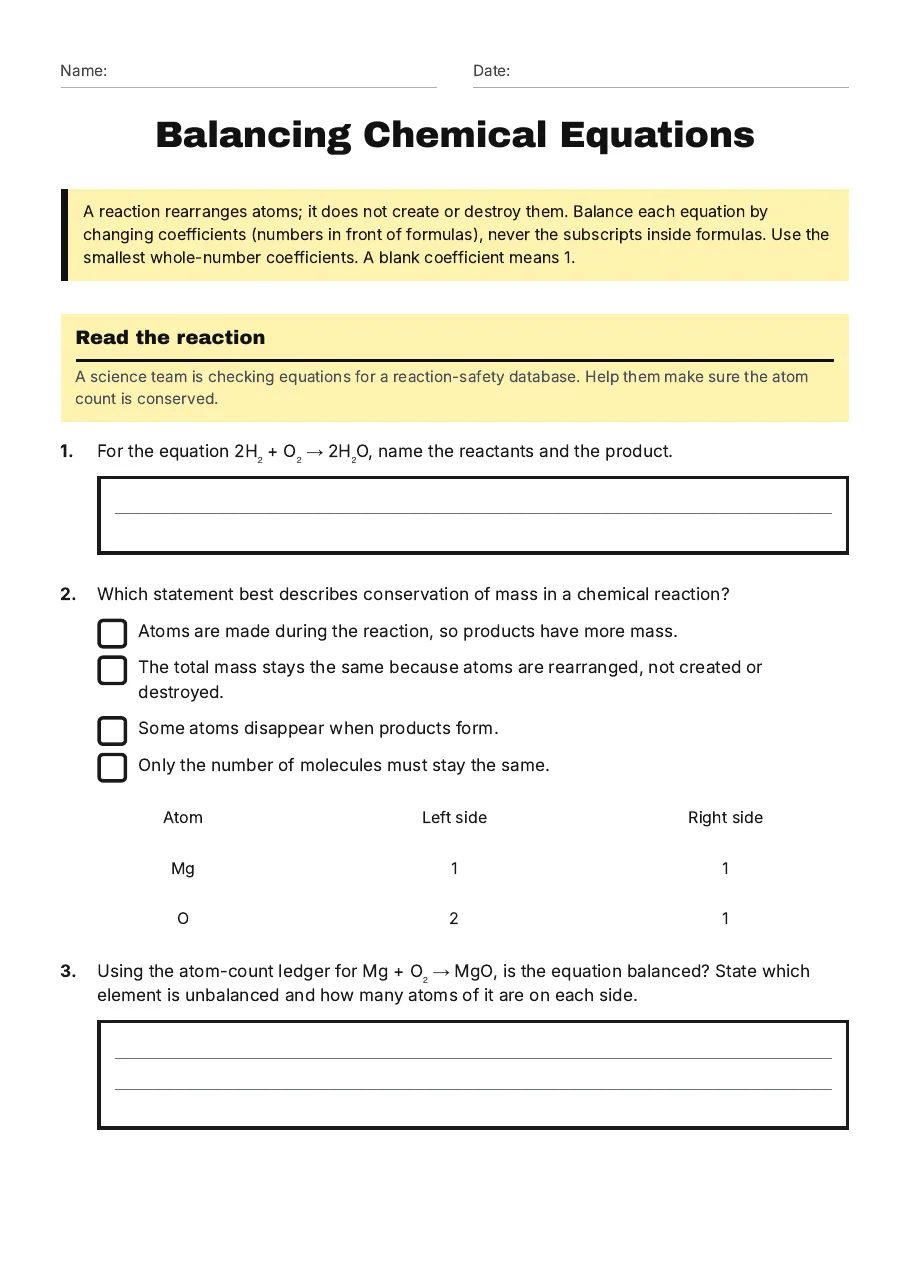
Balancing Chemical Equations

A reaction rearranges atoms; it does not create or destroy them. Balance each equation by changing coefficients (numbers in front of formulas), never the subscripts inside formulas. Use the smallest whole-number coefficients. A blank coefficient means 1.

Read the reaction

A science team is checking equations for a reaction-safety database. Help them make sure the atom count is conserved.

1.For the equation 2H₂ + O₂ → 2H₂O, name the reactants and the product.
2.Which statement best describes conservation of mass in a chemical reaction?
  • Atoms are made during the reaction, so products have more mass.
  • The total mass stays the same because atoms are rearranged, not created or destroyed.
  • Some atoms disappear when products form.
  • Only the number of molecules must stay the same.

Atom

Left side

Right side

Mg

1

1

O

2

1

3.Using the atom-count ledger for Mg + O₂ → MgO, is the equation balanced? State which element is unbalanced and how many atoms of it are on each side.
4.Why must you change a coefficient rather than changing the subscript in a formula when balancing an equation?

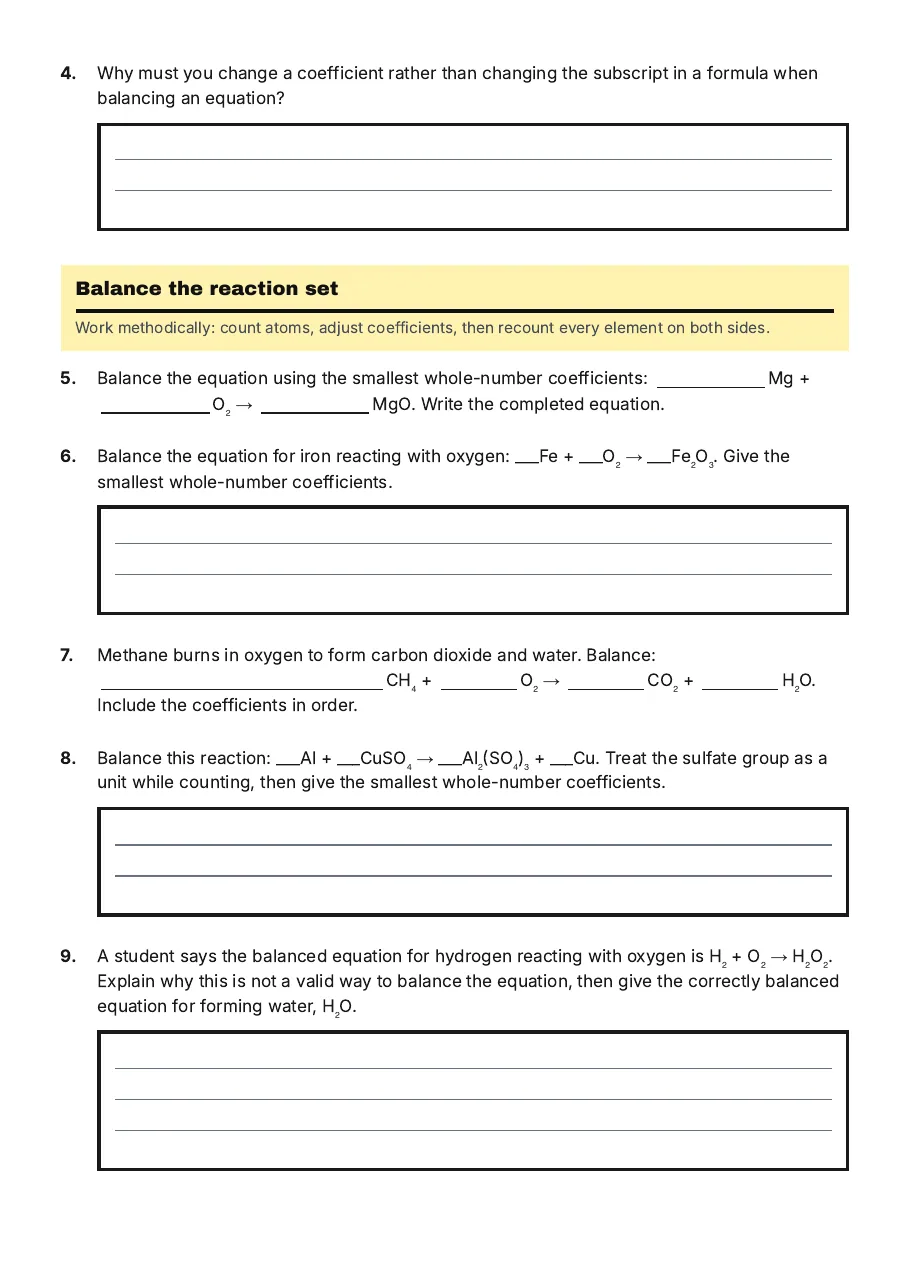
Balance the reaction set

Work methodically: count atoms, adjust coefficients, then recount every element on both sides.

5.Balance the equation using the smallest whole-number coefficients: Mg + O₂ → MgO. Write the completed equation.
6.Balance the equation for iron reacting with oxygen: ___Fe + ___O₂ → ___Fe₂O₃. Give the smallest whole-number coefficients.
7.Methane burns in oxygen to form carbon dioxide and water. Balance: CH₄ + O₂ → CO₂ + H₂O. Include the coefficients in order.
8.Balance this reaction: ___Al + ___CuSO₄ → ___Al₂(SO₄)₃ + ___Cu. Treat the sulfate group as a unit while counting, then give the smallest whole-number coefficients.
9.A student says the balanced equation for hydrogen reacting with oxygen is H₂ + O₂ → H₂O₂. Explain why this is not a valid way to balance the equation, then give the correctly balanced equation for forming water, H₂O.
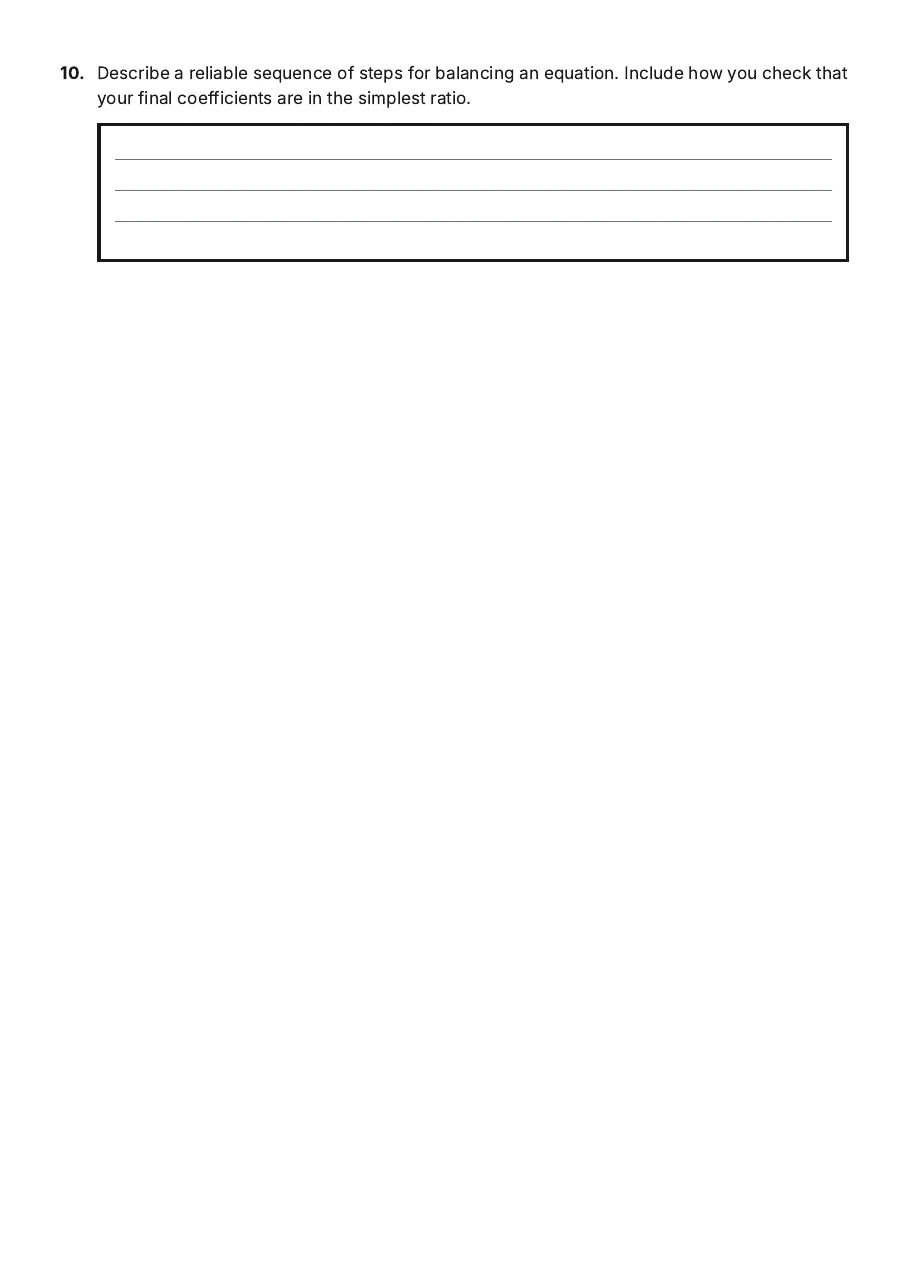
10.Describe a reliable sequence of steps for balancing an equation. Include how you check that your final coefficients are in the simplest ratio.

3 printable pages

  • Balancing Chemical Equations, page 1 of 3: Read the reaction

    Page 1

  • Balancing Chemical Equations, page 2 of 3: Balance the reaction set

    Page 2

  • Balancing Chemical Equations, page 3 of 3: 10. Describe a reliable sequence of steps for balancing an equation. Include how you…

    Page 3

About This Worksheet

Free in Kuraplan

Sign up free, grab the PDF, and customize it for your class.

Print-Ready

Formatted for standard paper. Clean layout, easy to read.

AI-Generated

Created with Kuraplan's AI, designed for real classroom use.

For Teachers & Parents

Use in classrooms, for homework, tutoring, or homeschool.

Need a custom version of this worksheet?

Kuraplan's AI generates custom worksheets in seconds — differentiated for every learner, aligned to your curriculum.

Generate Custom Worksheets — Free
No credit card Curriculum-aligned Under 60 seconds