Bennelong and Early Colonisation
A free social sciences worksheet ready for your classroom. Open in Kuraplan to grab the print-ready PDF, customize it for your students, or generate a fresh version in seconds.
Bennelong and Early Colonisation
📚 Information Pack
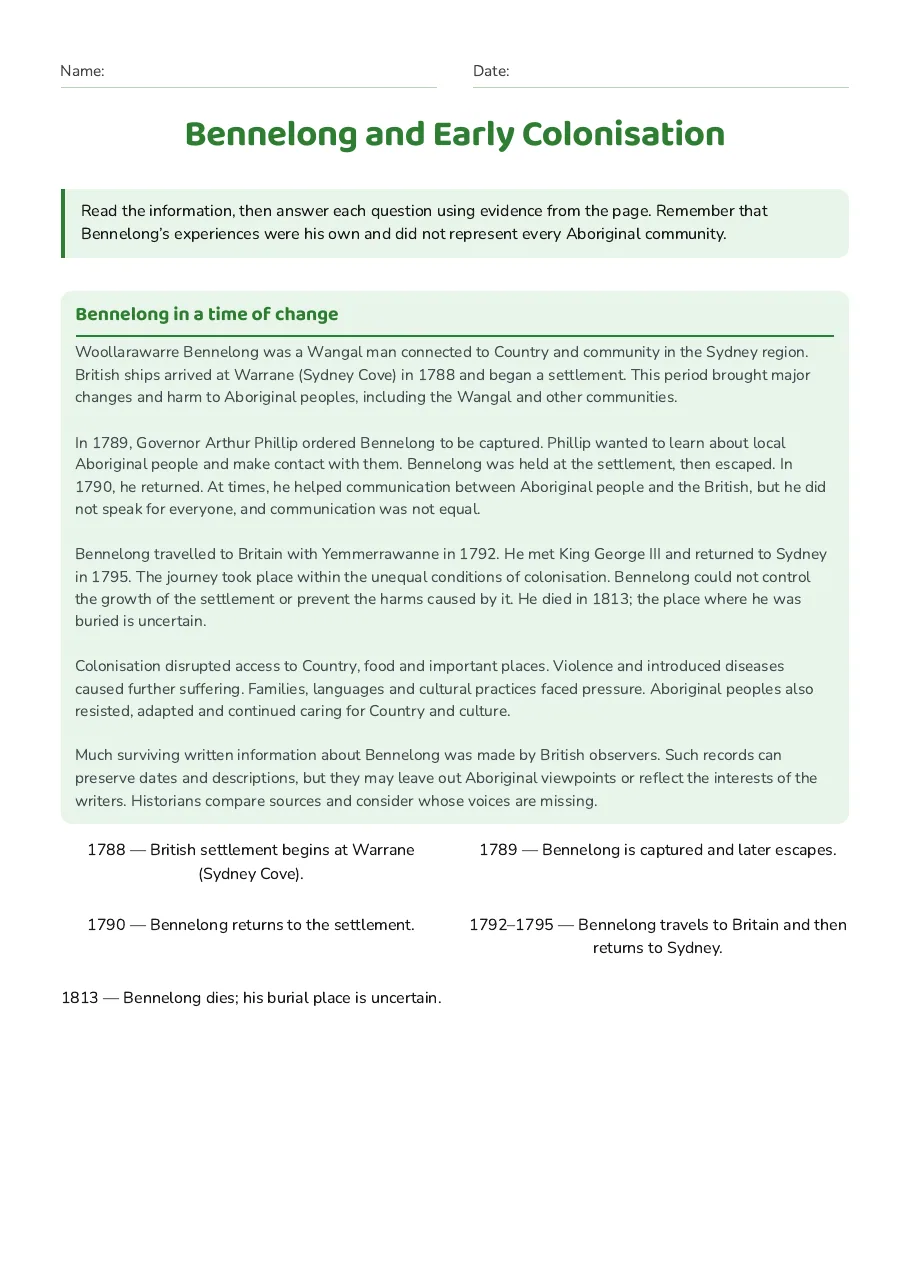
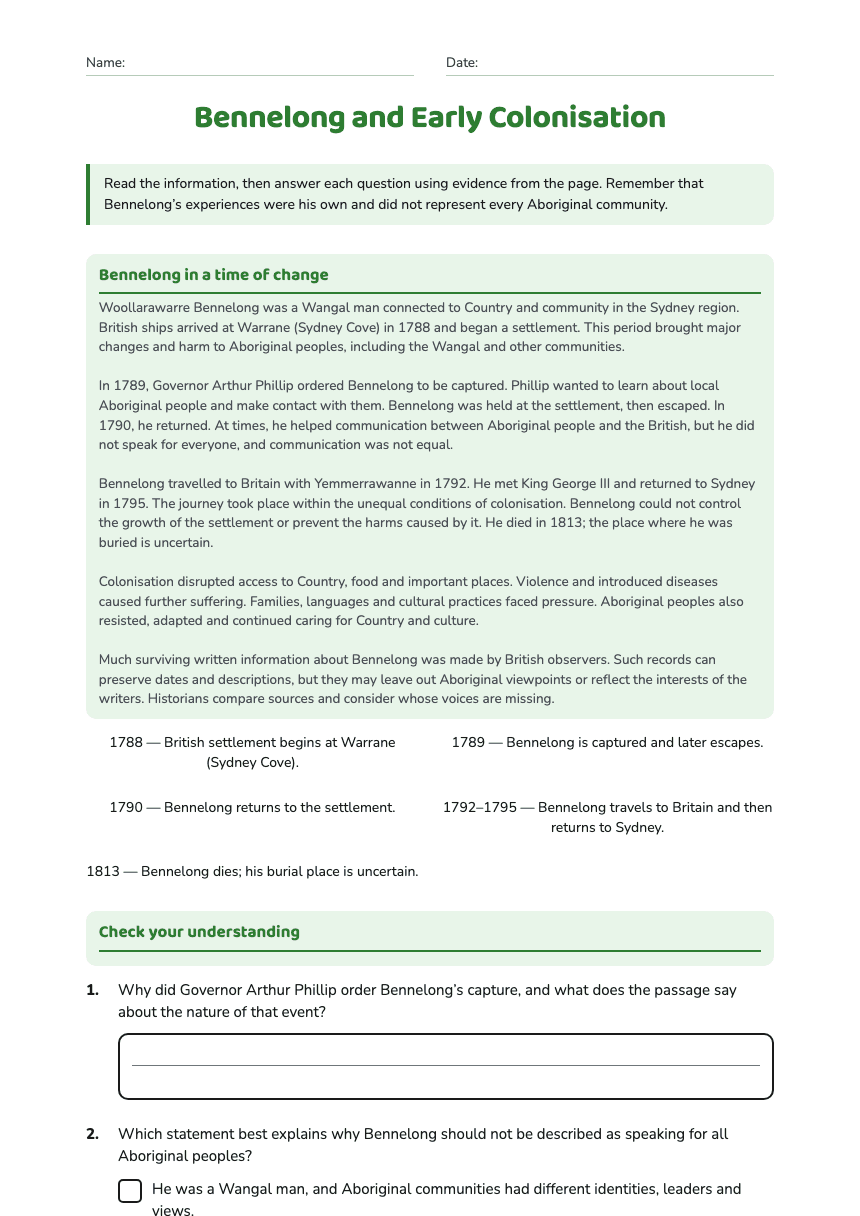
Overview: Woollarawarre Bennelong was a Wangal man from the Sydney area. He lived during the early period of British colonisation, when the First Fleet established a settlement at Warrane (Sydney Cove) in 1788. Bennelong’s life is known mainly through surviving British records, so historians must consider whose viewpoints were recorded and whose were left out.
A simple timeline
Before 1789: Bennelong lived as a Wangal man with strong connections to Country, family and community.
1789: Governor Arthur Phillip ordered Bennelong’s capture. Phillip wanted to learn more about the people living around the new settlement. Bennelong was held at the settlement, but later escaped.
1790: Bennelong returned to the settlement. He helped communication between some Aboriginal people and the British, although communication was difficult and his influence had limits.
1792–1795: Bennelong travelled to Britain with Yemmerrawanne. He met King George III and saw parts of British society. This journey happened within the unequal and coercive conditions of colonisation.
1795: Bennelong returned to Sydney. He later lived for periods at a house built for him at what is now known as Bennelong Point.
Later life: Bennelong maintained connections with Aboriginal people and the British settlement. His life was affected by loss of Country, violence, disease and major social disruption.
1813: Bennelong died. The exact location of his burial is uncertain.
Bennelong’s relationships and roles
Governor Arthur Phillip arranged Bennelong’s capture because he wanted information about local Aboriginal communities and hoped to establish communication. Capturing a person was an act of force, not a fair or equal exchange.
Over time, Bennelong and Phillip developed a complicated relationship. Bennelong sometimes communicated with the British and helped them understand aspects of local language and society. He also communicated Aboriginal concerns and maintained his own relationships and identity. It is more accurate to describe him as an intermediary or cultural broker in some situations than to call him simply an interpreter.
Bennelong did not speak for every Aboriginal person. The Sydney area included many different groups, including the Wangal and other Eora communities, with their own leaders, languages, families and interests. Bennelong’s choices cannot be used to explain the views of all Aboriginal peoples.
Visit to Britain and later life
Bennelong travelled to Britain with Yemmerrawanne in 1792. He met King George III and became known in British records as a representative of the people of Sydney. However, this description came from British observers and did not mean that Bennelong represented all Aboriginal nations.
When Bennelong returned in 1795, the colony had expanded and relationships had changed. He continued to live between Aboriginal and colonial worlds, but he could not control the expansion of the settlement or prevent the harm caused by colonisation.
🌏 Perspectives, Impacts and Key Terms
Colonisation and its effects
British colonisation affected the Wangal, Eora and neighbouring peoples in many connected ways. Aboriginal peoples experienced dispossession as settlers took land and restricted access to important places. Violence occurred, including conflict and attacks. Introduced diseases caused serious illness and death because Aboriginal communities had little previous exposure to some of them.
Colonisation also disrupted access to food, water and sacred places, and affected movement across Country. Families, cultural practices, languages and authority structures were placed under great pressure. Aboriginal peoples resisted, adapted and continued to care for Country and culture. These effects were not caused by Bennelong; they were part of the larger colonial invasion and settlement process.
Sources and perspectives: Much of the surviving information about Bennelong comes from British journals, letters and reports. These records can provide useful details, but they may be incomplete, use unfamiliar spellings, or reflect British assumptions and interests. Aboriginal perspectives were often not recorded, or were recorded through colonial observers. Historians compare different sources and avoid treating one record as the complete truth.
Glossary
Aboriginal peoples: The diverse First Peoples of mainland Australia and Tasmania.
Country: The living relationships between people, land, waters, skies, plants, animals, ancestors and culture.
colonisation: The process by which one power takes control of another people’s land and society.
dispossession: The forced loss of land, resources or rights.
Eora: A term used in some historical and modern contexts for Aboriginal peoples of the Sydney region; it should not be treated as the name of one single nation.
intermediary: A person who helps communication or relationships between groups.
Wangal: The Aboriginal people and community associated with the south side of the Parramatta River around the Sydney area, including Bennelong’s community.
perspective: A particular way of seeing or understanding an event.
coercive: Involving pressure, force or a lack of genuine free choice.
Comprehension and reflection
✅ Teacher Answer Guide
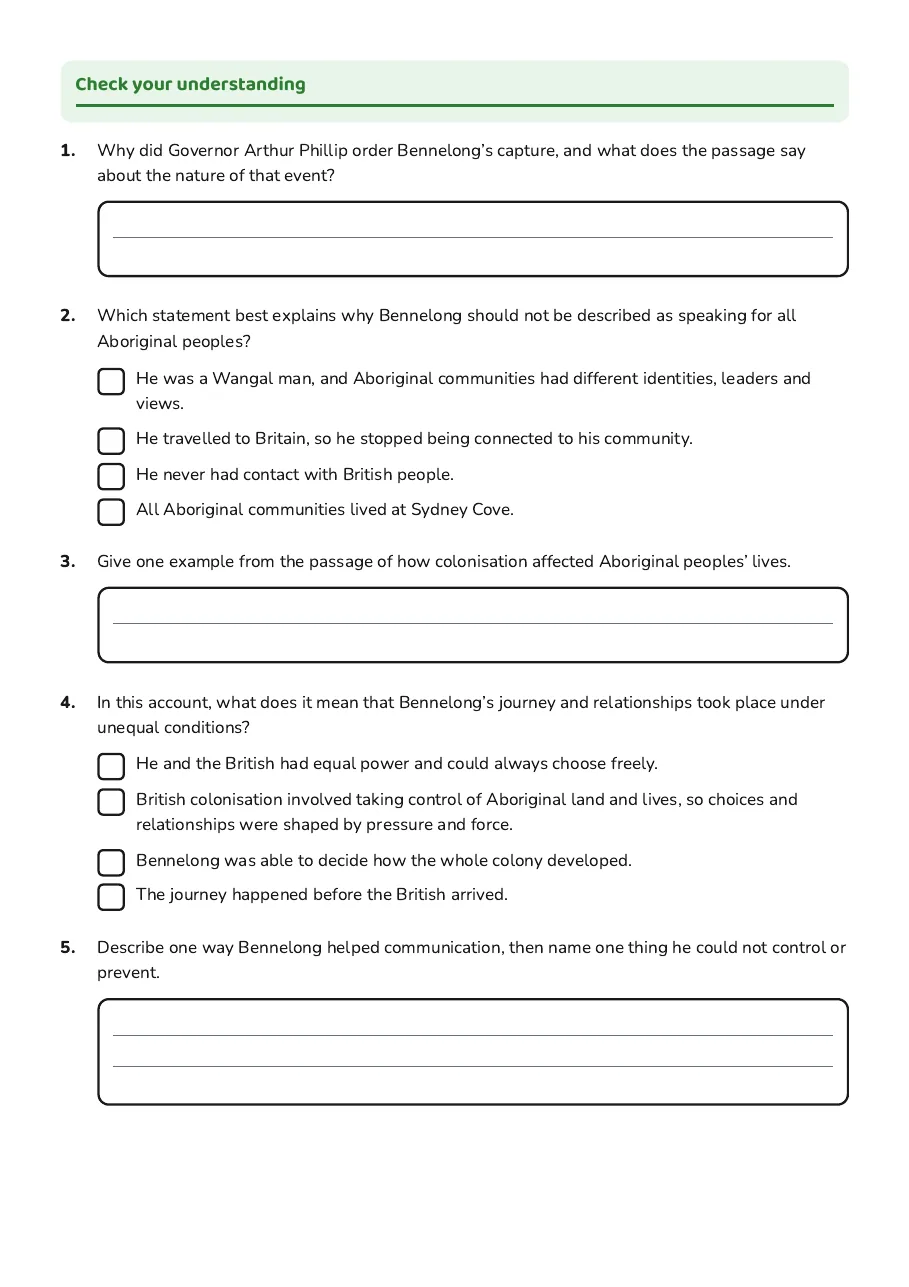
1. Phillip ordered Bennelong’s capture to learn more about local Aboriginal people and to try to establish communication with them. Students should also recognise that the capture involved force.
2. Bennelong was a Wangal man, and the Sydney area contained many different Aboriginal groups with their own views and leaders. His experiences and choices could not represent every Aboriginal community.
3. Accept answers including dispossession, violence, introduced disease, restricted access to Country, loss of resources, and disruption to family, culture, language or authority structures. Recognition of Aboriginal resistance and continuation is also appropriate.
4. Bennelong did not make choices in conditions of equality or complete freedom. His capture, movement and relationships took place while the British were taking control of Aboriginal land and lives.
5. Possible impact: he helped communication in some situations, shared knowledge, or made Aboriginal perspectives more visible in British records. Possible limitations: he could not control colonial expansion, prevent violence or disease, or speak for all Aboriginal peoples.
6. Possible strength: British records may provide dates, observations and details about events. Possible limitations: they may be incomplete, biased, mistranslated or focused on British interests. Students may suggest Aboriginal oral histories, community knowledge, archaeological evidence and records from different viewpoints.
About This Worksheet
Free in Kuraplan
Sign up free, grab the PDF, and customize it for your class.
Print-Ready
Formatted for standard paper. Clean layout, easy to read.
AI-Generated
Created with Kuraplan's AI, designed for real classroom use.
For Teachers & Parents
Use in classrooms, for homework, tutoring, or homeschool.
Need a custom version of this worksheet?
Kuraplan's AI generates custom worksheets in seconds — differentiated for every learner, aligned to your curriculum.
Generate Custom Worksheets — Free