ScienceFreePrintable
Chemical Changes and Matter
A free science worksheet ready for your classroom. Open in Kuraplan to grab the print-ready PDF, customize it for your students, or generate a fresh version in seconds.
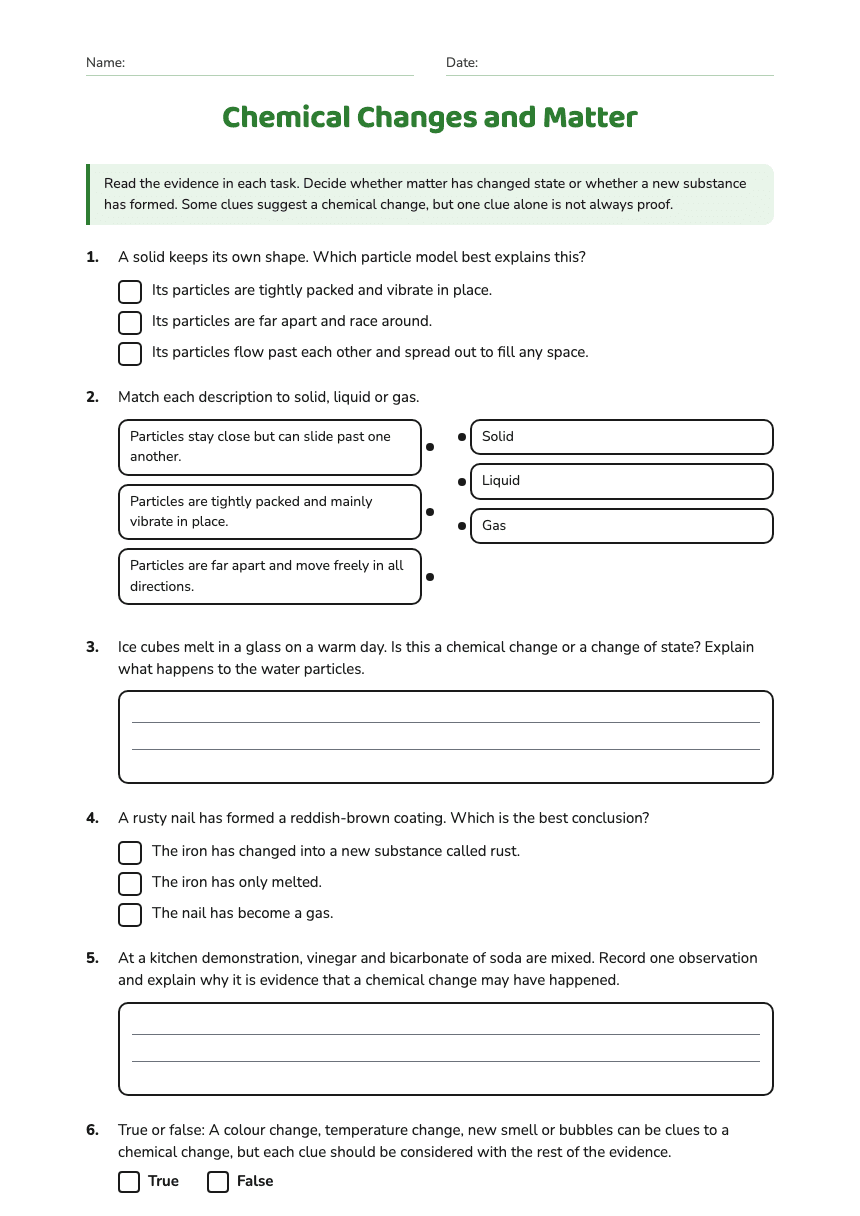
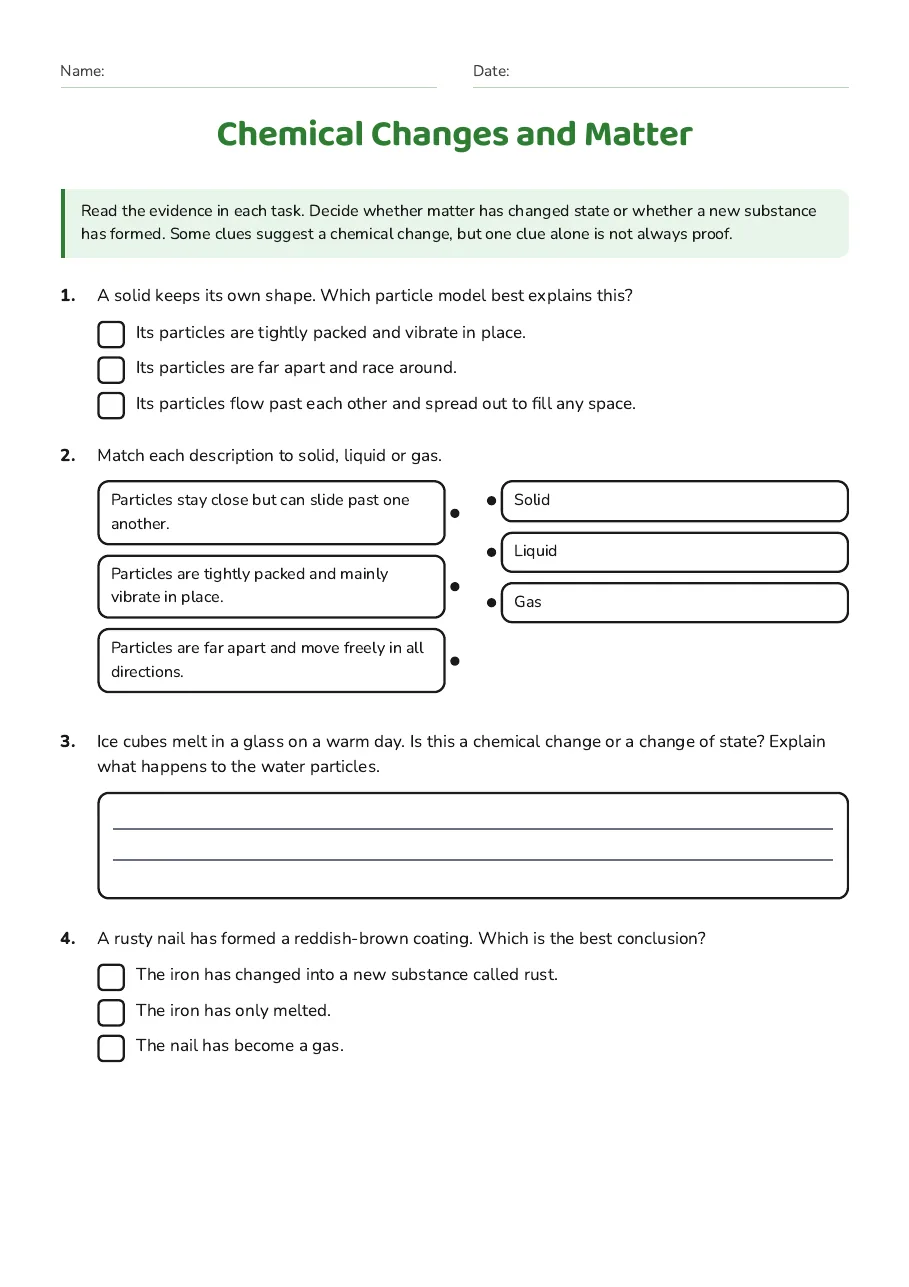
Name:Date:
Chemical Changes and Matter
Read the evidence in each task. Decide whether matter has changed state or whether a new substance has formed. Some clues suggest a chemical change, but one clue alone is not always proof.
1.A solid keeps its own shape. Which particle model best explains this?
- Its particles are tightly packed and vibrate in place.
- Its particles are far apart and race around.
- Its particles flow past each other and spread out to fill any space.
2.Match each description to solid, liquid or gas.
- Particles stay close but can slide past one another.
- Particles are tightly packed and mainly vibrate in place.
- Particles are far apart and move freely in all directions.
- Solid
- Liquid
- Gas
3.Ice cubes melt in a glass on a warm day. Is this a chemical change or a change of state? Explain what happens to the water particles.
4.A rusty nail has formed a reddish-brown coating. Which is the best conclusion?
- The iron has changed into a new substance called rust.
- The iron has only melted.
- The nail has become a gas.
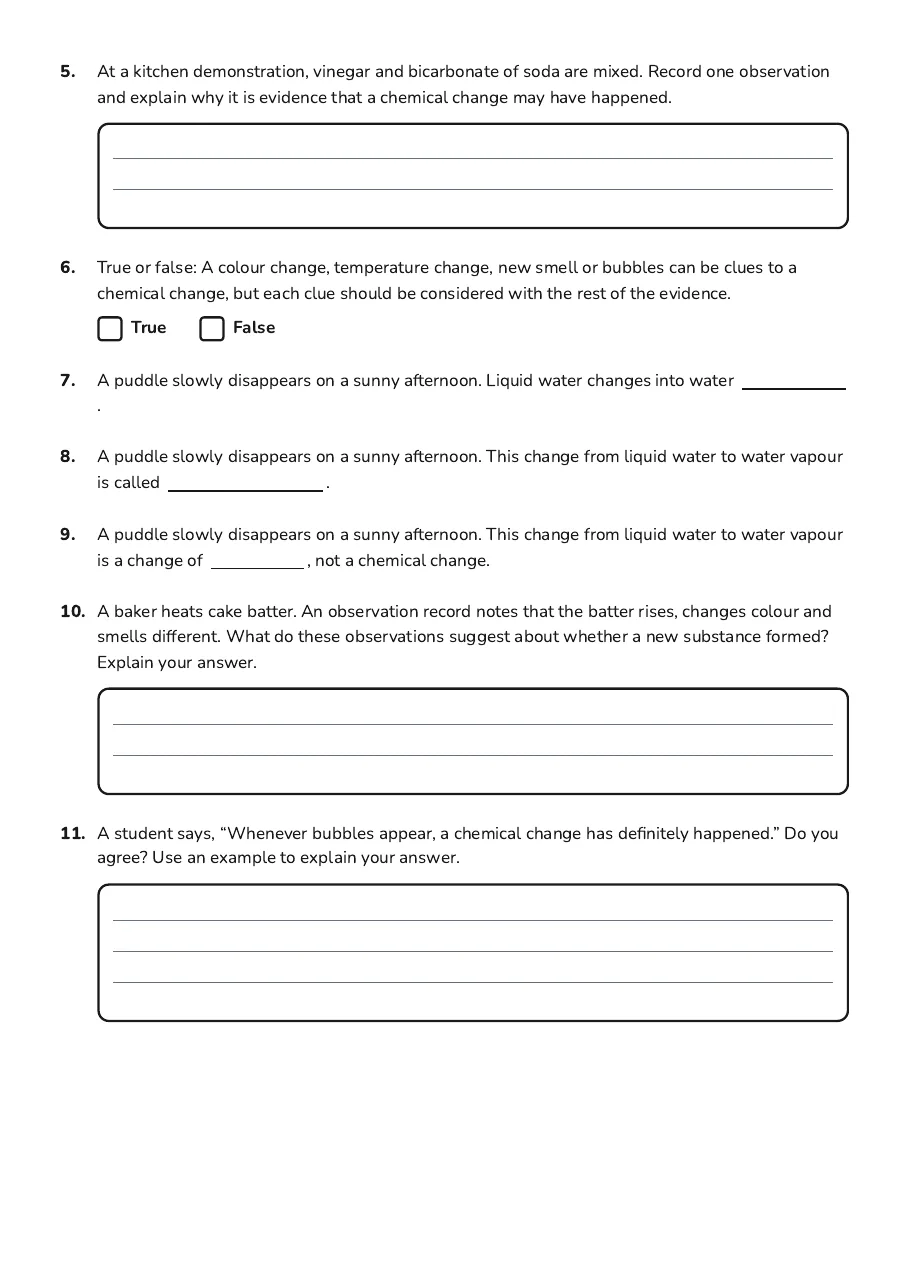
5.At a kitchen demonstration, vinegar and bicarbonate of soda are mixed. Record one observation and explain why it is evidence that a chemical change may have happened.
6.True or false: A colour change, temperature change, new smell or bubbles can be clues to a chemical change, but each clue should be considered with the rest of the evidence.
TrueFalse
7.A puddle slowly disappears on a sunny afternoon. Liquid water changes into water .
8.A puddle slowly disappears on a sunny afternoon. This change from liquid water to water vapour is called .
9.A puddle slowly disappears on a sunny afternoon. This change from liquid water to water vapour is a change of , not a chemical change.
10.A baker heats cake batter. An observation record notes that the batter rises, changes colour and smells different. What do these observations suggest about whether a new substance formed? Explain your answer.
11.A student says, “Whenever bubbles appear, a chemical change has definitely happened.” Do you agree? Use an example to explain your answer.
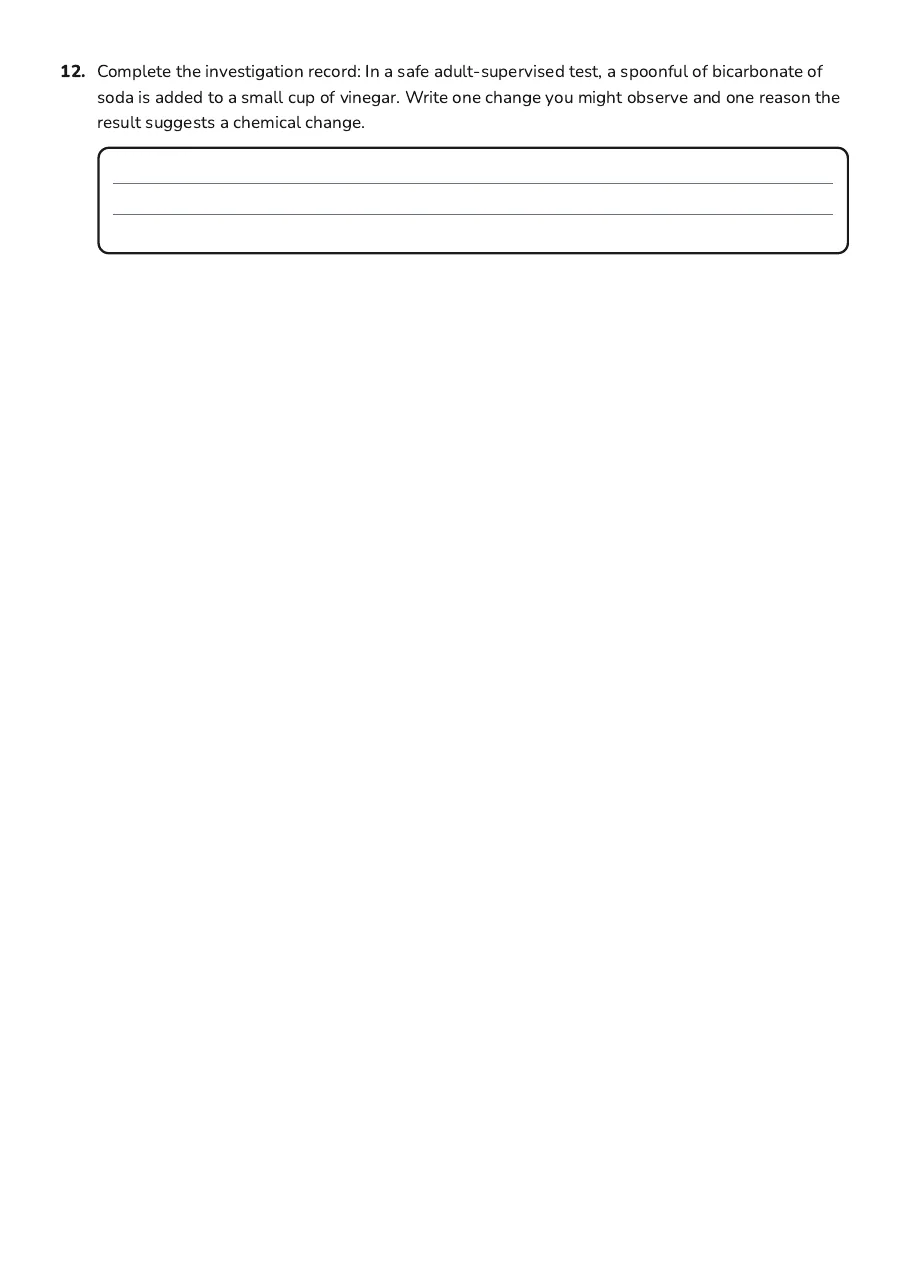
12.Complete the investigation record: In a safe adult-supervised test, a spoonful of bicarbonate of soda is added to a small cup of vinegar. Write one change you might observe and one reason the result suggests a chemical change.
3 printable pages
Page 1
Page 2
Page 3
About This Worksheet
Free in Kuraplan
Sign up free, grab the PDF, and customize it for your class.
Print-Ready
Formatted for standard paper. Clean layout, easy to read.
AI-Generated
Created with Kuraplan's AI, designed for real classroom use.
For Teachers & Parents
Use in classrooms, for homework, tutoring, or homeschool.
Need a custom version of this worksheet?
Kuraplan's AI generates custom worksheets in seconds — differentiated for every learner, aligned to your curriculum.
Generate Custom Worksheets — Free No credit card Curriculum-aligned Under 60 seconds
More Science Worksheets
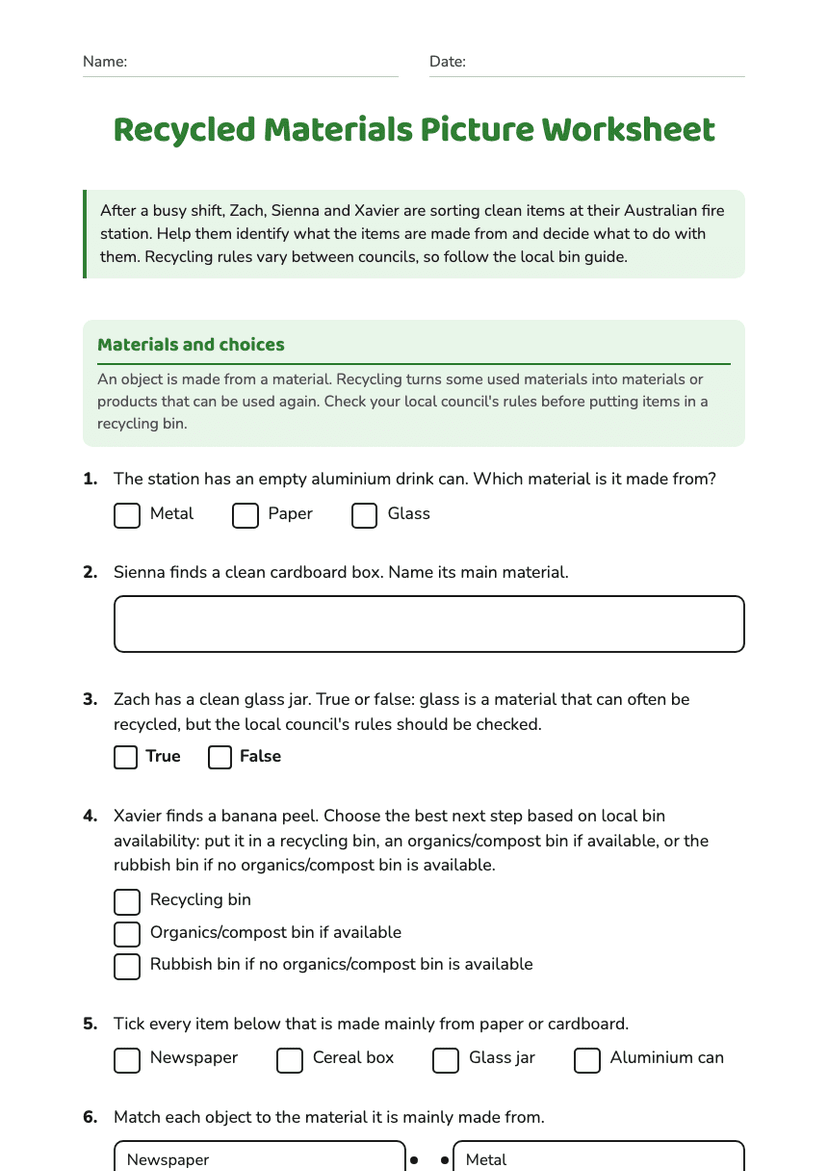
Recycled Materials Picture Worksheet
Free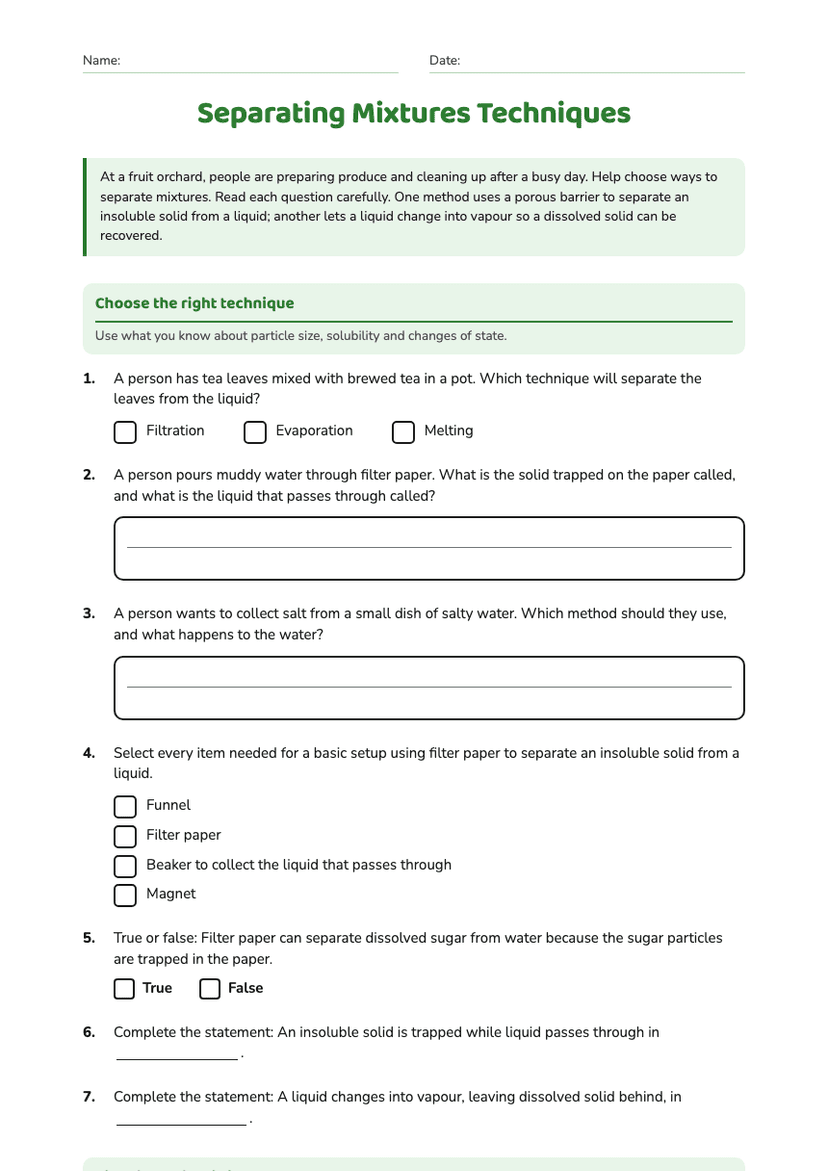
Separating Mixtures Techniques
Free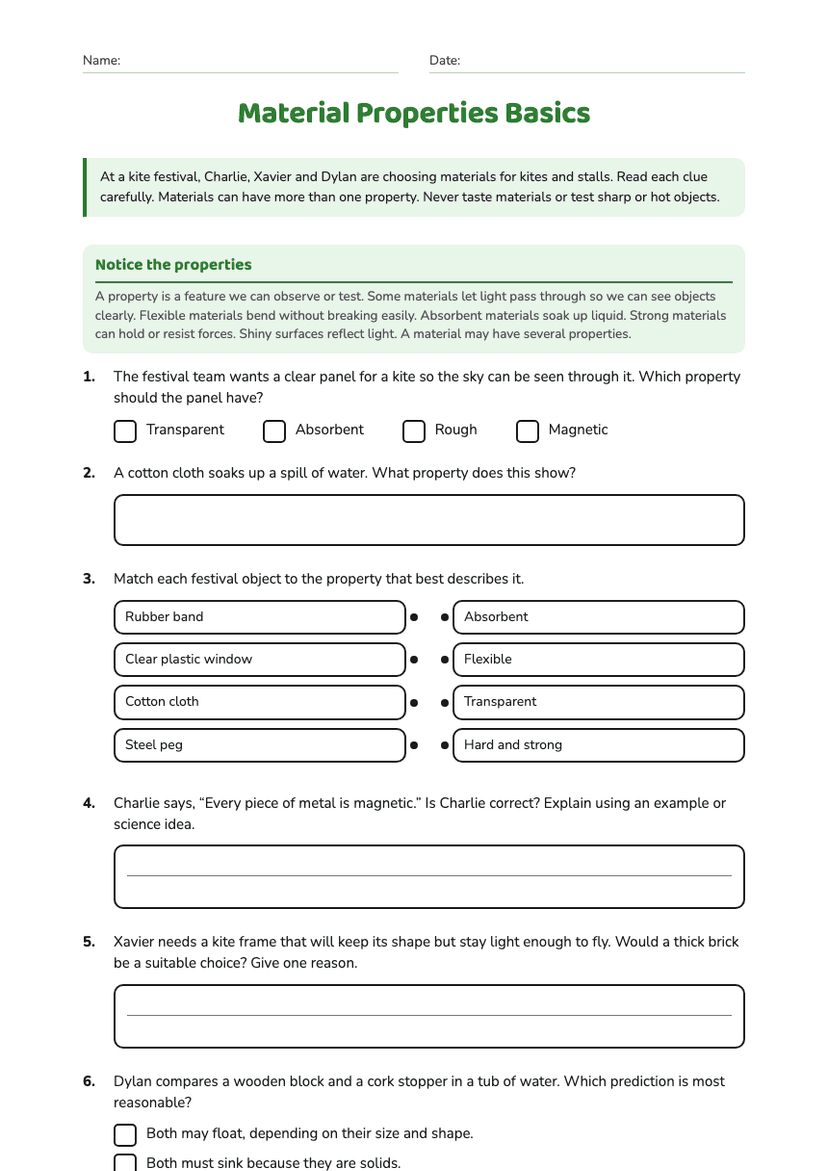
Material Properties Basics
Free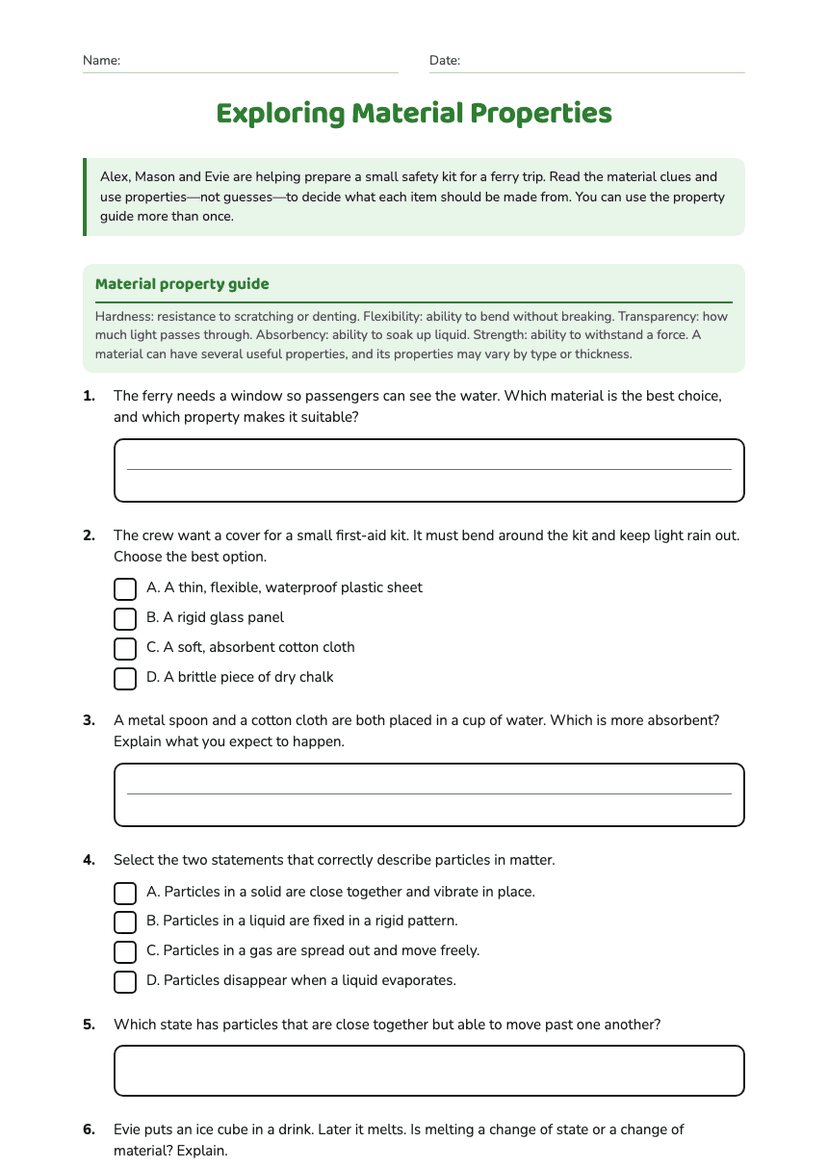
Year 5–6
Exploring Material Properties
Free
Year 3
States of Matter Exploration
Free
States of Matter Exploration
Free
Year 6
Reversible and Irreversible Changes
Free
Year 5–6