Exploring Material Properties
A free science worksheet ready for your classroom. Open in Kuraplan to grab the print-ready PDF, customize it for your students, or generate a fresh version in seconds.
Exploring Material Properties
🔬 Part 1: Material Properties Investigation
Fabric/Fibres:
Hardness: _____________ (hard/soft)
Flexibility: _____________ (flexible/rigid)
Transparency: _____________ (transparent/opaque)
Texture: _____________
Metal:
Hardness: _____________ (hard/soft)
Flexibility: _____________ (flexible/rigid)
Transparency: _____________ (transparent/opaque)
Weight: _____________ (heavy/light)
Plastic:
Hardness: _____________ (hard/soft)
Flexibility: _____________ (flexible/rigid)
Transparency: _____________ (transparent/opaque)
Durability: _____________
Glass:
Hardness: _____________ (hard/soft)
Flexibility: _____________ (flexible/rigid)
Transparency: _____________ (transparent/opaque)
Fragility: _____________
⚗️ Part 2: States of Matter
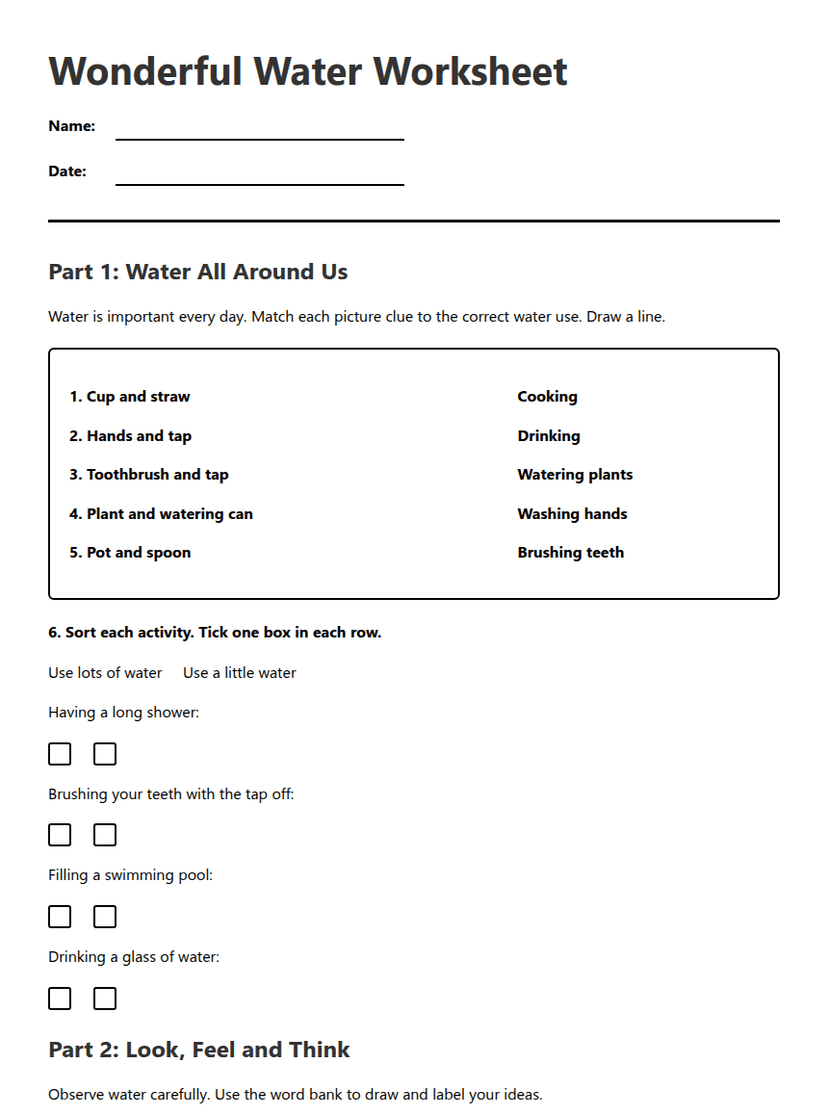
Ice cube:
Solid Liquid GasWater in a glass:
Solid Liquid GasAir in a balloon:
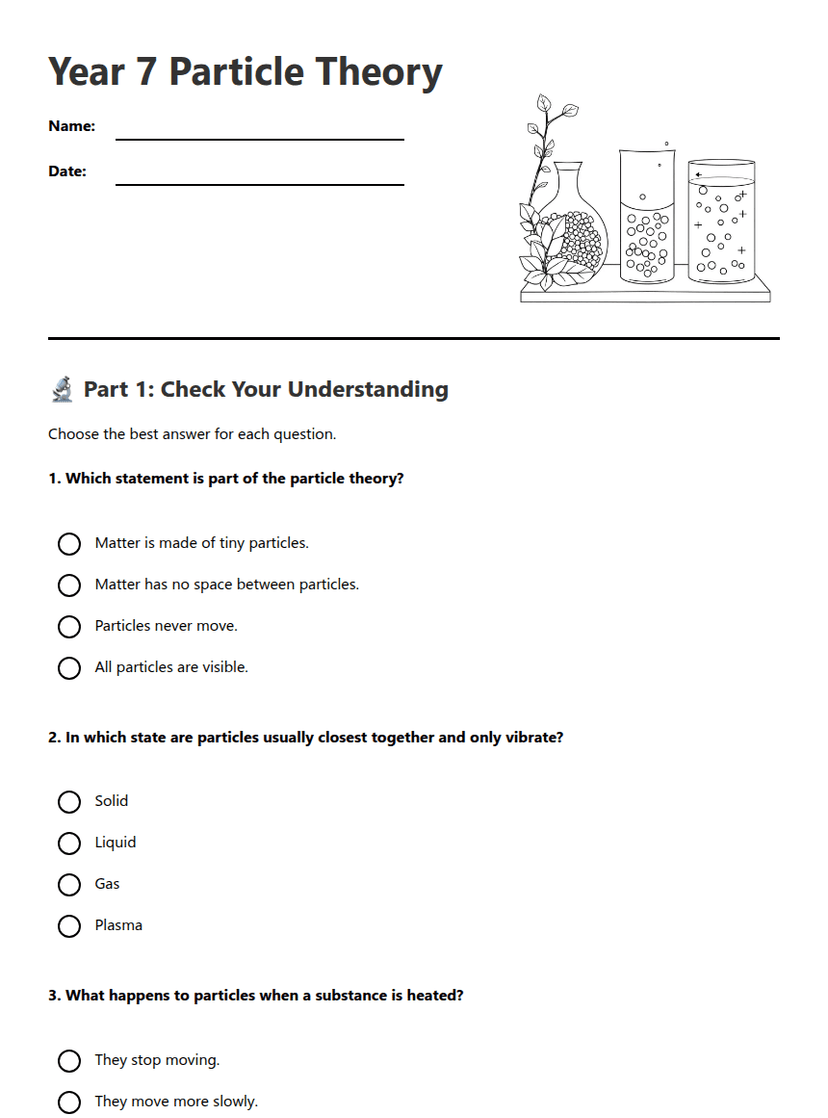
Solid Liquid GasIn a solid, particles are _____________ together and _____________ very little.
In a liquid, particles can _____________ past each other but stay close together.
In a gas, particles move _____________ and are spread _____________ apart.
🏗️ Part 3: Material Uses and Applications
Check all materials you would use:
Soft fabric (for cushioning) Hard plastic (for structure) Metal (for strength) Bubble wrap (for protection)🌏 Part 4: Real-World Connections
Natural fibres were used for: _________________________
Clay was used for: _________________________
Wood was used for: _________________________
Reversible change: _________________________
Irreversible change: _________________________
📊 Part 5: Investigation Results
About This Worksheet
Free in Kuraplan
Sign up free, grab the PDF, and customize it for your class.
Print-Ready
Formatted for standard paper. Clean layout, easy to read.
AI-Generated
Created with Kuraplan's AI, designed for real classroom use.
For Teachers & Parents
Use in classrooms, for homework, tutoring, or homeschool.
Need a custom version of this worksheet?
Kuraplan's AI generates custom worksheets in seconds — differentiated for every learner, aligned to your curriculum.
Generate Custom Worksheets — Free