Chinese Miners and Colonisation
A free social sciences worksheet ready for your classroom. Open in Kuraplan to grab the print-ready PDF, customize it for your students, or generate a fresh version in seconds.
Chinese Miners and Colonisation
📚 Part 1: Information, Timeline and Vocabulary
Why did Chinese migrants come? During the 1850s gold rushes, many people travelled from southern China to Australia because they hoped to earn money and support their families. News of gold was called the “New Gold Mountain”. Some migrants had also experienced poverty, population pressure, political unrest and limited work opportunities. Many travelled temporarily and planned to return home.
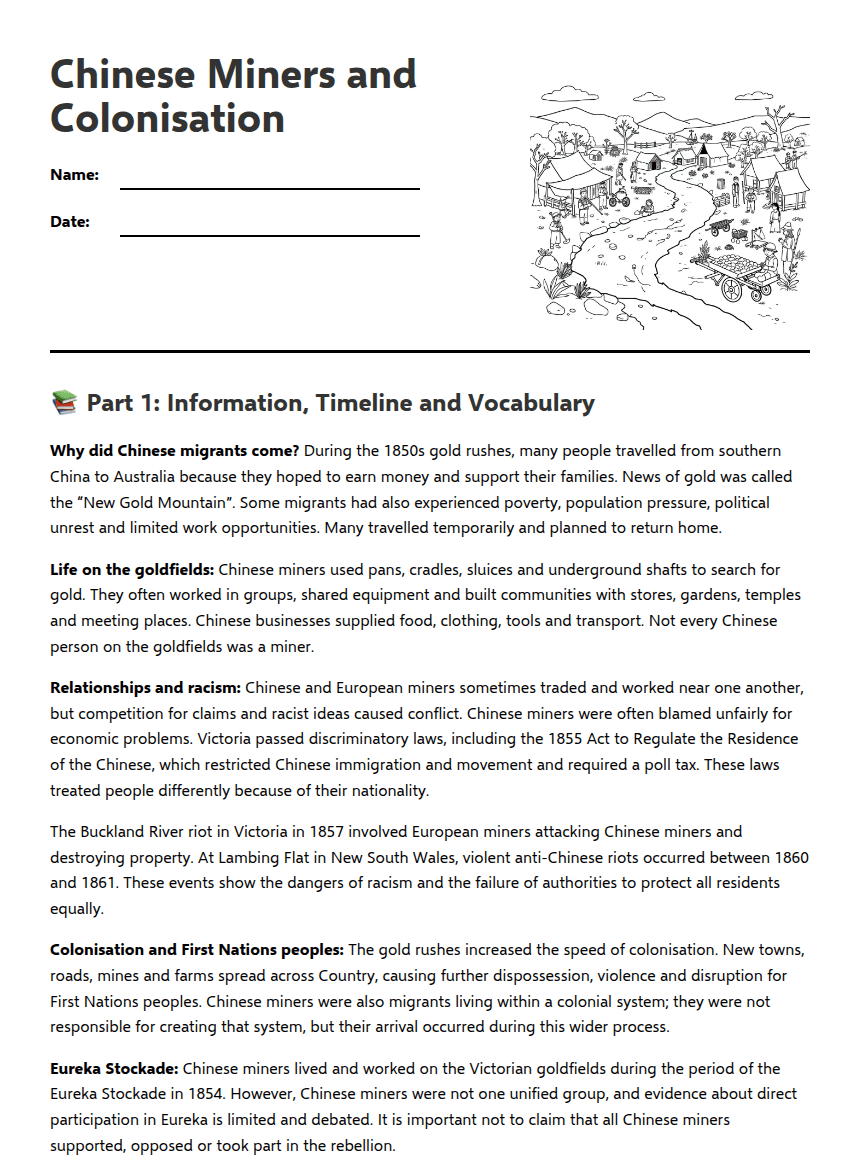
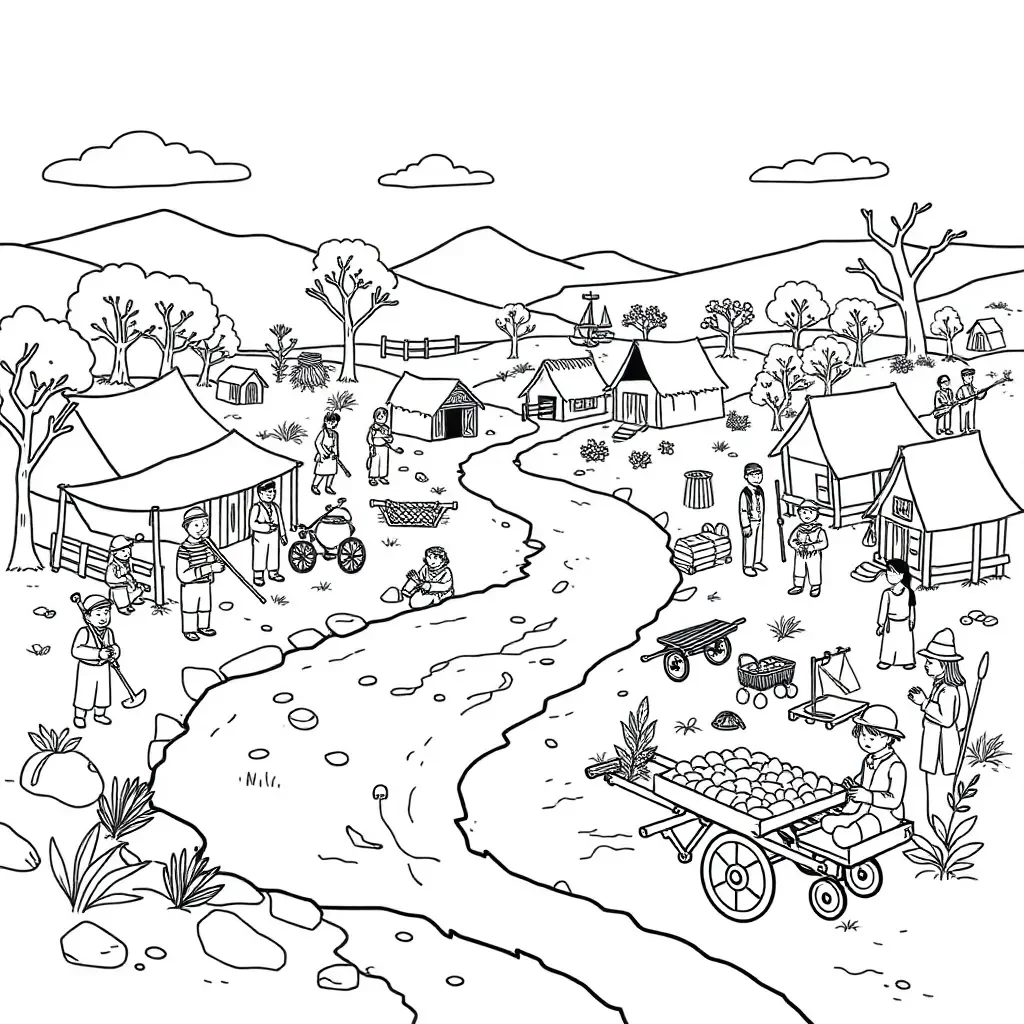
Life on the goldfields: Chinese miners used pans, cradles, sluices and underground shafts to search for gold. They often worked in groups, shared equipment and built communities with stores, gardens, temples and meeting places. Chinese businesses supplied food, clothing, tools and transport. Not every Chinese person on the goldfields was a miner.
Relationships and racism: Chinese and European miners sometimes traded and worked near one another, but competition for claims and racist ideas caused conflict. Chinese miners were often blamed unfairly for economic problems. Victoria passed discriminatory laws, including the 1855 Act to Regulate the Residence of the Chinese, which restricted Chinese immigration and movement and required a poll tax. These laws treated people differently because of their nationality.
The Buckland River riot in Victoria in 1857 involved European miners attacking Chinese miners and destroying property. At Lambing Flat in New South Wales, violent anti-Chinese riots occurred between 1860 and 1861. These events show the dangers of racism and the failure of authorities to protect all residents equally.
Colonisation and First Nations peoples: The gold rushes increased the speed of colonisation. New towns, roads, mines and farms spread across Country, causing further dispossession, violence and disruption for First Nations peoples. Chinese miners were also migrants living within a colonial system; they were not responsible for creating that system, but their arrival occurred during this wider process.
Eureka Stockade: Chinese miners lived and worked on the Victorian goldfields during the period of the Eureka Stockade in 1854. However, Chinese miners were not one unified group, and evidence about direct participation in Eureka is limited and debated. It is important not to claim that all Chinese miners supported, opposed or took part in the rebellion.
Timeline
1851: Gold discoveries in New South Wales and Victoria attract migrants from many places.
1854: Eureka Stockade takes place at Ballarat.
1855: Victoria introduces discriminatory legislation restricting Chinese immigration and movement.
1857: Buckland River riot attacks Chinese miners and their property.
1860–61: Lambing Flat riots target Chinese miners in New South Wales.
Late 1800s: Anti-Chinese policies contribute to wider restrictions on non-European migration.
Today: Chinese Australians contribute to Australia’s multicultural society, while historians continue to study gold-rush migration, racism and First Nations dispossession.
Key vocabulary
colonisation: The process by which a country extends control over another place and its people.
dispossession: The taking of people’s land, rights or resources, often by force or unfair laws.
goldfield: An area where gold is found and mined.
poll tax: A tax charged to each person, in this case used in a discriminatory way against Chinese migrants.
racism: Unfair treatment or beliefs based on a person’s race, culture or nationality.
multicultural: Including people, cultures and traditions from many backgrounds.
✏️ Part 2: Read, Compare and Respond
Source and map-reading activity
Source A: A map shows Chinese migration routes from southern China to the Victorian and New South Wales goldfields. It marks Ballarat and the Buckland River in Victoria, and Lambing Flat in New South Wales.
Source B: A government record describes a Victorian law that charged Chinese arrivals a poll tax and restricted the number of Chinese passengers allowed on ships.
Source C: A historical account describes Chinese businesses supplying vegetables, food, tools and services to people living on the goldfields.
Compare perspectives
Chinese miner or trader: May have valued the chance to earn money, support family and build a community, while facing racism and unfair laws.
European miner: May have wanted fair access to claims, but some European miners also used racist ideas to oppose Chinese competition. Europeans did not all think alike.
First Nations person or community: Experienced the effects of expanding colonisation, including loss of Country, violence and disruption, as mining settlements spread.
🔎 Part 3: Extension and Teacher Answer Guide
Extension and research questions
1. Research one Chinese goldfields community, garden, temple, store or market. What does it show about daily life?
2. Why is it important to use the terms “Chinese miners” carefully rather than treating all Chinese people as one group?
3. Investigate how the White Australia policy developed from earlier colonial attitudes and laws. What changed over time?
4. Find a First Nations source about the effects of gold-rush colonisation in the area where you live.
Teacher answer guide
1. Possible answers include the search for gold and income, supporting family, poverty, population pressure, political unrest, limited work, or the hope of returning with savings.
2. Panning, cradling, sluicing and underground shaft mining.
3. They supplied food, vegetables, tools, clothing, transport and other services; formed communities; created businesses; and contributed labour and trade.
4. The third option: Chinese miners were diverse, and evidence about direct participation in Eureka must be treated carefully.
5. Examples include the Victorian poll tax and immigration restrictions, the 1855 legislation, the Buckland River riot, and the Lambing Flat riots.
6. Victorian examples: Ballarat or Buckland River. New South Wales example: Lambing Flat.
7. Source B, because it describes a government law and provides evidence about official discrimination.
8–9. Accept answers that compare perspectives respectfully and use relevant evidence. Strong responses recognise both discrimination and Chinese contributions, avoid stereotypes, explain that groups were not uniform, and mention the wider impact of colonisation on First Nations peoples.
Curriculum alignment
AC9HS5K03: Migration experiences and the development of Australian society.
AC9HS5K02: The effects of colonisation and the continuing importance of First Nations histories.
AC9HS5S04: Analysing sources, perspectives and evidence.
AC9HS5S07: Developing explanations and arguments using evidence.
References for teachers and students
National Museum of Australia, resources on the Australian gold rushes, Chinese migration and the Eureka Stockade.
Australian Dictionary of Biography, entries on Chinese Australians and goldfields figures.
Museums Victoria, collections and articles about Chinese communities, the goldfields and anti-Chinese legislation.
Australian Institute of Aboriginal and Torres Strait Islander Studies (AIATSIS), resources on First Nations histories, Country and colonisation.
About This Worksheet
Free in Kuraplan
Sign up free, grab the PDF, and customize it for your class.
Print-Ready
Formatted for standard paper. Clean layout, easy to read.
AI-Generated
Created with Kuraplan's AI, designed for real classroom use.
For Teachers & Parents
Use in classrooms, for homework, tutoring, or homeschool.
Need a custom version of this worksheet?
Kuraplan's AI generates custom worksheets in seconds — differentiated for every learner, aligned to your curriculum.
Generate Custom Worksheets — Free