MathsFreePrintable
Composite Area Volume Problems
A free maths worksheet ready for your classroom. Open in Kuraplan to grab the print-ready PDF, customize it for your students, or generate a fresh version in seconds.
Name:Date:
Composite Area Volume Problems
Show your working. Use π ≈ 3.14 and give answers to 1 decimal place where needed. Include the correct units.
Composite shape area
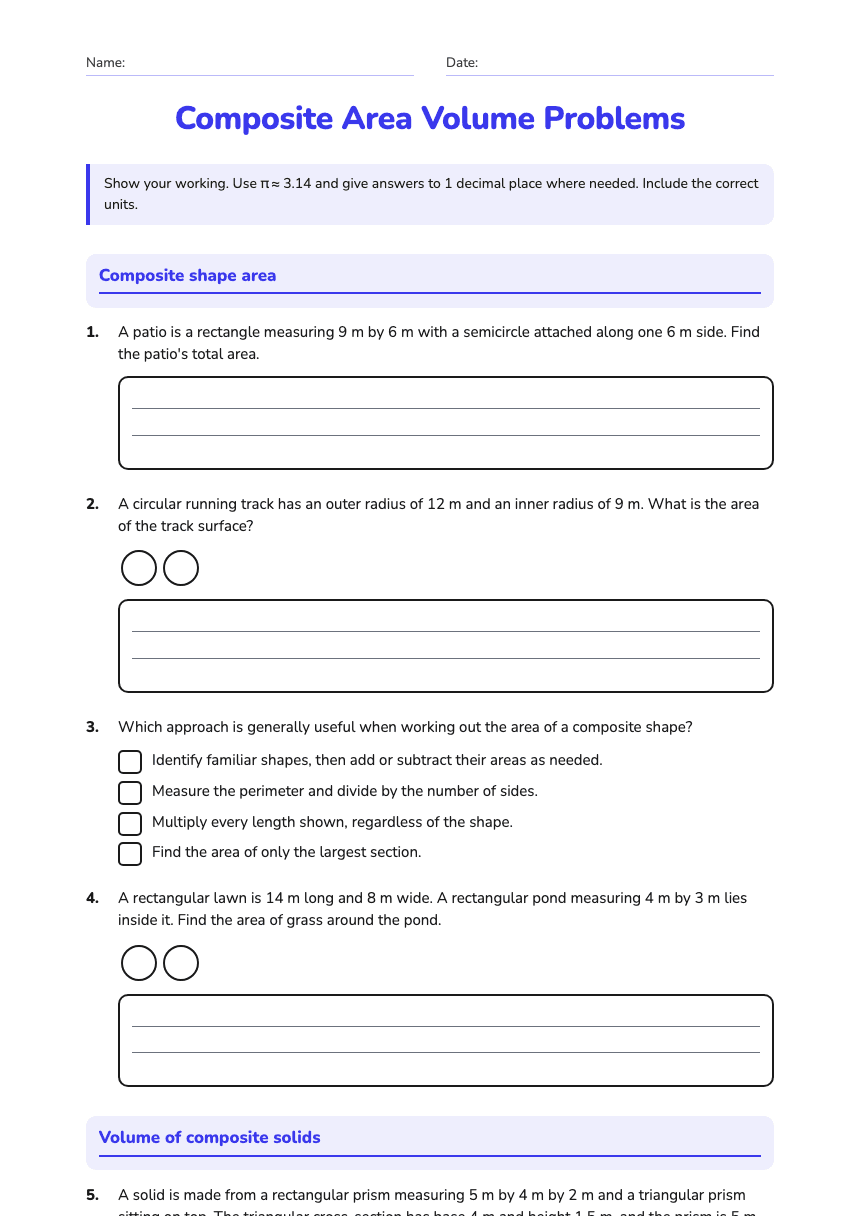
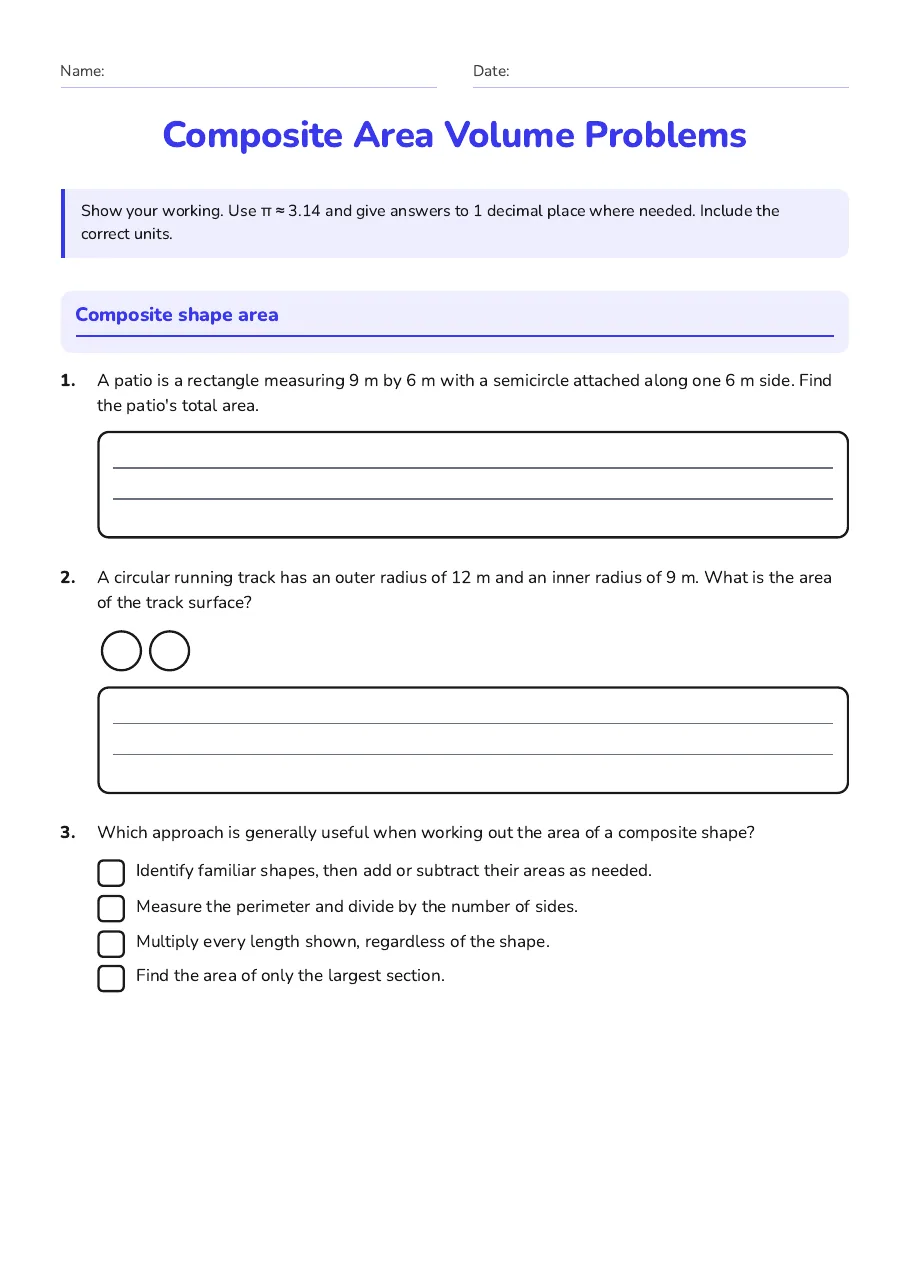
1.A patio is a rectangle measuring 9 m by 6 m with a semicircle attached along one 6 m side. Find the patio's total area.
2.A circular running track has an outer radius of 12 m and an inner radius of 9 m. What is the area of the track surface?
3.Which approach is generally useful when working out the area of a composite shape?
- Identify familiar shapes, then add or subtract their areas as needed.
- Measure the perimeter and divide by the number of sides.
- Multiply every length shown, regardless of the shape.
- Find the area of only the largest section.
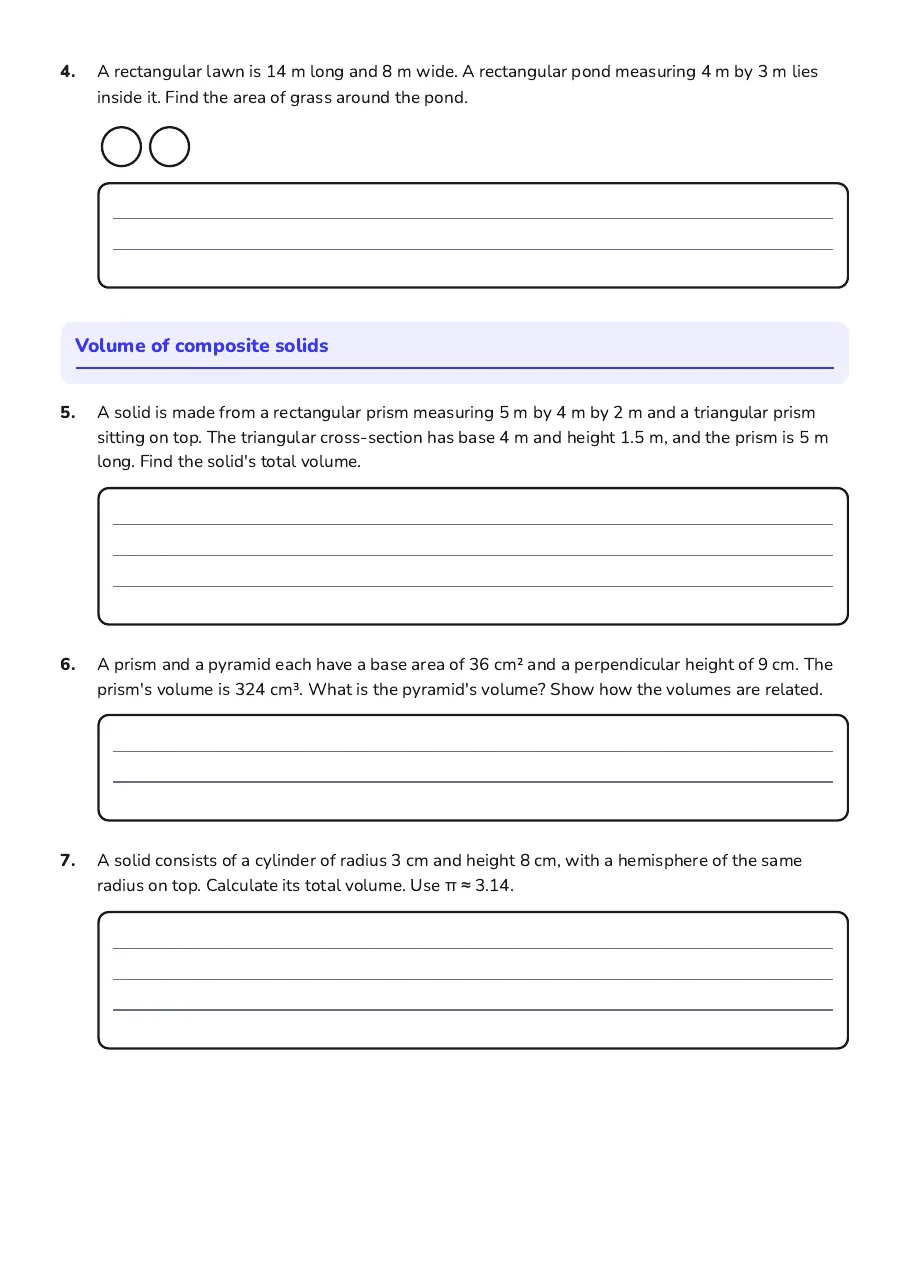
4.A rectangular lawn is 14 m long and 8 m wide. A rectangular pond measuring 4 m by 3 m lies inside it. Find the area of grass around the pond.
Volume of composite solids
5.A solid is made from a rectangular prism measuring 5 m by 4 m by 2 m and a triangular prism sitting on top. The triangular cross-section has base 4 m and height 1.5 m, and the prism is 5 m long. Find the solid's total volume.
6.A prism and a pyramid each have a base area of 36 cm² and a perpendicular height of 9 cm. The prism's volume is 324 cm³. What is the pyramid's volume? Show how the volumes are related.
7.A solid consists of a cylinder of radius 3 cm and height 8 cm, with a hemisphere of the same radius on top. Calculate its total volume. Use π ≈ 3.14.
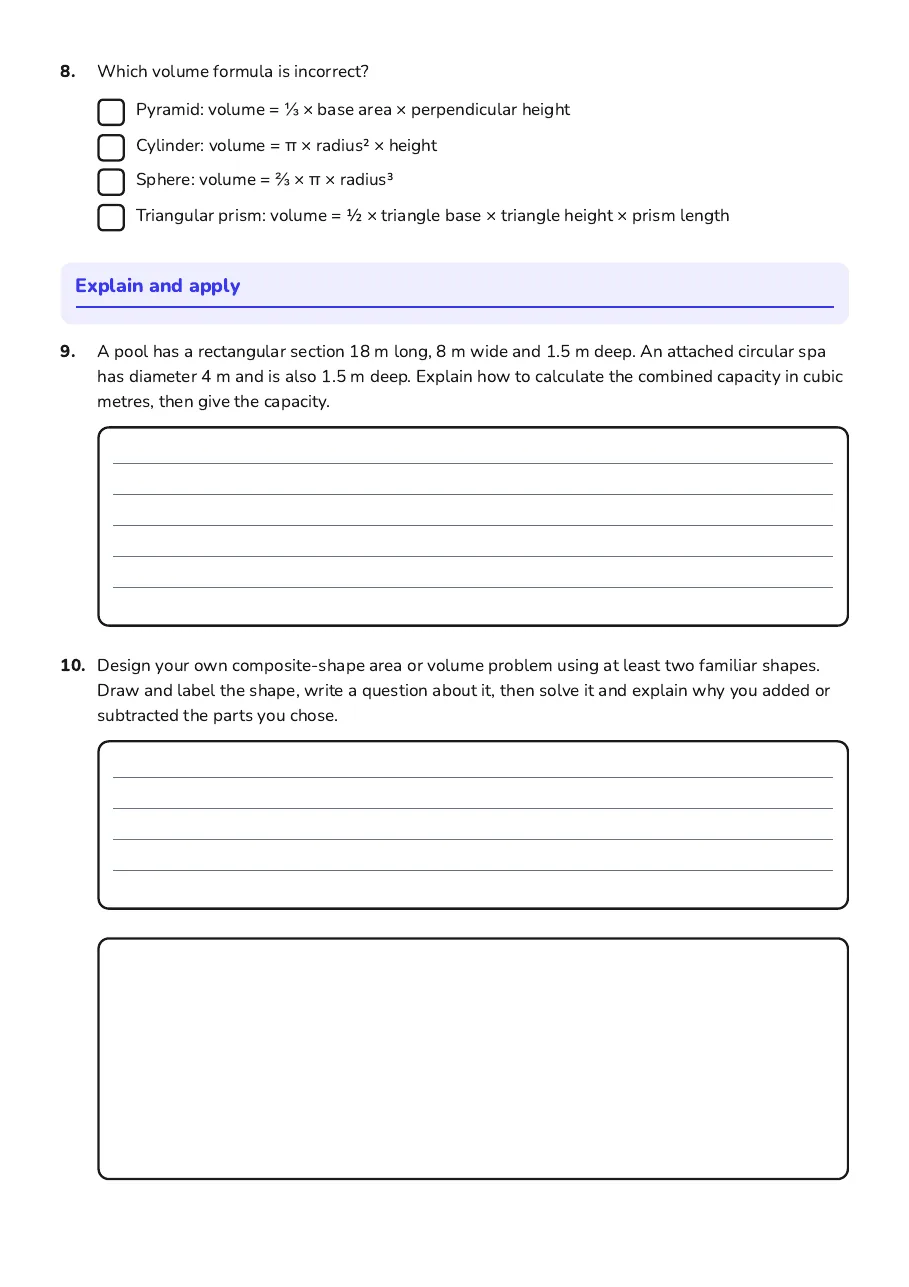
8.Which volume formula is incorrect?
- Pyramid: volume = ⅓ × base area × perpendicular height
- Cylinder: volume = π × radius² × height
- Sphere: volume = ⅔ × π × radius³
- Triangular prism: volume = ½ × triangle base × triangle height × prism length
Explain and apply
9.A pool has a rectangular section 18 m long, 8 m wide and 1.5 m deep. An attached circular spa has diameter 4 m and is also 1.5 m deep. Explain how to calculate the combined capacity in cubic metres, then give the capacity.
10.Design your own composite-shape area or volume problem using at least two familiar shapes. Draw and label the shape, write a question about it, then solve it and explain why you added or subtracted the parts you chose.
3 printable pages
Page 1
Page 2
Page 3
About This Worksheet
Free in Kuraplan
Sign up free, grab the PDF, and customize it for your class.
Print-Ready
Formatted for standard paper. Clean layout, easy to read.
AI-Generated
Created with Kuraplan's AI, designed for real classroom use.
For Teachers & Parents
Use in classrooms, for homework, tutoring, or homeschool.
Need a custom version of this worksheet?
Kuraplan's AI generates custom worksheets in seconds — differentiated for every learner, aligned to your curriculum.
Generate Custom Worksheets — Free No credit card Curriculum-aligned Under 60 seconds