Conservation of Mass
A free science worksheet ready for your classroom. Open in Kuraplan to grab the print-ready PDF, customize it for your students, or generate a fresh version in seconds.
Conservation of Mass
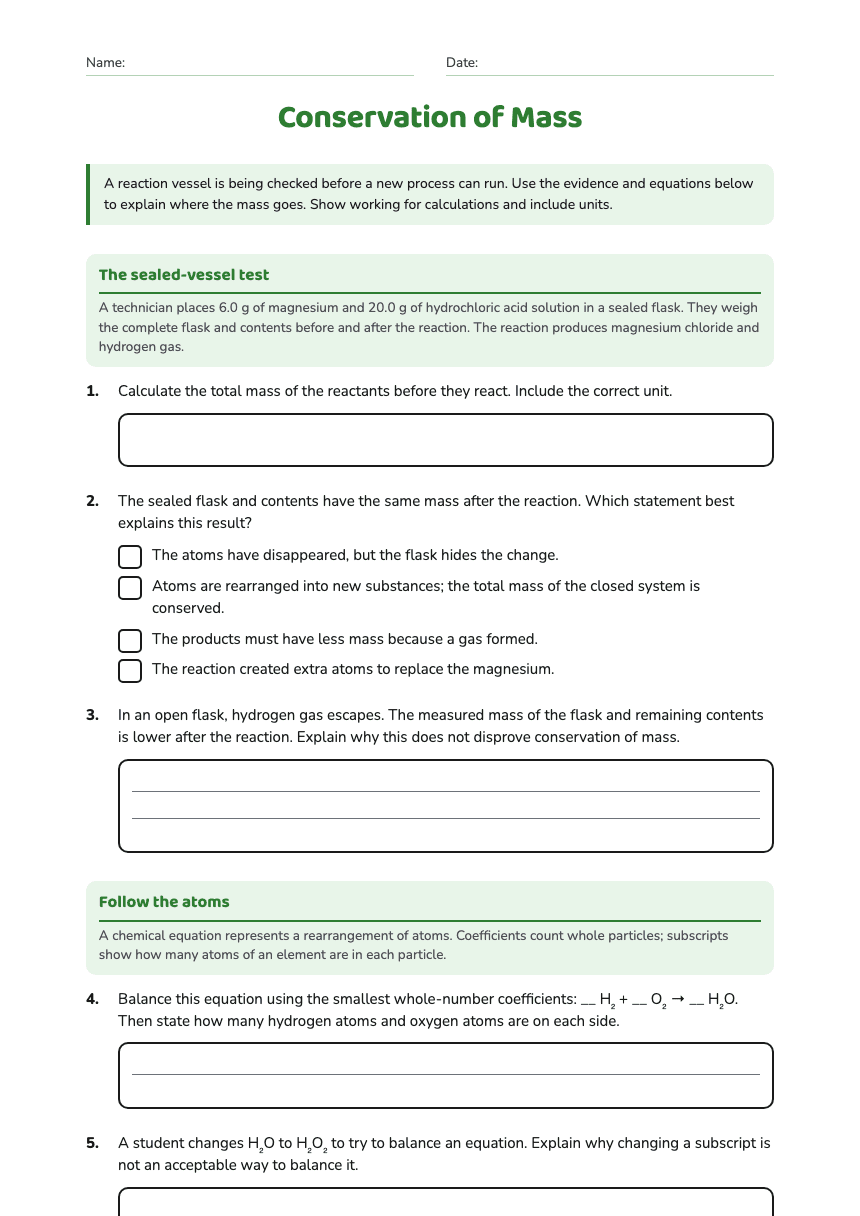
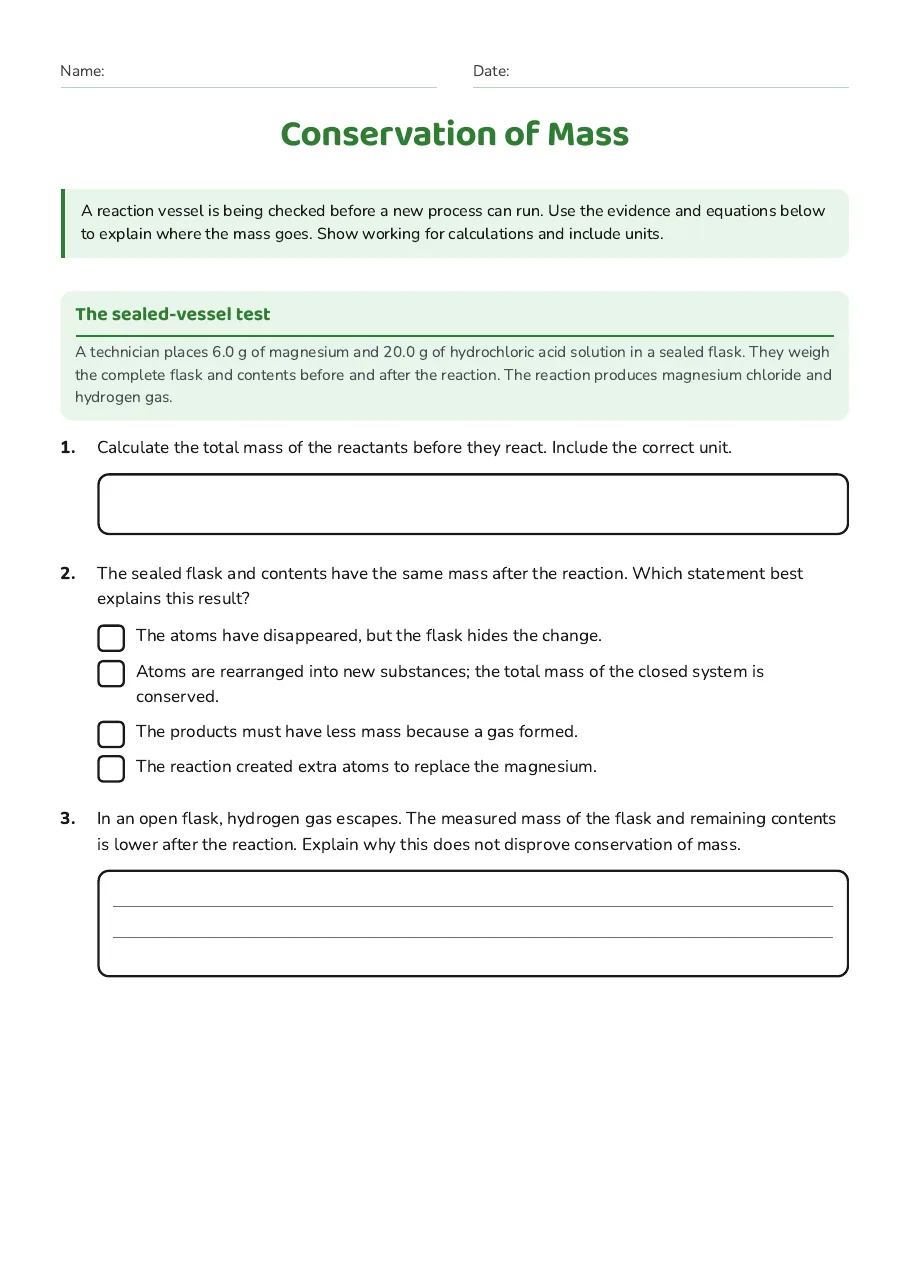
The sealed-vessel test
A technician places 6.0 g of magnesium and 20.0 g of hydrochloric acid solution in a sealed flask. They weigh the complete flask and contents before and after the reaction. The reaction produces magnesium chloride and hydrogen gas.
- The atoms have disappeared, but the flask hides the change.
- Atoms are rearranged into new substances; the total mass of the closed system is conserved.
- The products must have less mass because a gas formed.
- The reaction created extra atoms to replace the magnesium.
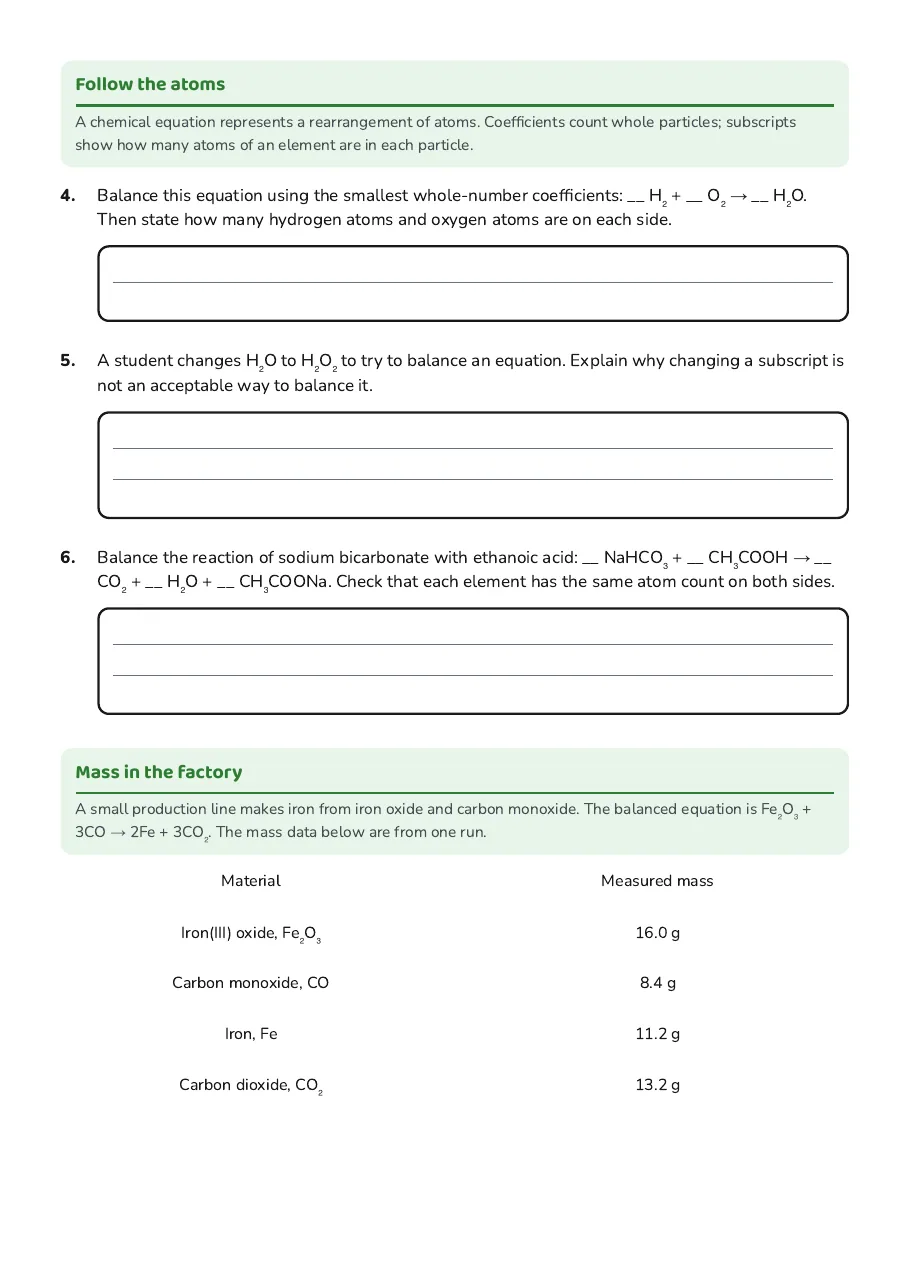
Follow the atoms
A chemical equation represents a rearrangement of atoms. Coefficients count whole particles; subscripts show how many atoms of an element are in each particle.
Mass in the factory
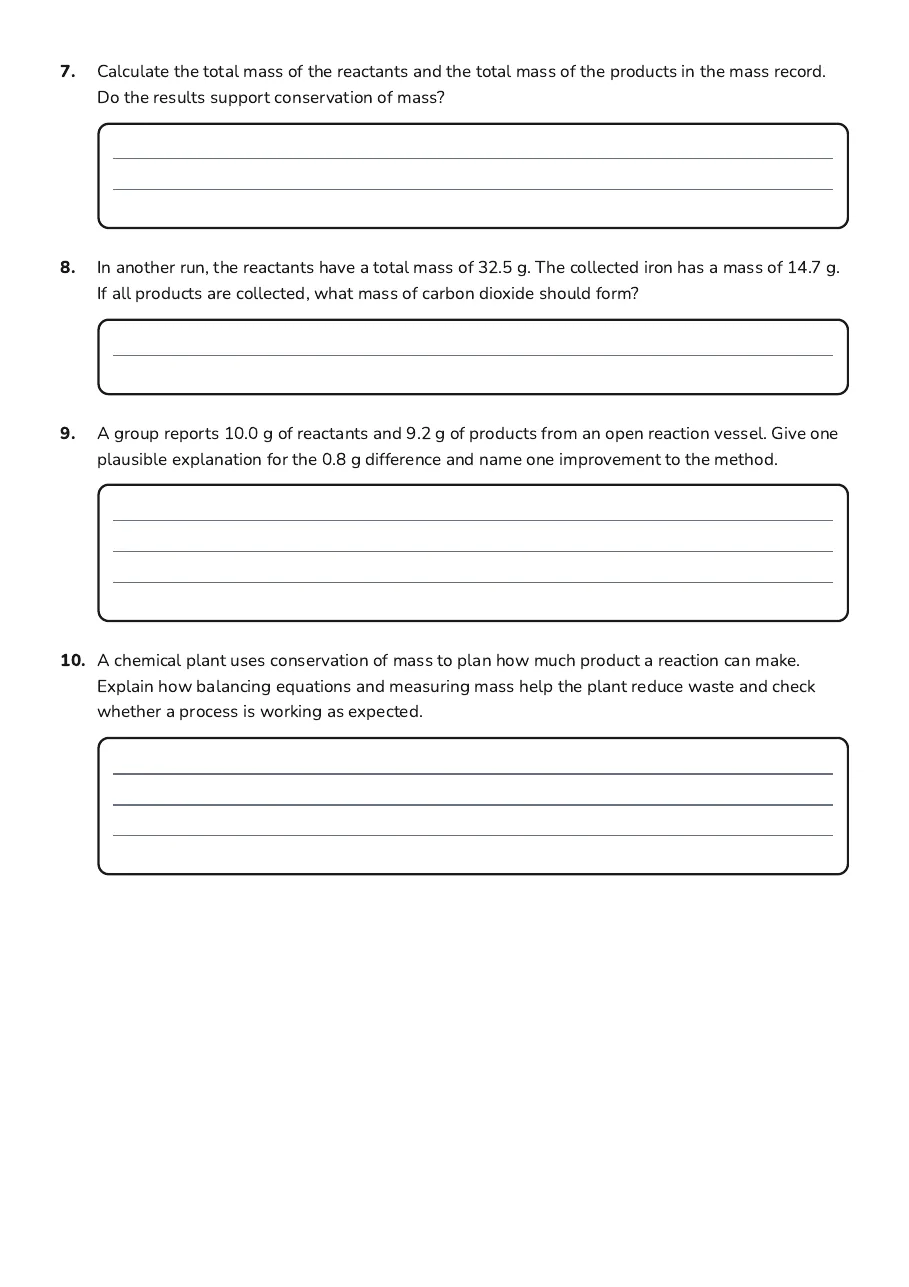
A small production line makes iron from iron oxide and carbon monoxide. The balanced equation is Fe₂O₃ + 3CO → 2Fe + 3CO₂. The mass data below are from one run.
Material
Measured mass
Iron(III) oxide, Fe₂O₃
16.0 g
Carbon monoxide, CO
8.4 g
Iron, Fe
11.2 g
Carbon dioxide, CO₂
13.2 g
3 printable pages
Page 1
Page 2
Page 3
About This Worksheet
Free in Kuraplan
Sign up free, grab the PDF, and customize it for your class.
Print-Ready
Formatted for standard paper. Clean layout, easy to read.
AI-Generated
Created with Kuraplan's AI, designed for real classroom use.
For Teachers & Parents
Use in classrooms, for homework, tutoring, or homeschool.
Need a custom version of this worksheet?
Kuraplan's AI generates custom worksheets in seconds — differentiated for every learner, aligned to your curriculum.
Generate Custom Worksheets — FreeMore Science Worksheets
Recycled Materials Picture Worksheet
Free
Separating Mixtures Techniques
Free
Material Properties Basics
Free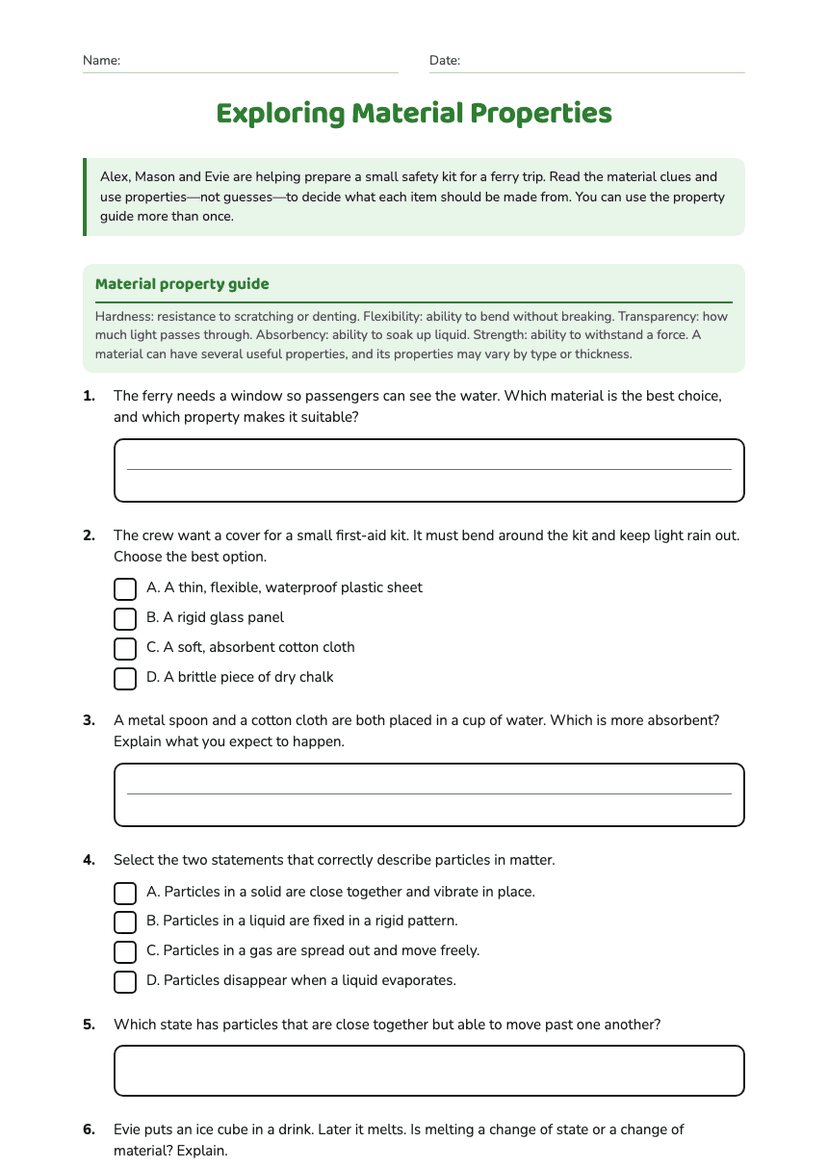
Exploring Material Properties
Free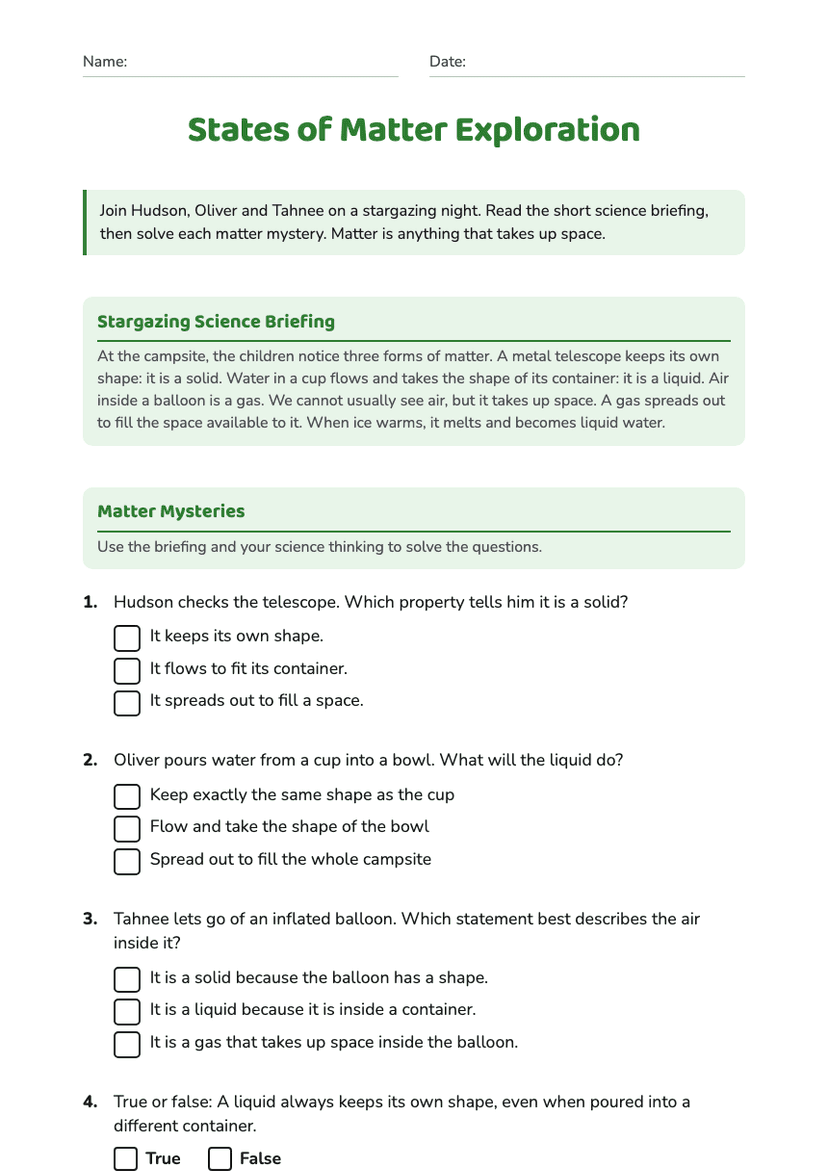
States of Matter Exploration
Free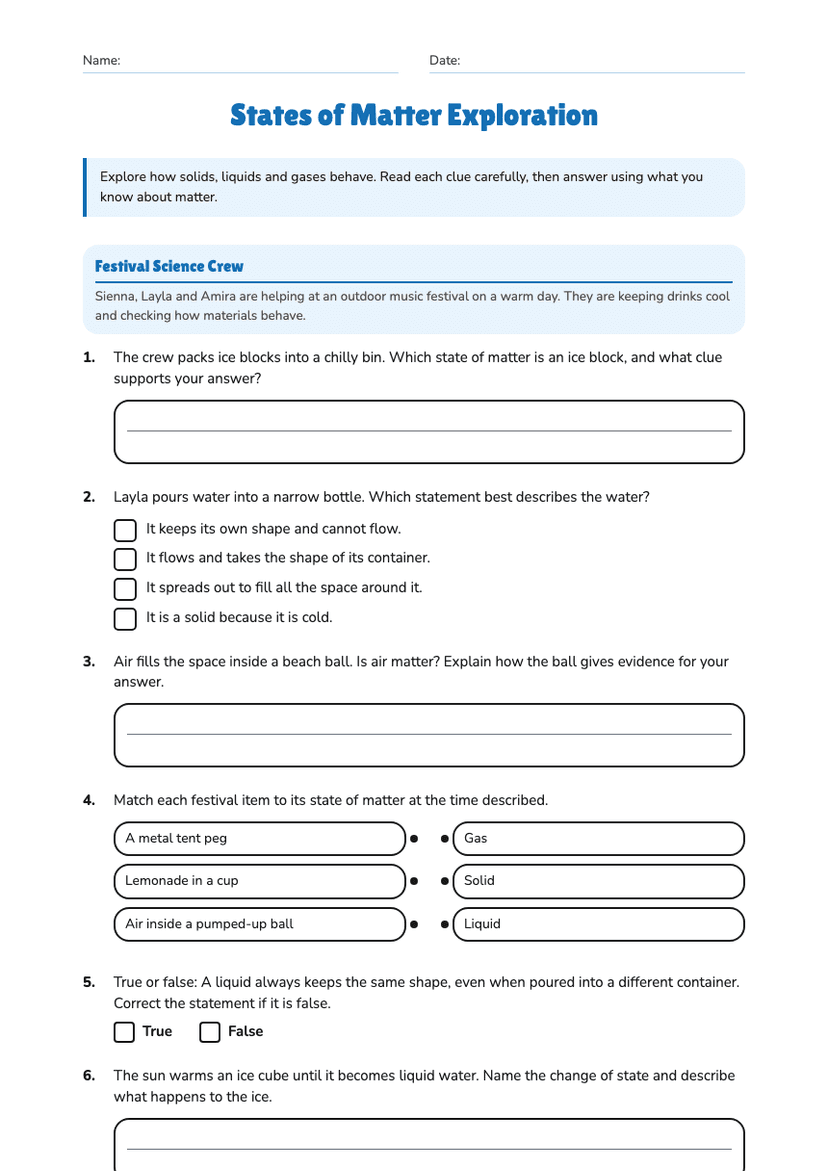
States of Matter Exploration
Free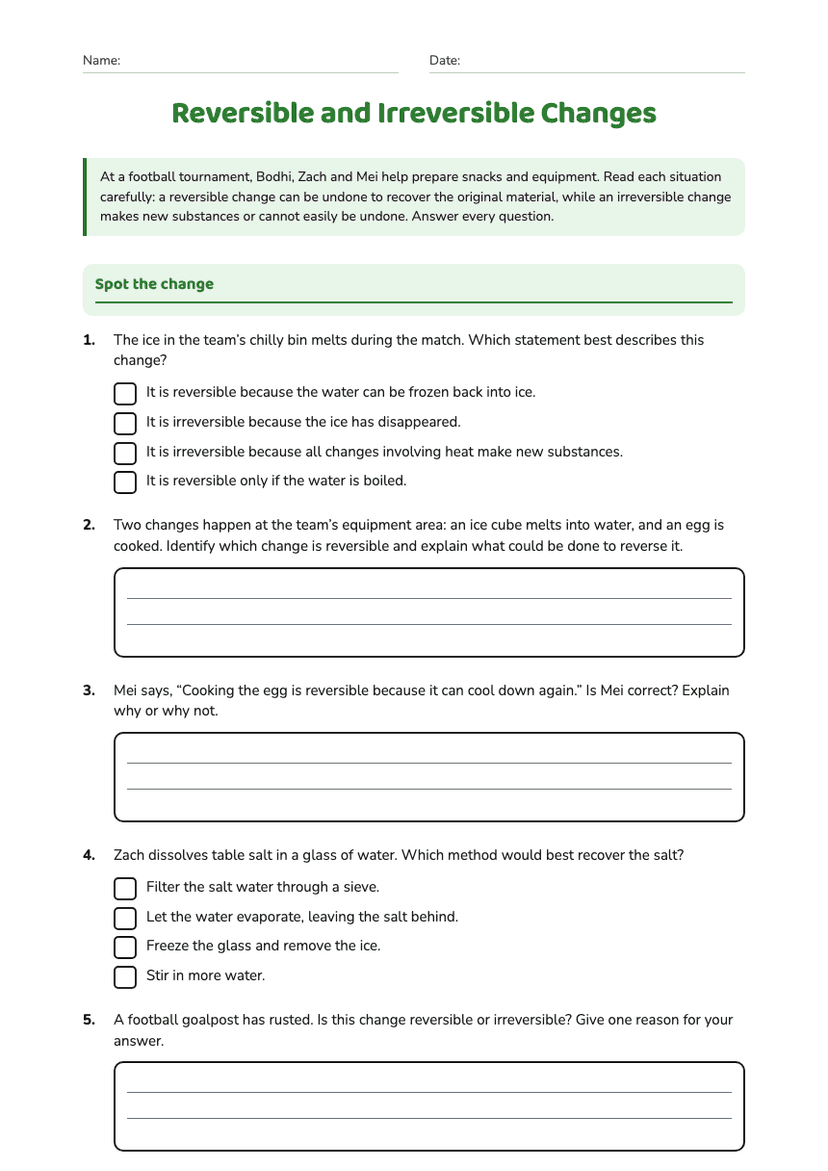
Reversible and Irreversible Changes
Free