EnglishFreePrintable

Contextual Research: The Outsiders

A free english worksheet ready for your classroom. Open in Kuraplan to grab the print-ready PDF, customize it for your students, or generate a fresh version in seconds.
Contextual Research: The Outsiders worksheet preview
Name:Date:

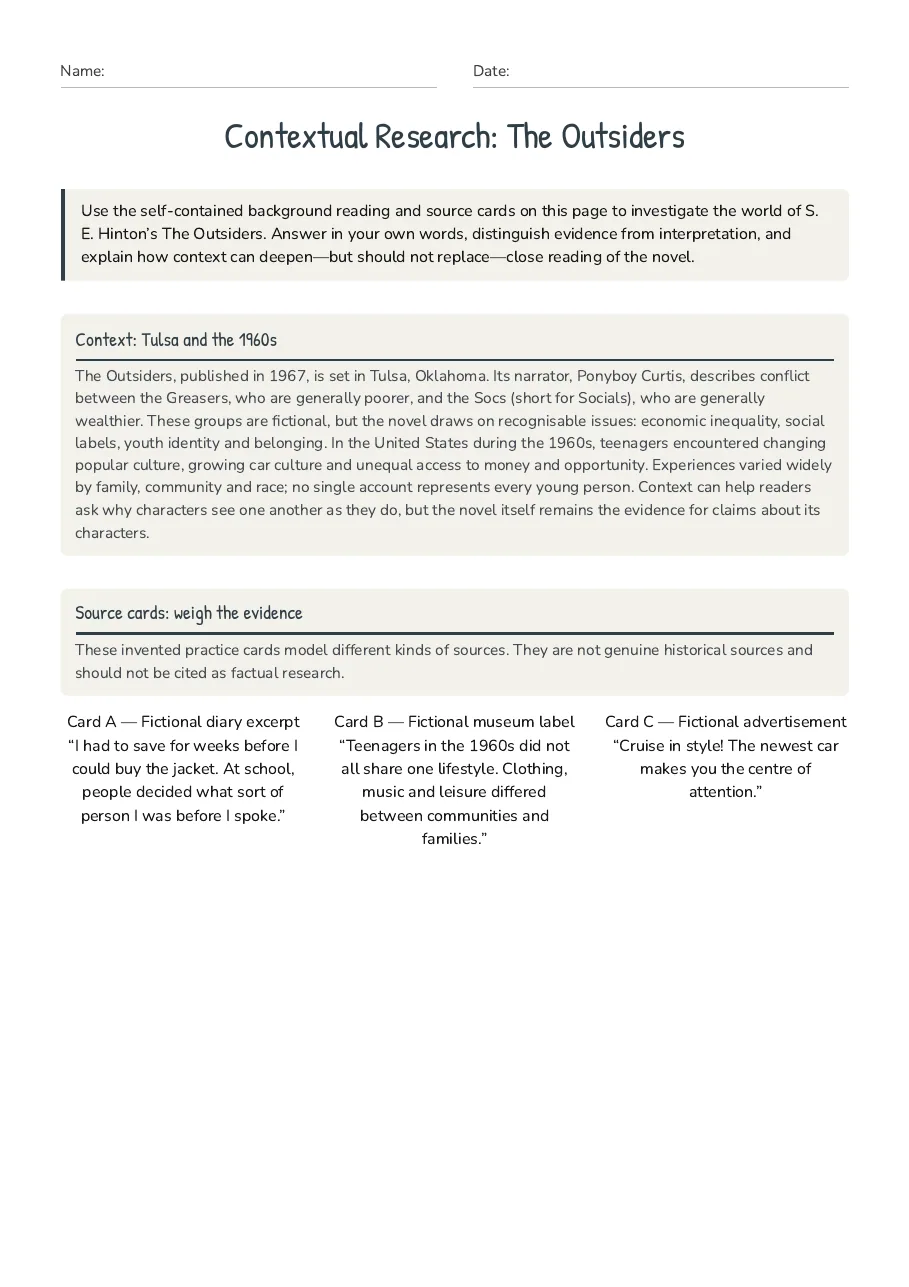
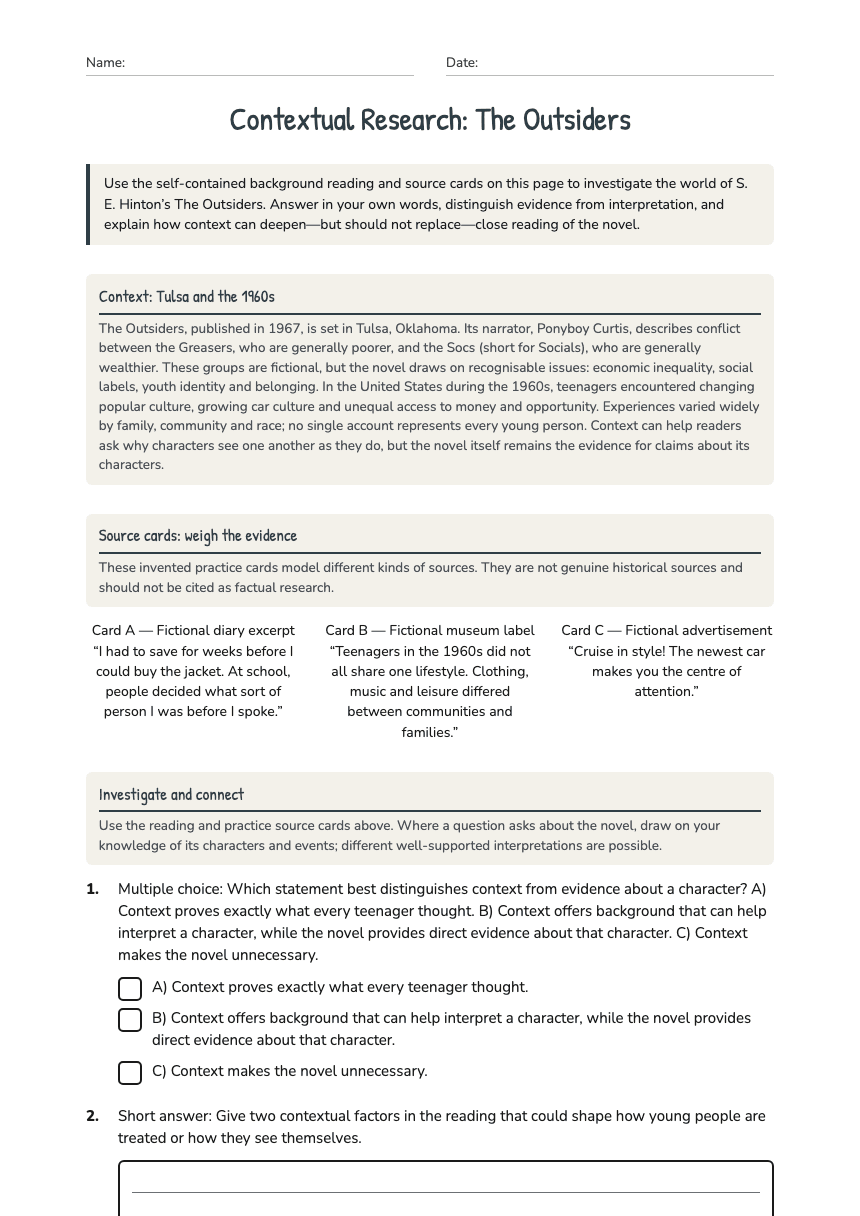
Contextual Research: The Outsiders

Use the self-contained background reading and source cards on this page to investigate the world of S. E. Hinton’s The Outsiders. Answer in your own words, distinguish evidence from interpretation, and explain how context can deepen—but should not replace—close reading of the novel.

Context: Tulsa and the 1960s

The Outsiders, published in 1967, is set in Tulsa, Oklahoma. Its narrator, Ponyboy Curtis, describes conflict between the Greasers, who are generally poorer, and the Socs (short for Socials), who are generally wealthier. These groups are fictional, but the novel draws on recognisable issues: economic inequality, social labels, youth identity and belonging. In the United States during the 1960s, teenagers encountered changing popular culture, growing car culture and unequal access to money and opportunity. Experiences varied widely by family, community and race; no single account represents every young person. Context can help readers ask why characters see one another as they do, but the novel itself remains the evidence for claims about its characters.

Source cards: weigh the evidence

These invented practice cards model different kinds of sources. They are not genuine historical sources and should not be cited as factual research.

Card A — Fictional diary excerpt “I had to save for weeks before I could buy the jacket. At school, people decided what sort of person I was before I spoke.”

Card B — Fictional museum label “Teenagers in the 1960s did not all share one lifestyle. Clothing, music and leisure differed between communities and families.”

Card C — Fictional advertisement “Cruise in style! The newest car makes you the centre of attention.”

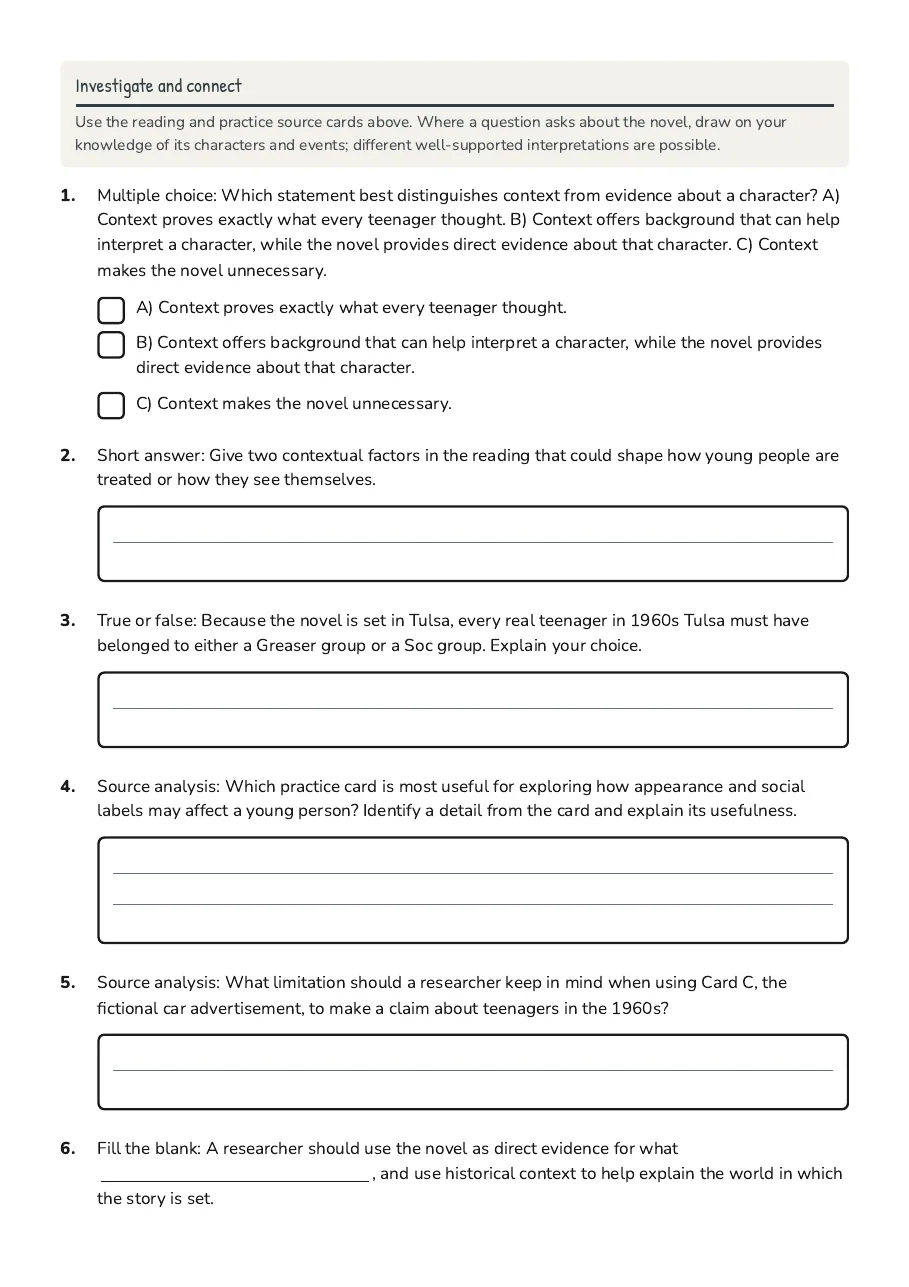
Investigate and connect

Use the reading and practice source cards above. Where a question asks about the novel, draw on your knowledge of its characters and events; different well-supported interpretations are possible.

1.Multiple choice: Which statement best distinguishes context from evidence about a character? A) Context proves exactly what every teenager thought. B) Context offers background that can help interpret a character, while the novel provides direct evidence about that character. C) Context makes the novel unnecessary.
  • A) Context proves exactly what every teenager thought.
  • B) Context offers background that can help interpret a character, while the novel provides direct evidence about that character.
  • C) Context makes the novel unnecessary.
2.Short answer: Give two contextual factors in the reading that could shape how young people are treated or how they see themselves.
3.True or false: Because the novel is set in Tulsa, every real teenager in 1960s Tulsa must have belonged to either a Greaser group or a Soc group. Explain your choice.
4.Source analysis: Which practice card is most useful for exploring how appearance and social labels may affect a young person? Identify a detail from the card and explain its usefulness.
5.Source analysis: What limitation should a researcher keep in mind when using Card C, the fictional car advertisement, to make a claim about teenagers in the 1960s?
6.Fill the blank: A researcher should use the novel as direct evidence for what , and use historical context to help explain the world in which the story is set.
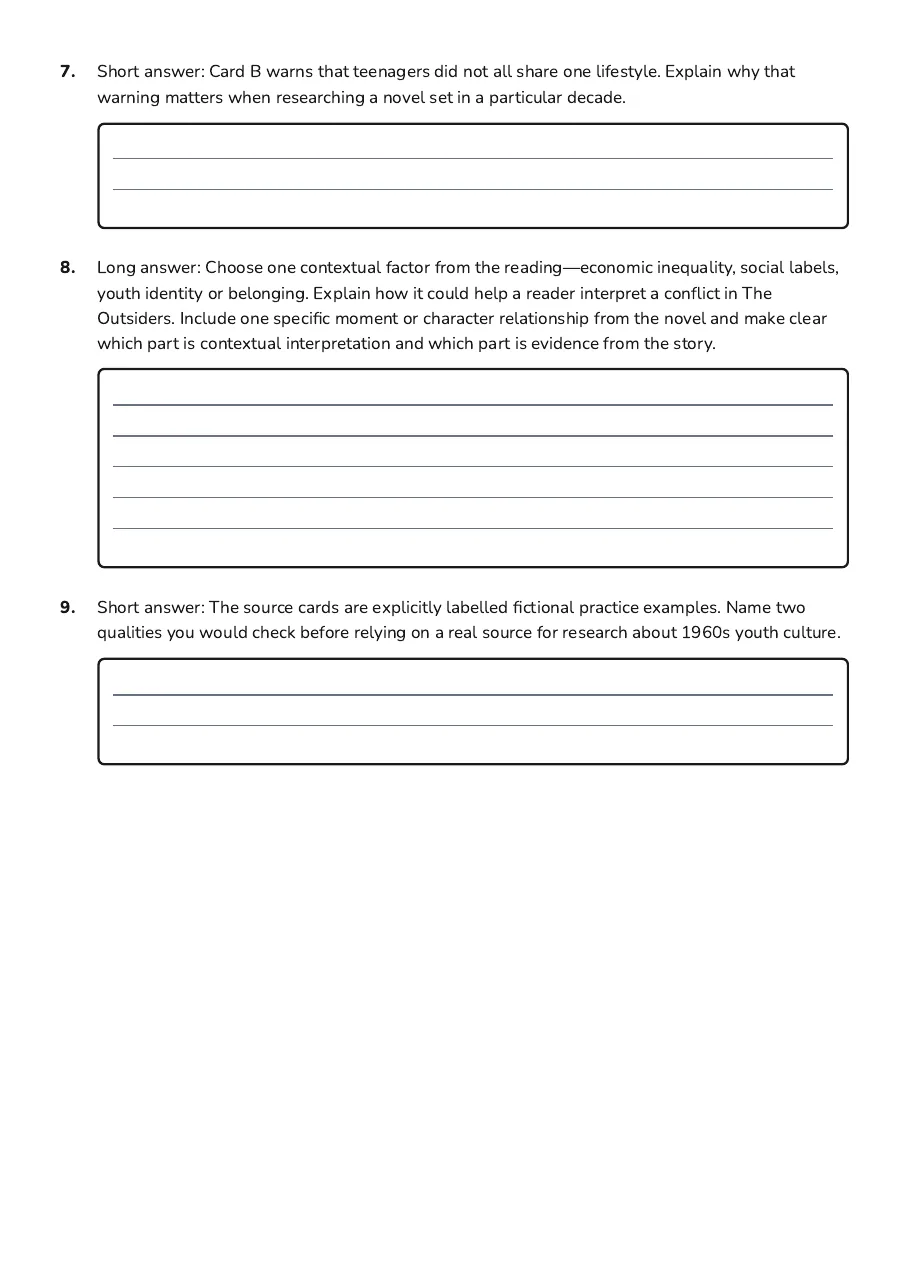
7.Short answer: Card B warns that teenagers did not all share one lifestyle. Explain why that warning matters when researching a novel set in a particular decade.
8.Long answer: Choose one contextual factor from the reading—economic inequality, social labels, youth identity or belonging. Explain how it could help a reader interpret a conflict in The Outsiders. Include one specific moment or character relationship from the novel and make clear which part is contextual interpretation and which part is evidence from the story.
9.Short answer: The source cards are explicitly labelled fictional practice examples. Name two qualities you would check before relying on a real source for research about 1960s youth culture.

3 printable pages

  • Contextual Research: The Outsiders, page 1 of 3: Context: Tulsa and the 1960s, Source cards: weigh the evidence

    Page 1

  • Contextual Research: The Outsiders, page 2 of 3: Investigate and connect

    Page 2

  • Contextual Research: The Outsiders, page 3 of 3: 7. Short answer: Card B warns that teenagers did not all share one lifestyle. Explain why…

    Page 3

About This Worksheet

Free in Kuraplan

Sign up free, grab the PDF, and customize it for your class.

Print-Ready

Formatted for standard paper. Clean layout, easy to read.

AI-Generated

Created with Kuraplan's AI, designed for real classroom use.

For Teachers & Parents

Use in classrooms, for homework, tutoring, or homeschool.

Need a custom version of this worksheet?

Kuraplan's AI generates custom worksheets in seconds — differentiated for every learner, aligned to your curriculum.

Generate Custom Worksheets — Free
No credit card Curriculum-aligned Under 60 seconds