EnglishFreePrintable
Dialogue Punctuation Practice
A free english worksheet ready for your classroom. Open in Kuraplan to grab the print-ready PDF, customize it for your students, or generate a fresh version in seconds.
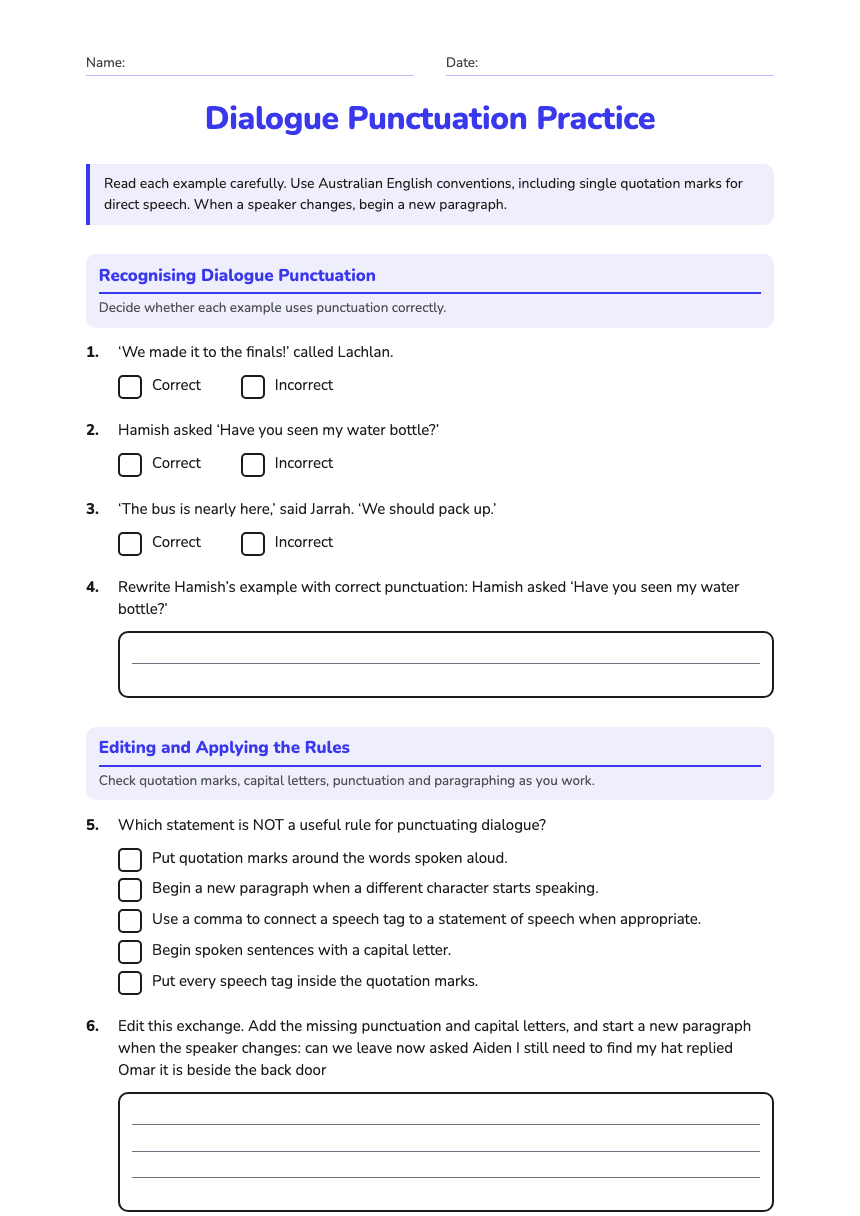
Name:Date:
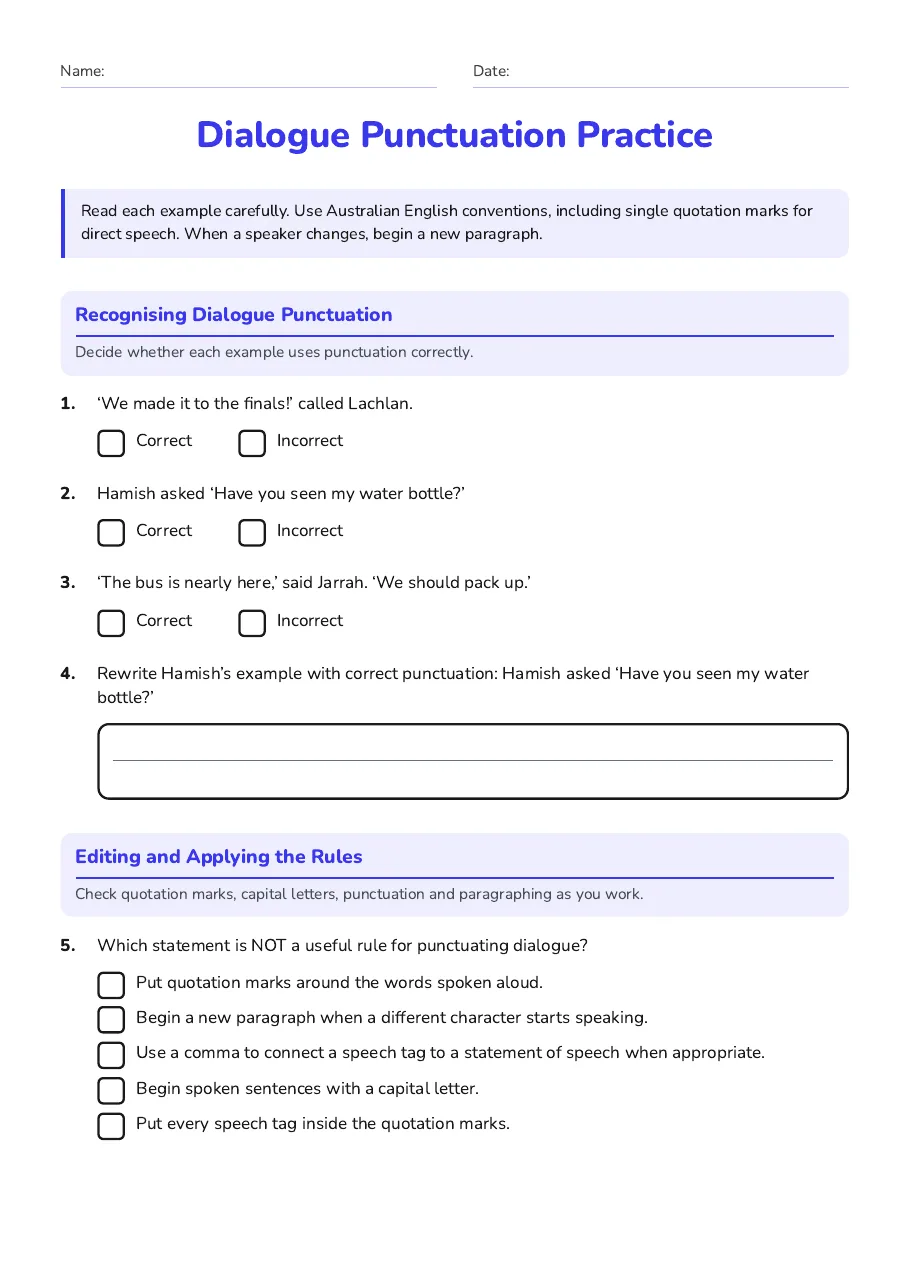
Dialogue Punctuation Practice
Read each example carefully. Use Australian English conventions, including single quotation marks for direct speech. When a speaker changes, begin a new paragraph.
Recognising Dialogue Punctuation
Decide whether each example uses punctuation correctly.
1.‘We made it to the finals!’ called Lachlan.
- Correct
- Incorrect
2.Hamish asked ‘Have you seen my water bottle?’
- Correct
- Incorrect
3.‘The bus is nearly here,’ said Jarrah. ‘We should pack up.’
- Correct
- Incorrect
4.Rewrite Hamish’s example with correct punctuation: Hamish asked ‘Have you seen my water bottle?’
Editing and Applying the Rules
Check quotation marks, capital letters, punctuation and paragraphing as you work.
5.Which statement is NOT a useful rule for punctuating dialogue?
- Put quotation marks around the words spoken aloud.
- Begin a new paragraph when a different character starts speaking.
- Use a comma to connect a speech tag to a statement of speech when appropriate.
- Begin spoken sentences with a capital letter.
- Put every speech tag inside the quotation marks.
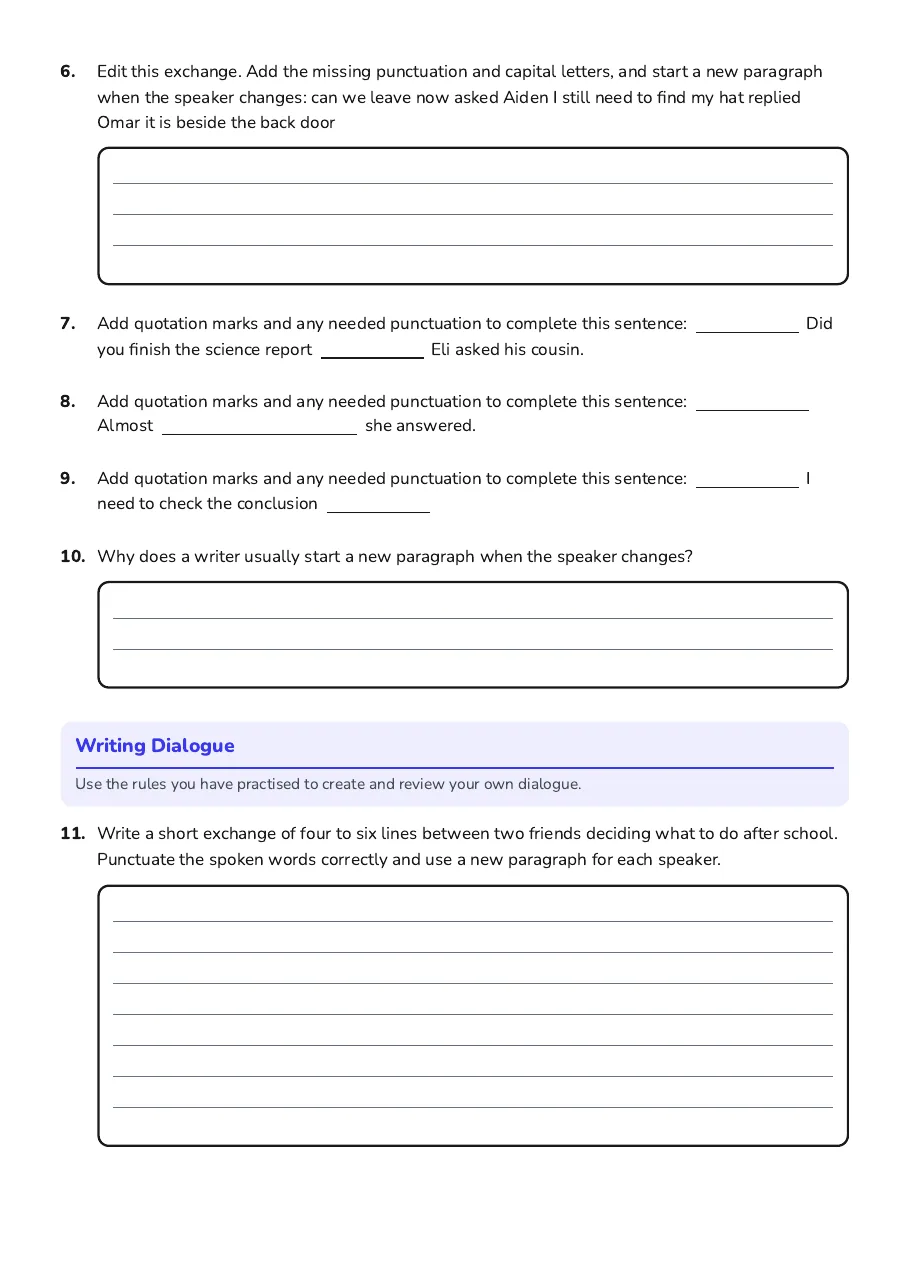
6.Edit this exchange. Add the missing punctuation and capital letters, and start a new paragraph when the speaker changes: can we leave now asked Aiden I still need to find my hat replied Omar it is beside the back door
7.Add quotation marks and any needed punctuation to complete this sentence: Did you finish the science report Eli asked his cousin.
8.Add quotation marks and any needed punctuation to complete this sentence: Almost she answered.
9.Add quotation marks and any needed punctuation to complete this sentence: I need to check the conclusion
10.Why does a writer usually start a new paragraph when the speaker changes?
Writing Dialogue
Use the rules you have practised to create and review your own dialogue.
11.Write a short exchange of four to six lines between two friends deciding what to do after school. Punctuate the spoken words correctly and use a new paragraph for each speaker.
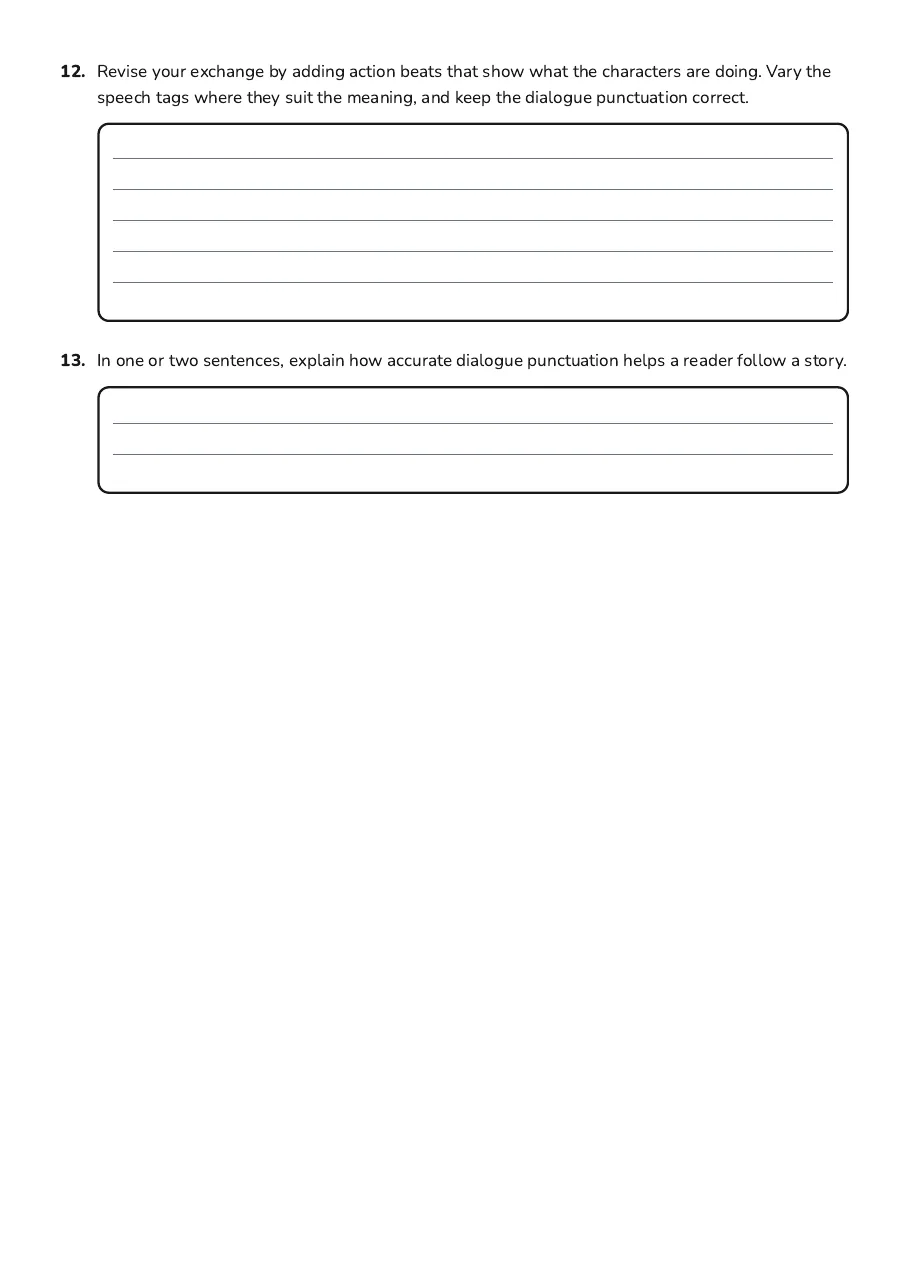
12.Revise your exchange by adding action beats that show what the characters are doing. Vary the speech tags where they suit the meaning, and keep the dialogue punctuation correct.
13.In one or two sentences, explain how accurate dialogue punctuation helps a reader follow a story.
3 printable pages
Page 1
Page 2
Page 3
About This Worksheet
Free in Kuraplan
Sign up free, grab the PDF, and customize it for your class.
Print-Ready
Formatted for standard paper. Clean layout, easy to read.
AI-Generated
Created with Kuraplan's AI, designed for real classroom use.
For Teachers & Parents
Use in classrooms, for homework, tutoring, or homeschool.
Need a custom version of this worksheet?
Kuraplan's AI generates custom worksheets in seconds — differentiated for every learner, aligned to your curriculum.
Generate Custom Worksheets — Free No credit card Curriculum-aligned Under 60 seconds