ScienceFreePrintable

Elements and Compounds

A free science worksheet ready for your classroom. Open in Kuraplan to grab the print-ready PDF, customize it for your students, or generate a fresh version in seconds.
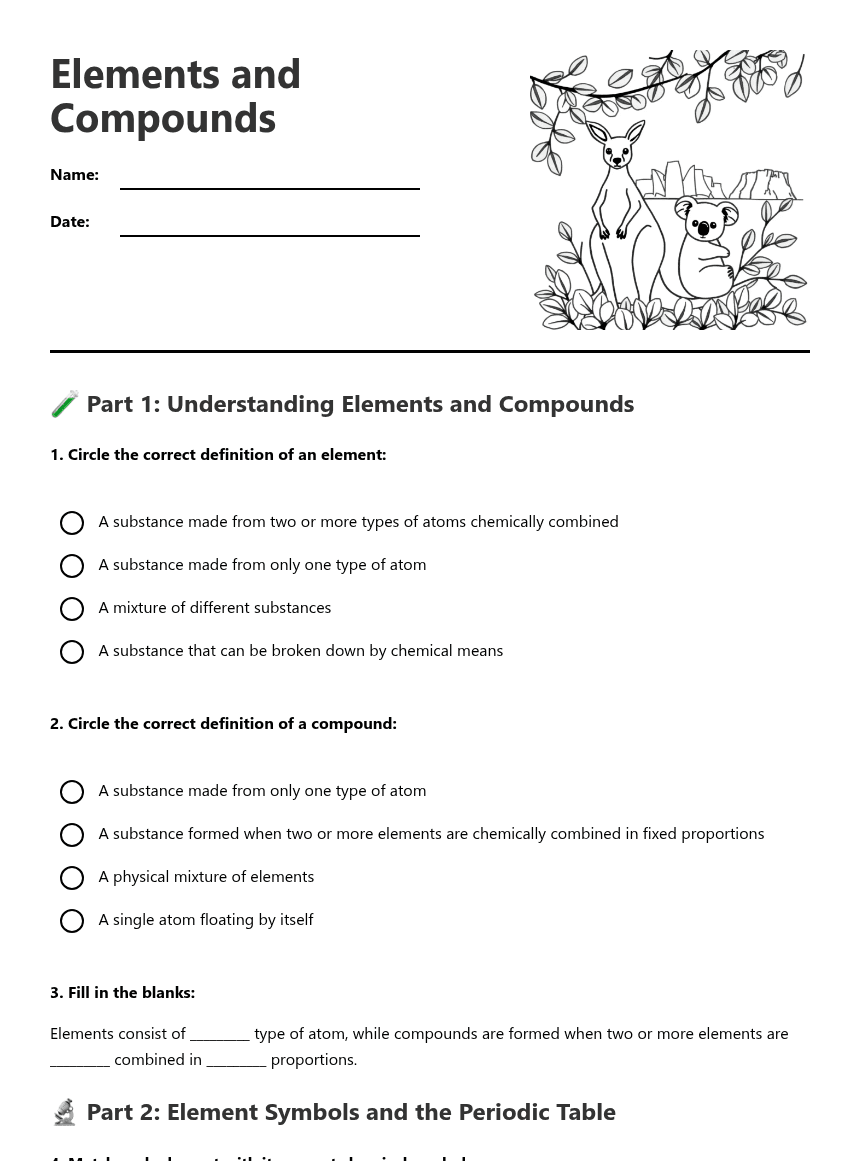
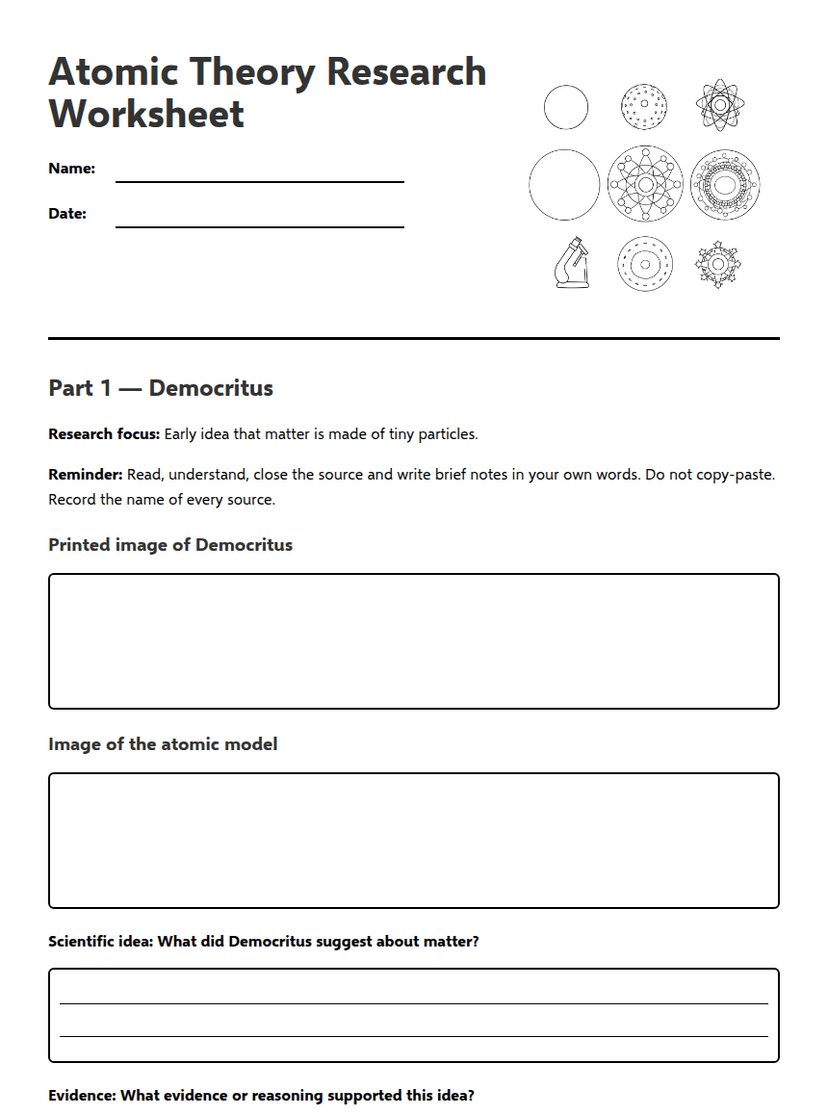
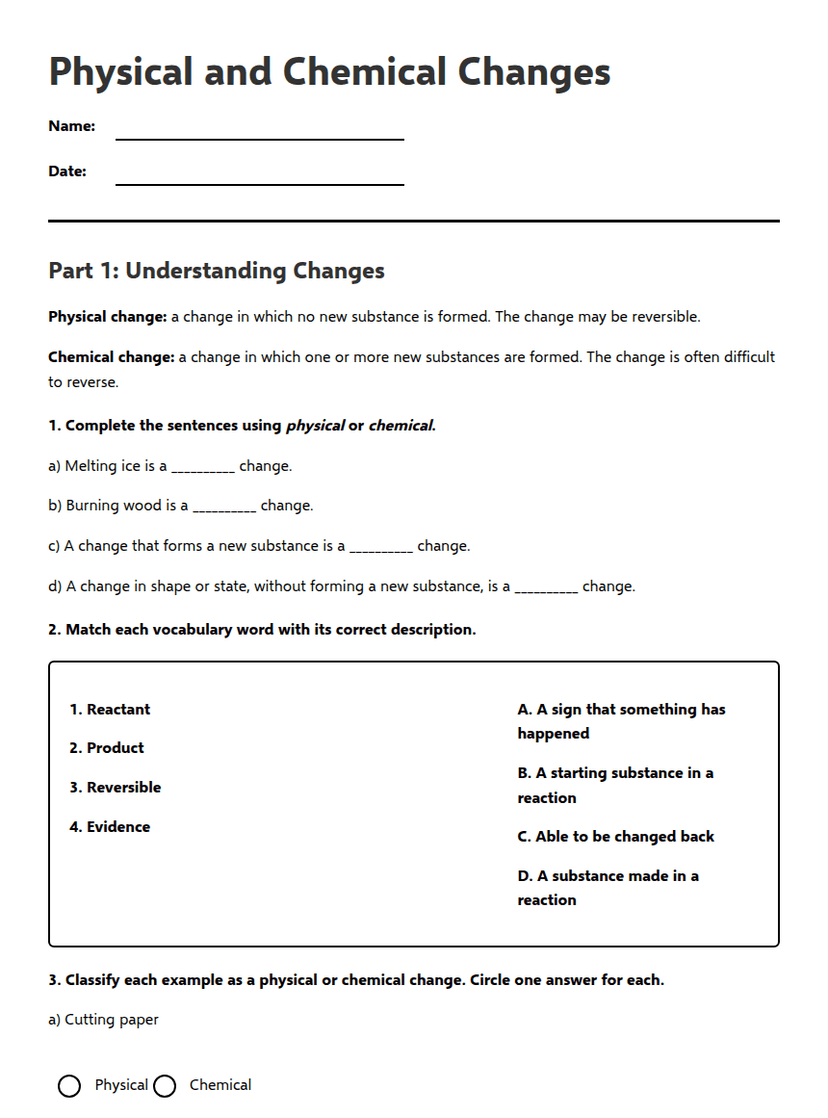
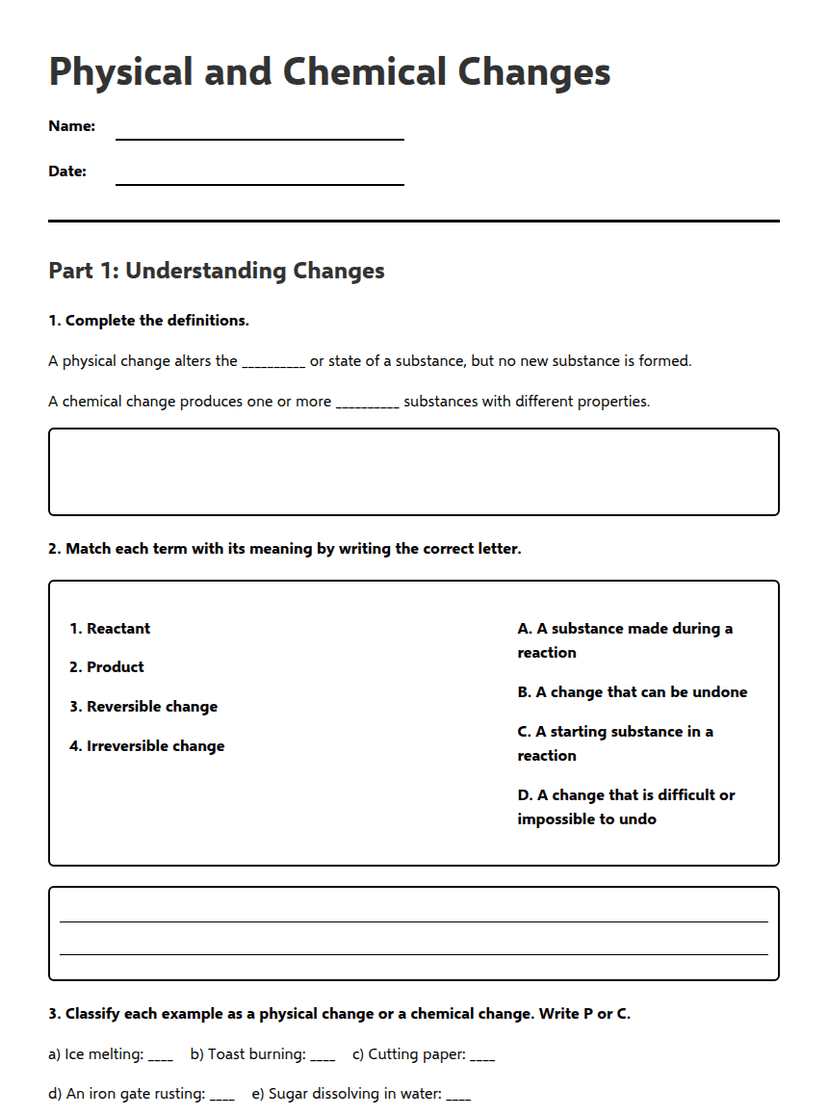
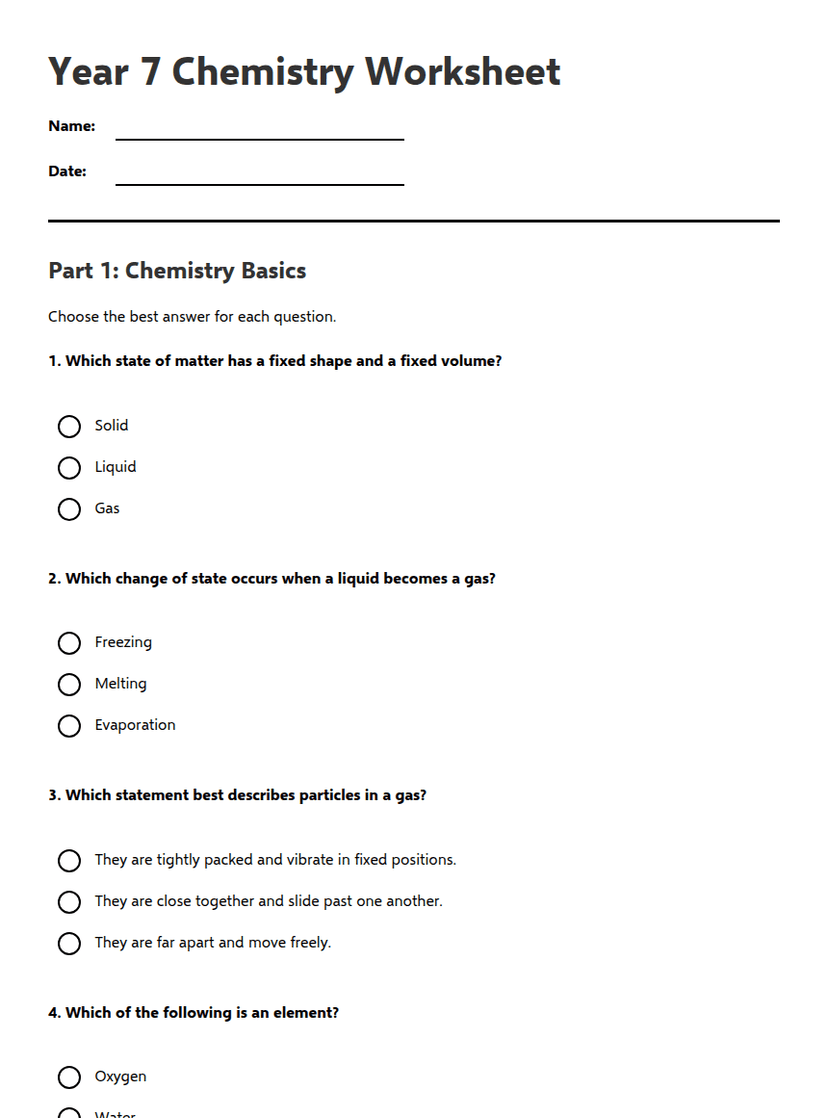
Elements and Compounds worksheet preview
Elements and Compounds

Elements and Compounds

Periodic table and molecular models

🧪 Part 1: Understanding Elements and Compounds

1. Circle the correct definition of an element:

A substance made from two or more types of atoms chemically combined

A substance made from only one type of atom

A mixture of different substances

A substance that can be broken down by chemical means

2. Circle the correct definition of a compound:

A substance made from only one type of atom

A substance formed when two or more elements are chemically combined in fixed proportions

A physical mixture of elements

A single atom floating by itself

3. Fill in the blanks:

Elements consist of _________ type of atom, while compounds are formed when two or more elements are _________ combined in _________ proportions.

🔬 Part 2: Element Symbols and the Periodic Table

4. Match each element with its correct chemical symbol:
1. Hydrogen
2. Oxygen
3. Carbon
4. Sodium
5. Chlorine
6. Iron
A. Fe
B. O
C. H
D. Na
E. C
F. Cl
5. True or False: Chemical symbols always start with a capital letter.

True

False

6. Complete the element symbols (write the missing letters):

a) Calcium: C___

b) Nitrogen: N

c) Magnesium: M___

d) Helium: H___

⚗️ Part 3: Identifying Elements and Compounds

7. Look at these chemical formulas. Tick whether each one is an ELEMENT or a COMPOUND:

H₂O (water)

Element

Compound

O₂ (oxygen gas)

Element

Compound

NaCl (salt)

Element

Compound

Fe (iron)

Element

Compound

CO₂ (carbon dioxide)

Element

Compound

8. Check all the statements that are TRUE about compounds:

They contain only one type of atom

They are formed when elements chemically combine

They have fixed proportions of elements

They can be broken down by chemical means

Water (H₂O) is an example of a compound

🌟 Part 4: Real-World Applications

9. Look around your classroom or think about your home. List THREE examples of compounds you might find:
10. Draw a simple diagram showing the difference between an element and a compound. Use circles to represent atoms and show how they are arranged differently:
11. Explain in your own words: How would you tell someone the difference between an element and a compound?
12. Challenge Question: If you had the compound water (H₂O), what elements would you get if you could break it down chemically?

About This Worksheet

Free in Kuraplan

Sign up free, grab the PDF, and customize it for your class.

Print-Ready

Formatted for standard paper. Clean layout, easy to read.

AI-Generated

Created with Kuraplan's AI, designed for real classroom use.

For Teachers & Parents

Use in classrooms, for homework, tutoring, or homeschool.

Need a custom version of this worksheet?

Kuraplan's AI generates custom worksheets in seconds — differentiated for every learner, aligned to your curriculum.

Generate Custom Worksheets — Free
No credit card Curriculum-aligned Under 60 seconds