Elements Scaffolding Answer Key
A free science worksheet ready for your classroom. Open in Kuraplan to grab the print-ready PDF, customize it for your students, or generate a fresh version in seconds.
Elements Scaffolding — Answer Key

📖 Part A: Definitions — Model Answers
Accept responses that convey the same meaning. Key terms are highlighted in bold.
✅ A pure substance made of only one type of atom that cannot be broken down into simpler substances by chemical means.
✅ The smallest particle of an element that still has the chemical properties of that element.
✅ The number of protons found in the nucleus of an atom of that element. It identifies the element on the periodic table.
✅ A organised arrangement of all known elements, ordered by increasing atomic number and grouped by similar chemical properties.
🔬 Part B: Classification Activity — Answer Guide
Students classify each element as a metal, non-metal, or metalloid. Correct answers below.
✅ Metals: Shiny lustre, good conductors of heat and electricity, malleable, ductile.
✅ Non-metals: Poor conductors, often gases or brittle solids at room temperature.
✅ Metalloids: Properties between metals and non-metals; semiconductors (e.g. silicon used in computer chips).
⚛️ Part C: Atomic Structure — Model Description
Students should draw and describe the structure of a named element. Use the model below for Carbon (C, atomic number 6) as a marking reference.
A central nucleus clearly labelled
6 protons (positive charge) shown in the nucleus
6 neutrons (neutral charge) shown in the nucleus
6 electrons arranged in shells (2 in the first shell, 4 in the second shell)
Shells/orbits drawn around the nucleus with electrons labelled
✅ "Carbon has an atomic number of 6, meaning it has 6 protons in its nucleus and 6 electrons orbiting in shells. The first electron shell holds 2 electrons and the second shell holds 4 electrons. The nucleus also contains 6 neutrons. Carbon is a non-metal and is found in all living things."
Marking note: Award full marks if the student correctly identifies the number of protons, electrons, and neutrons, and accurately describes the electron shell arrangement. Deduct marks if shells are incorrectly filled or the atomic number is confused with the mass number.
About This Worksheet
Free in Kuraplan
Sign up free, grab the PDF, and customize it for your class.
Print-Ready
Formatted for standard paper. Clean layout, easy to read.
AI-Generated
Created with Kuraplan's AI, designed for real classroom use.
For Teachers & Parents
Use in classrooms, for homework, tutoring, or homeschool.
Need a custom version of this worksheet?
Kuraplan's AI generates custom worksheets in seconds — differentiated for every learner, aligned to your curriculum.
Generate Custom Worksheets — FreeMore Science Worksheets
Atomic Theory Research Worksheet
Free
Physical and Chemical Changes
Free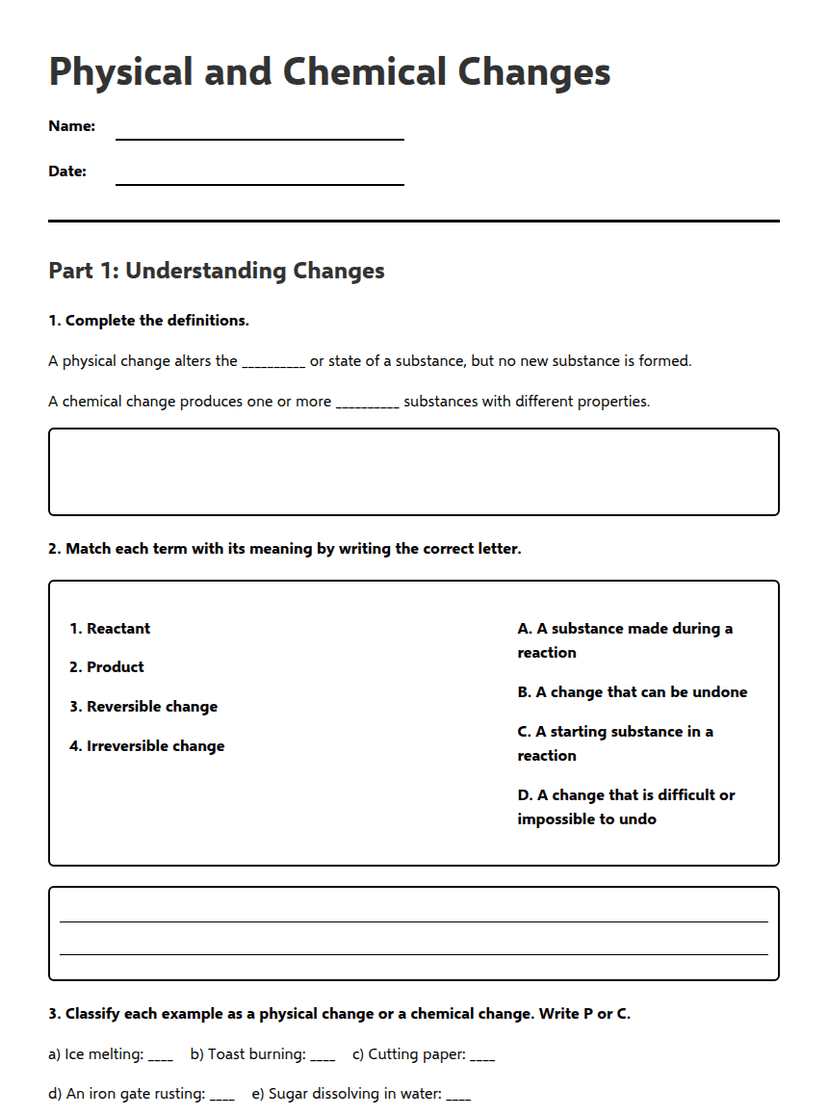
Physical and Chemical Changes
Free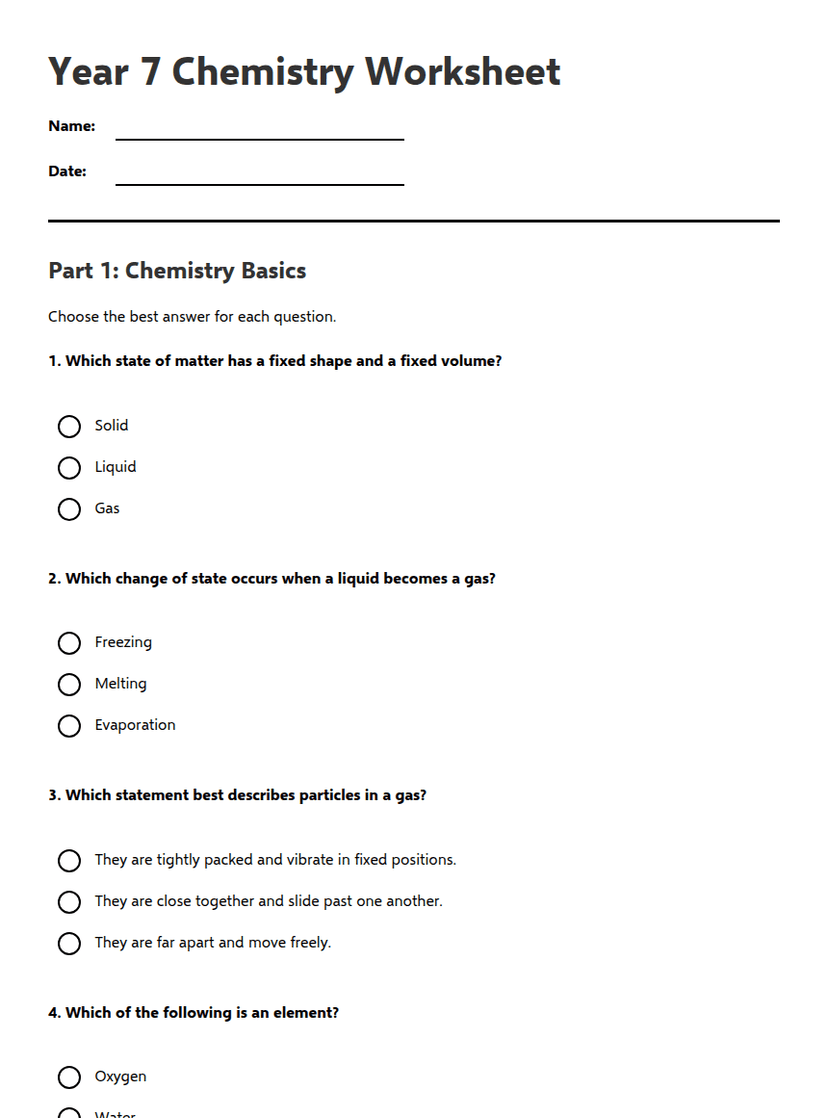
Year 7 Chemistry Worksheet
Free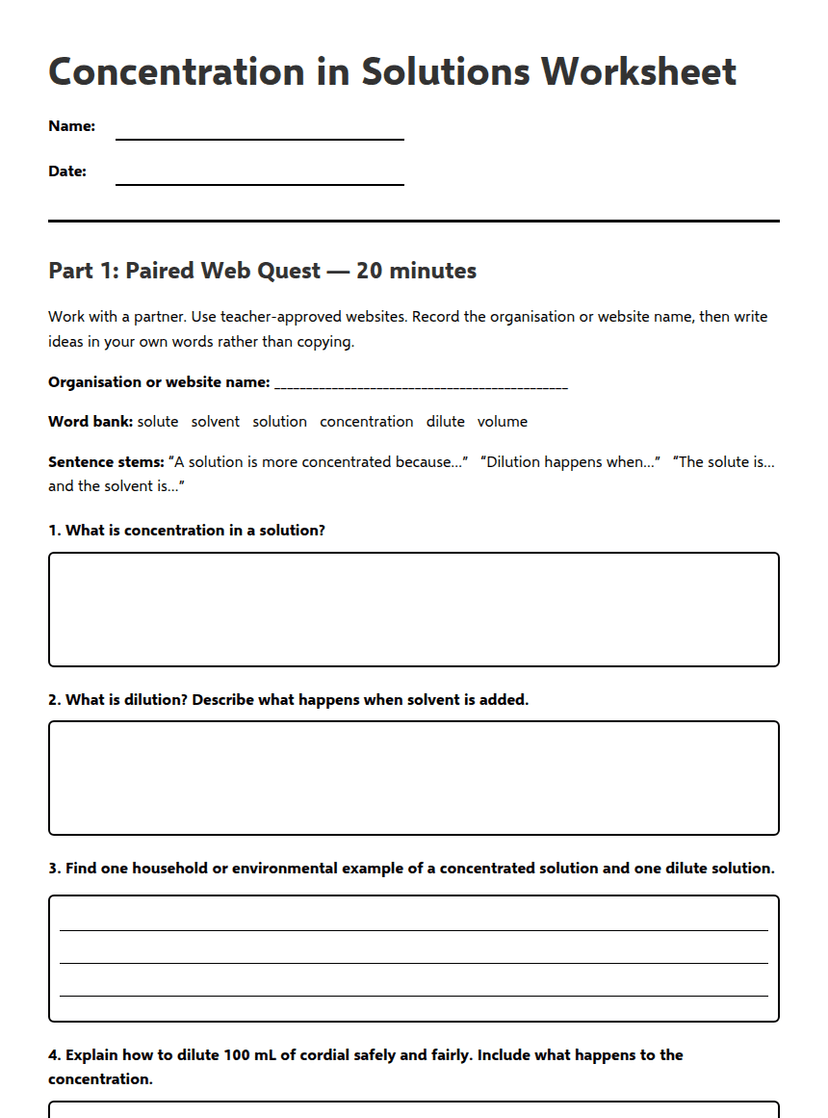
Concentration in Solutions Worksheet
Free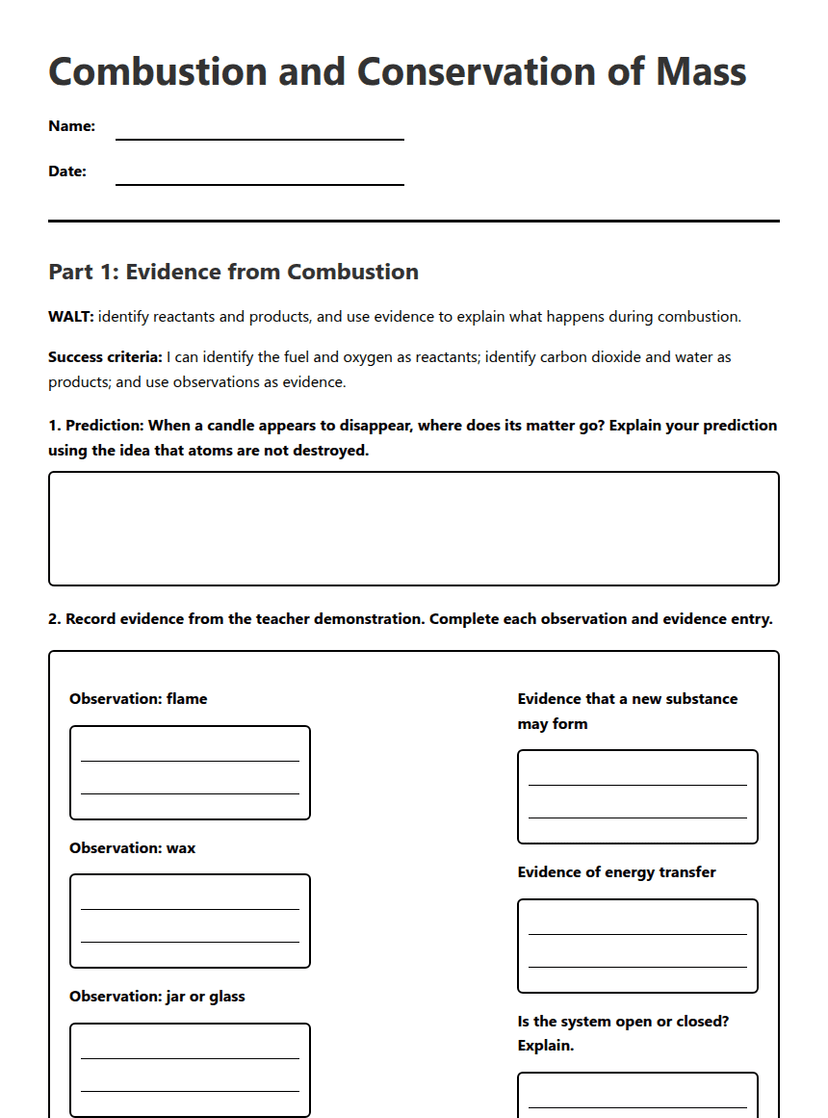
Combustion and Conservation of Mass
Free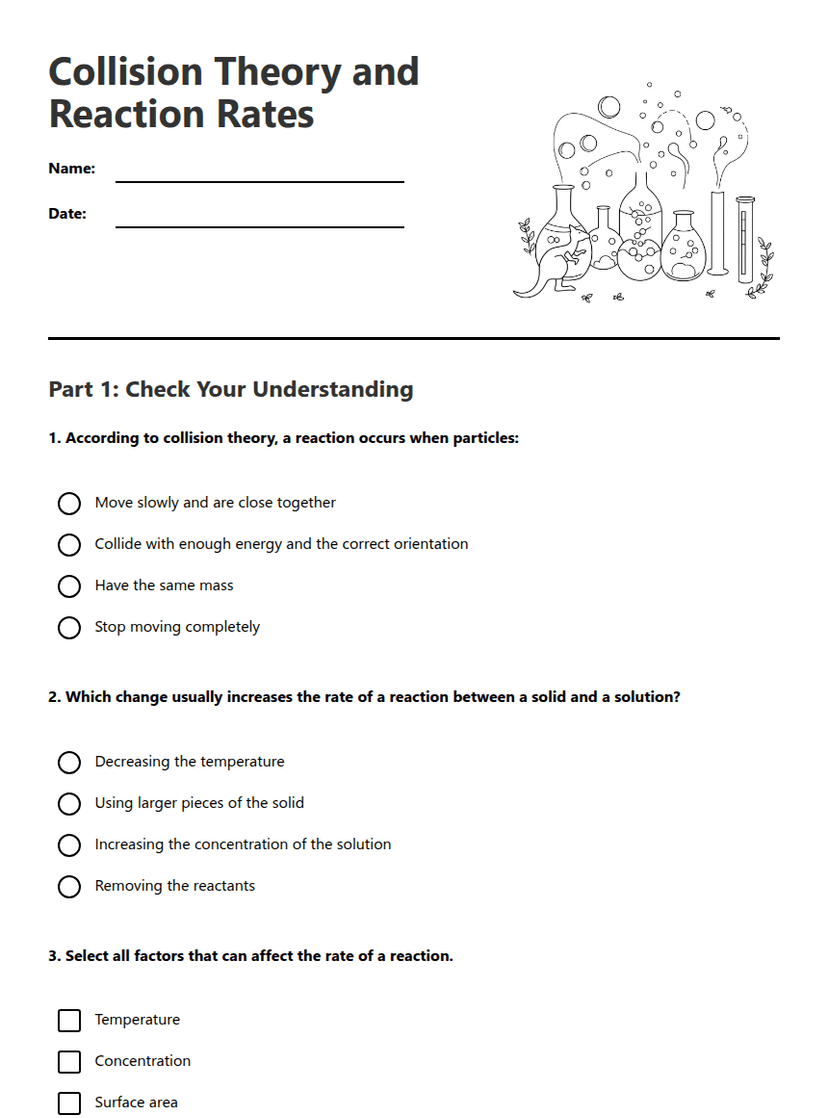
Collision Theory and Reaction Rates
Free