Evolution of Work
A free english worksheet ready for your classroom. Open in Kuraplan to grab the print-ready PDF, customize it for your students, or generate a fresh version in seconds.
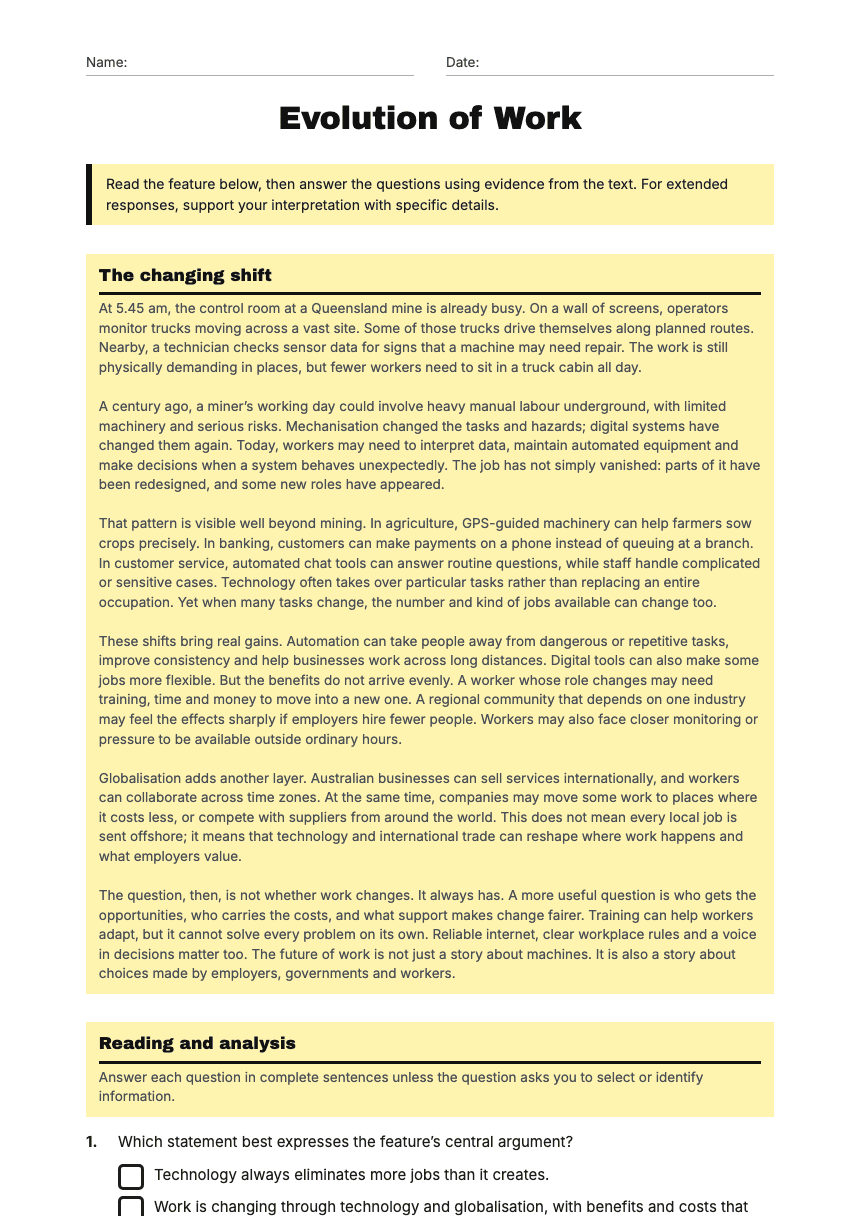
Evolution of Work
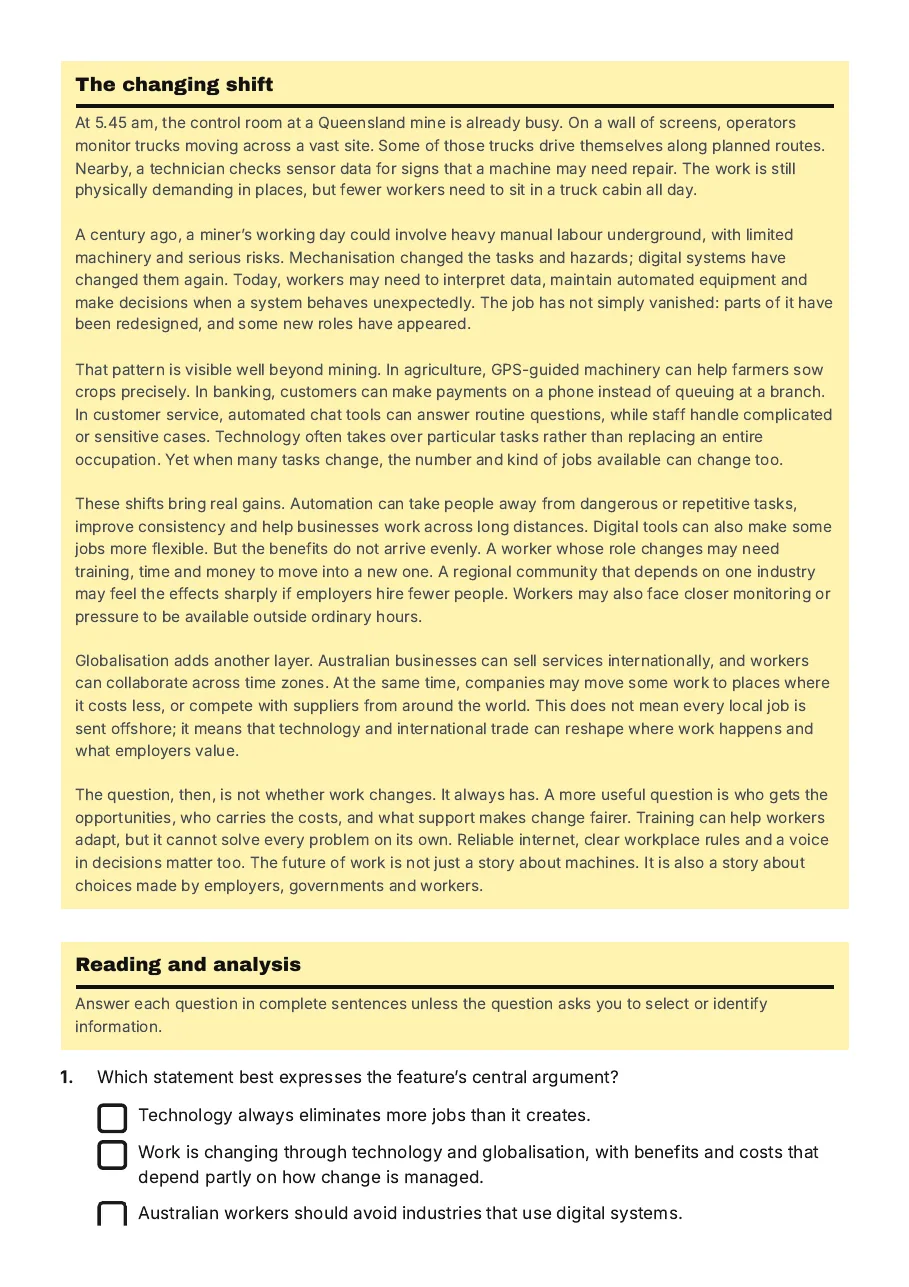
The changing shift
At 5.45 am, the control room at a Queensland mine is already busy. On a wall of screens, operators monitor trucks moving across a vast site. Some of those trucks drive themselves along planned routes. Nearby, a technician checks sensor data for signs that a machine may need repair. The work is still physically demanding in places, but fewer workers need to sit in a truck cabin all day. A century ago, a miner’s working day could involve heavy manual labour underground, with limited machinery and serious risks. Mechanisation changed the tasks and hazards; digital systems have changed them again. Today, workers may need to interpret data, maintain automated equipment and make decisions when a system behaves unexpectedly. The job has not simply vanished: parts of it have been redesigned, and some new roles have appeared. That pattern is visible well beyond mining. In agriculture, GPS-guided machinery can help farmers sow crops precisely. In banking, customers can make payments on a phone instead of queuing at a branch. In customer service, automated chat tools can answer routine questions, while staff handle complicated or sensitive cases. Technology often takes over particular tasks rather than replacing an entire occupation. Yet when many tasks change, the number and kind of jobs available can change too. These shifts bring real gains. Automation can take people away from dangerous or repetitive tasks, improve consistency and help businesses work across long distances. Digital tools can also make some jobs more flexible. But the benefits do not arrive evenly. A worker whose role changes may need training, time and money to move into a new one. A regional community that depends on one industry may feel the effects sharply if employers hire fewer people. Workers may also face closer monitoring or pressure to be available outside ordinary hours. Globalisation adds another layer. Australian businesses can sell services internationally, and workers can collaborate across time zones. At the same time, companies may move some work to places where it costs less, or compete with suppliers from around the world. This does not mean every local job is sent offshore; it means that technology and international trade can reshape where work happens and what employers value. The question, then, is not whether work changes. It always has. A more useful question is who gets the opportunities, who carries the costs, and what support makes change fairer. Training can help workers adapt, but it cannot solve every problem on its own. Reliable internet, clear workplace rules and a voice in decisions matter too. The future of work is not just a story about machines. It is also a story about choices made by employers, governments and workers.
Reading and analysis
Answer each question in complete sentences unless the question asks you to select or identify information.
- Technology always eliminates more jobs than it creates.
- Work is changing through technology and globalisation, with benefits and costs that depend partly on how change is managed.
- Australian workers should avoid industries that use digital systems.
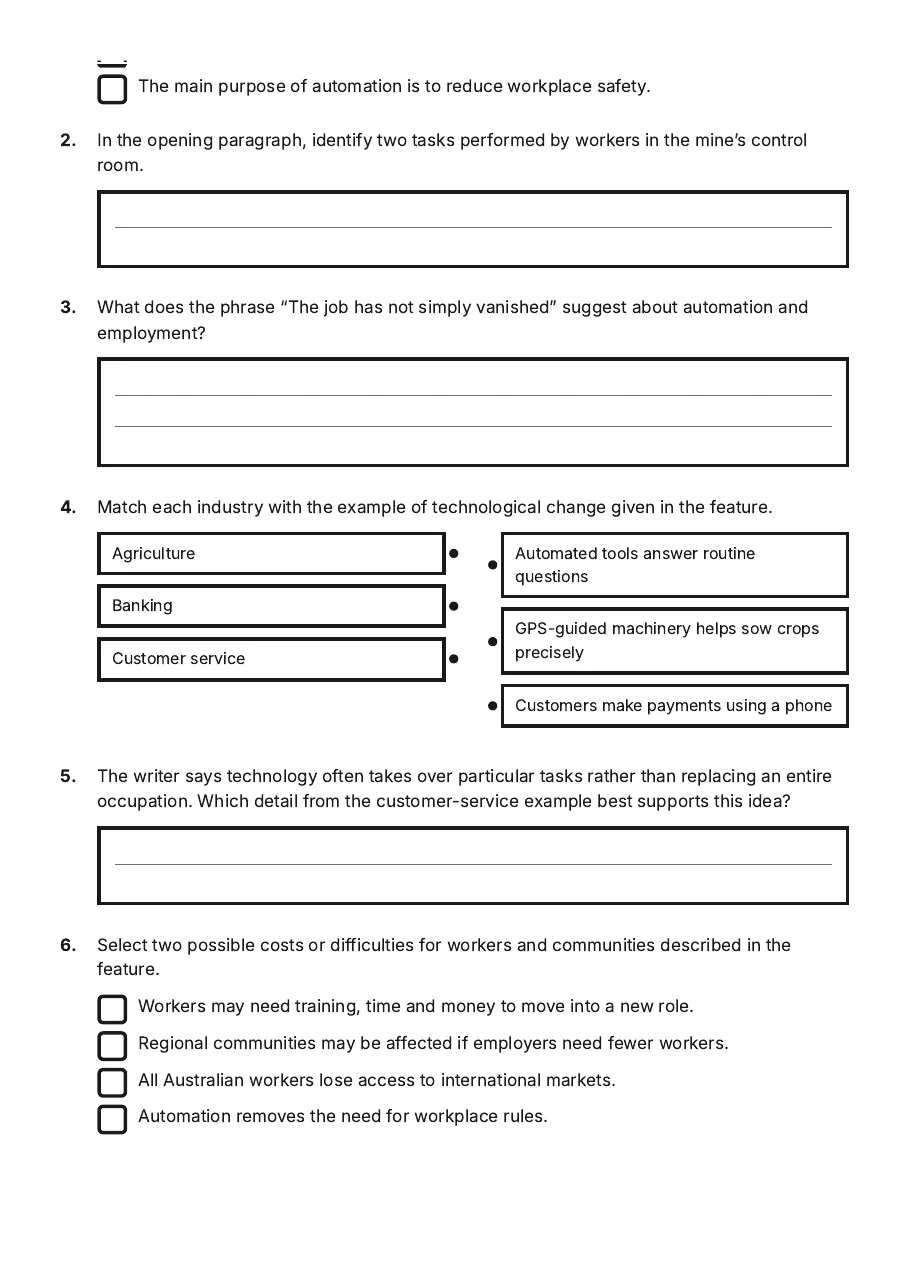
- The main purpose of automation is to reduce workplace safety.
- Agriculture
- Banking
- Customer service
- Automated tools answer routine questions
- GPS-guided machinery helps sow crops precisely
- Customers make payments using a phone
- Workers may need training, time and money to move into a new role.
- Regional communities may be affected if employers need fewer workers.
- All Australian workers lose access to international markets.
- Automation removes the need for workplace rules.
5 printable pages
Page 1
Page 2
Page 3
Page 4
Page 5
About This Worksheet
Free in Kuraplan
Sign up free, grab the PDF, and customize it for your class.
Print-Ready
Formatted for standard paper. Clean layout, easy to read.
AI-Generated
Created with Kuraplan's AI, designed for real classroom use.
For Teachers & Parents
Use in classrooms, for homework, tutoring, or homeschool.
Need a custom version of this worksheet?
Kuraplan's AI generates custom worksheets in seconds — differentiated for every learner, aligned to your curriculum.
Generate Custom Worksheets — Free