EnglishFreePrintable
Film Analysis Introduction
A free english worksheet ready for your classroom. Open in Kuraplan to grab the print-ready PDF, customize it for your students, or generate a fresh version in seconds.
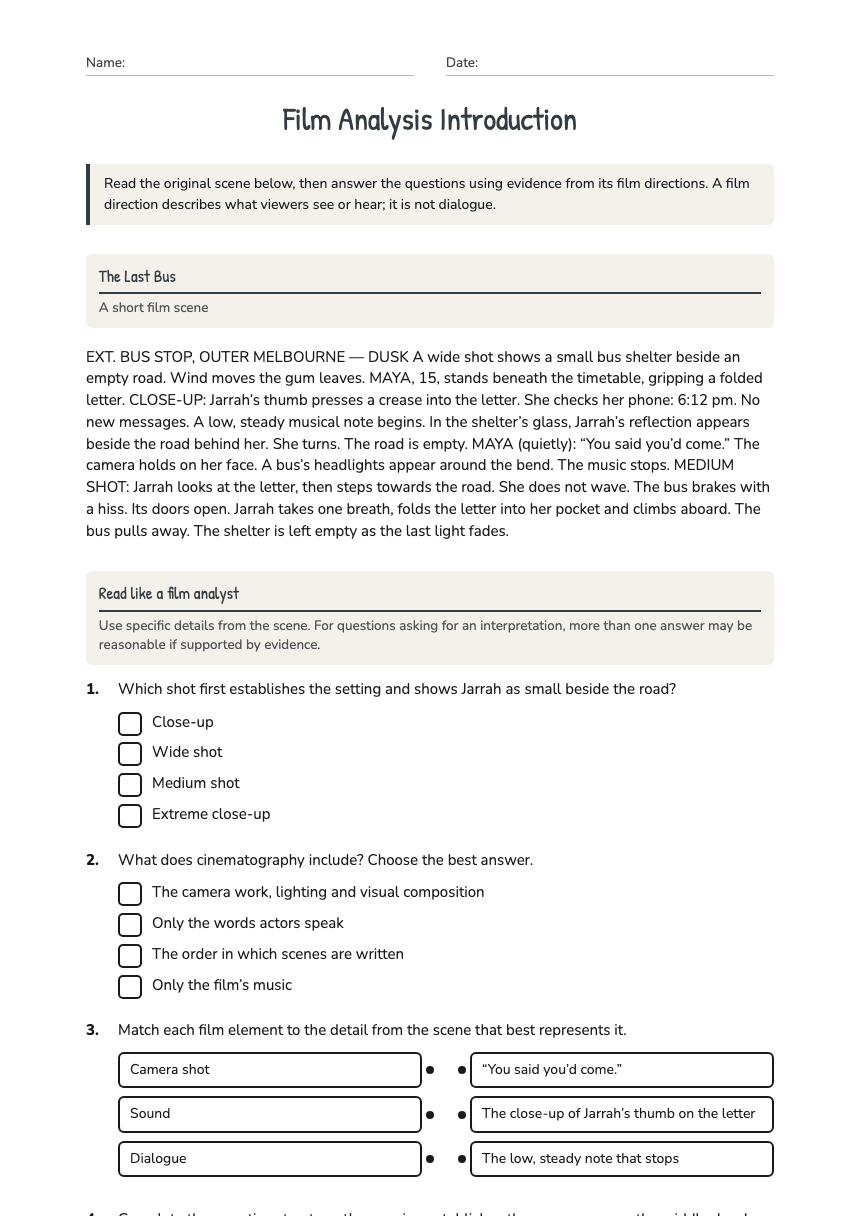
Name:Date:
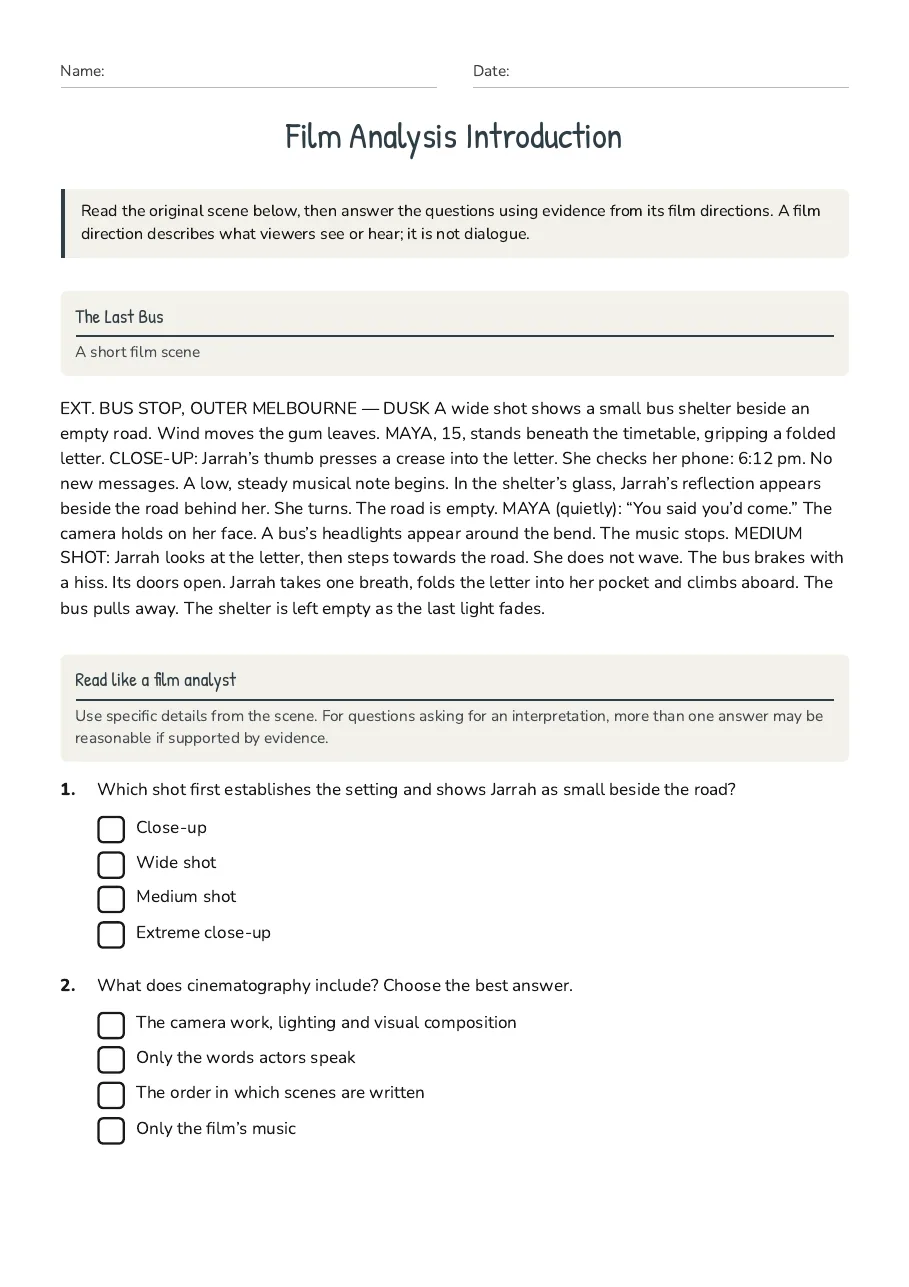
Film Analysis Introduction
Read the original scene below, then answer the questions using evidence from its film directions. A film direction describes what viewers see or hear; it is not dialogue.
The Last Bus
A short film scene
EXT. BUS STOP, OUTER MELBOURNE — DUSK
A wide shot shows a small bus shelter beside an empty road. Wind moves the gum leaves. MAYA, 15, stands beneath the timetable, gripping a folded letter.
CLOSE-UP: Jarrah’s thumb presses a crease into the letter. She checks her phone: 6:12 pm. No new messages.
A low, steady musical note begins. In the shelter’s glass, Jarrah’s reflection appears beside the road behind her. She turns. The road is empty.
MAYA (quietly): “You said you’d come.”
The camera holds on her face. A bus’s headlights appear around the bend. The music stops.
MEDIUM SHOT: Jarrah looks at the letter, then steps towards the road. She does not wave.
The bus brakes with a hiss. Its doors open. Jarrah takes one breath, folds the letter into her pocket and climbs aboard.
The bus pulls away. The shelter is left empty as the last light fades.
Read like a film analyst
Use specific details from the scene. For questions asking for an interpretation, more than one answer may be reasonable if supported by evidence.
1.Which shot first establishes the setting and shows Jarrah as small beside the road?
- Close-up
- Wide shot
- Medium shot
- Extreme close-up
2.What does cinematography include? Choose the best answer.
- The camera work, lighting and visual composition
- Only the words actors speak
- The order in which scenes are written
- Only the film’s music
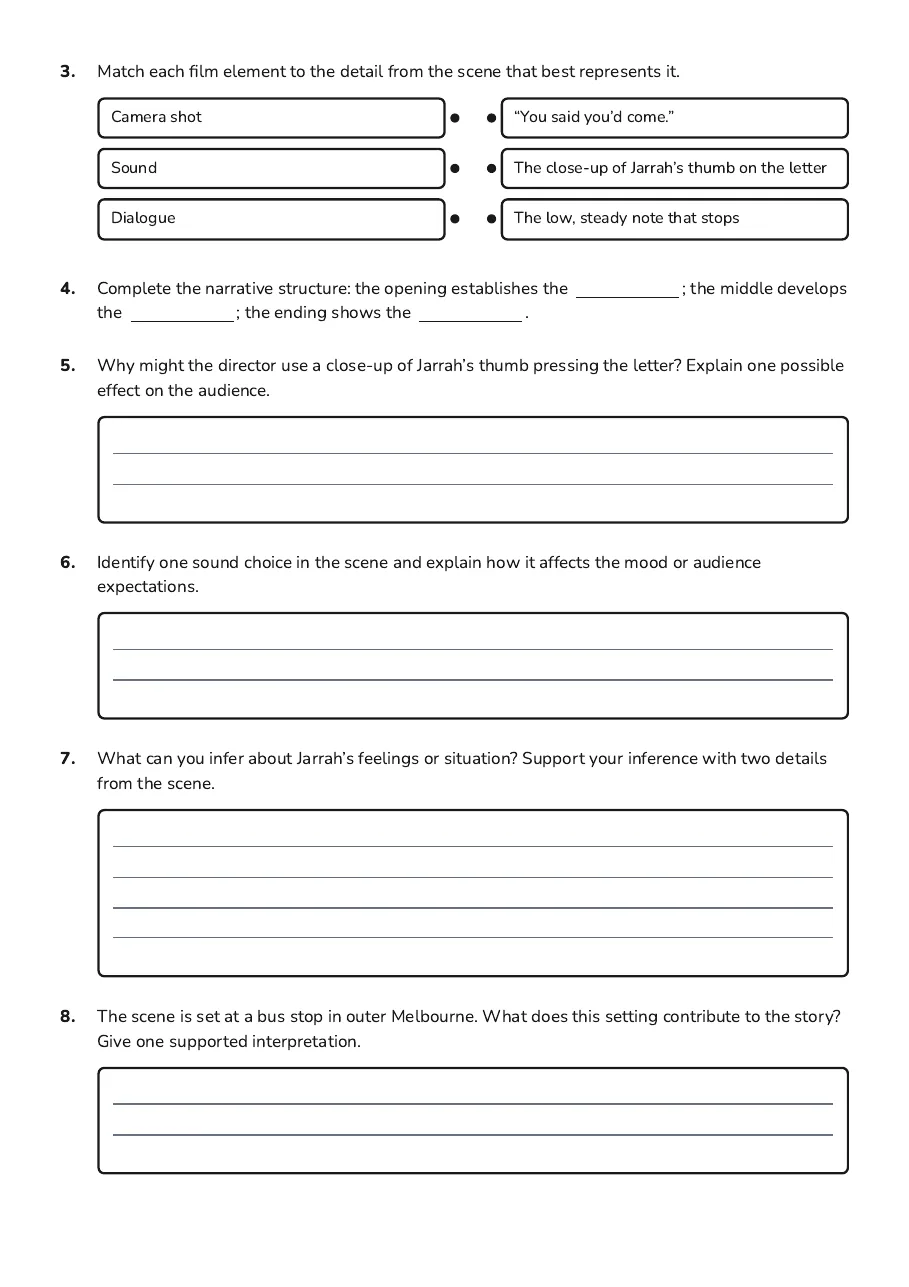
3.Match each film element to the detail from the scene that best represents it.
- Camera shot
- Sound
- Dialogue
- “You said you’d come.”
- The close-up of Jarrah’s thumb on the letter
- The low, steady note that stops
4.Complete the narrative structure: the opening establishes the ; the middle develops the ; the ending shows the .
5.Why might the director use a close-up of Jarrah’s thumb pressing the letter? Explain one possible effect on the audience.
6.Identify one sound choice in the scene and explain how it affects the mood or audience expectations.
7.What can you infer about Jarrah’s feelings or situation? Support your inference with two details from the scene.
8.The scene is set at a bus stop in outer Melbourne. What does this setting contribute to the story? Give one supported interpretation.
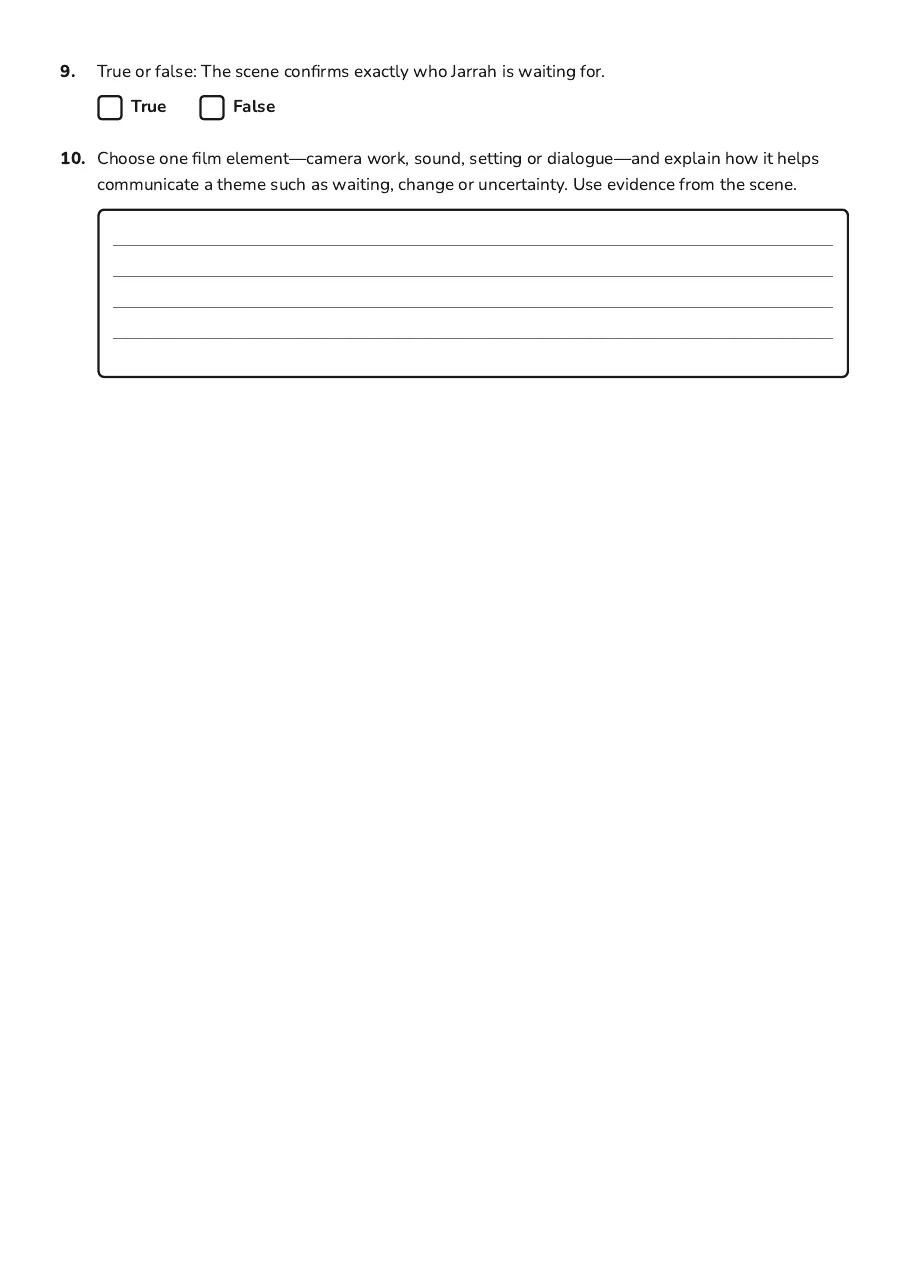
9.True or false: The scene confirms exactly who Jarrah is waiting for.
TrueFalse
10.Choose one film element—camera work, sound, setting or dialogue—and explain how it helps communicate a theme such as waiting, change or uncertainty. Use evidence from the scene.
3 printable pages
Page 1
Page 2
Page 3
About This Worksheet
Free in Kuraplan
Sign up free, grab the PDF, and customize it for your class.
Print-Ready
Formatted for standard paper. Clean layout, easy to read.
AI-Generated
Created with Kuraplan's AI, designed for real classroom use.
For Teachers & Parents
Use in classrooms, for homework, tutoring, or homeschool.
Need a custom version of this worksheet?
Kuraplan's AI generates custom worksheets in seconds — differentiated for every learner, aligned to your curriculum.
Generate Custom Worksheets — Free No credit card Curriculum-aligned Under 60 seconds