ScienceFreePrintable

Food Web Habitat Disruption

A free science worksheet ready for your classroom. Open in Kuraplan to grab the print-ready PDF, customize it for your students, or generate a fresh version in seconds.
Food Web Habitat Disruption worksheet preview
Name:Date:

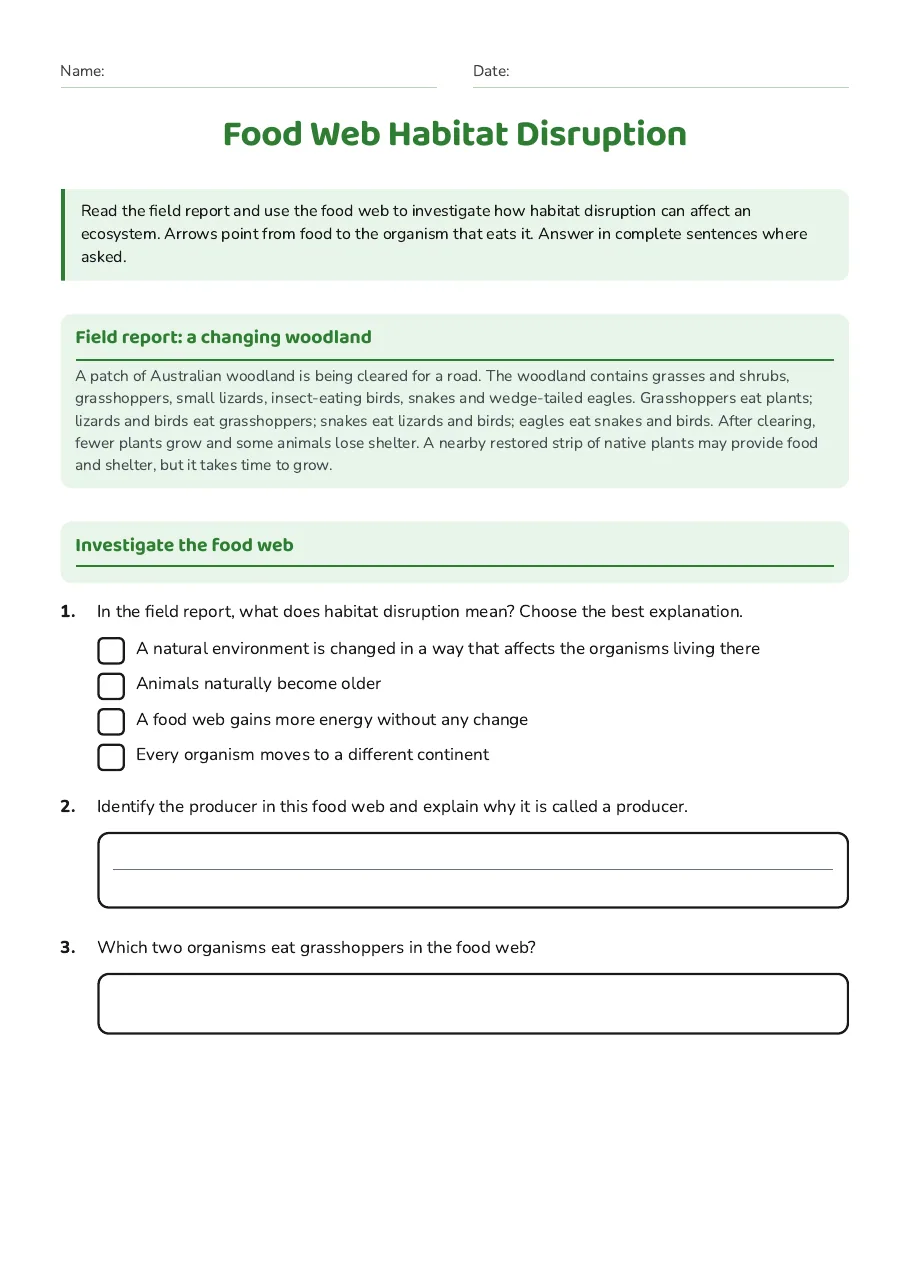
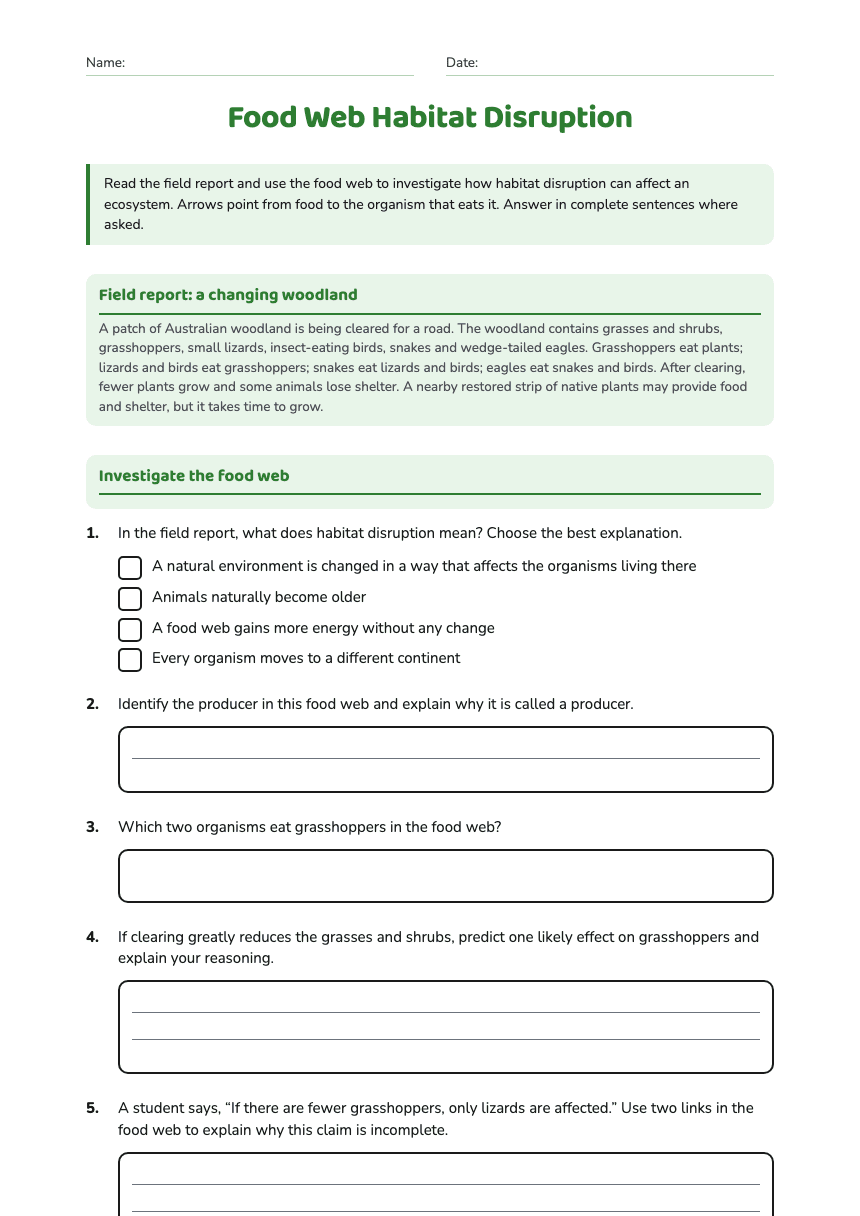
Food Web Habitat Disruption

Read the field report and use the food web to investigate how habitat disruption can affect an ecosystem. Arrows point from food to the organism that eats it. Answer in complete sentences where asked.

Field report: a changing woodland

A patch of Australian woodland is being cleared for a road. The woodland contains grasses and shrubs, grasshoppers, small lizards, insect-eating birds, snakes and wedge-tailed eagles. Grasshoppers eat plants; lizards and birds eat grasshoppers; snakes eat lizards and birds; eagles eat snakes and birds. After clearing, fewer plants grow and some animals lose shelter. A nearby restored strip of native plants may provide food and shelter, but it takes time to grow.

Investigate the food web

1.In the field report, what does habitat disruption mean? Choose the best explanation.
  • A natural environment is changed in a way that affects the organisms living there
  • Animals naturally become older
  • A food web gains more energy without any change
  • Every organism moves to a different continent
2.Identify the producer in this food web and explain why it is called a producer.
3.Which two organisms eat grasshoppers in the food web?
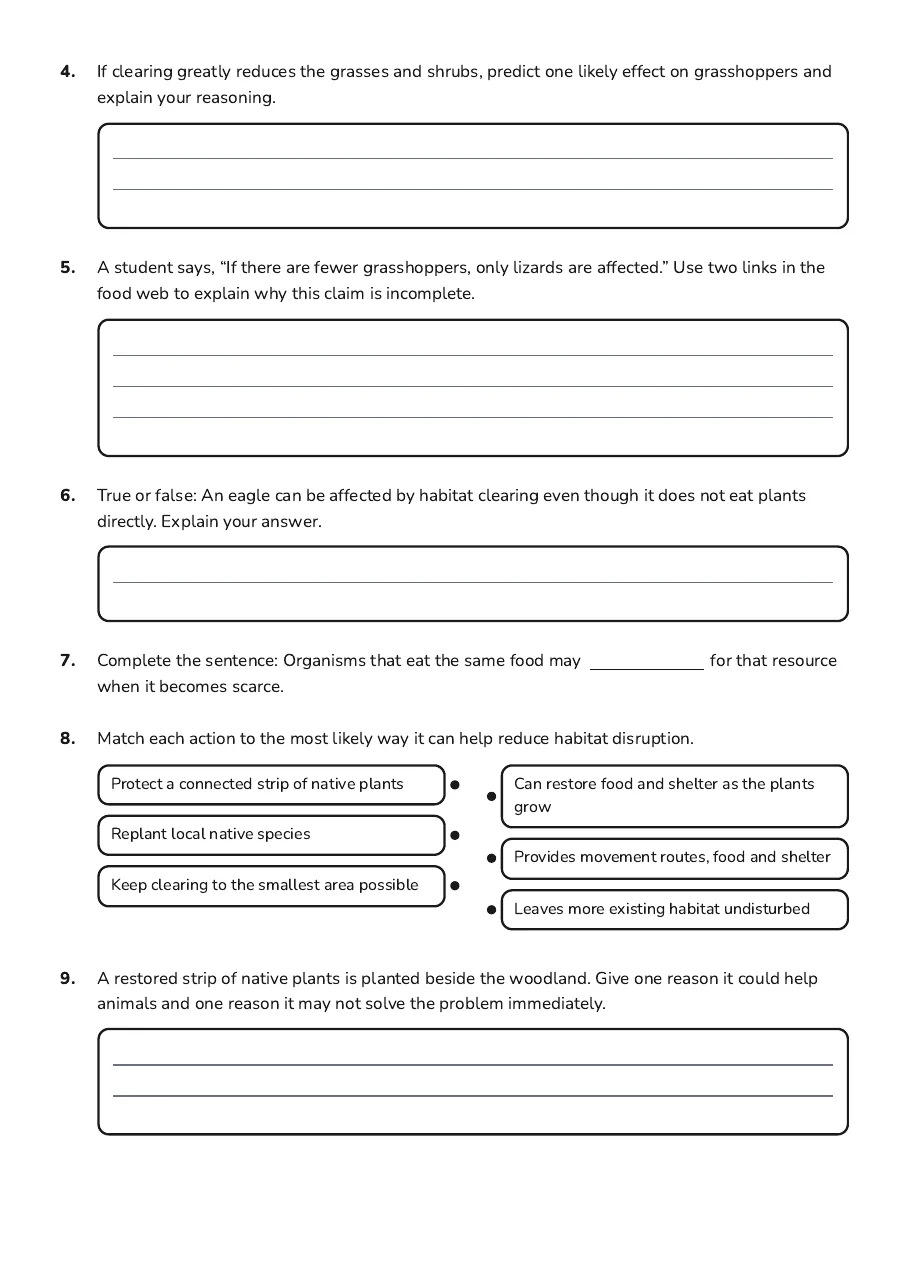
4.If clearing greatly reduces the grasses and shrubs, predict one likely effect on grasshoppers and explain your reasoning.
5.A student says, “If there are fewer grasshoppers, only lizards are affected.” Use two links in the food web to explain why this claim is incomplete.
6.True or false: An eagle can be affected by habitat clearing even though it does not eat plants directly. Explain your answer.
7.Complete the sentence: Organisms that eat the same food may for that resource when it becomes scarce.
8.Match each action to the most likely way it can help reduce habitat disruption.
  • Protect a connected strip of native plants
  • Replant local native species
  • Keep clearing to the smallest area possible
  • Can restore food and shelter as the plants grow
  • Provides movement routes, food and shelter
  • Leaves more existing habitat undisturbed
9.A restored strip of native plants is planted beside the woodland. Give one reason it could help animals and one reason it may not solve the problem immediately.
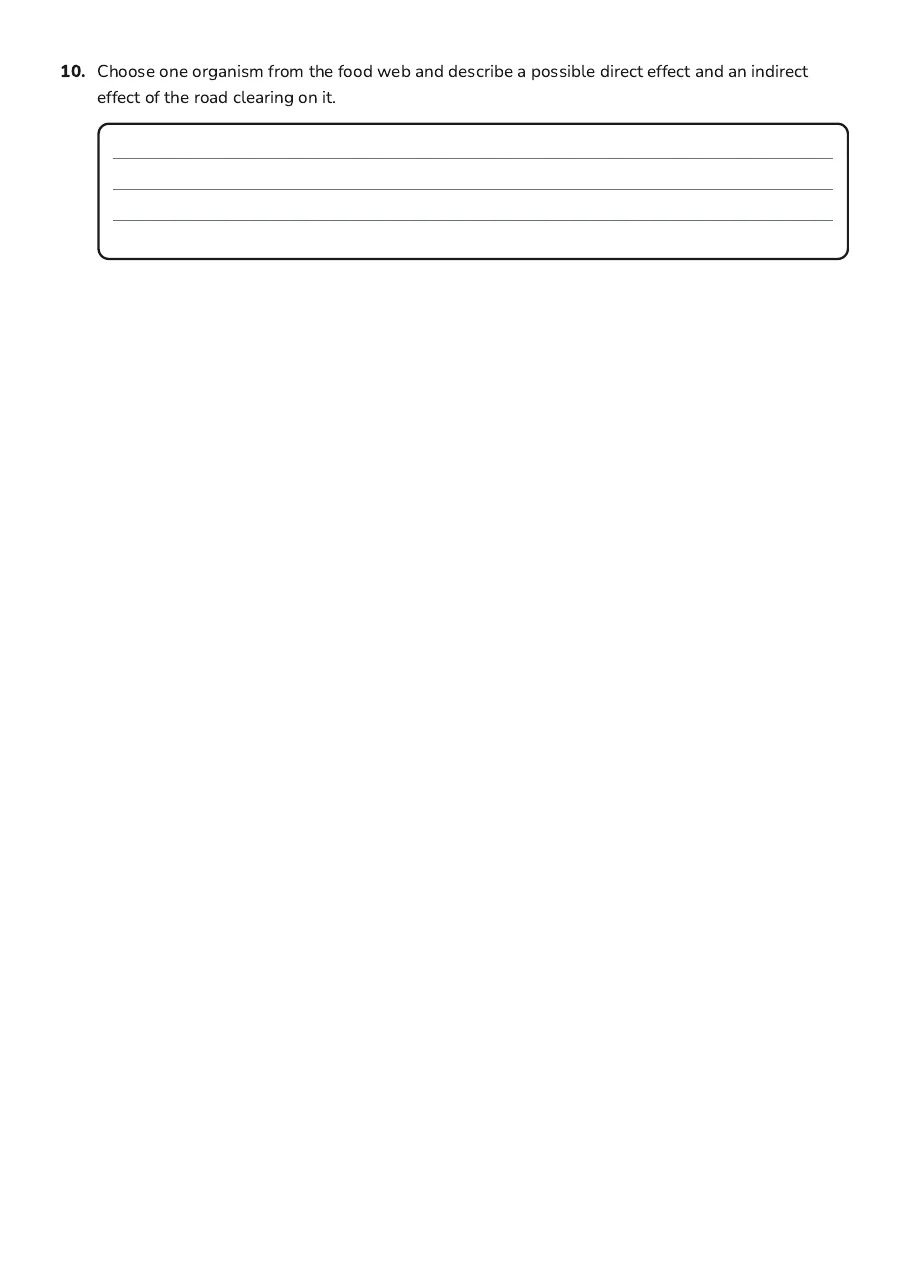
10.Choose one organism from the food web and describe a possible direct effect and an indirect effect of the road clearing on it.

3 printable pages

  • Food Web Habitat Disruption, page 1 of 3: Field report: a changing woodland, Investigate the food web

    Page 1

  • Food Web Habitat Disruption, page 2 of 3: 4. If clearing greatly reduces the grasses and shrubs, predict one likely effect on…

    Page 2

  • Food Web Habitat Disruption, page 3 of 3: 10. Choose one organism from the food web and describe a possible direct effect and an…

    Page 3

About This Worksheet

Free in Kuraplan

Sign up free, grab the PDF, and customize it for your class.

Print-Ready

Formatted for standard paper. Clean layout, easy to read.

AI-Generated

Created with Kuraplan's AI, designed for real classroom use.

For Teachers & Parents

Use in classrooms, for homework, tutoring, or homeschool.

Need a custom version of this worksheet?

Kuraplan's AI generates custom worksheets in seconds — differentiated for every learner, aligned to your curriculum.

Generate Custom Worksheets — Free
No credit card Curriculum-aligned Under 60 seconds