ScienceFreePrintable

Goblet and Cilia Cells

A free science worksheet ready for your classroom. Open in Kuraplan to grab the print-ready PDF, customize it for your students, or generate a fresh version in seconds.
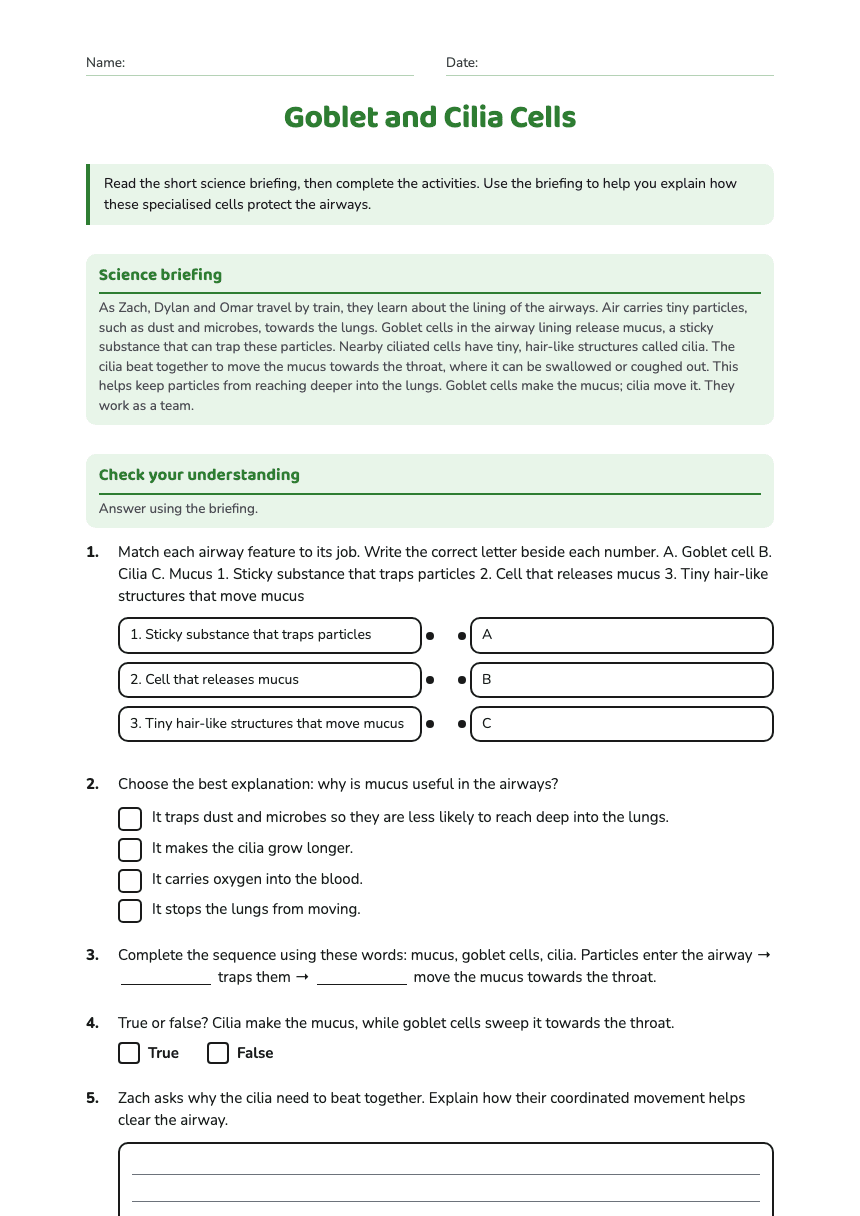
Goblet and Cilia Cells worksheet preview
Name:Date:

Goblet and Cilia Cells

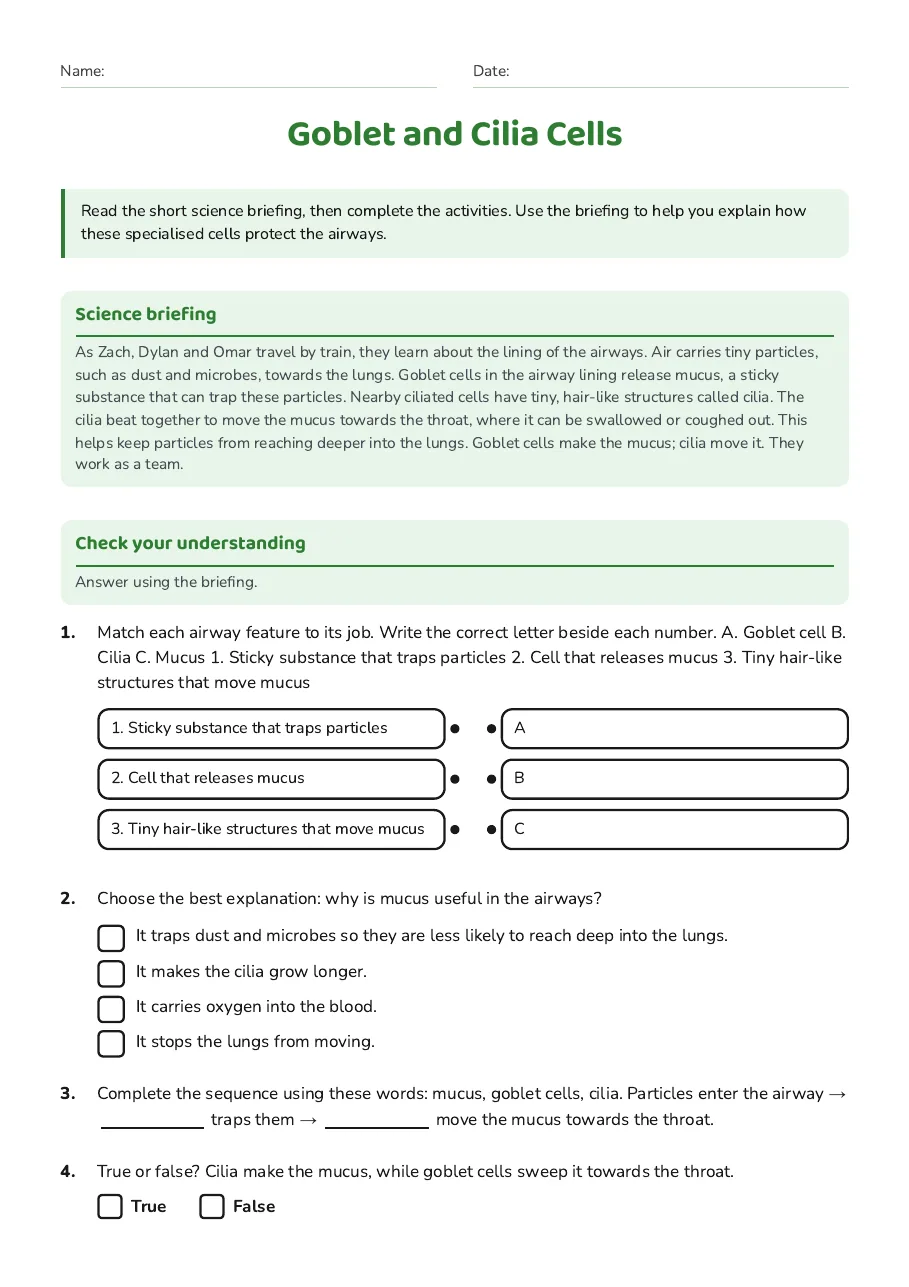
Read the short science briefing, then complete the activities. Use the briefing to help you explain how these specialised cells protect the airways.

Science briefing

As Zach, Dylan and Omar travel by train, they learn about the lining of the airways. Air carries tiny particles, such as dust and microbes, towards the lungs. Goblet cells in the airway lining release mucus, a sticky substance that can trap these particles. Nearby ciliated cells have tiny, hair-like structures called cilia. The cilia beat together to move the mucus towards the throat, where it can be swallowed or coughed out. This helps keep particles from reaching deeper into the lungs. Goblet cells make the mucus; cilia move it. They work as a team.

Check your understanding

Answer using the briefing.

1.Match each airway feature to its job. Write the correct letter beside each number. A. Goblet cell B. Cilia C. Mucus 1. Sticky substance that traps particles 2. Cell that releases mucus 3. Tiny hair-like structures that move mucus
  • 1. Sticky substance that traps particles
  • 2. Cell that releases mucus
  • 3. Tiny hair-like structures that move mucus
  • A
  • B
  • C
2.Choose the best explanation: why is mucus useful in the airways?
  • It traps dust and microbes so they are less likely to reach deep into the lungs.
  • It makes the cilia grow longer.
  • It carries oxygen into the blood.
  • It stops the lungs from moving.
3.Complete the sequence using these words: mucus, goblet cells, cilia. Particles enter the airway → traps them → move the mucus towards the throat.
4.True or false? Cilia make the mucus, while goblet cells sweep it towards the throat.
TrueFalse
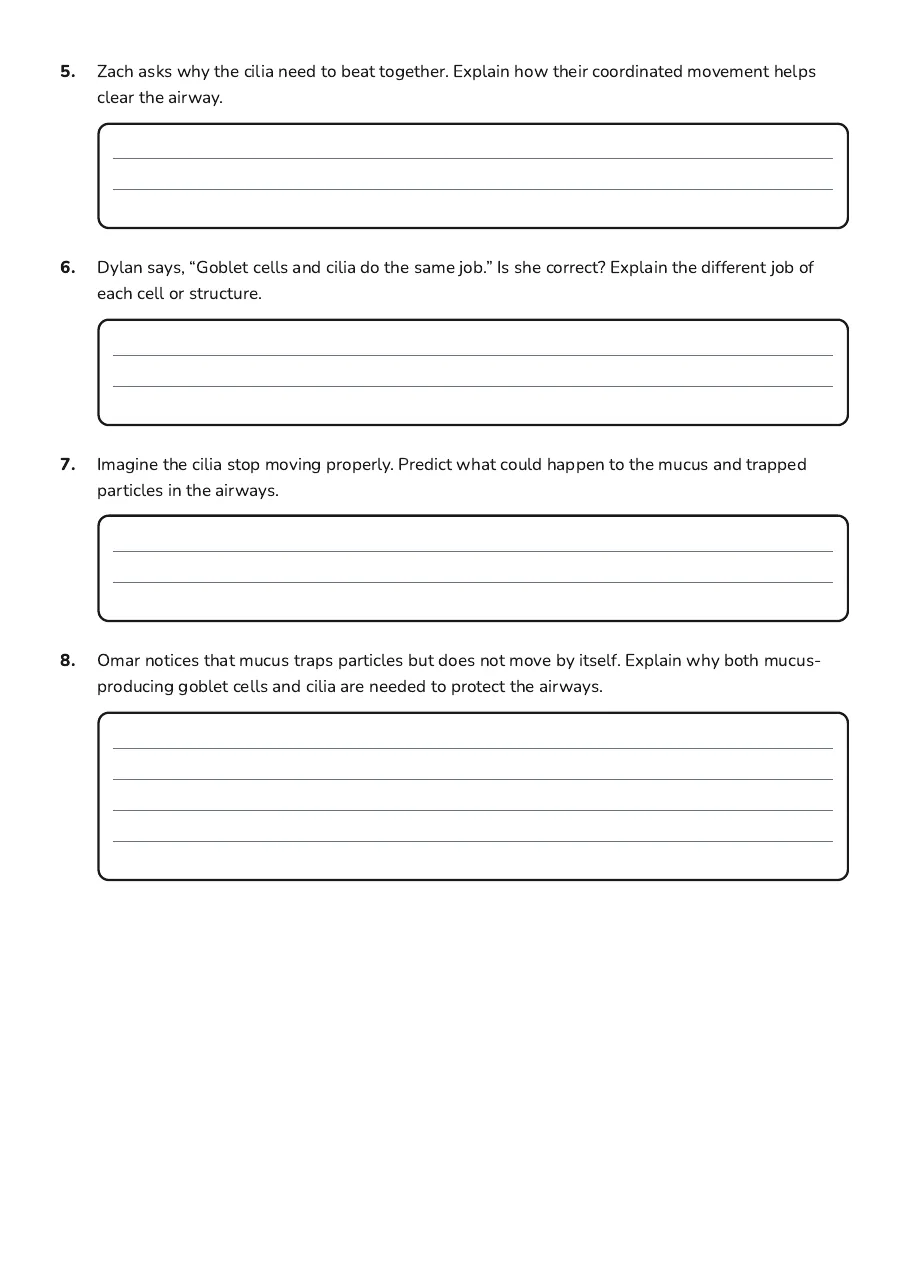
5.Zach asks why the cilia need to beat together. Explain how their coordinated movement helps clear the airway.
6.Dylan says, “Goblet cells and cilia do the same job.” Is she correct? Explain the different job of each cell or structure.
7.Imagine the cilia stop moving properly. Predict what could happen to the mucus and trapped particles in the airways.
8.Omar notices that mucus traps particles but does not move by itself. Explain why both mucus-producing goblet cells and cilia are needed to protect the airways.
Draw a simple airway lining. Include one goblet cell releasing mucus, cilia moving the mucus towards the throat, and particles caught in the mucus. Add arrows and labels. Check that your arrows show the direction the mucus moves.

3 printable pages

  • Goblet and Cilia Cells, page 1 of 3: Science briefing, Check your understanding

    Page 1

  • Goblet and Cilia Cells, page 2 of 3: 5. Zach asks why the cilia need to beat together. Explain how their coordinated movement…

    Page 2

  • Goblet and Cilia Cells, page 3 of 3: Draw a simple airway lining. Include one goblet cell releasing mucus, cilia moving the…

    Page 3

About This Worksheet

Free in Kuraplan

Sign up free, grab the PDF, and customize it for your class.

Print-Ready

Formatted for standard paper. Clean layout, easy to read.

AI-Generated

Created with Kuraplan's AI, designed for real classroom use.

For Teachers & Parents

Use in classrooms, for homework, tutoring, or homeschool.

Need a custom version of this worksheet?

Kuraplan's AI generates custom worksheets in seconds — differentiated for every learner, aligned to your curriculum.

Generate Custom Worksheets — Free
No credit card Curriculum-aligned Under 60 seconds