Fossil Hunters: Digging Into History
A free social sciences worksheet ready for your classroom. Open in Kuraplan to grab the print-ready PDF, customize it for your students, or generate a fresh version in seconds.
Fossil Hunters: Digging Into History
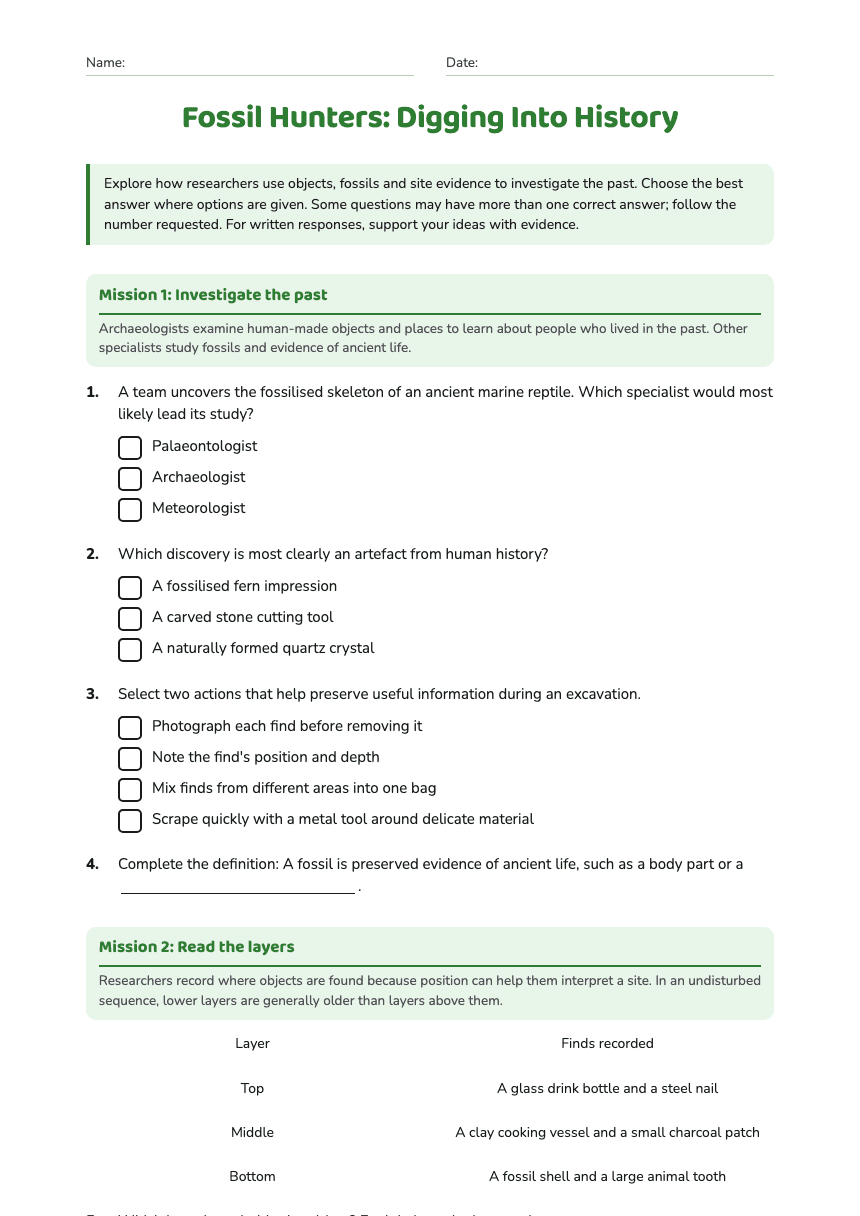
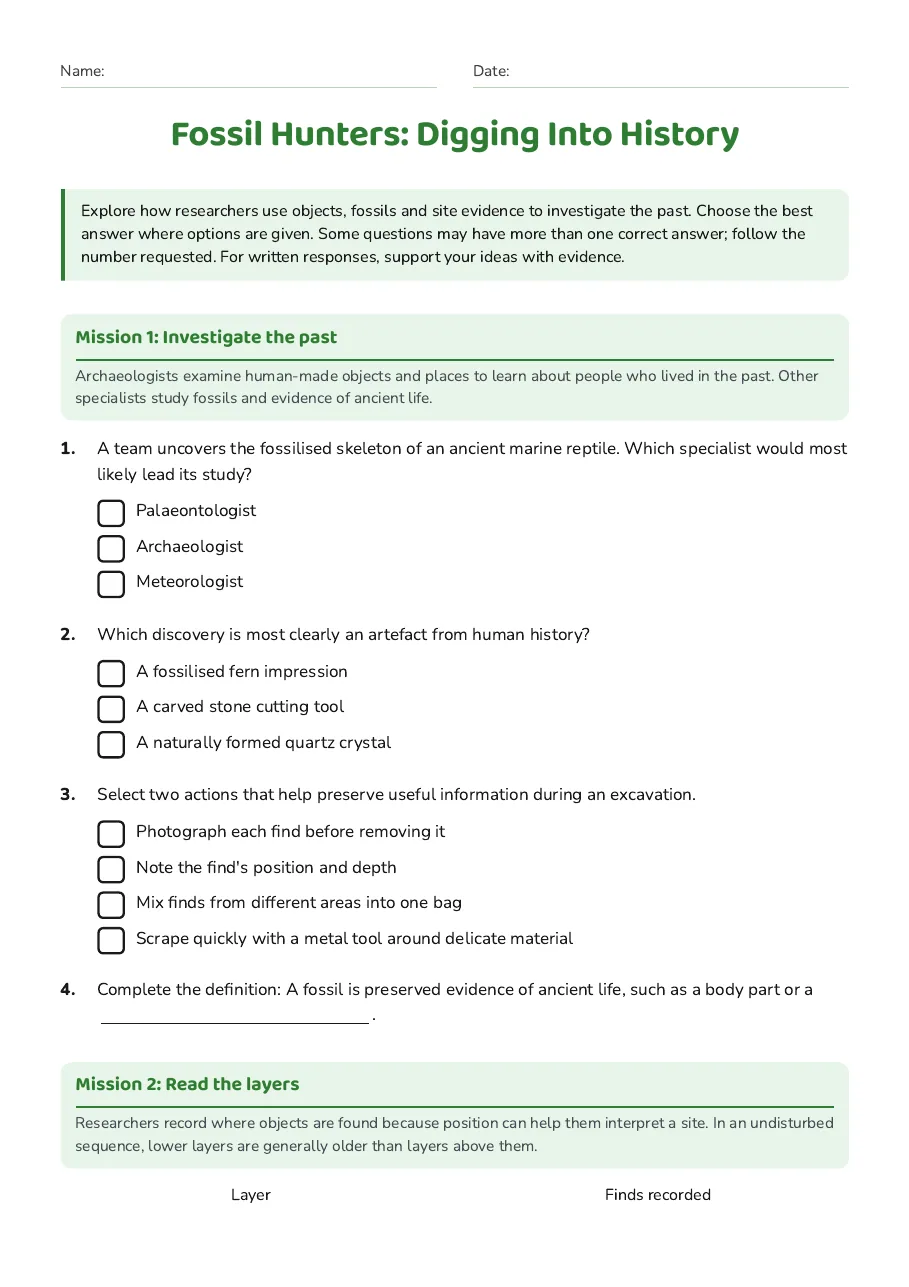
Mission 1: Investigate the past
Archaeologists examine human-made objects and places to learn about people who lived in the past. Other specialists study fossils and evidence of ancient life.
- Palaeontologist
- Archaeologist
- Meteorologist
- A fossilised fern impression
- A carved stone cutting tool
- A naturally formed quartz crystal
- Photograph each find before removing it
- Note the find's position and depth
- Mix finds from different areas into one bag
- Scrape quickly with a metal tool around delicate material
Mission 2: Read the layers
Researchers record where objects are found because position can help them interpret a site. In an undisturbed sequence, lower layers are generally older than layers above them.
Layer
Finds recorded
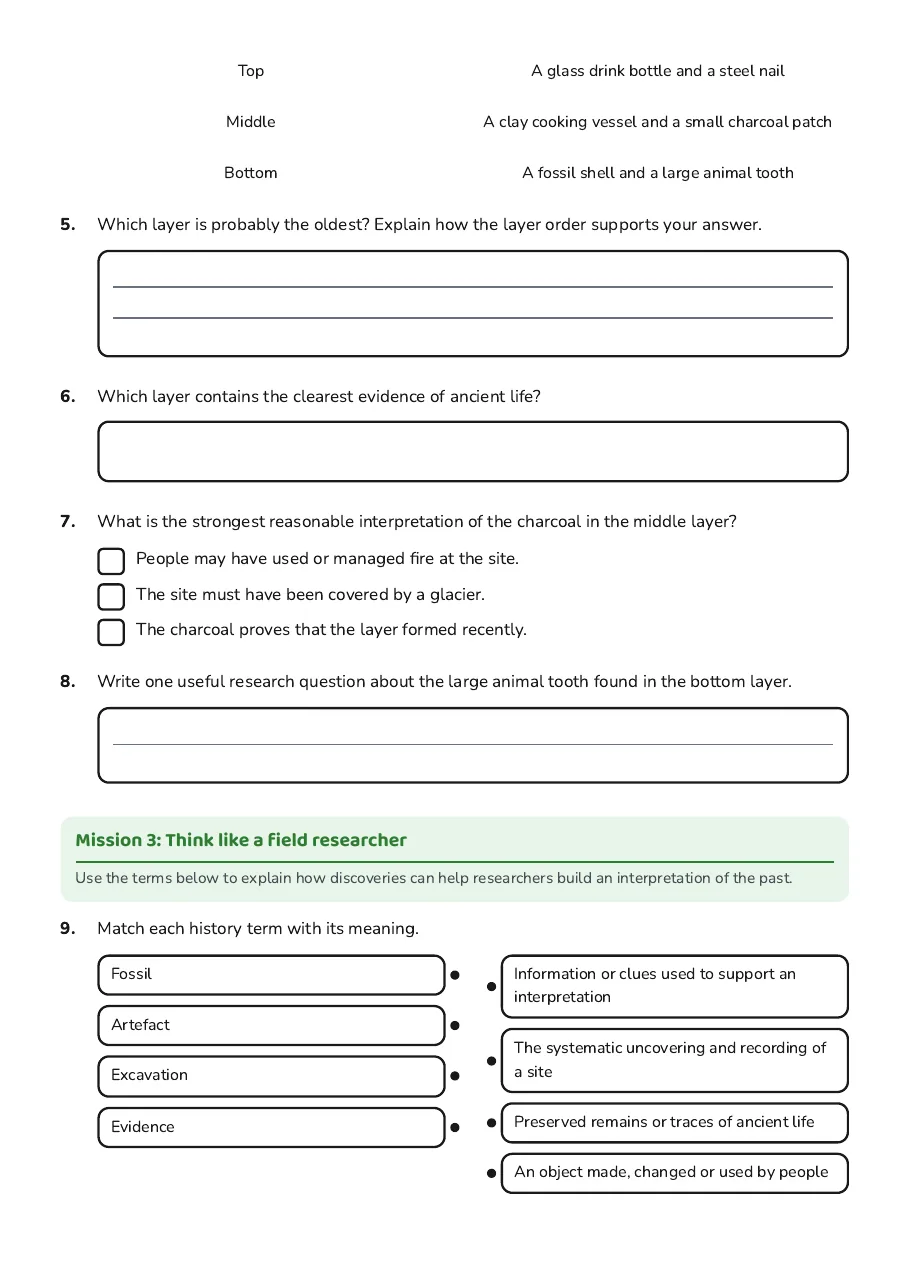
Top
A glass drink bottle and a steel nail
Middle
A clay cooking vessel and a small charcoal patch
Bottom
A fossil shell and a large animal tooth
- People may have used or managed fire at the site.
- The site must have been covered by a glacier.
- The charcoal proves that the layer formed recently.
Mission 3: Think like a field researcher
Use the terms below to explain how discoveries can help researchers build an interpretation of the past.
- Fossil
- Artefact
- Excavation
- Evidence
- Information or clues used to support an interpretation
- The systematic uncovering and recording of a site
- Preserved remains or traces of ancient life
- An object made, changed or used by people
3 printable pages
Page 1
Page 2
Page 3
About This Worksheet
Free in Kuraplan
Sign up free, grab the PDF, and customize it for your class.
Print-Ready
Formatted for standard paper. Clean layout, easy to read.
AI-Generated
Created with Kuraplan's AI, designed for real classroom use.
For Teachers & Parents
Use in classrooms, for homework, tutoring, or homeschool.
Need a custom version of this worksheet?
Kuraplan's AI generates custom worksheets in seconds — differentiated for every learner, aligned to your curriculum.
Generate Custom Worksheets — Free