Fractions to Hundredths Mastery
A free maths worksheet ready for your classroom. Open in Kuraplan to grab the print-ready PDF, customize it for your students, or generate a fresh version in seconds.

Fractions to Hundredths Mastery
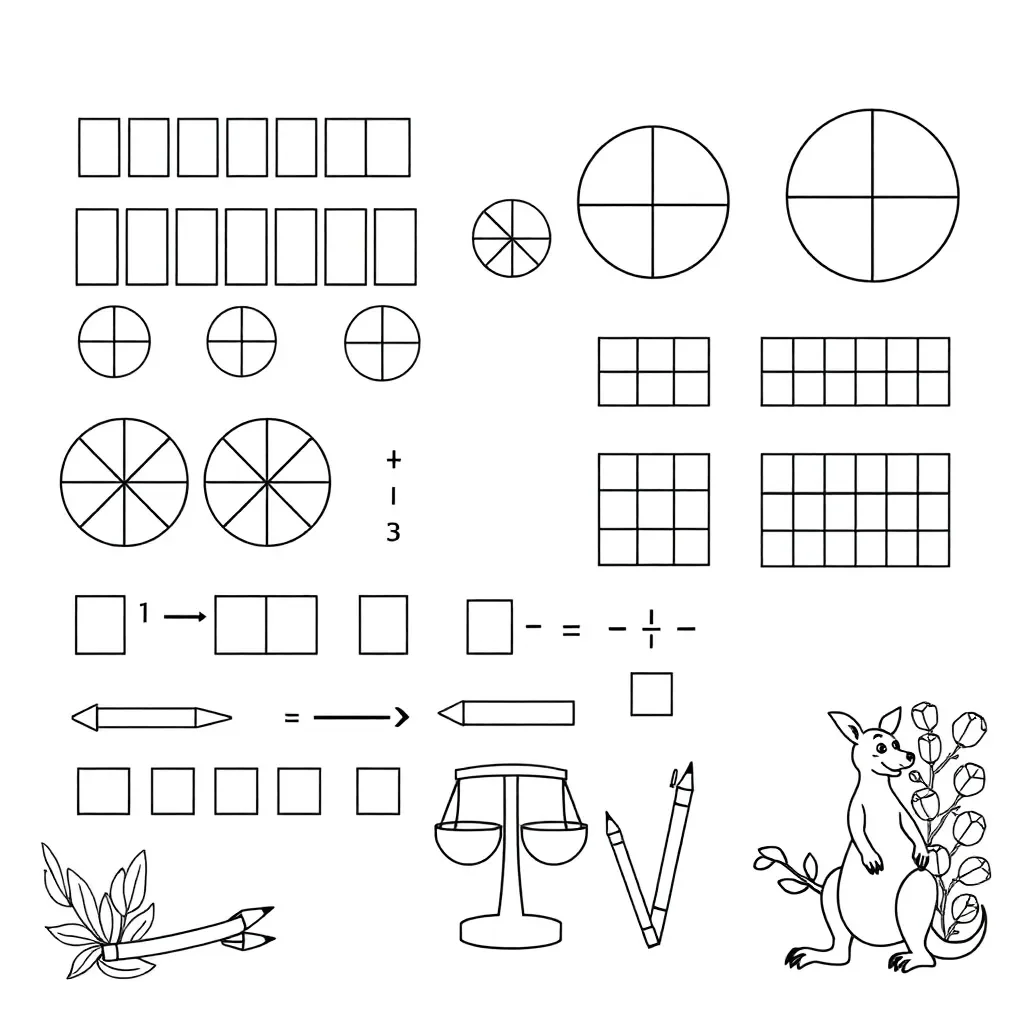
Part 1: The Rule and Guided Examples
To convert a fraction to an equivalent fraction with denominator 100, multiply the numerator and denominator by the same whole-number factor.
Worked example: 10/20 = ?/100. Since 20 × 5 = 100, multiply both parts by 5: 10 × 5 / 20 × 5 = 50/100.
Worked example: 30/50 = ?/100. Since 50 × 2 = 100, multiply both parts by 2: 30 × 2 / 50 × 2 = 60/100.
a) 7/20 = ______/100
b) 18/25 = ______/100
c) 23/50 = ______/100
Part 2: Independent Practice and Challenge
a) ____/20 = 65/100
b) 19/____ = 76/100
c) ____/50 = 88/100
a) 37/50 ____ 72/100
b) 9/20 ____ 46/100
a) 17/20 = ______/100 = ______ = ______%
b) 21/25 = ______/100 = ______ = ______%
a) 7/16
b) 9/25
c) 11/40
d) 13/50
Answer Key
1. 25 × 4 = 100, so multiply both parts by 4: 5/25 = 20/100.
2. a) 20 × 5 = 100; 7 × 5 = 35, so 7/20 = 35/100.
b) 25 × 4 = 100; 18 × 4 = 72, so 18/25 = 72/100.
c) 50 × 2 = 100; 23 × 2 = 46, so 23/50 = 46/100.
3. Both parts must be multiplied by the same factor so the fraction’s value remains unchanged. Multiplying only the denominator changes the value.
4. 20 × 5 = 100; 13 × 5 = 65. Therefore, 13/20 = 65/100.
5. 25 × 4 = 100; 17 × 4 = 68. Therefore, 17/25 = 68/100.
6. 50 × 2 = 100; 41 × 2 = 82. Therefore, 41/50 = 82/100.
7. a) 13/20 = 65/100. b) 19/25 = 76/100. c) 44/50 = 88/100.
8. a) 37/50 = 74/100, so 37/50 > 72/100. b) 9/20 = 45/100, so 9/20 < 46/100.
9. 13/25 = 52/100, 57/100 = 57/100, and 3/5 = 60/100. Order: 13/25, 57/100, 3/5.
10. a) 17/20 = 85/100 = 0.85 = 85%. b) 21/25 = 84/100 = 0.84 = 84%.
11. Mia changed only the denominator. The multiplier must be 5 for both parts: 3/20 = 15/100.
12. a) Cannot: 16 is not a factor of 100, so no whole-number multiplier changes 16 to 100. b) Can: 9/25 = 36/100. c) Cannot: 40 × 2.5 = 100, and 2.5 is not a whole number. d) Can: 13/50 = 26/100.
About This Worksheet
Free in Kuraplan
Sign up free, grab the PDF, and customize it for your class.
Print-Ready
Formatted for standard paper. Clean layout, easy to read.
AI-Generated
Created with Kuraplan's AI, designed for real classroom use.
For Teachers & Parents
Use in classrooms, for homework, tutoring, or homeschool.
Need a custom version of this worksheet?
Kuraplan's AI generates custom worksheets in seconds — differentiated for every learner, aligned to your curriculum.
Generate Custom Worksheets — Free