Gangs: Then and Now
A free english worksheet ready for your classroom. Open in Kuraplan to grab the print-ready PDF, customize it for your students, or generate a fresh version in seconds.
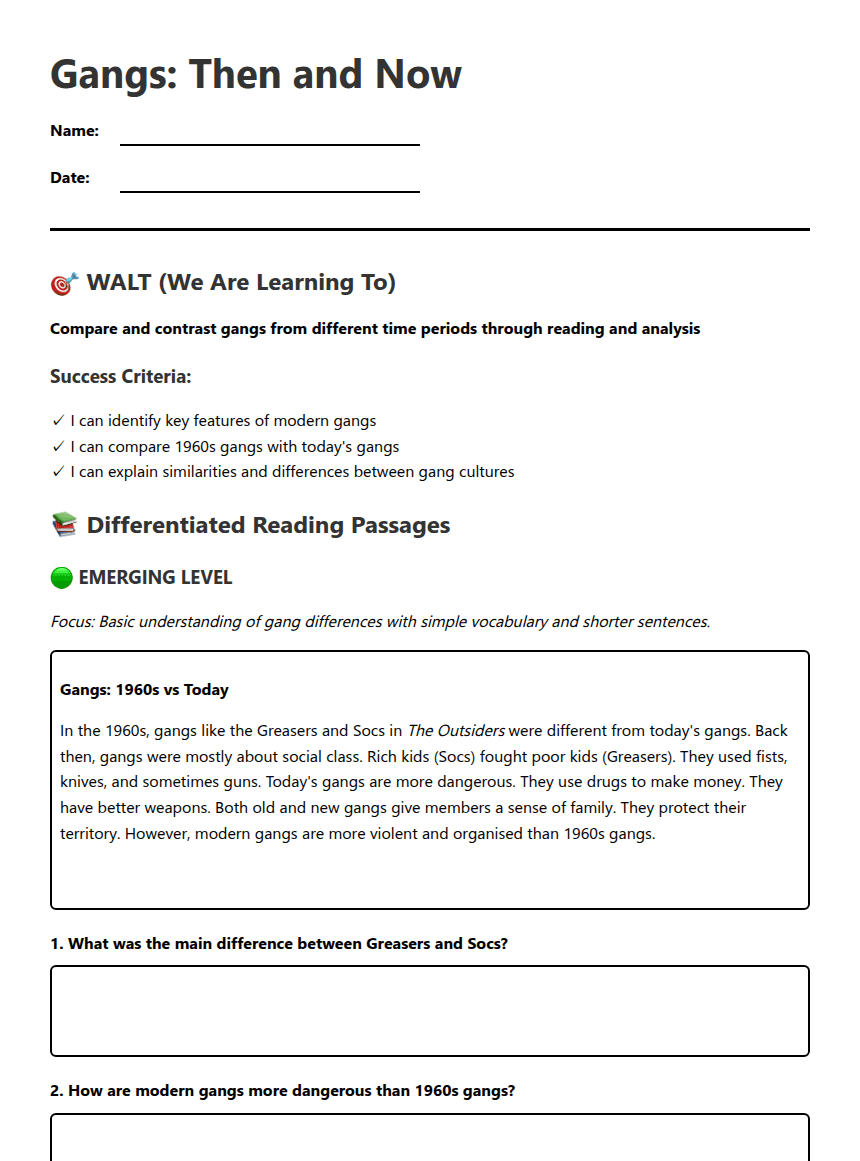
Gangs: Then and Now
🎯 WALT (We Are Learning To)
Compare and contrast gangs from different time periods through reading and analysis
Success Criteria:
✓ I can identify key features of modern gangs
✓ I can compare 1960s gangs with today's gangs
✓ I can explain similarities and differences between gang cultures
📚 Differentiated Reading Passages
🟢 EMERGING LEVEL
Focus: Basic understanding of gang differences with simple vocabulary and shorter sentences.
Gangs: 1960s vs Today
In the 1960s, gangs like the Greasers and Socs in The Outsiders were different from today's gangs. Back then, gangs were mostly about social class. Rich kids (Socs) fought poor kids (Greasers). They used fists, knives, and sometimes guns. Today's gangs are more dangerous. They use drugs to make money. They have better weapons. Both old and new gangs give members a sense of family. They protect their territory. However, modern gangs are more violent and organised than 1960s gangs.
🟡 DEVELOPING LEVEL
Focus: Detailed comparison with analysis of causes and effects using moderate complexity.
Gang Evolution: From The Outsiders to Today
The gang culture depicted in S.E. Hinton's The Outsiders reflects 1960s society, where gangs primarily formed along socioeconomic lines. The Greasers and Socs represented class warfare - working-class youth versus privileged teenagers. Their conflicts involved physical confrontations, territorial disputes, and honour-based violence. Contemporary gangs have evolved into more sophisticated criminal organisations. Modern gangs engage in drug trafficking, cybercrime, and international networks. Technology has transformed recruitment methods, with social media playing a crucial role. However, fundamental motivations remain similar: seeking belonging, protection, and identity. Both eras show young people joining gangs due to family breakdown, poverty, and lack of opportunities.
🔴 EXTENDING LEVEL
Focus: Critical analysis of societal factors and complex evaluation of gang evolution.
Socioeconomic Transformation of Gang Culture
The romanticised gang rivalry portrayed in The Outsiders represents a relatively innocent era compared to contemporary gang culture. 1960s gangs operated within localised territories with clearly defined social boundaries - the economic disparity between Greasers and Socs reflected broader societal inequalities but remained geographically contained. Modern gangs have transformed into transnational criminal enterprises, exploiting globalisation and digital connectivity. Contemporary gang membership often transcends traditional socioeconomic boundaries, incorporating middle-class youth seeking excitement or identity. The proliferation of sophisticated weaponry, international drug cartels, and cyber-enabled crimes has exponentially increased the stakes. However, underlying sociological factors persist: marginalised communities, inadequate social support systems, and the fundamental human need for belonging continue to drive gang recruitment across generations.
🎯 Dyslexia-Friendly Reading Support
Key vocabulary with definitions:
• Socioeconomic: relating to social class and money
• Territory: area that a gang controls
• Contemporary: modern, happening now
• Sophisticated: complex and advanced
• Marginalised: pushed to the edges of society
About This Worksheet
Free in Kuraplan
Sign up free, grab the PDF, and customize it for your class.
Print-Ready
Formatted for standard paper. Clean layout, easy to read.
AI-Generated
Created with Kuraplan's AI, designed for real classroom use.
For Teachers & Parents
Use in classrooms, for homework, tutoring, or homeschool.
Need a custom version of this worksheet?
Kuraplan's AI generates custom worksheets in seconds — differentiated for every learner, aligned to your curriculum.
Generate Custom Worksheets — Free