Gangs Then and Now
A free english worksheet ready for your classroom. Open in Kuraplan to grab the print-ready PDF, customize it for your students, or generate a fresh version in seconds.
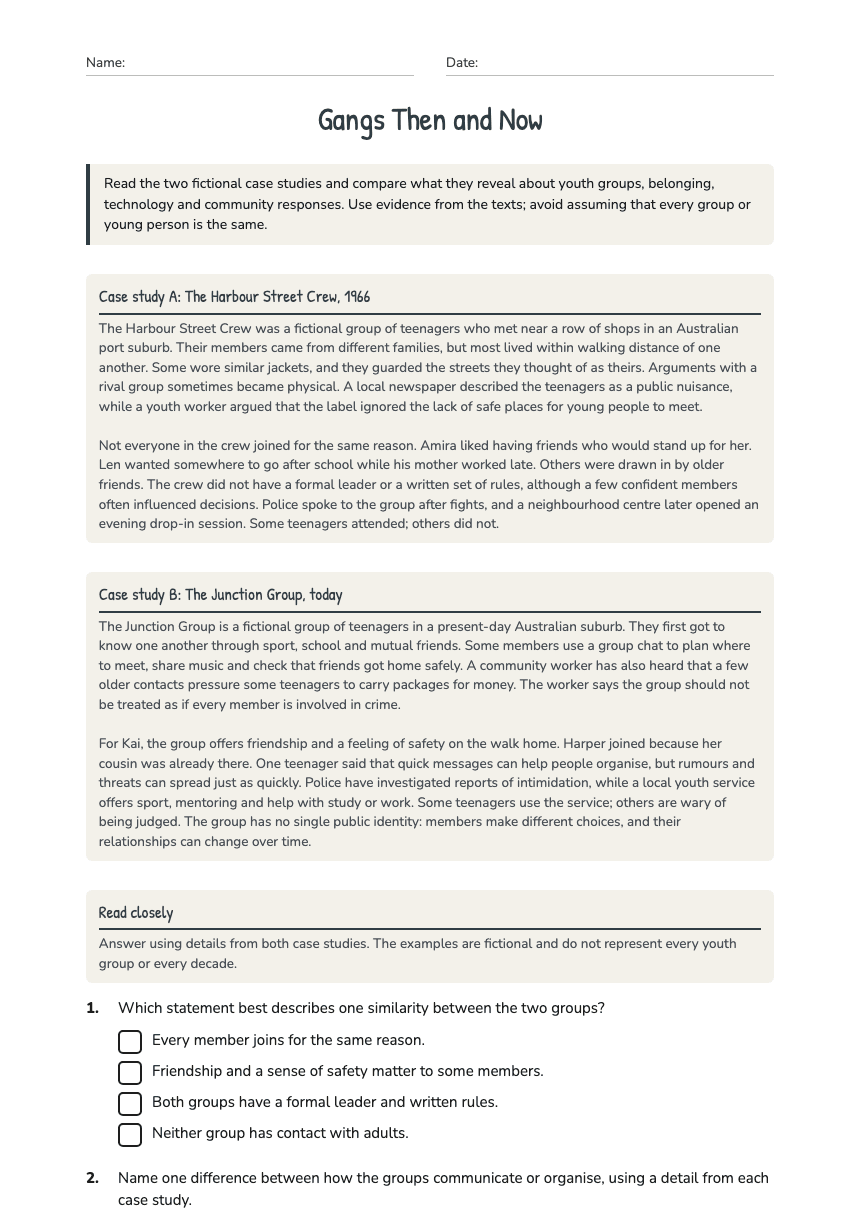
Gangs Then and Now
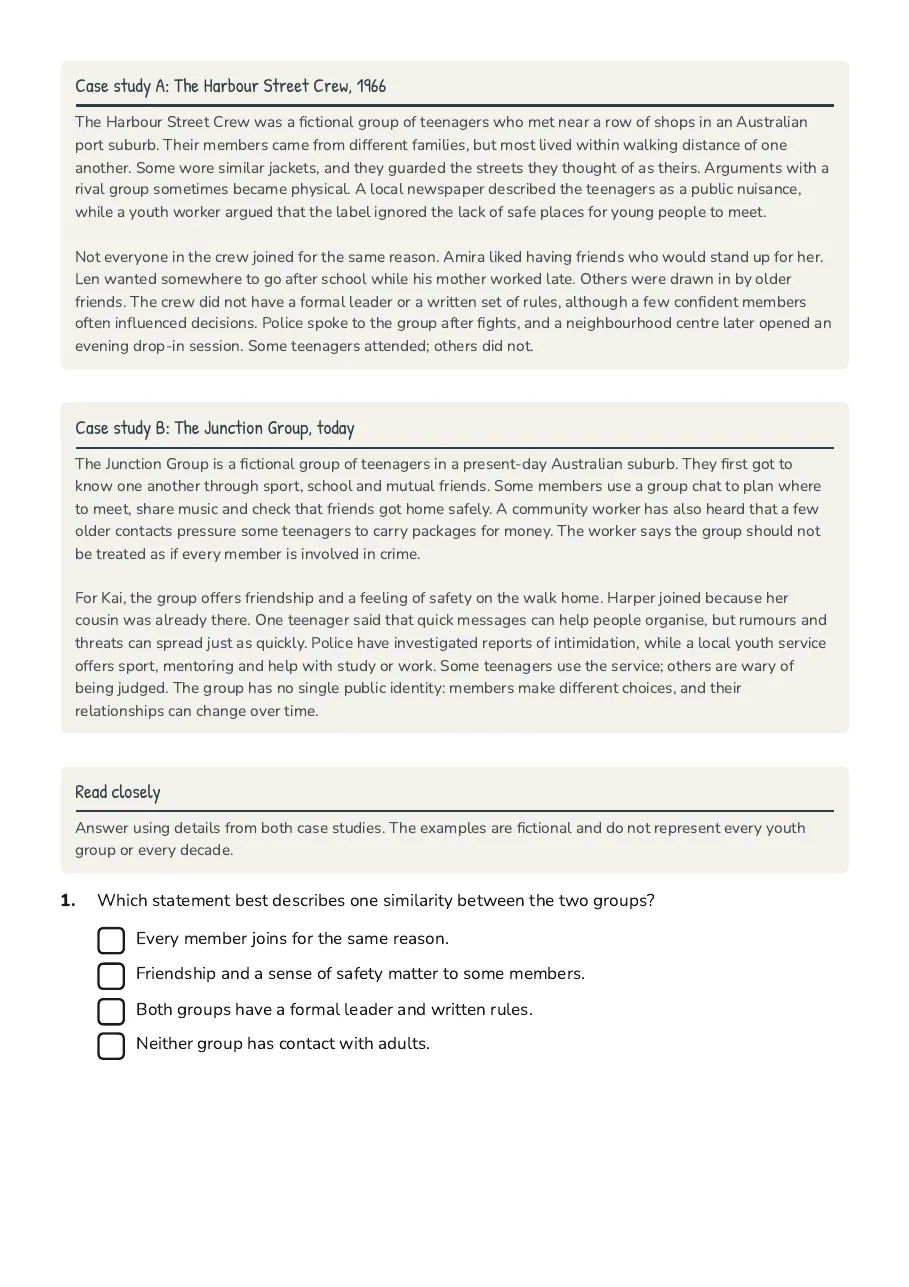
Case study A: The Harbour Street Crew, 1966
The Harbour Street Crew was a fictional group of teenagers who met near a row of shops in an Australian port suburb. Their members came from different families, but most lived within walking distance of one another. Some wore similar jackets, and they guarded the streets they thought of as theirs. Arguments with a rival group sometimes became physical. A local newspaper described the teenagers as a public nuisance, while a youth worker argued that the label ignored the lack of safe places for young people to meet. Not everyone in the crew joined for the same reason. Amira liked having friends who would stand up for her. Len wanted somewhere to go after school while his mother worked late. Others were drawn in by older friends. The crew did not have a formal leader or a written set of rules, although a few confident members often influenced decisions. Police spoke to the group after fights, and a neighbourhood centre later opened an evening drop-in session. Some teenagers attended; others did not.
Case study B: The Junction Group, today
The Junction Group is a fictional group of teenagers in a present-day Australian suburb. They first got to know one another through sport, school and mutual friends. Some members use a group chat to plan where to meet, share music and check that friends got home safely. A community worker has also heard that a few older contacts pressure some teenagers to carry packages for money. The worker says the group should not be treated as if every member is involved in crime. For Kai, the group offers friendship and a feeling of safety on the walk home. Harper joined because her cousin was already there. One teenager said that quick messages can help people organise, but rumours and threats can spread just as quickly. Police have investigated reports of intimidation, while a local youth service offers sport, mentoring and help with study or work. Some teenagers use the service; others are wary of being judged. The group has no single public identity: members make different choices, and their relationships can change over time.
Read closely
Answer using details from both case studies. The examples are fictional and do not represent every youth group or every decade.
- Every member joins for the same reason.
- Friendship and a sense of safety matter to some members.
- Both groups have a formal leader and written rules.
- Neither group has contact with adults.
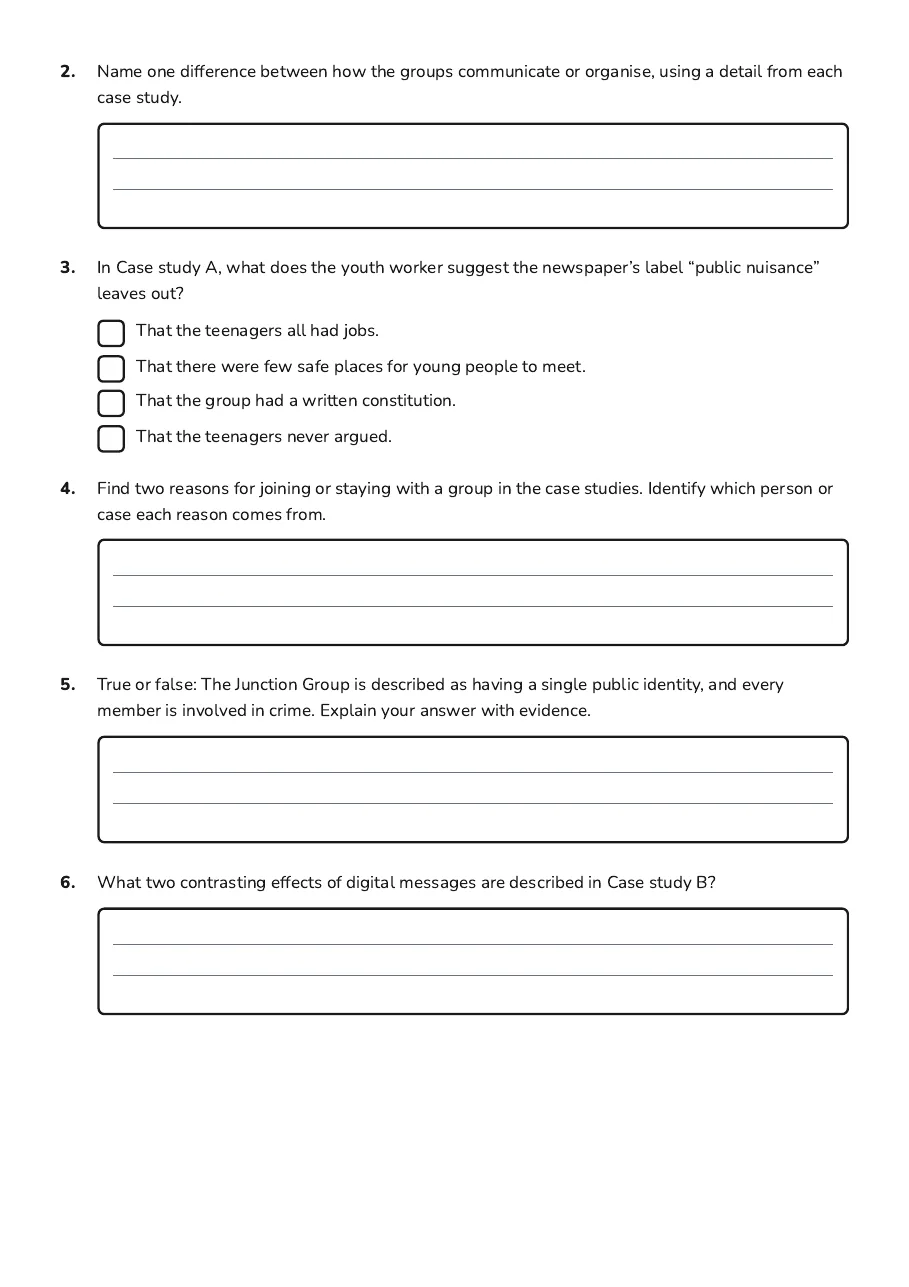
- That the teenagers all had jobs.
- That there were few safe places for young people to meet.
- That the group had a written constitution.
- That the teenagers never argued.
4 printable pages

Page 1
Page 2
Page 3
Page 4
About This Worksheet
Free in Kuraplan
Sign up free, grab the PDF, and customize it for your class.
Print-Ready
Formatted for standard paper. Clean layout, easy to read.
AI-Generated
Created with Kuraplan's AI, designed for real classroom use.
For Teachers & Parents
Use in classrooms, for homework, tutoring, or homeschool.
Need a custom version of this worksheet?
Kuraplan's AI generates custom worksheets in seconds — differentiated for every learner, aligned to your curriculum.
Generate Custom Worksheets — Free