MathsFreePrintable

Introduction to Differentiation

A free maths worksheet ready for your classroom. Open in Kuraplan to grab the print-ready PDF, customize it for your students, or generate a fresh version in seconds.
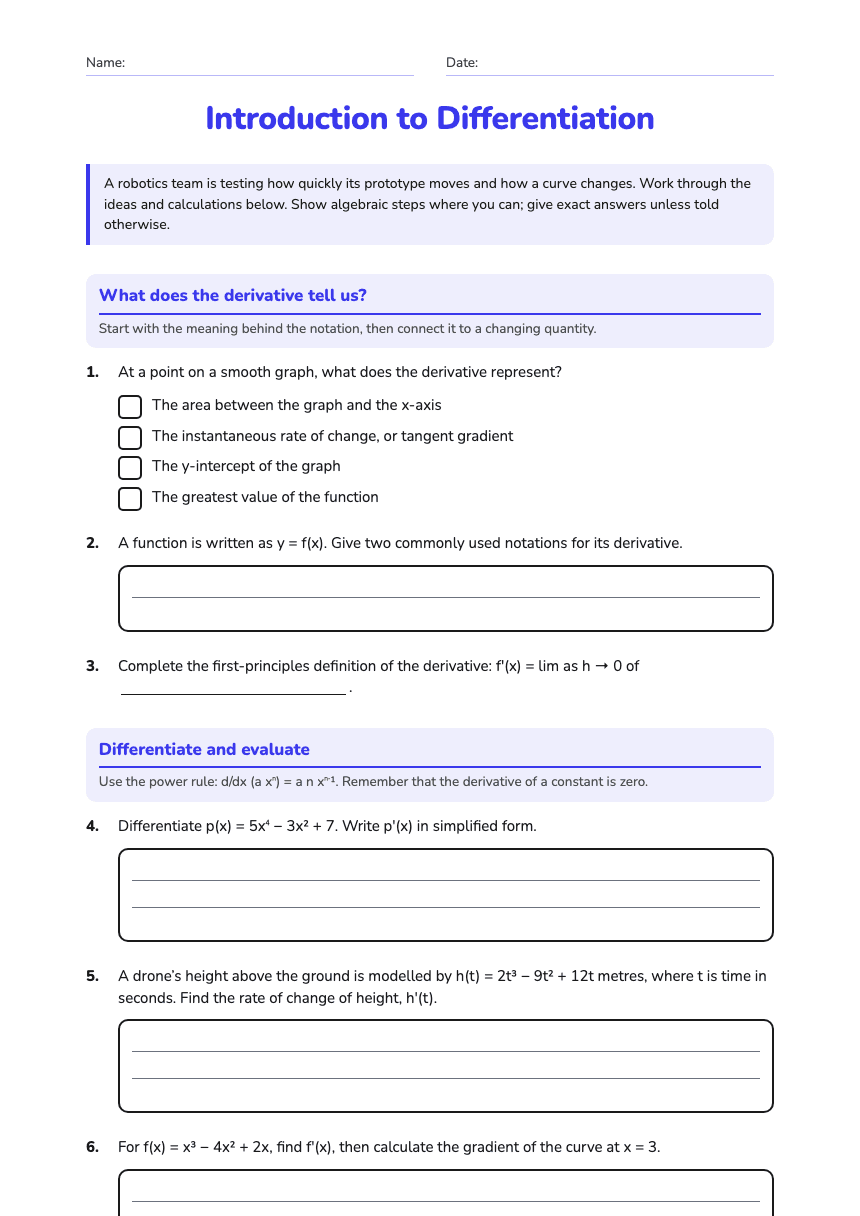
Introduction to Differentiation worksheet preview
Name:Date:

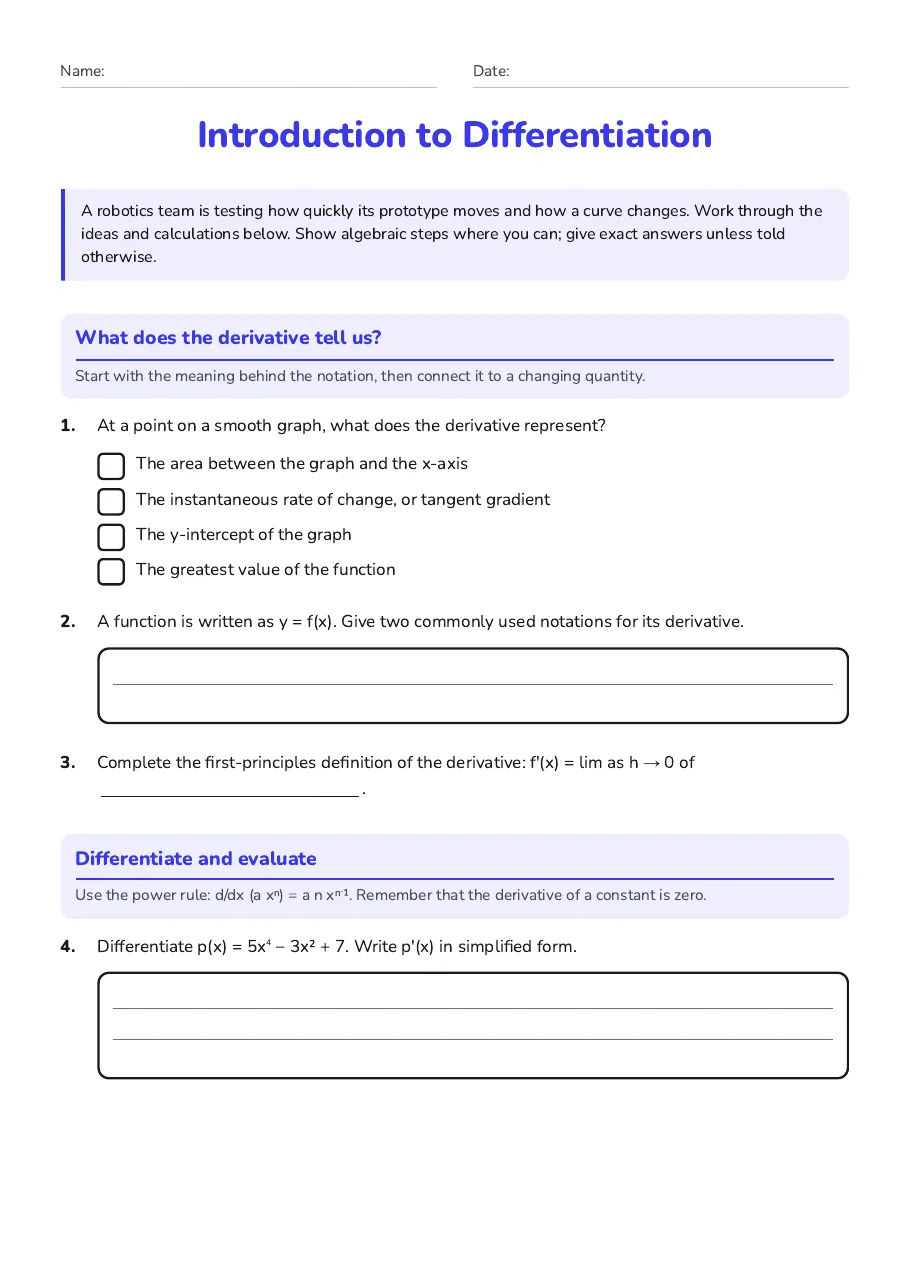
Introduction to Differentiation

A robotics team is testing how quickly its prototype moves and how a curve changes. Work through the ideas and calculations below. Show algebraic steps where you can; give exact answers unless told otherwise.

What does the derivative tell us?

Start with the meaning behind the notation, then connect it to a changing quantity.

1.At a point on a smooth graph, what does the derivative represent?
  • The area between the graph and the x-axis
  • The instantaneous rate of change, or tangent gradient
  • The y-intercept of the graph
  • The greatest value of the function
2.A function is written as y = f(x). Give two commonly used notations for its derivative.
3.Complete the first-principles definition of the derivative: f′(x) = lim as h → 0 of .

Differentiate and evaluate

Use the power rule: d/dx (a xⁿ) = a n xⁿ⁻¹. Remember that the derivative of a constant is zero.

4.Differentiate p(x) = 5x⁴ − 3x² + 7. Write p′(x) in simplified form.
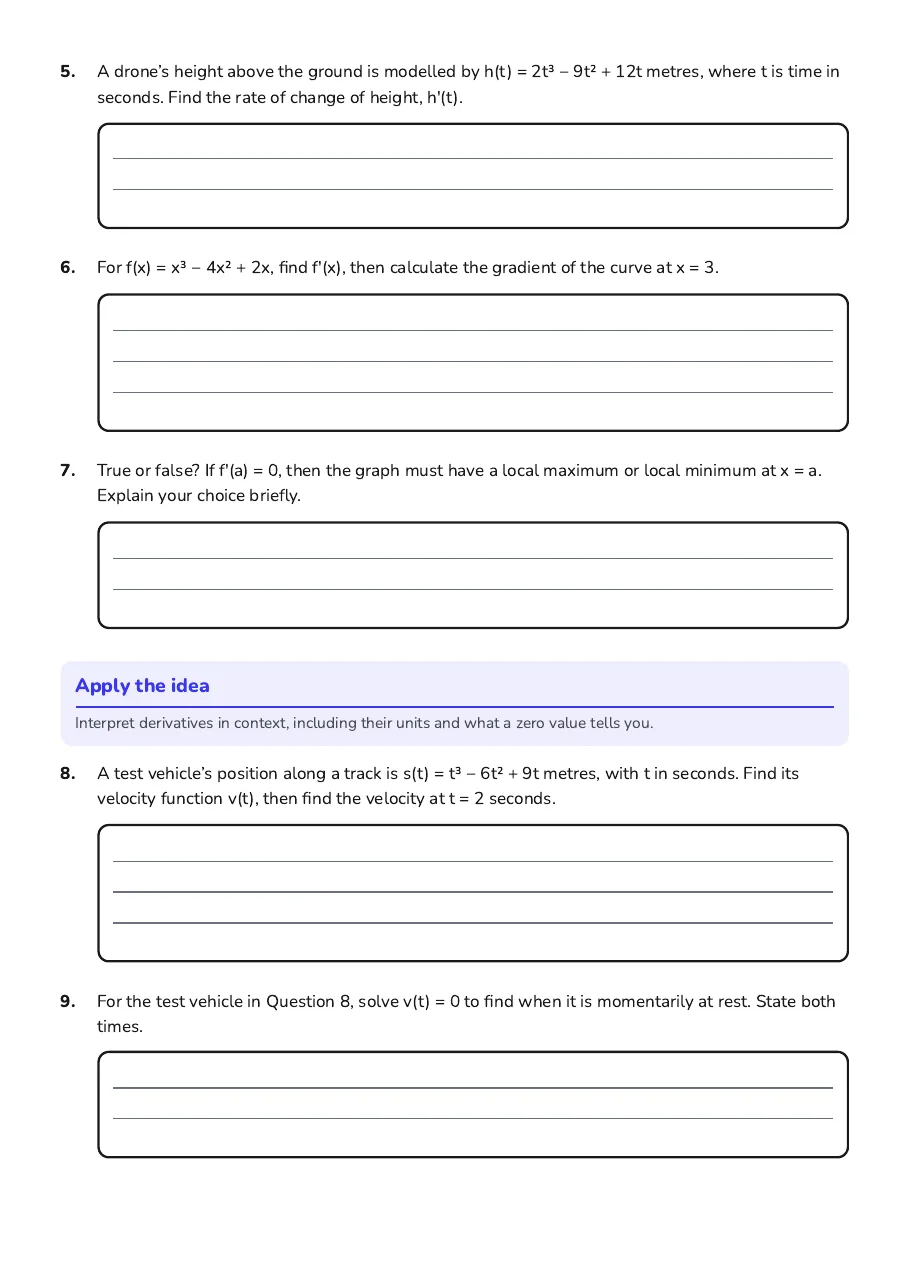
5.A drone’s height above the ground is modelled by h(t) = 2t³ − 9t² + 12t metres, where t is time in seconds. Find the rate of change of height, h′(t).
6.For f(x) = x³ − 4x² + 2x, find f′(x), then calculate the gradient of the curve at x = 3.
7.True or false? If f′(a) = 0, then the graph must have a local maximum or local minimum at x = a. Explain your choice briefly.

Apply the idea

Interpret derivatives in context, including their units and what a zero value tells you.

8.A test vehicle’s position along a track is s(t) = t³ − 6t² + 9t metres, with t in seconds. Find its velocity function v(t), then find the velocity at t = 2 seconds.
9.For the test vehicle in Question 8, solve v(t) = 0 to find when it is momentarily at rest. State both times.
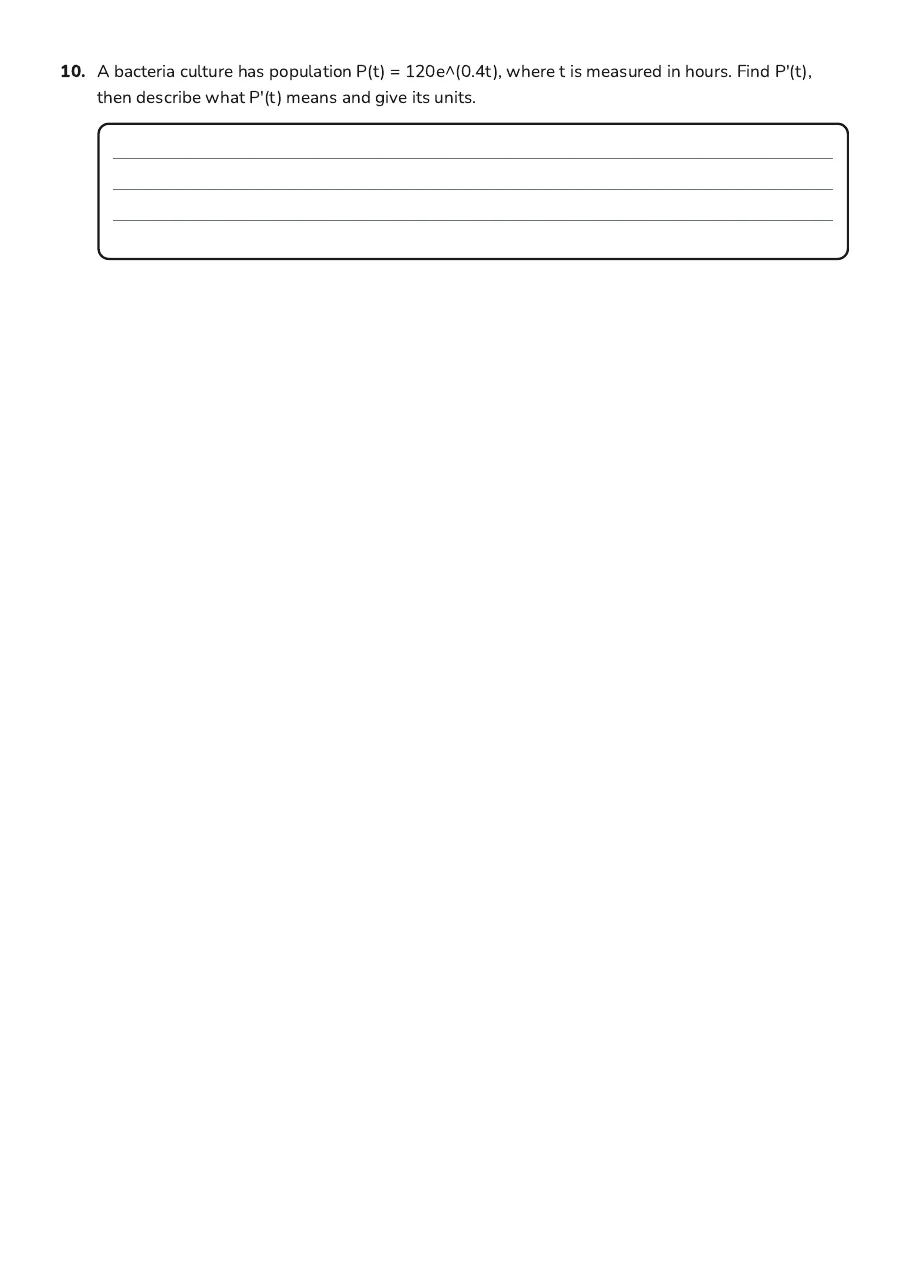
10.A bacteria culture has population P(t) = 120e^(0.4t), where t is measured in hours. Find P′(t), then describe what P′(t) means and give its units.

3 printable pages

  • Introduction to Differentiation, page 1 of 3: What does the derivative tell us?, Differentiate and evaluate

    Page 1

  • Introduction to Differentiation, page 2 of 3: Apply the idea

    Page 2

  • Introduction to Differentiation, page 3 of 3: 10. A bacteria culture has population P(t) = 120e^(0.4t), where t is measured in hours.…

    Page 3

About This Worksheet

Free in Kuraplan

Sign up free, grab the PDF, and customize it for your class.

Print-Ready

Formatted for standard paper. Clean layout, easy to read.

AI-Generated

Created with Kuraplan's AI, designed for real classroom use.

For Teachers & Parents

Use in classrooms, for homework, tutoring, or homeschool.

Need a custom version of this worksheet?

Kuraplan's AI generates custom worksheets in seconds — differentiated for every learner, aligned to your curriculum.

Generate Custom Worksheets — Free
No credit card Curriculum-aligned Under 60 seconds