ScienceFreePrintable

Material Properties Investigation

A free science worksheet ready for your classroom. Open in Kuraplan to grab the print-ready PDF, customize it for your students, or generate a fresh version in seconds.
Material Properties Investigation worksheet preview
Name:Date:

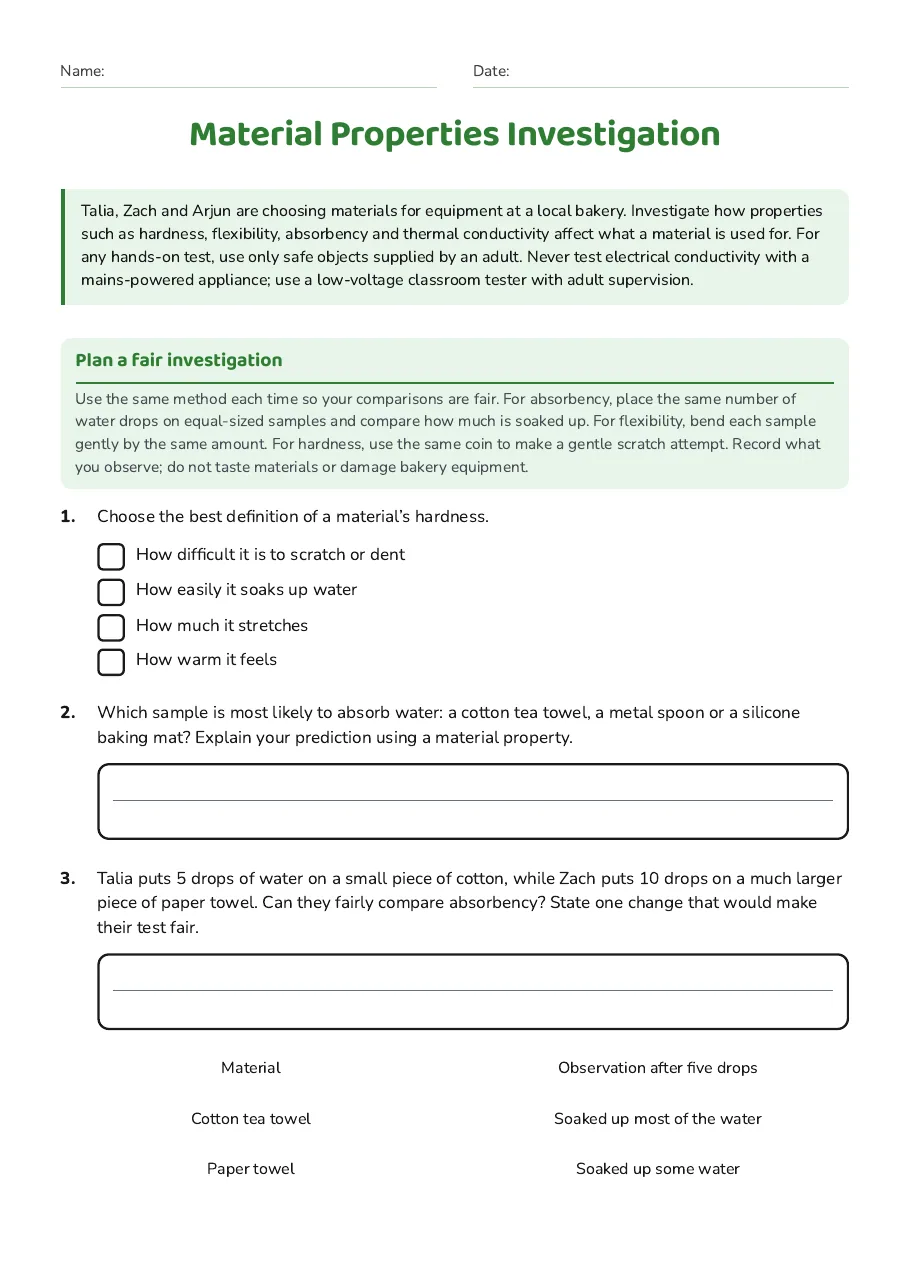
Material Properties Investigation

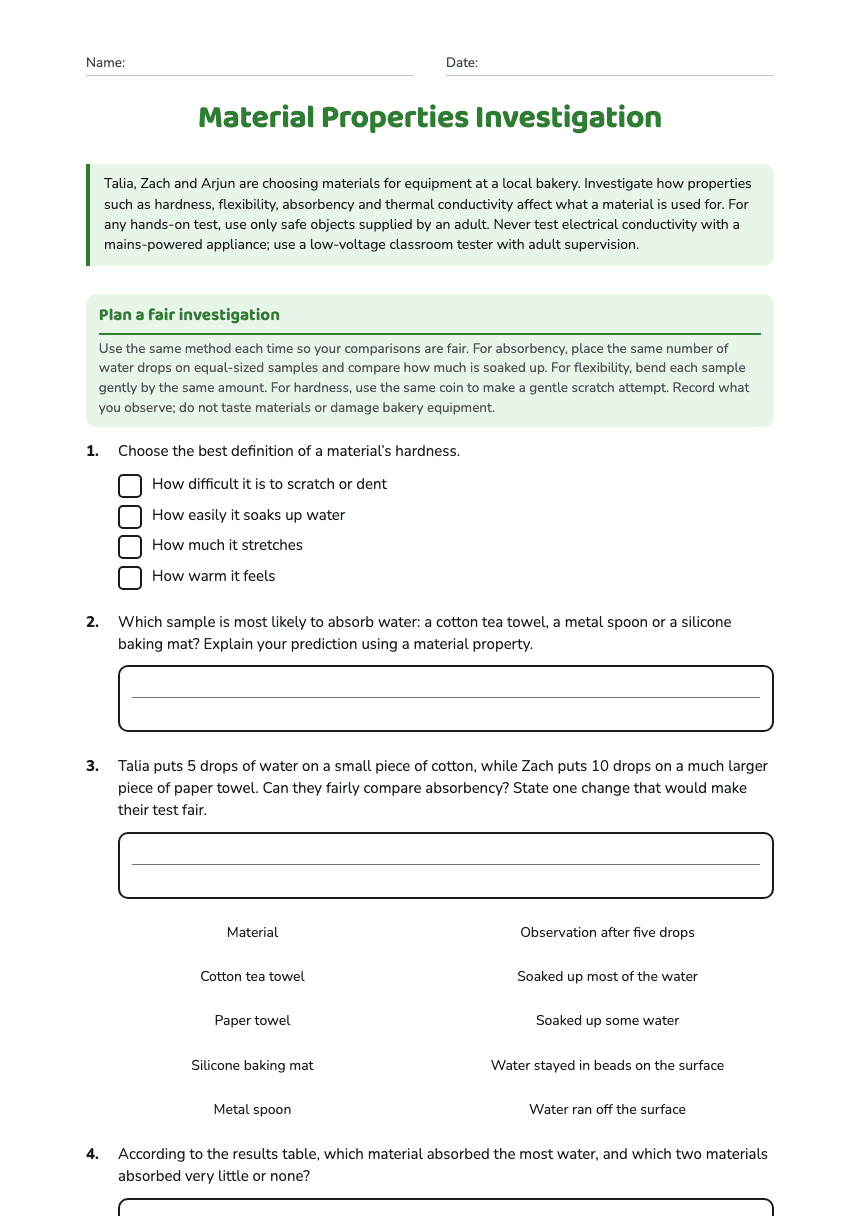
Talia, Zach and Arjun are choosing materials for equipment at a local bakery. Investigate how properties such as hardness, flexibility, absorbency and thermal conductivity affect what a material is used for. For any hands-on test, use only safe objects supplied by an adult. Never test electrical conductivity with a mains-powered appliance; use a low-voltage classroom tester with adult supervision.

Plan a fair investigation

Use the same method each time so your comparisons are fair. For absorbency, place the same number of water drops on equal-sized samples and compare how much is soaked up. For flexibility, bend each sample gently by the same amount. For hardness, use the same coin to make a gentle scratch attempt. Record what you observe; do not taste materials or damage bakery equipment.

1.Choose the best definition of a material’s hardness.
  • How difficult it is to scratch or dent
  • How easily it soaks up water
  • How much it stretches
  • How warm it feels
2.Which sample is most likely to absorb water: a cotton tea towel, a metal spoon or a silicone baking mat? Explain your prediction using a material property.
3.Talia puts 5 drops of water on a small piece of cotton, while Zach puts 10 drops on a much larger piece of paper towel. Can they fairly compare absorbency? State one change that would make their test fair.

Material

Observation after five drops

Cotton tea towel

Soaked up most of the water

Paper towel

Soaked up some water

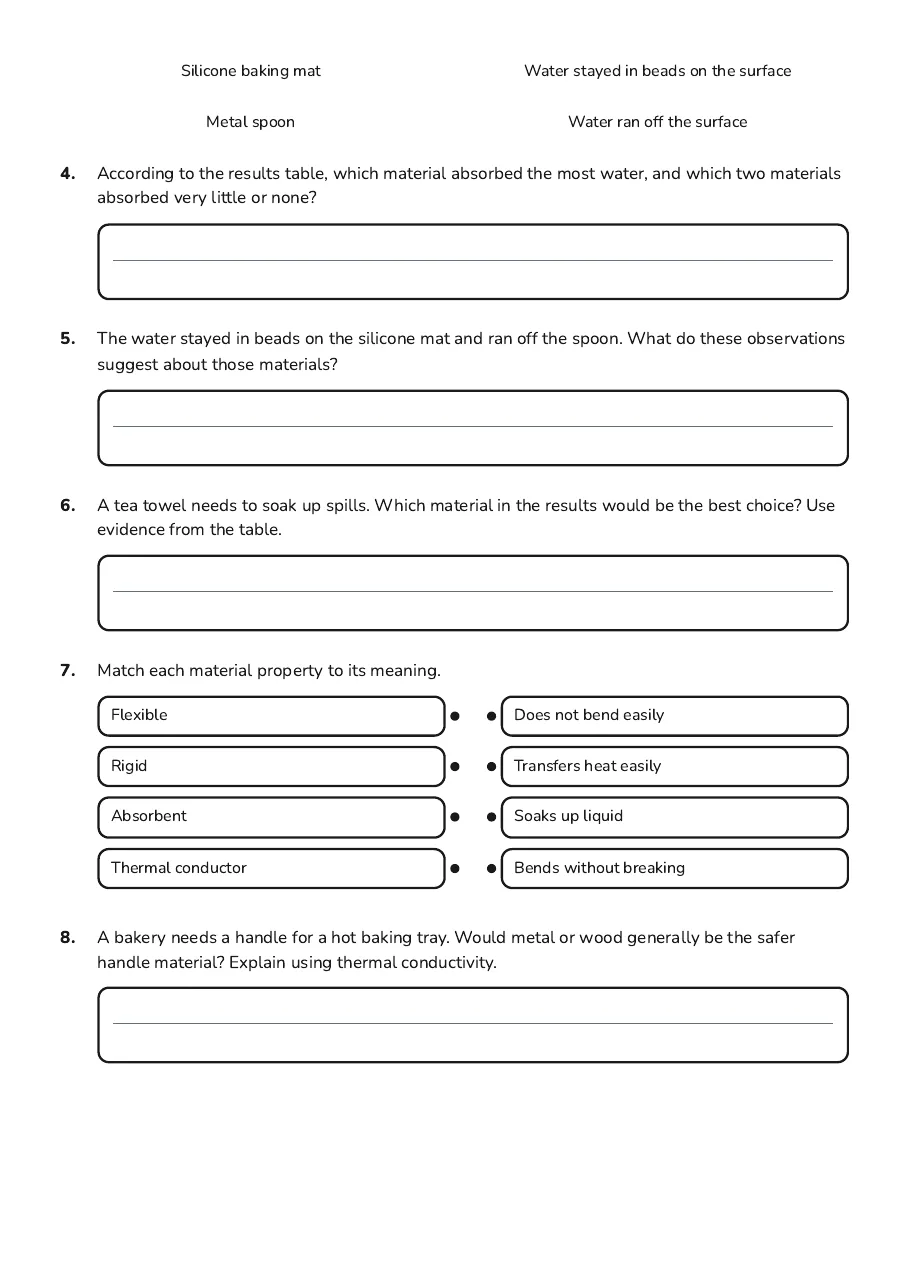
Silicone baking mat

Water stayed in beads on the surface

Metal spoon

Water ran off the surface

4.According to the results table, which material absorbed the most water, and which two materials absorbed very little or none?
5.The water stayed in beads on the silicone mat and ran off the spoon. What do these observations suggest about those materials?
6.A tea towel needs to soak up spills. Which material in the results would be the best choice? Use evidence from the table.
7.Match each material property to its meaning.
  • Flexible
  • Rigid
  • Absorbent
  • Thermal conductor
  • Does not bend easily
  • Transfers heat easily
  • Soaks up liquid
  • Bends without breaking
8.A bakery needs a handle for a hot baking tray. Would metal or wood generally be the safer handle material? Explain using thermal conductivity.
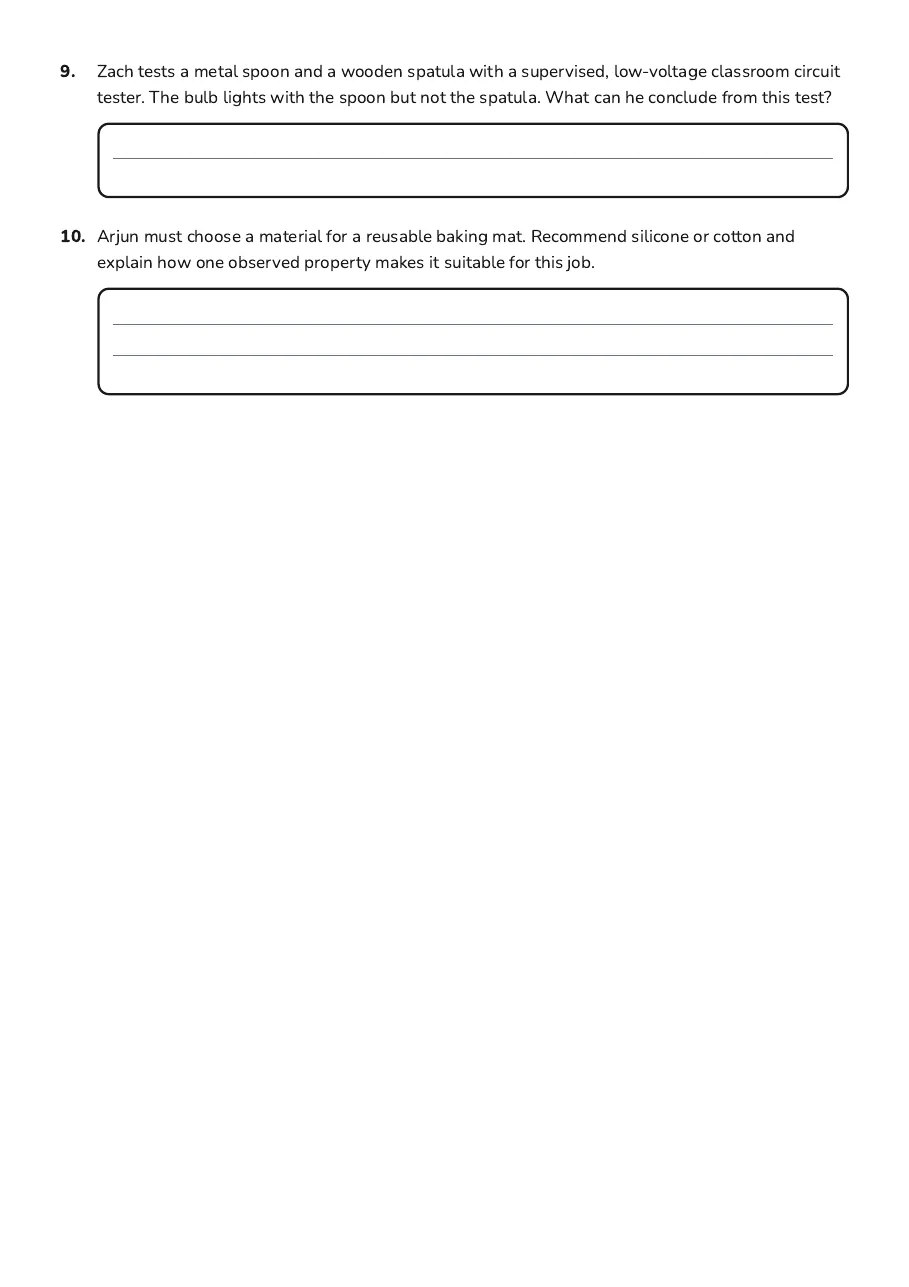
9.Zach tests a metal spoon and a wooden spatula with a supervised, low-voltage classroom circuit tester. The bulb lights with the spoon but not the spatula. What can he conclude from this test?
10.Arjun must choose a material for a reusable baking mat. Recommend silicone or cotton and explain how one observed property makes it suitable for this job.

3 printable pages

  • Material Properties Investigation, page 1 of 3: Plan a fair investigation

    Page 1

  • Material Properties Investigation, page 2 of 3: Silicone baking mat Water stayed in beads on the surface

    Page 2

  • Material Properties Investigation, page 3 of 3: 9. Zach tests a metal spoon and a wooden spatula with a supervised, low-voltage classroom…

    Page 3

About This Worksheet

Free in Kuraplan

Sign up free, grab the PDF, and customize it for your class.

Print-Ready

Formatted for standard paper. Clean layout, easy to read.

AI-Generated

Created with Kuraplan's AI, designed for real classroom use.

For Teachers & Parents

Use in classrooms, for homework, tutoring, or homeschool.

Need a custom version of this worksheet?

Kuraplan's AI generates custom worksheets in seconds — differentiated for every learner, aligned to your curriculum.

Generate Custom Worksheets — Free
No credit card Curriculum-aligned Under 60 seconds