Moon Landing Language Analysis
A free english worksheet ready for your classroom. Open in Kuraplan to grab the print-ready PDF, customize it for your students, or generate a fresh version in seconds.
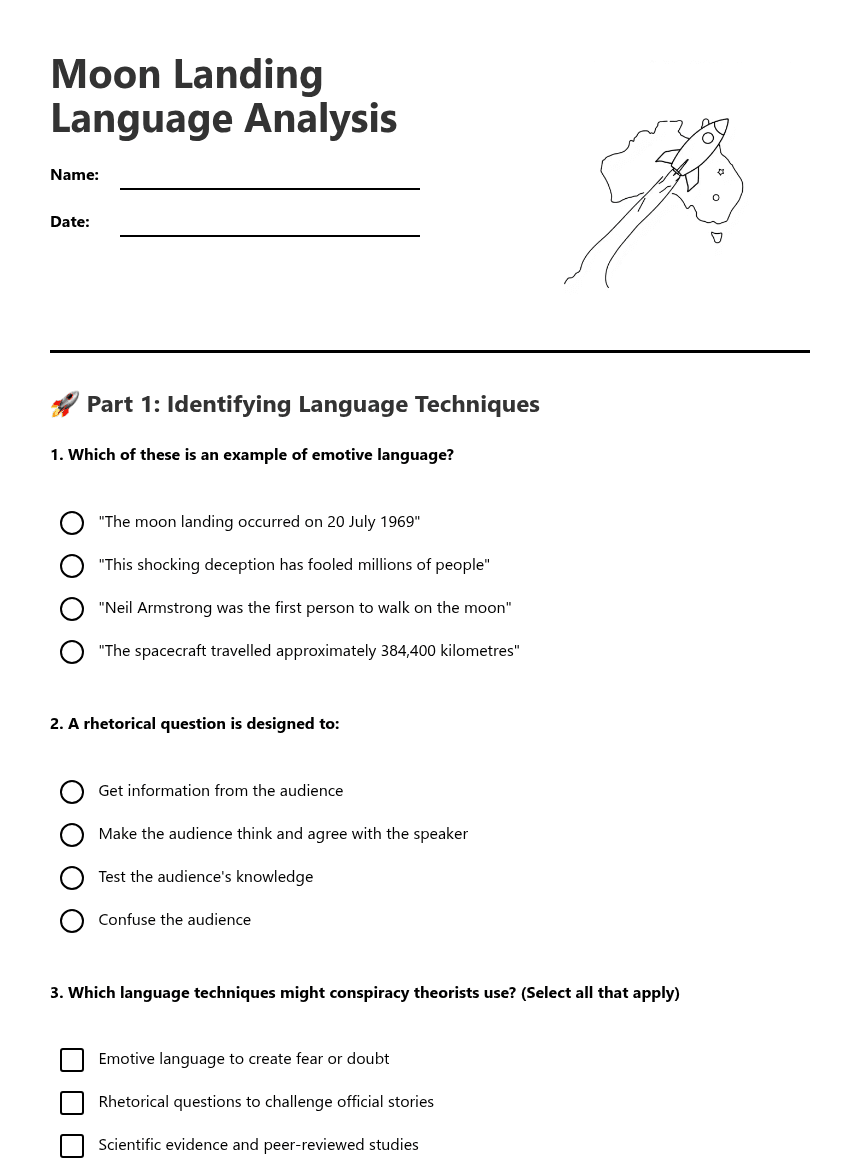
Moon Landing Language Analysis
🚀 Part 1: Identifying Language Techniques
Repetition in argumentative texts is used to _________________________________.
🔍 Part 2: Text Analysis
"How can anyone seriously believe that primitive 1960s technology could safely transport humans 384,400 kilometres through deadly space radiation? Wake up, people! The so-called 'moon landing' was nothing more than a Hollywood production designed to fool the world."
Identify two language techniques used in this extract:
"Extensive documentation, including 382 kilograms of lunar samples, thousands of photographs, and retroreflectors still used by scientists today, provides overwhelming evidence that the Apollo missions successfully landed on the moon. Multiple independent space agencies have confirmed these achievements through their own observations and missions."
How does the language in this scientific response differ from the conspiracy theory extract?
💭 Part 3: Critical Reflection
About This Worksheet
Free in Kuraplan
Sign up free, grab the PDF, and customize it for your class.
Print-Ready
Formatted for standard paper. Clean layout, easy to read.
AI-Generated
Created with Kuraplan's AI, designed for real classroom use.
For Teachers & Parents
Use in classrooms, for homework, tutoring, or homeschool.
Need a custom version of this worksheet?
Kuraplan's AI generates custom worksheets in seconds — differentiated for every learner, aligned to your curriculum.
Generate Custom Worksheets — Free