Social SciencesFreePrintable

New Technologies Driving Change

A free social sciences worksheet ready for your classroom. Open in Kuraplan to grab the print-ready PDF, customize it for your students, or generate a fresh version in seconds.
New Technologies Driving Change worksheet preview

New Technologies Driving Change

🇦🇺 Part 1: Background information

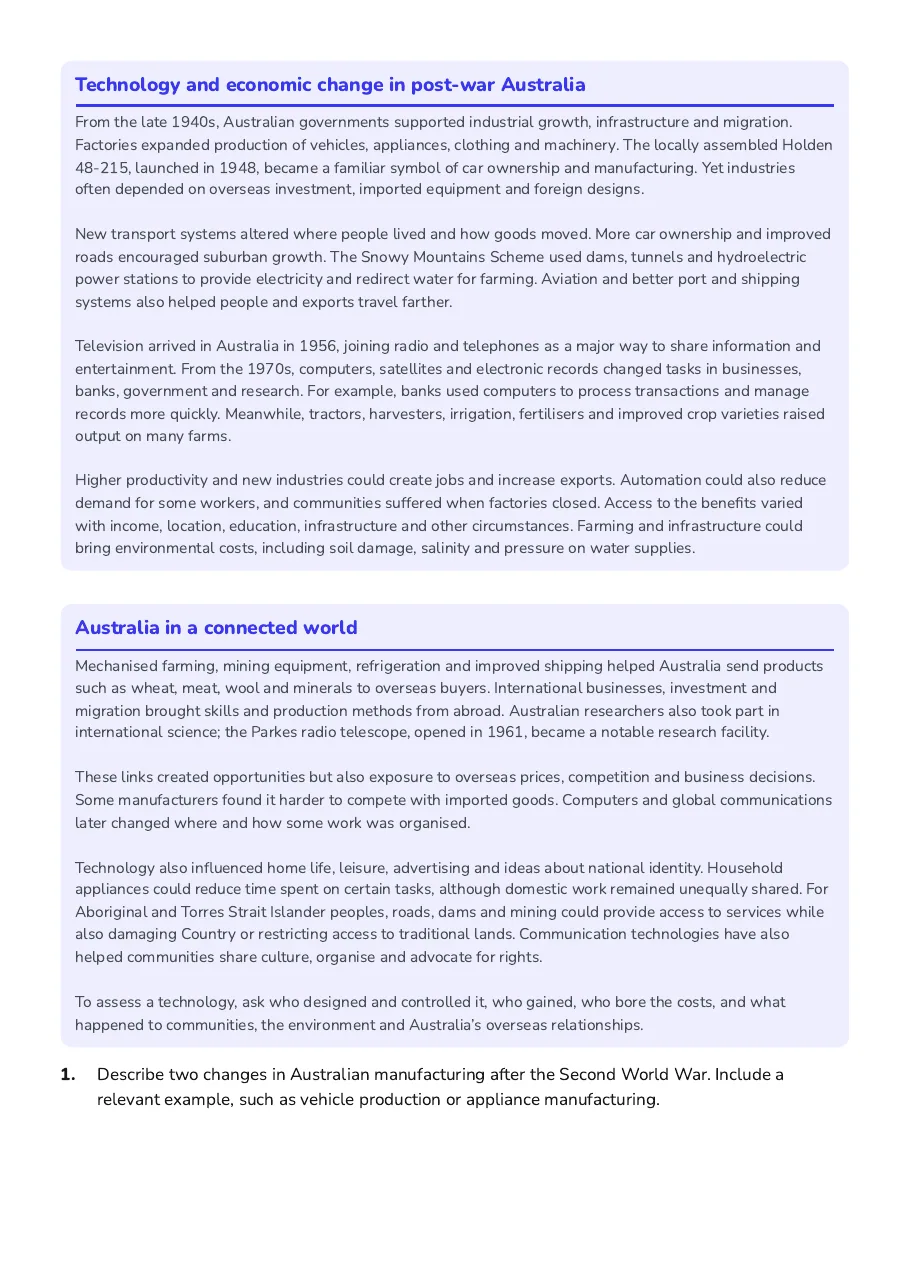
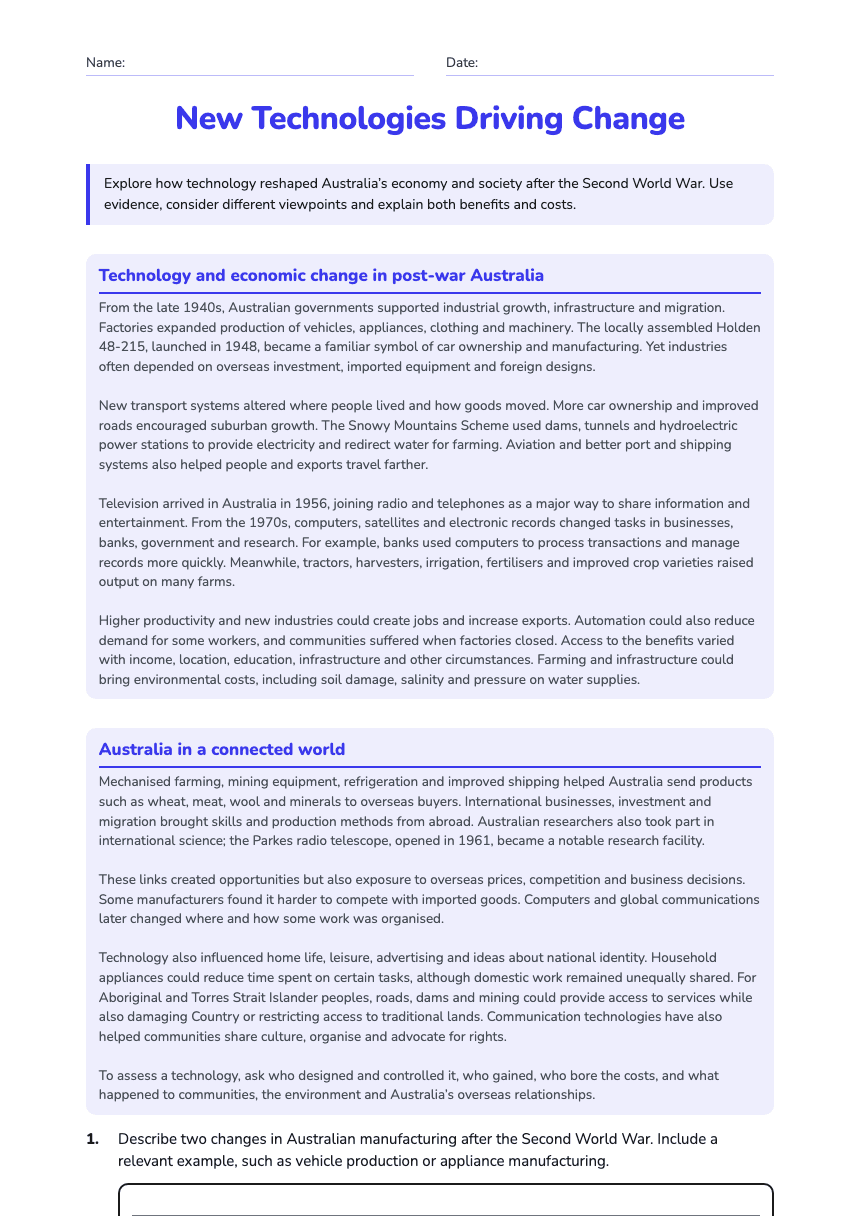
After the Second World War, Australia entered a period of rapid technological and economic change. Government policies encouraged migration, industrial development and infrastructure projects. New technologies reshaped how Australians worked, travelled, communicated and lived, while also connecting Australia more closely to global markets.

Manufacturing expanded during the post-war decades. Factories produced cars, electrical appliances, clothing, chemicals, machinery and building materials. International companies, including General Motors-Holden, established or expanded Australian operations. The Holden 48-215, released in 1948, became a symbol of local manufacturing and mass car ownership. However, many Australian industries relied on imported designs, machinery and investment, which limited complete independence from overseas companies.

Transportation changed significantly. Cars became more affordable, roads were improved and suburban development spread beyond existing public transport routes. The Snowy Mountains Scheme used major engineering projects, tunnels and hydroelectric technology to provide electricity and water for agriculture. Commercial aviation expanded through airlines such as Qantas, while container shipping and improved port facilities made the movement of Australian exports more efficient.

Communications technologies transformed Australian society. Television began broadcasting nationally in 1956, bringing news, sport and entertainment into homes. Radio remained important, while telephones became more widespread. From the 1970s onwards, computers, satellites and electronic data systems changed banking, government administration, education, business and scientific research. Later digital networks allowed Australians to communicate and trade almost instantly across long distances.

Agriculture also became more mechanised and scientifically managed. Tractors, combine harvesters, irrigation systems, improved fertilisers, pesticides and new crop varieties increased productivity in many regions. In northern Australia, technologies such as large-scale irrigation and improved cattle management supported agricultural expansion. These changes could increase exports and reduce some forms of manual labour, but they also contributed to soil degradation, salinity, water use conflicts and environmental damage.

Technological change contributed to economic growth, higher productivity and new employment opportunities. At the same time, automation reduced demand for some traditional jobs, and manufacturing regions could suffer when factories closed or moved overseas. The benefits of new technologies were uneven: income, location, gender, disability, access to education and connection to infrastructure all influenced who could use and benefit from them.

🌏 Part 2: Australia in a changing world

Post-war technology strengthened Australia's position as an exporter of agricultural products and minerals. Mechanised farming, improved transport and new mining equipment helped Australia supply wheat, wool, meat, coal, iron ore and other resources to overseas markets. Advances in refrigeration, shipping and port technology allowed perishable products to be transported over longer distances.

Australia also became more connected to global technological developments. Overseas investment, migration and multinational companies brought new skills, machinery and production methods. Australian scientists and engineers contributed to fields such as medical research, telecommunications, Antarctic science and space tracking. The Parkes radio telescope, opened in 1961, became an important scientific facility and helped demonstrate Australia's role in international research.

Global connections created opportunities but also increased dependence. Australian industries were affected by overseas prices, foreign investment decisions, international competition and changing trade agreements. From the 1970s and 1980s, some Australian manufacturers struggled to compete with cheaper imported goods. Later, computerisation and global communication changed the location and organisation of work.

Technology influenced Australian society by supporting urbanisation, suburban lifestyles and changing expectations about convenience and leisure. Household appliances reduced the time required for some domestic tasks, although the benefits were not shared equally and domestic work remained unevenly distributed. Television helped create shared national experiences, but it also influenced political debate, advertising, consumer culture and ideas about Australian identity.

Technological change also affected Aboriginal and Torres Strait Islander peoples in complex ways. Roads, mining, pastoral expansion, dams and communication systems sometimes improved access to services and helped communities organise and communicate. However, these developments could damage Country, restrict access to traditional lands, disrupt cultural practices and increase government or commercial control. Technologies have also supported Indigenous activism, cultural preservation, broadcasting and campaigns for land rights and recognition.

Technology does not produce the same result for everyone. When evaluating a technological development, consider who designed it, who controlled it, who benefited economically, who carried the risks and how the environment and Australia's international relationships were affected.

✏️ Part 3: Short answer and critical thinking questions

1. Identify two ways manufacturing changed in Australia after WWII. Include one specific industry, company or product.
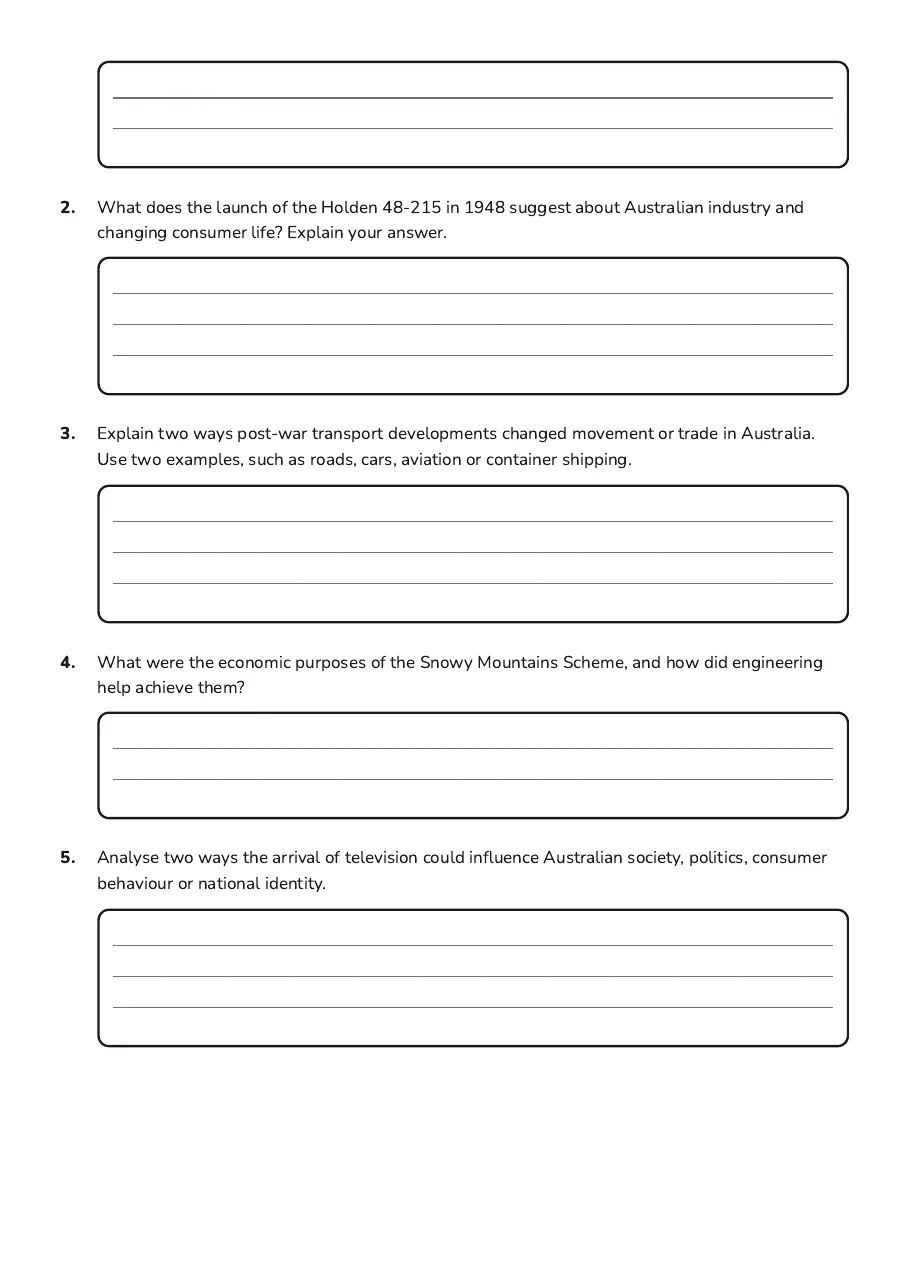
2. Why was the Holden 48-215 significant in post-war Australia? Explain what it suggests about manufacturing, employment or consumer culture.
3. Explain two ways that cars, improved roads, commercial aviation or container shipping changed movement and trade in Australia.
4. What was the purpose of the Snowy Mountains Scheme, and how did its technology support Australia's economy?
5. Television began broadcasting in Australia in 1956. Analyse two ways television changed Australian society, politics, consumer behaviour or national identity.
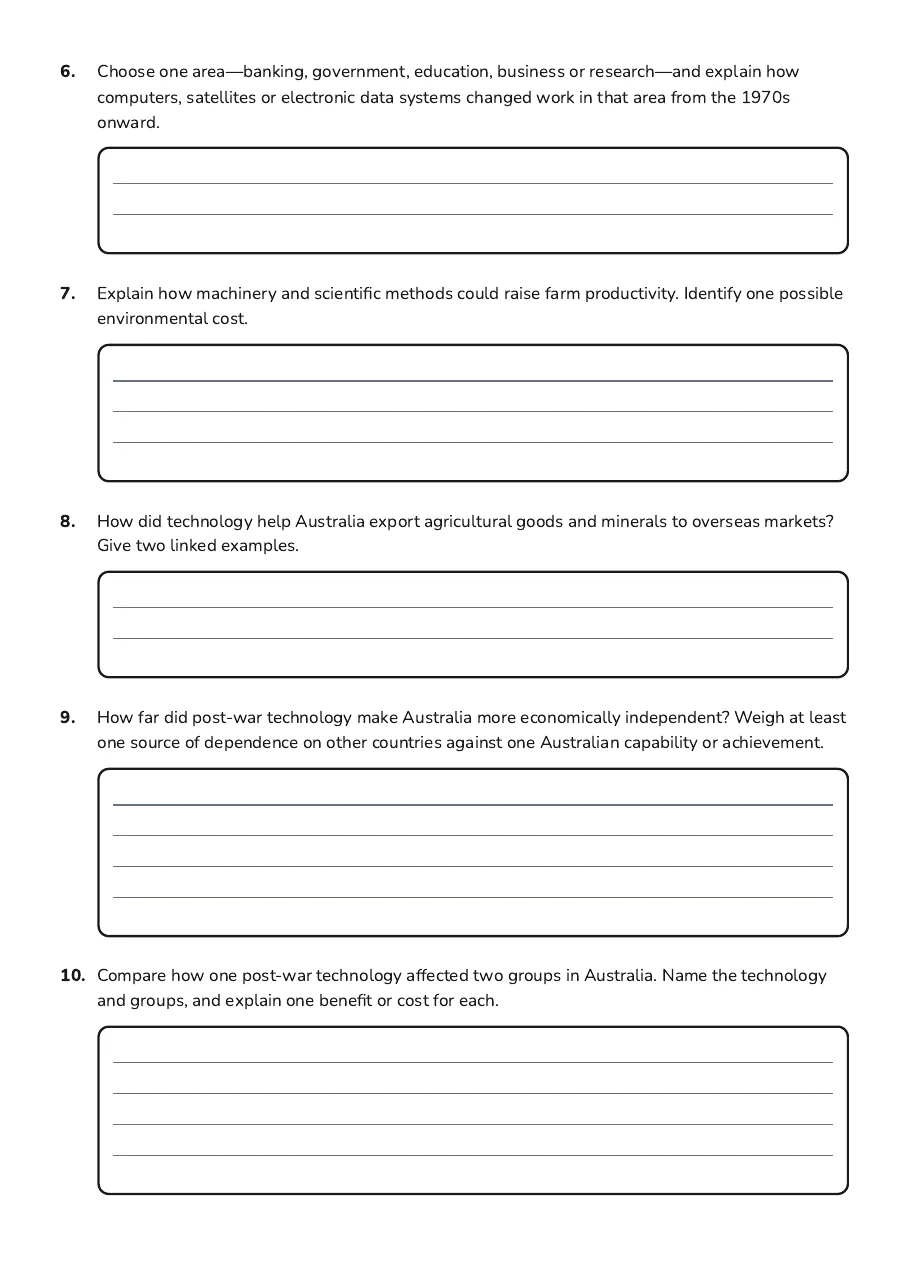
6. How did computers, satellites or electronic data systems change one area of Australian life or work from the 1970s onwards?
7. Explain how mechanisation and scientific technology increased agricultural productivity. Identify one possible environmental cost.
8. How did technology help Australia become a more important exporter of agricultural products and minerals?
9. To what extent did post-war technology make Australia more independent? In your response, consider overseas investment, imported designs, international trade and Australian scientific achievements.
10. Compare the effects of one technology on two different groups in Australian society. You could consider workers and employers, urban and rural communities, or Indigenous and non-Indigenous Australians.
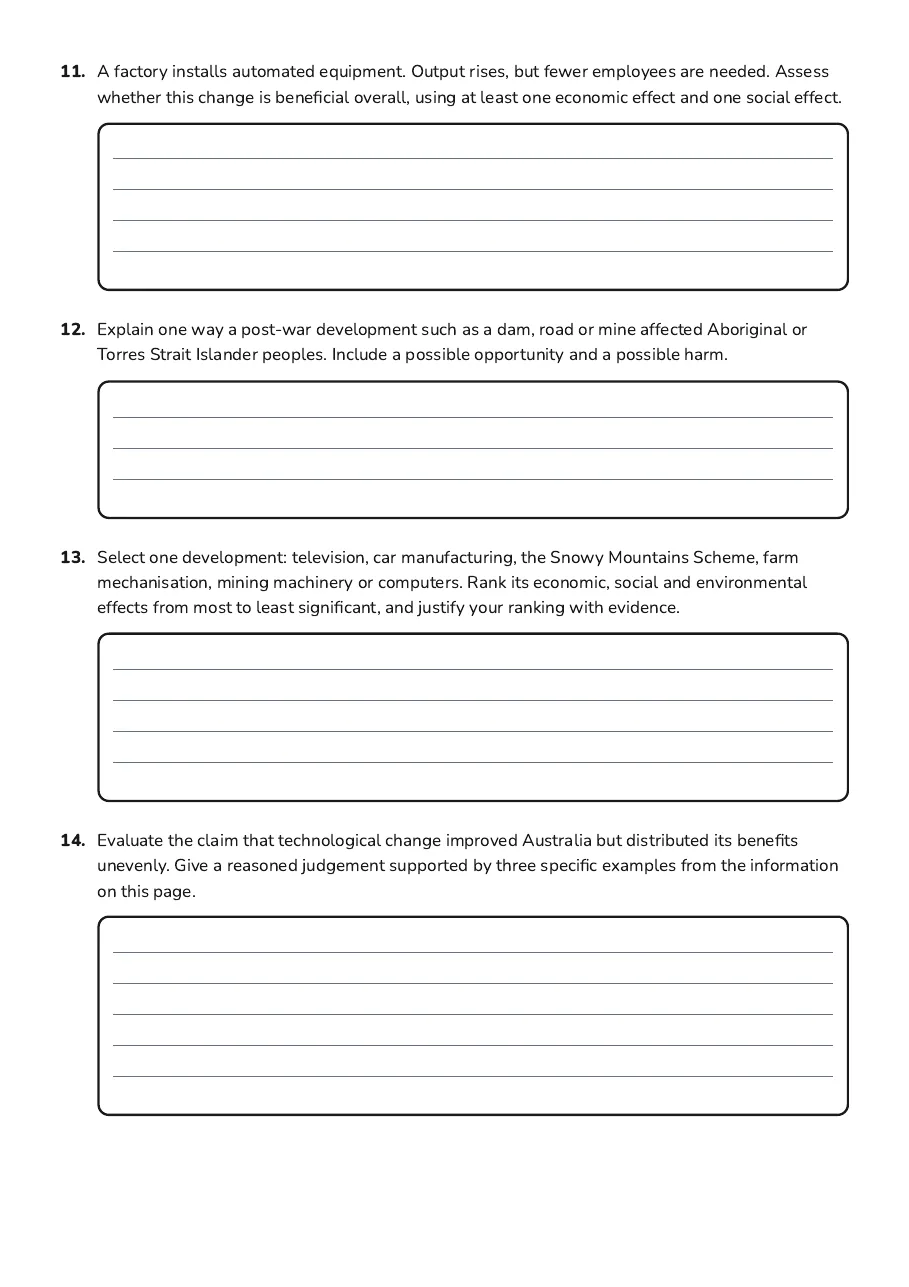
11. A factory introduces automated machinery that increases production but reduces the number of workers needed. Evaluate whether this is an overall benefit to Australia. Use economic and social evidence in your response.
12. Explain one way a post-war technology affected Aboriginal and Torres Strait Islander peoples. Include both a possible opportunity and a possible form of harm or exclusion.
13. Choose one development: television, the Holden car, the Snowy Mountains Scheme, mechanised agriculture, mining machinery or computers. Rank its economic, social and environmental impacts from most significant to least significant. Justify your ranking.
14. “Technological progress improved Australia, but it did not benefit everyone equally.” Do you agree? Write a reasoned judgement using at least three specific Australian examples.
15. Design a short classroom activity that would help students investigate whether one post-war technology was more beneficial or harmful overall. Identify the evidence students would need to examine.

About This Worksheet

Free in Kuraplan

Sign up free, grab the PDF, and customize it for your class.

Print-Ready

Formatted for standard paper. Clean layout, easy to read.

AI-Generated

Created with Kuraplan's AI, designed for real classroom use.

For Teachers & Parents

Use in classrooms, for homework, tutoring, or homeschool.

Need a custom version of this worksheet?

Kuraplan's AI generates custom worksheets in seconds — differentiated for every learner, aligned to your curriculum.

Generate Custom Worksheets — Free
No credit card Curriculum-aligned Under 60 seconds