One Character, Two Readings
A free english worksheet ready for your classroom. Open in Kuraplan to grab the print-ready PDF, customize it for your students, or generate a fresh version in seconds.
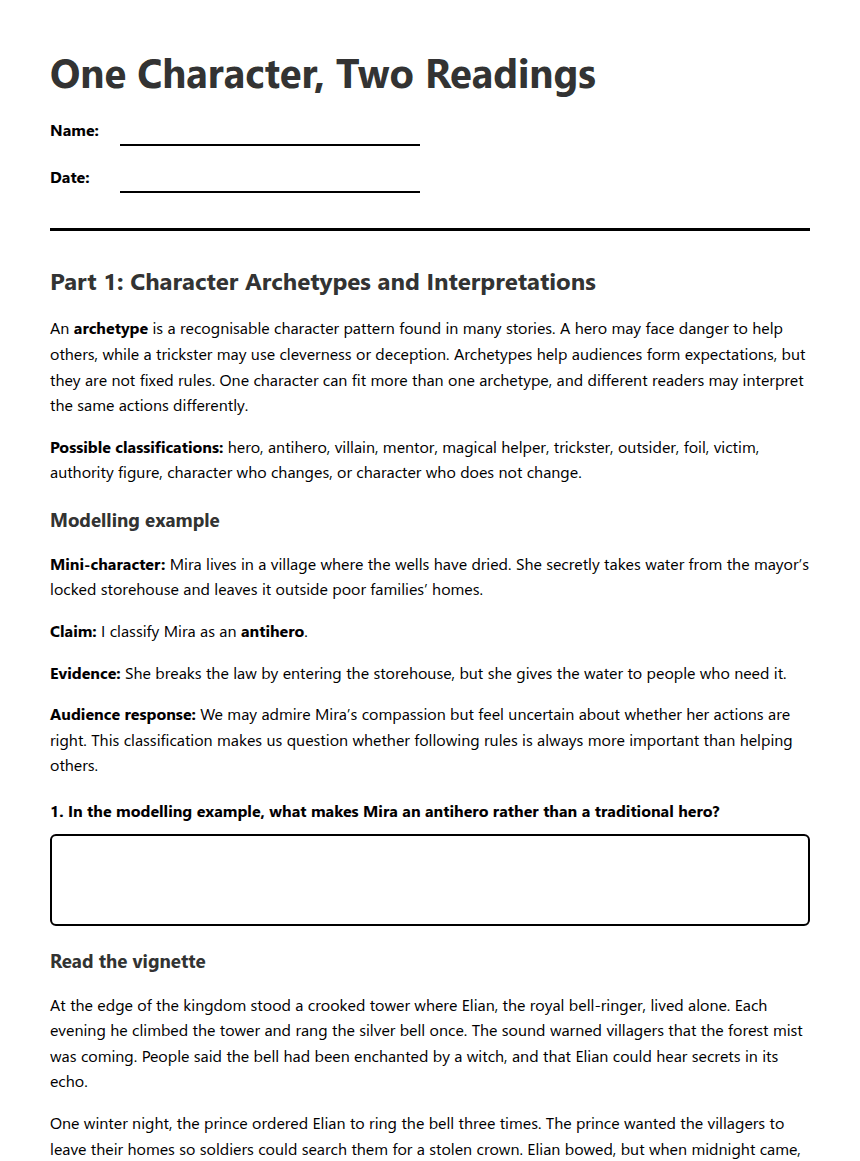
One Character, Two Readings
Part 1: Character Archetypes and Interpretations
An archetype is a recognisable character pattern found in many stories. A hero may face danger to help others, while a trickster may use cleverness or deception. Archetypes help audiences form expectations, but they are not fixed rules. One character can fit more than one archetype, and different readers may interpret the same actions differently.
Possible classifications: hero, antihero, villain, mentor, magical helper, trickster, outsider, foil, victim, authority figure, character who changes, or character who does not change.
Modelling example
Mini-character: Mira lives in a village where the wells have dried. She secretly takes water from the mayor’s locked storehouse and leaves it outside poor families’ homes.
Claim: I classify Mira as an antihero.
Evidence: She breaks the law by entering the storehouse, but she gives the water to people who need it.
Audience response: We may admire Mira’s compassion but feel uncertain about whether her actions are right. This classification makes us question whether following rules is always more important than helping others.
Read the vignette
At the edge of the kingdom stood a crooked tower where Elian, the royal bell-ringer, lived alone. Each evening he climbed the tower and rang the silver bell once. The sound warned villagers that the forest mist was coming. People said the bell had been enchanted by a witch, and that Elian could hear secrets in its echo.
One winter night, the prince ordered Elian to ring the bell three times. The prince wanted the villagers to leave their homes so soldiers could search them for a stolen crown. Elian bowed, but when midnight came, he struck the bell only once. Then he opened the tower door and allowed a young stranger, chased by soldiers, to hide inside.
By morning, the stranger had disappeared. In the tower, the prince found a trail of silver dust leading towards the forest. Elian was arrested, yet he refused to explain what had happened. Some villagers called him a traitor. Others noticed that the mist never crossed the village boundary while Elian remained in the tower.
Years later, the prince’s crown was found beneath the forest roots. Beside it lay a silver bell, cracked but still warm.
Part 2: Two Readings of Elian
Use precise evidence from the vignette. Evidence may be an action, a description, a piece of dialogue, an object or an event.
I classify Elian as a ______________________________ because ________________________________________________.
Evidence: ________________________________________________________________________________________________
I classify Elian as a ______________________________ because ________________________________________________.
Evidence: ________________________________________________________________________________________________
Comparison organiser
Classification: ____________________
Key evidence: ____________________
Audience response: ________________
Classification: ____________________
Key evidence: ____________________
Audience response: ________________
Feelings: _________________________
Expectations: _____________________
Judgement: ________________________
At first, Elian can be interpreted as a __________________ because ________________________________. This reading makes the audience ________________________________. However, he can also be interpreted as a __________________ because ________________________________. This second reading changes the audience’s response by ________________________________. The ambiguity is important because ________________________________________________.
Part 3: Extend, Check and Reflect
If the detail __________________________________ were changed to __________________________________, Elian would seem more like a ______________________________ because ________________________________________________.
This would make the audience ________________________________________________.
Self-check
Teacher assessment criteria
Working towards: identifies a possible archetype and gives a general or partly relevant detail.
Developing: identifies two classifications and supports each with relevant evidence, with some explanation of audience response.
Strong: compares two thoughtful interpretations, explains how language and narrative details shape meaning, and clearly connects each reading to audience feelings, expectations or judgement.
Curriculum links: EN4-URA-01: analyse how meaning is created through and responded to language forms, features and structures. EN4-URB-01: explain how texts represent ideas, experiences and values.
Answer guide: plausible interpretations
Responses may vary. Elian could be classified as a hero because he protects villagers and helps the stranger; a magical helper because the bell and mist suggest hidden powers; an outsider because he lives alone and is mistrusted; or a trickster because he appears to obey the prince while secretly acting against him. He may also be seen as an antihero because he breaks rules for a possibly just cause.
A hero or magical-helper reading may make the audience trust Elian, admire his courage and expect him to defeat the prince’s plan. An outsider or trickster reading may create uncertainty, curiosity and suspicion. The ending supports more than one interpretation because the silver dust, the stranger and the warm cracked bell are mysterious. Strong answers explain how these details shape the audience’s response rather than simply naming an archetype.
About This Worksheet
Free in Kuraplan
Sign up free, grab the PDF, and customize it for your class.
Print-Ready
Formatted for standard paper. Clean layout, easy to read.
AI-Generated
Created with Kuraplan's AI, designed for real classroom use.
For Teachers & Parents
Use in classrooms, for homework, tutoring, or homeschool.
Need a custom version of this worksheet?
Kuraplan's AI generates custom worksheets in seconds — differentiated for every learner, aligned to your curriculum.
Generate Custom Worksheets — Free