Operation Barbarossa Impact Analysis
A free social sciences worksheet ready for your classroom. Open in Kuraplan to grab the print-ready PDF, customize it for your students, or generate a fresh version in seconds.

Operation Barbarossa Impact Analysis
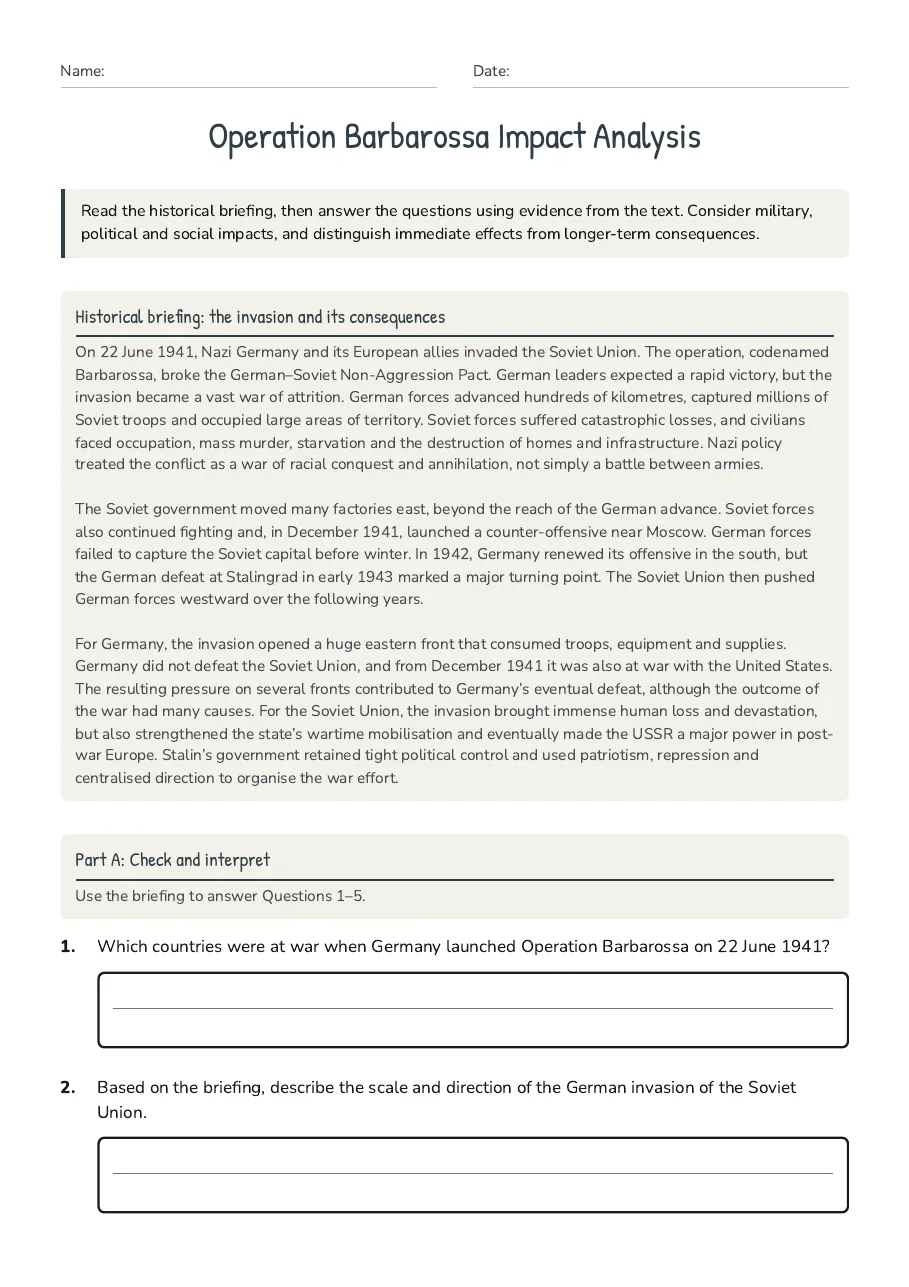
Historical briefing: the invasion and its consequences
On 22 June 1941, Nazi Germany and its European allies invaded the Soviet Union. The operation, codenamed Barbarossa, broke the German–Soviet Non-Aggression Pact. German leaders expected a rapid victory, but the invasion became a vast war of attrition. German forces advanced hundreds of kilometres, captured millions of Soviet troops and occupied large areas of territory. Soviet forces suffered catastrophic losses, and civilians faced occupation, mass murder, starvation and the destruction of homes and infrastructure. Nazi policy treated the conflict as a war of racial conquest and annihilation, not simply a battle between armies. The Soviet government moved many factories east, beyond the reach of the German advance. Soviet forces also continued fighting and, in December 1941, launched a counter-offensive near Moscow. German forces failed to capture the Soviet capital before winter. In 1942, Germany renewed its offensive in the south, but the German defeat at Stalingrad in early 1943 marked a major turning point. The Soviet Union then pushed German forces westward over the following years. For Germany, the invasion opened a huge eastern front that consumed troops, equipment and supplies. Germany did not defeat the Soviet Union, and from December 1941 it was also at war with the United States. The resulting pressure on several fronts contributed to Germany’s eventual defeat, although the outcome of the war had many causes. For the Soviet Union, the invasion brought immense human loss and devastation, but also strengthened the state’s wartime mobilisation and eventually made the USSR a major power in post-war Europe. Stalin’s government retained tight political control and used patriotism, repression and centralised direction to organise the war effort.
Part A: Check and interpret
Use the briefing to answer Questions 1–5.
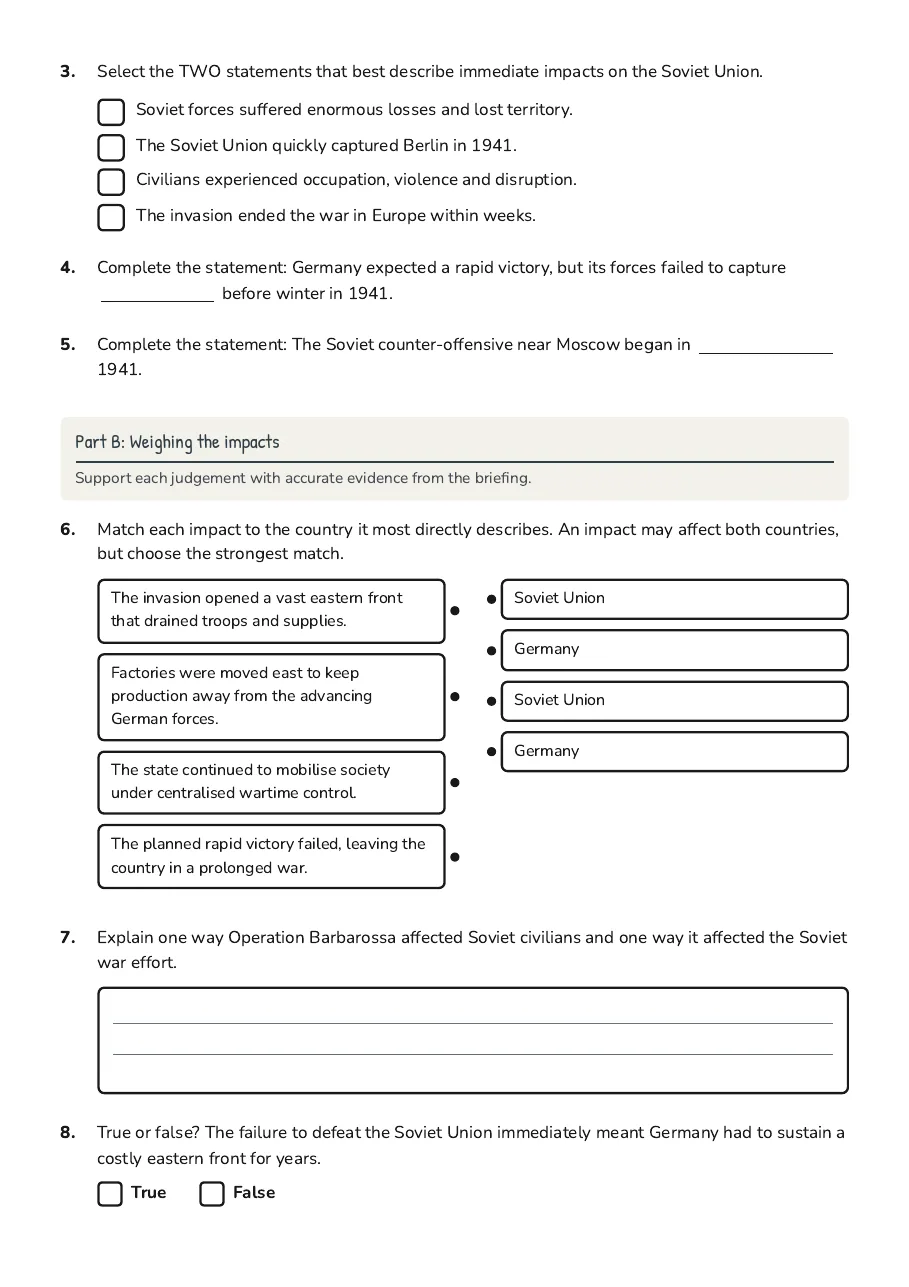
- Soviet forces suffered enormous losses and lost territory.
- The Soviet Union quickly captured Berlin in 1941.
- Civilians experienced occupation, violence and disruption.
- The invasion ended the war in Europe within weeks.
Part B: Weighing the impacts
Support each judgement with accurate evidence from the briefing.
- The invasion opened a vast eastern front that drained troops and supplies.
- Factories were moved east to keep production away from the advancing German forces.
- The state continued to mobilise society under centralised wartime control.
- The planned rapid victory failed, leaving the country in a prolonged war.
- Soviet Union
- Germany
- Soviet Union
- Germany
3 printable pages
Page 1
Page 2
Page 3
About This Worksheet
Free in Kuraplan
Sign up free, grab the PDF, and customize it for your class.
Print-Ready
Formatted for standard paper. Clean layout, easy to read.
AI-Generated
Created with Kuraplan's AI, designed for real classroom use.
For Teachers & Parents
Use in classrooms, for homework, tutoring, or homeschool.
Need a custom version of this worksheet?
Kuraplan's AI generates custom worksheets in seconds — differentiated for every learner, aligned to your curriculum.
Generate Custom Worksheets — Free