Operation Barbarossa Impact Analysis
A free social sciences worksheet ready for your classroom. Open in Kuraplan to grab the print-ready PDF, customize it for your students, or generate a fresh version in seconds.

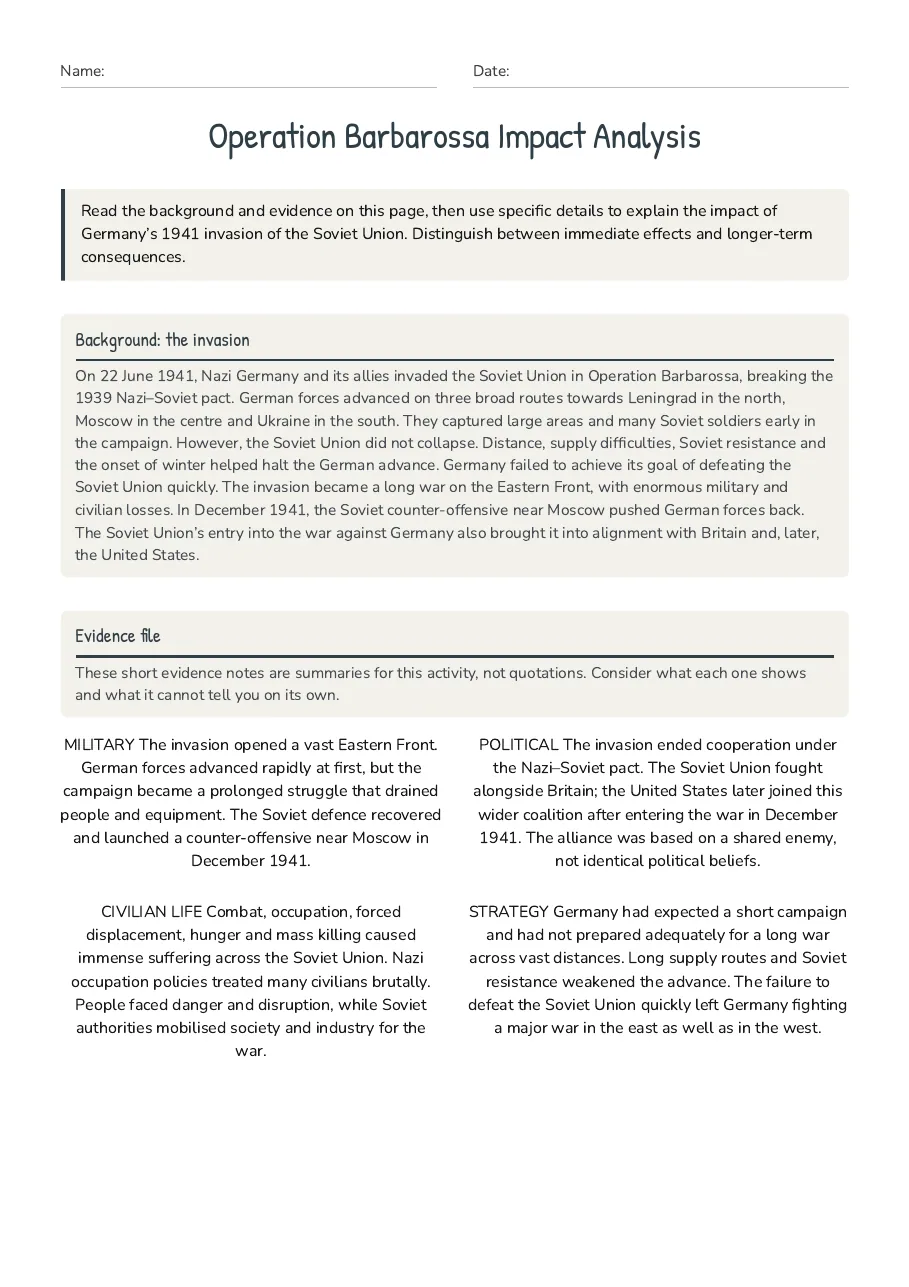
Operation Barbarossa Impact Analysis
Background: the invasion
On 22 June 1941, Nazi Germany and its allies invaded the Soviet Union in Operation Barbarossa, breaking the 1939 Nazi–Soviet pact. German forces advanced on three broad routes towards Leningrad in the north, Moscow in the centre and Ukraine in the south. They captured large areas and many Soviet soldiers early in the campaign. However, the Soviet Union did not collapse. Distance, supply difficulties, Soviet resistance and the onset of winter helped halt the German advance. Germany failed to achieve its goal of defeating the Soviet Union quickly. The invasion became a long war on the Eastern Front, with enormous military and civilian losses. In December 1941, the Soviet counter-offensive near Moscow pushed German forces back. The Soviet Union’s entry into the war against Germany also brought it into alignment with Britain and, later, the United States.
Evidence file
These short evidence notes are summaries for this activity, not quotations. Consider what each one shows and what it cannot tell you on its own.
MILITARY The invasion opened a vast Eastern Front. German forces advanced rapidly at first, but the campaign became a prolonged struggle that drained people and equipment. The Soviet defence recovered and launched a counter-offensive near Moscow in December 1941.
POLITICAL The invasion ended cooperation under the Nazi–Soviet pact. The Soviet Union fought alongside Britain; the United States later joined this wider coalition after entering the war in December 1941. The alliance was based on a shared enemy, not identical political beliefs.
CIVILIAN LIFE Combat, occupation, forced displacement, hunger and mass killing caused immense suffering across the Soviet Union. Nazi occupation policies treated many civilians brutally. People faced danger and disruption, while Soviet authorities mobilised society and industry for the war.
STRATEGY Germany had expected a short campaign and had not prepared adequately for a long war across vast distances. Long supply routes and Soviet resistance weakened the advance. The failure to defeat the Soviet Union quickly left Germany fighting a major war in the east as well as in the west.
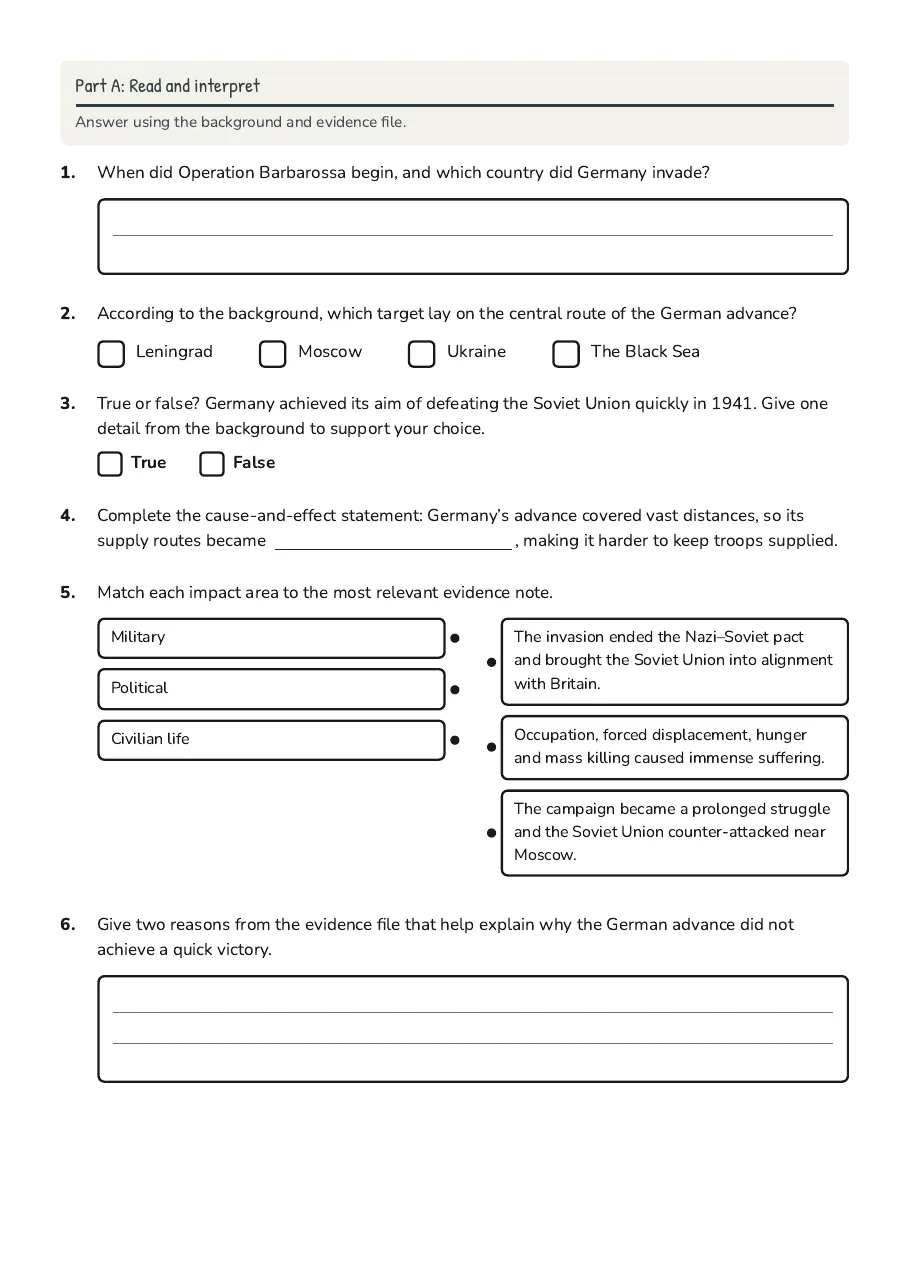
Part A: Read and interpret
Answer using the background and evidence file.
- Leningrad
- Moscow
- Ukraine
- The Black Sea
- Military
- Political
- Civilian life
- The invasion ended the Nazi–Soviet pact and brought the Soviet Union into alignment with Britain.
- Occupation, forced displacement, hunger and mass killing caused immense suffering.
- The campaign became a prolonged struggle and the Soviet Union counter-attacked near Moscow.
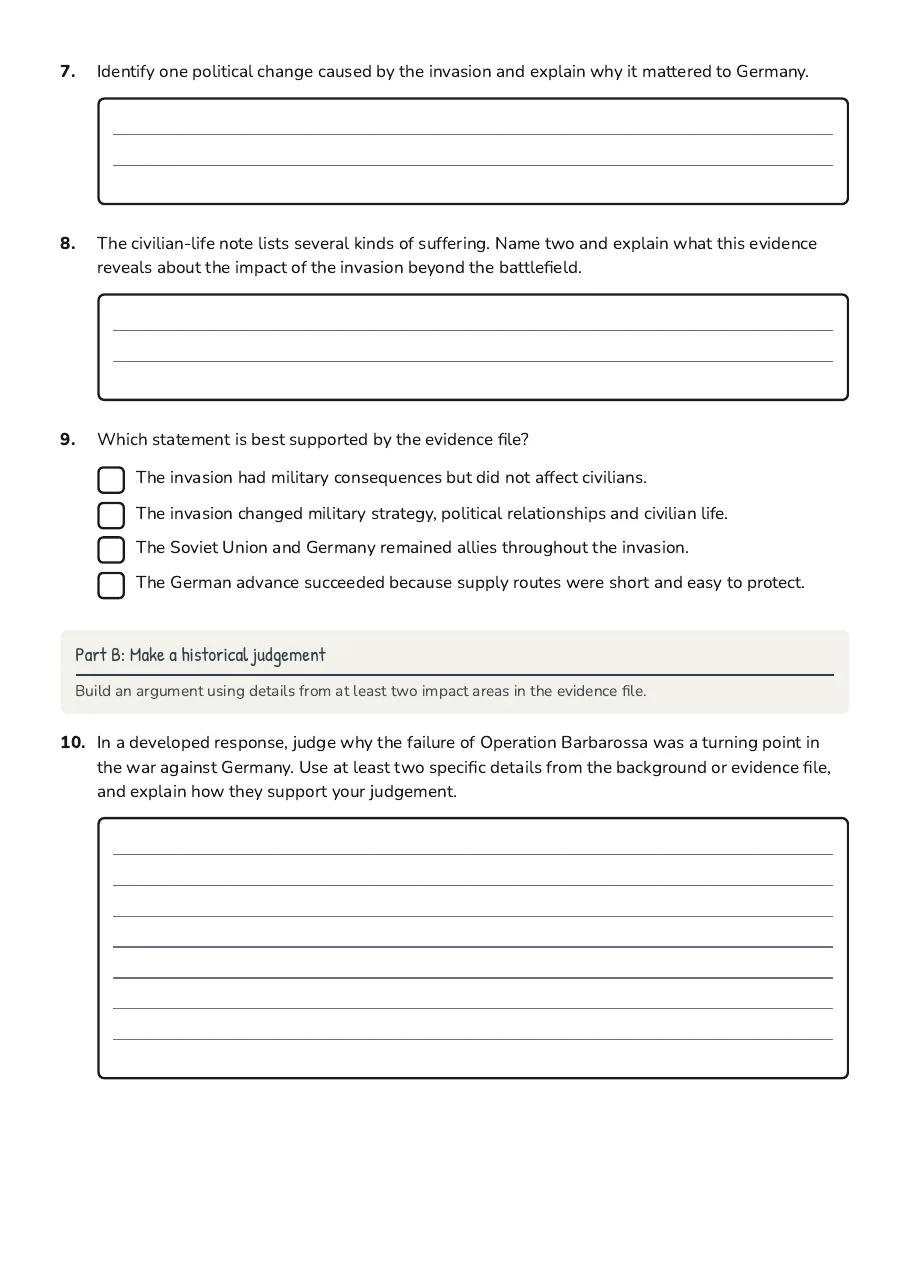
- The invasion had military consequences but did not affect civilians.
- The invasion changed military strategy, political relationships and civilian life.
- The Soviet Union and Germany remained allies throughout the invasion.
- The German advance succeeded because supply routes were short and easy to protect.
Part B: Make a historical judgement
Build an argument using details from at least two impact areas in the evidence file.
3 printable pages
Page 1
Page 2
Page 3
About This Worksheet
Free in Kuraplan
Sign up free, grab the PDF, and customize it for your class.
Print-Ready
Formatted for standard paper. Clean layout, easy to read.
AI-Generated
Created with Kuraplan's AI, designed for real classroom use.
For Teachers & Parents
Use in classrooms, for homework, tutoring, or homeschool.
Need a custom version of this worksheet?
Kuraplan's AI generates custom worksheets in seconds — differentiated for every learner, aligned to your curriculum.
Generate Custom Worksheets — Free