Operation Barbarossa Worksheet
A free social sciences worksheet ready for your classroom. Open in Kuraplan to grab the print-ready PDF, customize it for your students, or generate a fresh version in seconds.
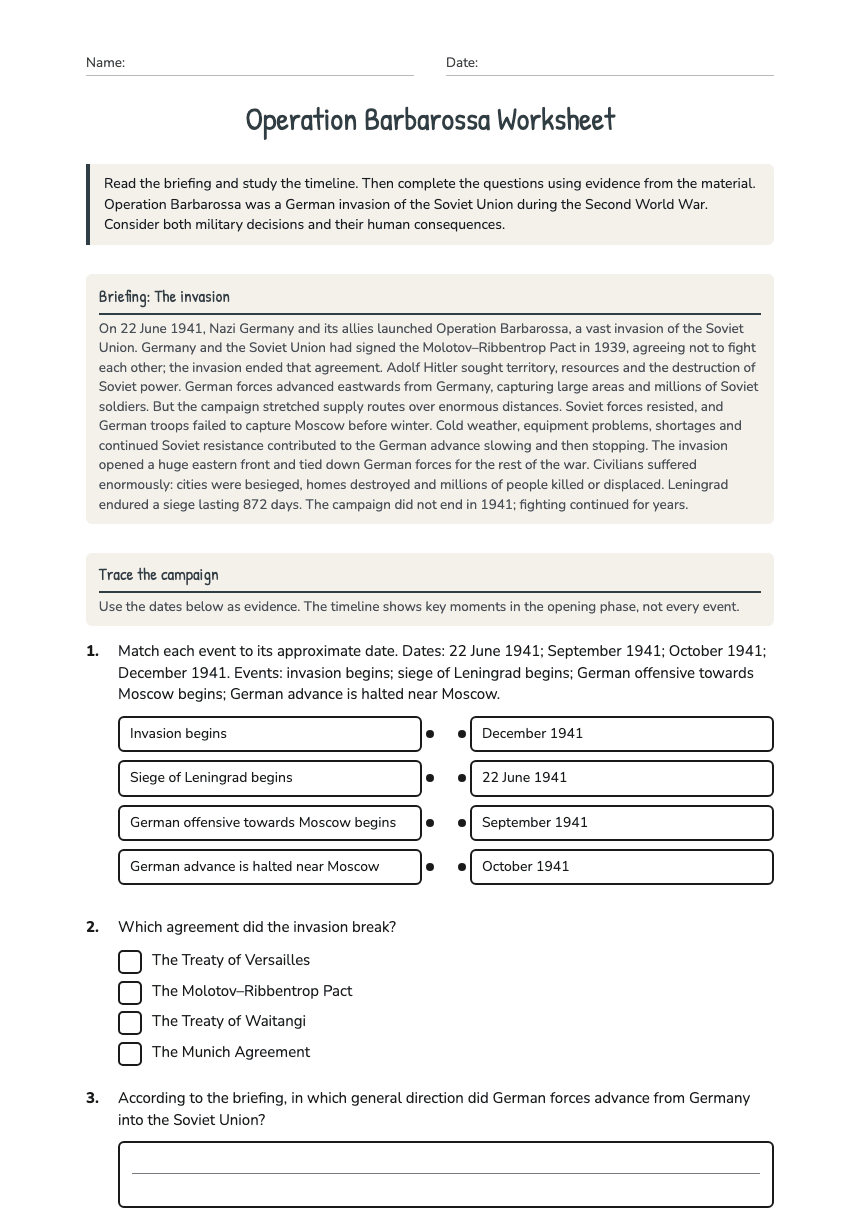
Operation Barbarossa Worksheet
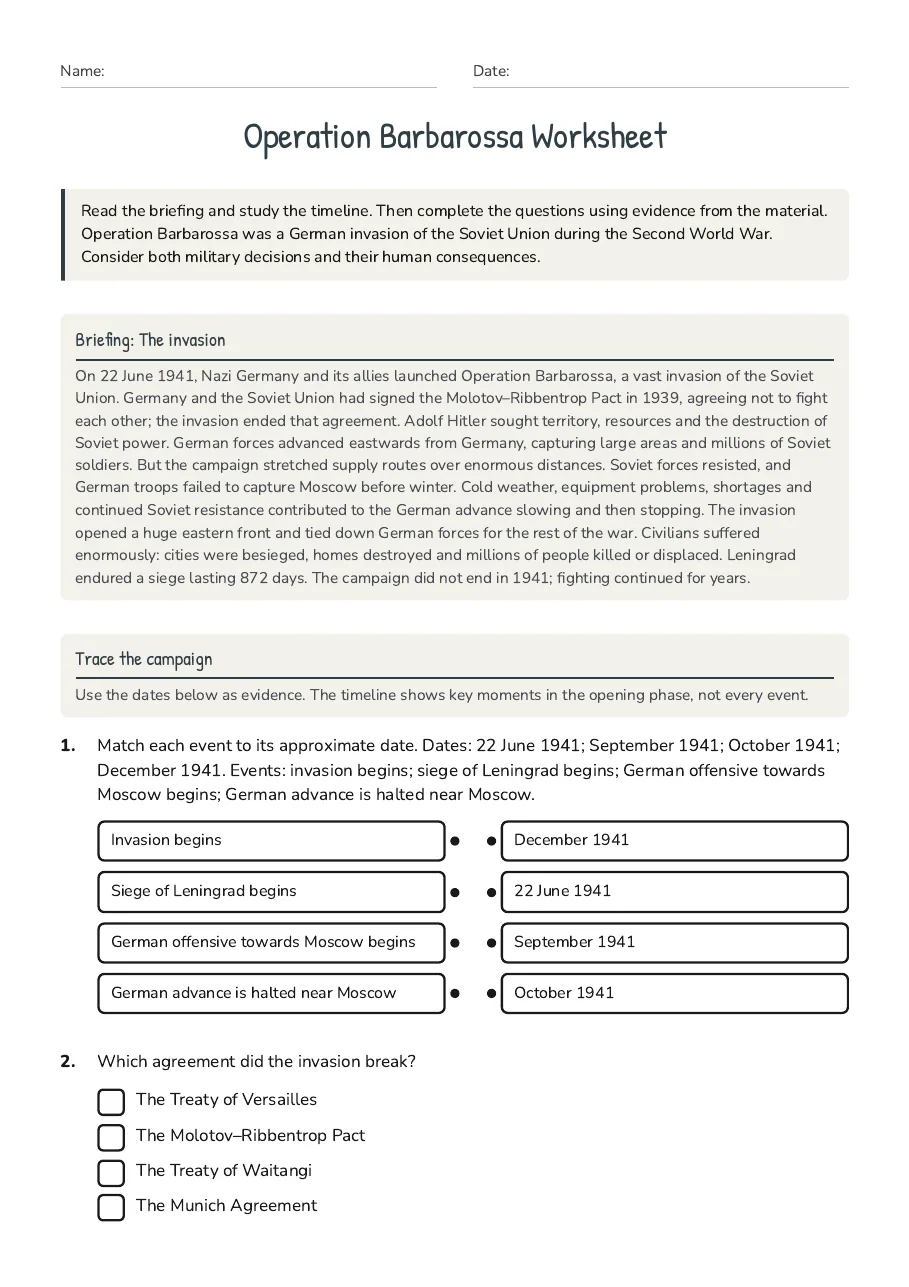
Briefing: The invasion
On 22 June 1941, Nazi Germany and its allies launched Operation Barbarossa, a vast invasion of the Soviet Union. Germany and the Soviet Union had signed the Molotov–Ribbentrop Pact in 1939, agreeing not to fight each other; the invasion ended that agreement. Adolf Hitler sought territory, resources and the destruction of Soviet power. German forces advanced eastwards from Germany, capturing large areas and millions of Soviet soldiers. But the campaign stretched supply routes over enormous distances. Soviet forces resisted, and German troops failed to capture Moscow before winter. Cold weather, equipment problems, shortages and continued Soviet resistance contributed to the German advance slowing and then stopping. The invasion opened a huge eastern front and tied down German forces for the rest of the war. Civilians suffered enormously: cities were besieged, homes destroyed and millions of people killed or displaced. Leningrad endured a siege lasting 872 days. The campaign did not end in 1941; fighting continued for years.
Trace the campaign
Use the dates below as evidence. The timeline shows key moments in the opening phase, not every event.
- Invasion begins
- Siege of Leningrad begins
- German offensive towards Moscow begins
- German advance is halted near Moscow
- December 1941
- 22 June 1941
- September 1941
- October 1941
- The Treaty of Versailles
- The Molotov–Ribbentrop Pact
- The Treaty of Waitangi
- The Munich Agreement
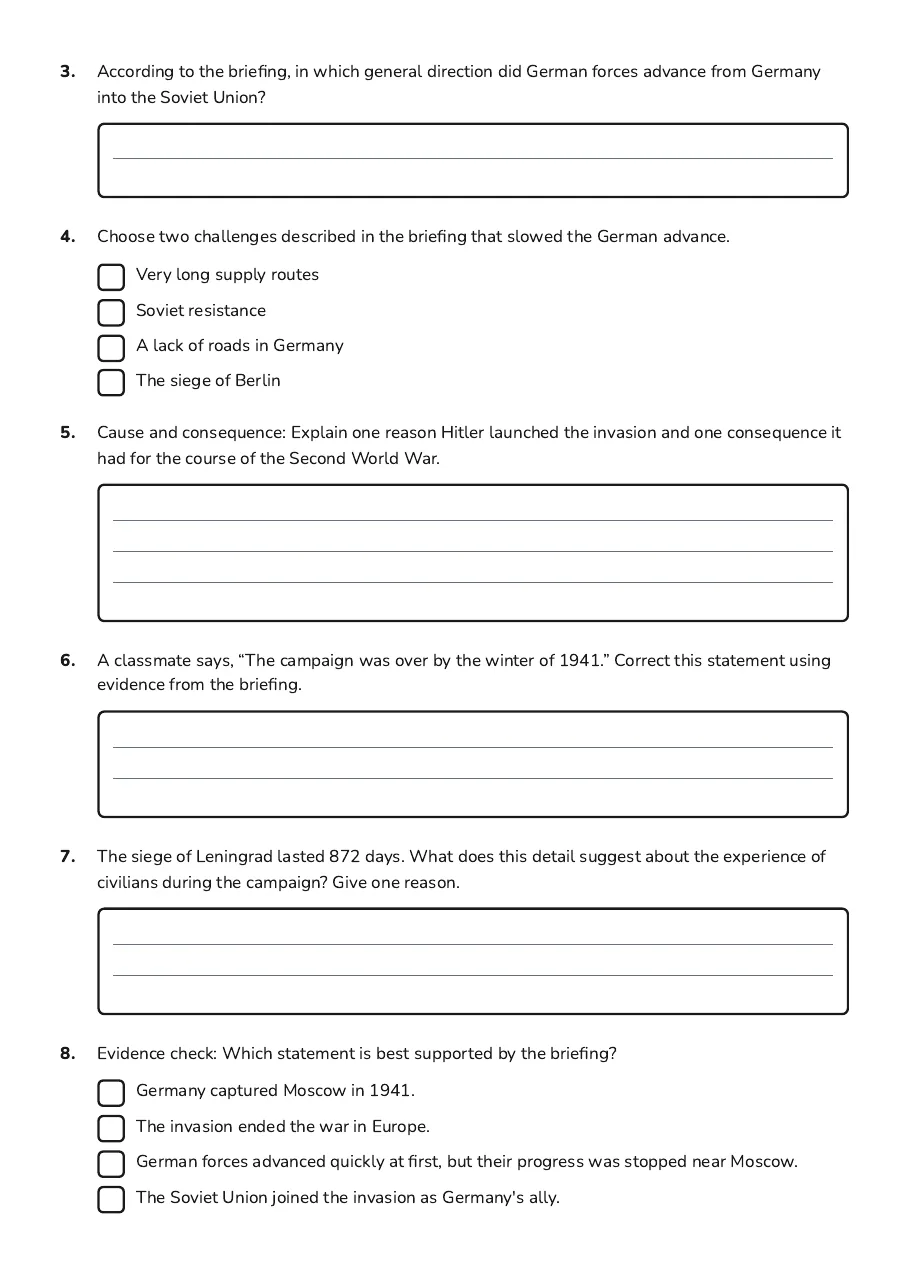
- Very long supply routes
- Soviet resistance
- A lack of roads in Germany
- The siege of Berlin
- Germany captured Moscow in 1941.
- The invasion ended the war in Europe.
- German forces advanced quickly at first, but their progress was stopped near Moscow.
- The Soviet Union joined the invasion as Germany's ally.
3 printable pages
Page 1
Page 2
Page 3
About This Worksheet
Free in Kuraplan
Sign up free, grab the PDF, and customize it for your class.
Print-Ready
Formatted for standard paper. Clean layout, easy to read.
AI-Generated
Created with Kuraplan's AI, designed for real classroom use.
For Teachers & Parents
Use in classrooms, for homework, tutoring, or homeschool.
Need a custom version of this worksheet?
Kuraplan's AI generates custom worksheets in seconds — differentiated for every learner, aligned to your curriculum.
Generate Custom Worksheets — Free